F-1: Registration statement for certain foreign private issuers
Published on October 24, 2025
As filed with the U.S. Securities and Exchange Commission on October 24, 2025.
Registration No. 333-[ ]
UNITED STATES
SECURITIES AND EXCHANGE COMMISSION
Washington, D.C. 20549
__________________________________
FORM F-1
REGISTRATION STATEMENT
UNDER
THE SECURITIES ACT OF 1933
__________________________________
DDC ENTERPRISE LIMITED
(Exact Name of Registrant as Specified in its Charter)
Not Applicable
(Translation of Registrant’s Name into English)
__________________________________
|
Cayman Islands |
2000 |
Not Applicable |
||
|
(State or other jurisdiction of |
(Primary Standard Industrial |
(I.R.S. Employer |
368 9th Ave, New York, NY 10001, USA
+852-2803-0688
(Address, including zip code, and telephone number, including area code, of registrant’s principal executive offices)
__________________________________
Cogency Global Inc.
122 East 42nd Street, 18th Floor
New York, NY 10168
(212) 947-7200
(Name, address, including zip code, and telephone number, including area code, of agent for service)
__________________________________
Copies of all communications, including communications sent to agent for service, should be sent to:
|
Lawrence S. Venick, Esq. |
__________________________________
Approximate date of commencement of proposed sale to the public: As soon as practicable after this Registration Statement becomes effective.
If any of the securities being registered on this Form are to be offered on a delayed or continuous basis pursuant to Rule 415 under the Securities Act of 1933, check the following box: ☒
If this Form is filed to register additional securities for an offering pursuant to Rule 462(b) under the Securities Act, check the following box and list the Securities Act registration statement number of the earlier effective registration statement for the same offering. ☐
If this Form is a post-effective amendment filed pursuant to Rule 462(c) under the Securities Act, check the following box and list the Securities Act registration statement number of the earlier effective registration statement for the same offering. ☐
If this Form is a post-effective amendment filed pursuant to Rule 462(d) under the Securities Act, check the following box and list the Securities Act registration number of the earlier effective registration statement for the same offering. ☐
Emerging growth company. ☒
If an emerging growth company that prepares its financial statements in accordance with U.S. GAAP, indicate by check mark if the registrant has elected not to use the extended transition period for complying with any new or revised financial accounting standards provided pursuant to Section 7(a)(2)(B) of the Securities Act. ☐
This registration statement shall hereafter become effective in accordance with the provisions of section 8(a) of the Securities Act of 1933.
The information in this preliminary prospectus is not complete and may be changed. These securities may not be sold until the registration statement filed with the Securities and Exchange Commission is effective. This preliminary prospectus is not an offer to sell these securities nor does it seek an offer to buy these securities in any jurisdiction where the offer or sale is not permitted.
|
PRELIMINARY PROSPECTUS |
Subject to Completion, Dated October 24, 2025 |
DDC Enterprise Limited
12,100,000 Class A Ordinary Shares
This prospectus relates to the resale, from time to time, by the selling shareholders (“Selling Shareholders”) identified in this prospectus of up to 12,100,000 of our Class A Ordinary Shares, par value US$0.40 per share (“Class A Ordinary Shares”).
Our registration of the Class A Ordinary Shares covered by this prospectus does not mean that the Selling Shareholders will offer or sell any of such Class A Ordinary Shares. The Selling Shareholders named in this prospectus, or their donees, pledgees, transferees or other successors-in-interest, may resell the Class A Ordinary Shares covered by this prospectus through public or private transactions at prevailing market prices, at prices related to prevailing market prices or at privately negotiated prices. For additional information on the possible methods of sale that may be used by the Selling Shareholders, you should refer to the section of this prospectus entitled “Plan of Distribution.”
We are not selling any securities under this prospectus and will not receive any of the proceeds from the sale of Class A Ordinary Shares by the Selling Shareholders named in this prospectus. All net proceeds from the sale of the Class A Ordinary Shares covered by this prospectus will go to the Selling Shareholders.
All Class A Ordinary Shares subject to resale hereunder have been issued by us and acquired by the Selling Shareholders in a private placement that closed on or around October 8, 2025 (the “Private Placement”). The Class A Ordinary Shares were issued directly by the Company pursuant to subscription agreements and transaction documents entered into with the Selling Shareholders in connection with such private placement. No underwriter or other person has been engaged by the Selling Shareholders or the Company to facilitate the sale of the Class A Ordinary Shares in this offering. The Company will bear all costs, expenses and fees in connection with the registration of the Class A Ordinary Shares. The Selling Shareholders will bear all commissions and discounts, if any, attributable to their respective sales of the Class A Ordinary Shares.
Our Class A Ordinary Shares are traded on The NYSE American under the symbol “DDC”. On October 22, 2025, the last reported sales price of our Class A Ordinary Shares on The NYSE American was $7.205 per share.
We have a dual class ordinary share structure. Our Ordinary Shares are divided into Class A Ordinary Shares, par value $0.40 per share, and Class B Ordinary Shares, par value $0.16 per share. Each Class A Ordinary Share shall entitle the holder thereof to one (1) vote on all matters subject to vote at general meetings of the Company, and each Class B Ordinary Share shall entitle the holder thereof to ten (10) votes on all matters subject to vote at general meetings of the Company. In no event shall Class A Ordinary Shares be convertible into Class B Ordinary Shares. In no event shall Class B Ordinary Shares be convertible into Class A Ordinary Shares. See “Description of Share Capital — Ordinary Shares” for more details regarding our Class A Ordinary Shares and Class B Ordinary Shares.
As of the date of this prospectus, 22,660,530 Class A Ordinary Shares and 1,750,000 Class B Ordinary Shares were issued and outstanding.
Provided that such transfer complies with applicable NYSE American listing standards, our shareholders may freely transfer Class A Ordinary Shares to another person by completing an instrument of transfer in a common form or in a form prescribed by the NYSE American listing standards or in any other form approved by our directors, executed where the Class A Ordinary Shares are fully paid, by or on behalf of that shareholder; and where the Class A Ordinary Shares are partly paid, by or on behalf of that shareholder and the transferee. Where the shares of any class in question are not listed on any stock exchange or subject to the rules of any stock exchange, our directors may in their absolute discretion decline to register any transfer of such shares which are not fully paid up or on which our Company has a lien. There is no restriction for potential future issuances of Class B Ordinary Shares. If such occurred, Class A shareholders’ shareholding will be diluted. The Company’s Class B Ordinary Shares are not convertible to its Class A Ordinary Shares and shall only be held by Ms. Norma Chu Ya Kin, our Chief Executive Officer and Director.
Investing in the Class A Ordinary Shares involves a high degree of risk. See section titled “Risk Factors” beginning on page 10 of this prospectus.
We are both an “emerging growth company” and a “foreign private issuer” under applicable U.S. Securities and Exchange Commission rules and will be eligible for reduced public company disclosure requirements. See section titled “Prospectus Summary — Implications of Being an ‘Emerging Growth Company’ and a ‘Foreign Private Issuer’” for additional information.
Neither the Securities and Exchange Commission nor any state securities commission nor any other regulatory body has approved or disapproved of these securities or passed upon the adequacy or accuracy of this prospectus. Any representation to the contrary is a criminal offense.
We are a Cayman Islands holding company conducting a significant portion of our operations in China through our PRC subsidiaries. Therefore, investing in our securities being offered pursuant to this prospectus involves unique and a high degree of risk.
The securities offered in this offering are of the offshore holding company DDC Enterprise Limited (the “Company”), which owns equity interests, directly or indirectly, of the operating subsidiaries. Subsidiaries conduct operations in China and the holding company does not conduct operations in China. Unless otherwise stated, as used in this prospectus and in the context of describing our operations and consolidated financial information, “DDC” “we,” “us,” “Company,” or “our,” refers to DDC Enterprise Limited, a Cayman Islands exempted company. We will also refer to all of our subsidiaries, “Subsidiaries”.
As a holding company, we may rely on dividends and other distributions on equity paid by our PRC subsidiaries for our cash and financing requirements. If any of our subsidiaries incurs debt on its own behalf in the future, the instruments governing such debt may restrict their ability to pay dividends to us. We have not paid any dividends to our shareholders for the years ended December 31, 2024 and 2023. Our subsidiaries received an aggregate transfer of $5,265,741.78, $127,336,045.38 and $102,324,125.95 for the period from January to June 2025, the years ended December 31, 2024 and 2023, respectively, from the Company to fund their business operations. Our Company received an aggregate transfer of $393,039.69, $4,354,260.75 and $2,499,027.35 for the period from January to June 2025, the year ended December 31, 2024 and 2023, respectively, from its subsidiaries. In the future, any cash proceeds raised from overseas financing activities, including this offering, may be transferred by us to our subsidiaries via capital contribution or shareholder loans, as the case may be. As a holding company with no material operations of our own, we conduct our substantial operations through our subsidiaries in China. As such, the Chinese government may exercise oversight and discretion over the conduct of our business and may intervene in or influence our operations at any time. Such governmental actions:
• could result in a material change in our operations;
• could hinder our ability to continue to offer securities to investors; and
• may cause the value of our Class A Ordinary Shares to significantly decline or be worthless.
Currently, we are not aware there are any material restrictions on foreign exchange, the ability to transfer cash between our entities, or the ability to distribute earnings to investors outside of China. Further, we are aware that recently, the Chinese government recently initiated a series of regulatory actions and statements to regulate business operations in China with little advance notice, including cracking down on illegal activities in the securities market, enhancing supervision over China-based companies listed overseas using entity variable interest entity (“VIE”) structure, adopting new measures to extend the scope of cybersecurity reviews, and expanding the efforts in anti-monopoly enforcement. Since these statements and regulatory actions are new, it is highly uncertain how soon legislative or administrative regulation making bodies will respond and what existing or new laws or regulations or detailed implementations and interpretations will be modified or promulgated, if any, and the potential impact such modified or new laws and regulations will have on our operations given that we have clients from Mainland China, the ability to accept foreign investments and list on an U.S. or other foreign exchange. Any future action by the Chinese government expanding the categories of industries and companies whose foreign securities offerings are subject to government review could significantly limit or completely hinder our ability to offer or continue to offer securities to investors and could cause the value of such securities to significantly decline or be worthless. For a detailed description of the risks related to our business, see “Risk Factors — Risks Related to Doing Business in China and Hong Kong.”
On December 16, 2021, the United States Public Company Accounting Oversight Board, or PCAOB, issued a Determination Report which found that the PCAOB is unable to inspect or investigate completely registered public accounting firms headquartered in: (i) China, and (ii) Hong Kong. Enrome LLP, our auditor, is not identified in the 2021 PCAOB Report as a firm subject to the PCAOB’s determination. While our auditor is headquartered in Singapore and is registered with PCAOB and subject to PCAOB inspection, in the event it is later determined that the PCAOB is unable to inspect or investigate completely our auditor because of a position taken by an authority in a foreign jurisdiction On August 26, 2022, the PCAOB announced that it had signed a Statement of Protocol (the “Protocol”)
with the CSRC and the Ministry of Finance (“MOF”) of the People’s Republic of China, which governs inspections and investigations of audit firms based in mainland China and Hong Kong. Pursuant to the fact sheet with respect to the Protocol released by the SEC, the PCAOB shall have independent discretion to select any issuer audits for inspection or investigation and the unfettered ability to transfer information to the SEC. According to the PCAOB, its December 2021 determinations under the Holding Foreign Companies Accountable Act, or HFCAA, remain in effect. On December 15, 2022, the PCAOB announced that it was able to secure complete access to inspect and investigate PCAOB-registered public accounting firms headquartered in mainland China and Hong Kong in 2022, and the PCAOB Board vacated its previous determinations that the PCAOB was unable to inspect or investigate completely registered public accounting firms headquartered in mainland China and Hong Kong. It is possible when the PCAOB may reassess its determinations in the future, and it could determine that it is still unable to inspect or investigate completely registered public accounting firms in mainland China and Hong Kong. On December 23, 2022 the Accelerating Holding Foreign Companies Accountable Act (“AHFCAA”) was enacted, which amended the HFCAA by requiring the SEC to prohibit an issuer’s securities from trading on any U.S. stock exchanges if its auditor is not subject to PCAOB inspections for two consecutive years instead of three. On December 29, 2022, a legislation entitled “Consolidated Appropriations Act, 2023” (the “Consolidated Appropriations Act”), was signed into law by President Biden. The Consolidated Appropriations Act contained, among other things, an identical provision to AHFCAA, which reduces the number of consecutive non-inspection years required for triggering the prohibitions under the Holding Foreign Companies Accountable Act from three years to two. Whether the PCAOB will continue to be able to satisfactorily conduct inspections of PCAOB-registered public accounting firms headquartered in mainland China and Hong Kong is subject to uncertainty and depends on a number of factors out of our, and our auditor’s, control. The PCAOB is continuing to demand complete access in mainland China and Hong Kong moving forward and is already making plans to resume regular inspections in early 2023 and beyond, as well as to continue pursuing ongoing investigations and initiate new investigations as needed. The PCAOB has indicated that it will act immediately to consider the need to issue new determinations with the HFCAA if needed, without having to wait another year to reassess its determinations. In the future, if there is any regulatory change or step taken by PRC regulators that does not permit our auditor to provide audit documentations located in China or Hong Kong to the PCAOB for inspection or investigation, or the PCAOB expands the scope of the determination so that we are subject to the HFCAA, as the same may be amended, you may be deprived of the benefits of such inspection which could result in limitation or restriction to our access to the U.S. capital markets and trading of our securities, including trading on the national exchange and trading on “over-the-counter” markets, may be prohibited under the HFCAA.
The date of this prospectus is [ ], 2025
|
Page |
||
|
1 |
||
|
10 |
||
|
70 |
||
|
72 |
||
|
73 |
||
|
74 |
||
|
76 |
||
|
MANAGEMENT’S DISCUSSION AND ANALYSIS OF FINANCIAL CONDITION AND RESULTS OF OPERATIONS |
78 |
|
|
94 |
||
|
96 |
||
|
99 |
||
|
114 |
||
|
128 |
||
|
136 |
||
|
138 |
||
|
140 |
||
|
145 |
||
|
152 |
||
|
153 |
||
|
153 |
||
|
156 |
||
|
157 |
||
|
F-1 |
The definitions of certain capitalized terms used in this prospectus can be found in the section titled “Prospectus Summary — Conventions Which Apply to this Prospectus” beginning on page 7 of this prospectus.
For investors outside the United States: neither we nor the Selling Shareholders have done anything that would permit this offering or possession or distribution of this prospectus in any jurisdiction, other than the United States, where action for that purpose is required. Persons outside the United States who come into possession of this prospectus must inform themselves about, and observe any restrictions relating to, the offering of the Class A Ordinary Shares and the distribution of this prospectus outside the United States.
You should rely only on the information contained in this prospectus, any amendment or supplement to this prospectus, or on any free writing prospectus, that we have authorized for use in connection with this offering. Neither we nor the Selling Shareholders have authorized anyone to provide you with any information or to make any representations other than those contained in this prospectus, any amendment or supplement to this prospectus, or in any free writing prospectus we have prepared, and neither we nor the Selling Shareholders take responsibility for, and can provide no assurance as to the reliability of, any other information others may give you. Neither we nor the Selling Shareholders are making an offer to sell, or seeking offers to buy, these securities in any jurisdiction where the offer or sale is not permitted. The information contained in this prospectus is accurate only as of the date on the cover page of this prospectus, regardless of the time of delivery of this prospectus or the sale of the Class A Ordinary Shares. Our business, financial condition, results of operations and prospects may have changed since the date on the cover page of this prospectus.
i
This summary highlights selected information contained elsewhere in this prospectus. This summary does not contain all of the information that you should consider before investing in our Class A Ordinary Shares. For a more complete understanding of us and this Offering, you should read and carefully consider the entire prospectus, including the more detailed information set forth under “Risk Factors” and “Management’s Discussion and Analysis of Financial Condition and Results of Operations” and our consolidated financial statements and the related notes included elsewhere in this prospectus. Some of the statements in this prospectus are forward-looking statements. See section titled “Special Note Regarding Forward-Looking Statements.” In this prospectus, unless the context requires otherwise, references to “we,” “us,” “our,” or “our company” refer to DC Enterprise Limited and its consolidated subsidiaries.
Our Business
Food Innovation
Our omni-channel (online and offline) sales, end-to-end (“E2E”) product development and distribution strategy, and data analytics capabilities enable us to successfully identify, assess, and pivot to cater to changing consumer preferences and trends across multiple customer segments and price-points. From a product distribution standpoint, we have created a network of direct-to-customer (“D2C”), retailer, and wholesaler sale options.
• We operate in the Mainland China market but are actively expanding into international markets including but not limited to the United States;
• We own multiple brands in our portfolio that provide convenient meal solution products to a wide range of consumers. We are actively looking for acquisition opportunities in complimentary brands in the Asian food and cooking categories as well as targets that can strengthen the company’s network of sales distribution; and
• We have access to a network of offline point-of-sales (“POS”) through partnerships with a network of distributors to drive retail network sales performance. Equally important, we have selective direct-to-consumer e-commerce platform and e-commerce platform operations that drive online sales performance.
Bitcoin Treasury
We believe that bitcoin is an attractive asset because (i) it can serve as a store of value, supported by a robust and public open-source architecture, untethered to sovereign monetary policy, (ii) due to its limited supply, bitcoin offers the potential to serve as a hedge against inflation in the long-term and, if its adoption increases, the opportunity for appreciation in value, and (iii) the Bitcoin network provides the infrastructure and opportunity for the development of financial and technological innovations.
On February 21, 2025, our Board of Directors adopted a Treasury Reserve Policy (as amended to date, the “Treasury Reserve Policy”) that updated our treasury management and capital allocation strategies, under which our treasury reserve assets will consist of:
• cash and cash equivalents and short-term investments (“Cash Assets”) held by us that exceed working capital requirements; and
• bitcoin held by us, with bitcoin serving as the primary treasury reserve asset on an ongoing basis, subject to market conditions and anticipated needs of the business for Cash Assets.
On May 15, 2025, we adopted, in addition to and in conjunction with our Treasury Reserve Policy, a corporate strategy of acquiring and holding bitcoin, including with the proceeds of capital raising transactions.
1
Our bitcoin strategy generally involves from time to time, subject to market conditions, (i) issuing debt or equity securities or engaging in other capital raising transactions with the objective of using the proceeds to purchase bitcoin and (ii) acquiring bitcoin with our liquid assets that exceed working capital requirements. We intend to fund further bitcoin acquisitions primarily through issuances of common stock and a variety of fixed-income instruments, including debt, convertible notes and preferred stock.
We view our bitcoin holdings as long-term holdings and expect to continue to accumulate bitcoin. We have not set any specific target for the amount of bitcoin we seek to hold, and we will continue to monitor market conditions in determining whether to engage in additional financings to purchase additional bitcoin. This overall strategy also contemplates that we may (i) enter into additional capital raising transactions that are collateralized by our bitcoin holdings, and (ii) consider pursuing strategies to create income streams or otherwise generate funds using our bitcoin holdings.
Our Bitcoin Holdings
We currently hold 1,083 bitcoins with an average price per bitcoin paid of $108,726. We have not yet had any bitcoin dispositions.
Corporate History and Structure
DDC Enterprise Limited is a Cayman Islands holding company and conducts its operations primarily in China through its wholly-owned or controlled subsidiaries.
We are a food innovator with leading content driven (i.e. using content to reach and engage target customers) consumer brands offering easy, convenient RTH, RTC, RTE and plant-based meal products (i.e. meal products consisting largely or solely of vegetables, fruits, grains and other foods derived from plant-based protein, rather than animal protein) while promoting healthier lifestyle choices to our predominately Millennial and Generation Z (“GenZ”) customer-base. We are also engaged in the provision of advertising services.
As of December 31, 2024, our main product categories include (i) own-branded RTH products — typically semi-cooked meals with some but minimal preparation required ahead of serving, (ii) own-branded RTC products — ready to be consumed within 8 to 15 minutes with some additional cooking preparation, (iii) own-branded RTE products — typically pre-cooked meals that are ready to serve with minimal level of additional preparation, which includes our plant-based meal products localized for the palate of an Asian consumer, and (iv) private label products (i.e. third-party branded food products).
In addition, commencing on May 15, 2025, we expanded our business to include Bitcoin treasury activities (“Bitcoin Treasury”). We are a publicly traded company that has adopted Bitcoin as our primary treasury reserve asset. By using proceeds from equity and debt financings, as well as any future cash flows from our operations, we strategically accumulate Bitcoin and advocate for its role as digital capital.
We were founded in Hong Kong in 2012 by Ms. Norma Ka Yin Chu, a highly regarded entrepreneur and a true cooking enthusiast, as an online platform which distributed food recipes and culinary content. Subsequently, we further expanded our business to provide advertising services to brands that wish to place advertisements on our platform or video content. In 2015, we entered the Mainland China market through the establishment of DDC Shanghai to engage in technology development of computer software, food circulation and advertising production in China. In 2017, we started expanded our business from content creation to content commerce. Later in 2019, we extended our business to include the production and sale of, among others, own-branded RTH, RTC convenient meal solution products.
2
Corporate Structure
The chart below summarizes our corporate structure and identifies our principal subsidiaries as of the date of this prospectus (All holdings without specifying the percentage are 100%):
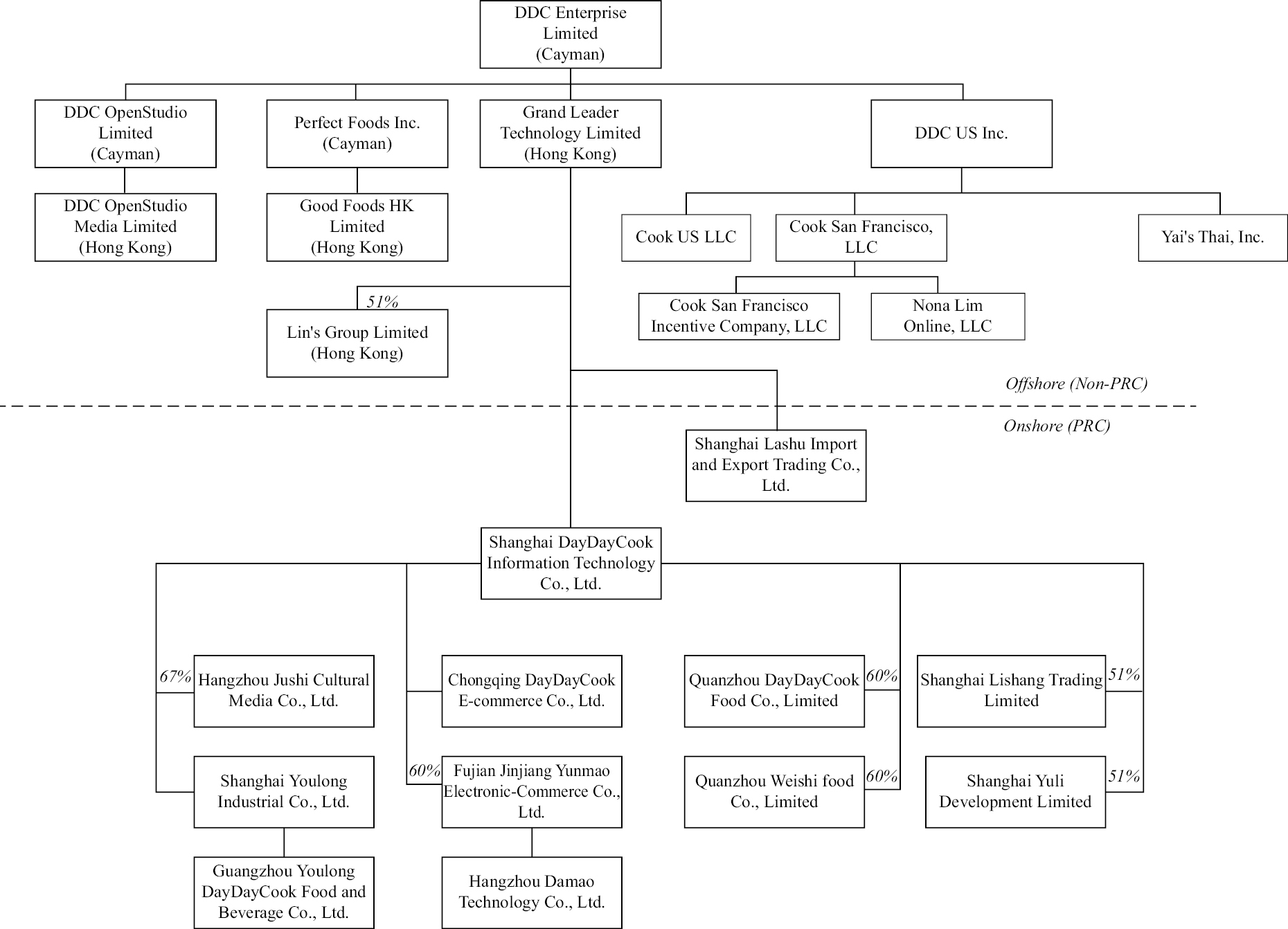
Bitcoins are held by the Company.
Risk Factors Summary
We face risks and uncertainties relating to our business and operation, including, but not limited to the following:
Risks Related to Our Business and Industry
• Our business and future growth prospects rely on consumer demand for our products. Any shift in consumer demand, or any unexpected situation with a negative impact on consumer demand may materially and adversely affect our business and results of operations.
• If we fail to retain existing customers, derive revenue from existing customers consistent with historical performance or acquire new customers cost-effectively, our business could be adversely affected.
• The market for ready-to-heat (“RTH”), ready-to-cook (“RTC”), ready-to-eat (“RTE”) and plant-based meal products in China and the United States is continuously evolving and may not grow as quickly as expected, or at all, which could negatively affect our business and prospects.
• We are actively expanding our business outside the PRC, where we may be subject to increased business, regulatory, and economic risks that could materially adversely affect our business, financial condition, results of operations, and prospects. A severe or prolonged downturn in the PRC or global economy could also materially and adversely affect our business, results of operations and financial condition.
3
• If we are unable to expand our business to international markets successfully, our business and results of operations would be adversely affected.
• Changes to the pricing of our products could adversely affect our results of operations.
• Our business and prospects depend on our ability to build our brands and reputation, which could be harmed by negative publicity with respect to us, our products and operations, our management, brand ambassadors, key opinion leaders (“KOLs”), or other business partners.
For a detailed description of the risks above, please refer to pages 10 to 29.
Risks Related to Our Corporate Structure
• We may rely on dividends and other distributions on equity paid by our PRC subsidiaries to fund cash and financing requirements we may have, and any limitation on the ability of our PRC subsidiaries to make payments to us could have a material and adverse effect on our ability to conduct our business.
• PRC regulation of loans to and direct investment in PRC entities by offshore holding companies and governmental control of currency conversion may delay or prevent us from making loans or additional capital contributions to our PRC subsidiaries, which could materially and adversely affect our liquidity and our ability to fund and expand our business.
• If the chops of our PRC subsidiaries are not kept safely, are stolen or are used by unauthorized persons or for unauthorized purposes, the corporate governance of these entities could be severely and adversely compromised.
• We face uncertainties with respect to the interpretation and implementation of the newly enacted Foreign Investment Law and how it may impact the viability of our current corporate structure, corporate governance and business operations.
• Our operating results, revenues, and expenses may fluctuate significantly, which could have an adverse effect on the market price of our listed securities.
For a detailed description of the risks above, please refer to pages 30 to 32.
Risks Related to Our Bitcoin Strategy and Holdings
• A significant decrease in the market value of our bitcoin holdings could adversely affect our ability to satisfy our financial obligations.
• Our bitcoin strategy exposes us to various risks, including risks associated with bitcoin.
• Bitcoin is a highly volatile asset, and fluctuations in the price of bitcoin have in the past influenced and are likely to continue to influence our financial results and the market price of our listed securities.
• Bitcoin and other digital assets are novel assets, and are subject to significant legal, commercial, regulatory and technical uncertainty.
• Our historical financial statements do not reflect the potential variability in earnings that we may experience in the future relating to our bitcoin holdings.
Risks Related to Doing Business in China and Hong Kong
• A downturn in the Hong Kong, China or global economy, and economic and political policies of China could materially and adversely affect our business and financial condition.
• The Hong Kong legal system embodies uncertainties which could limit the legal protections available to us.
4
• Uncertainties with respect to the PRC legal system, including uncertainties regarding the enforcement of laws, and sudden or unexpected changes in laws and regulations in China could adversely affect us.
• The Chinese government exerts substantial influence over the manner in which we must conduct our business activities, and may intervene or influence our operations at any time, or may exert more oversight and control over offerings conducted overseas. Any actions by the Chinese government to exert more oversight and control over offerings that are conducted overseas and/or foreign investment in China-based issuers could significantly limit or completely hinder our ability to offer or continue to offer our Class A Ordinary Shares to investors and could cause the value of our Class A Ordinary Shares to significantly decline or become worthless.
• There are significant legal and other obstacles to obtaining information needed for shareholder investigations or litigation outside China or otherwise with respect to foreign entities.
For a detailed description of the risks above, please refer to pages 44 to 62.
Risks Related to Our Securities
• An active trading market for our Class A Ordinary Shares may not be sustained.
• Our dual-class share structure with different voting rights will limit your ability to influence corporate matters and could discourage others from pursuing any change of control transactions that holders of our Class A Ordinary Shares may view as beneficial.
• Our shares have traded under $5.00 per Class A Ordinary Share and thus could be known as a penny stock, subject to certain exceptions. Trading in penny stocks has certain restrictions and these restrictions could negatively affect the price and liquidity of our Class A Ordinary Shares.
• Our share price may be volatile and may fluctuate.
• We intend to grant employee share options and other share-based awards in the future. We will recognize any share-based compensation expenses in our consolidated statements of operations and comprehensive loss. Any additional grant of employee share options and other share-based awards in the future may have a material adverse effect on our results of operation.
For a detailed description of the risks above, please refer to pages 62 to 69.
Corporate Information
Our registered office is the offices of International Corporation Services Ltd., Harbour Place 2nd Floor, 103 South Church Street, P.O. Box 472, George Town, Grand Cayman KY1-1106, Cayman Islands and our principal office is 368 9th Ave., 6th Floor, New York, New York 10001, USA. The telephone number of our principal office is +852-2803 0688. Our agent for service of process in the United States is Cogency Global Inc. Our corporate website is https://ir.daydaycook.com. Information contained on our website does not constitute part of this prospectus.
Implications of Being an “Emerging Growth Company” and a “Foreign Private Issuer”
As a company with less than US$1.235 billion in revenue during our most recently completed fiscal year, we qualify as an “emerging growth company” as defined in Section 2(a) of the Securities Act, as modified by the JOBS Act. As an emerging growth company, we may take advantage of certain reduced disclosure and requirements that are otherwise applicable generally to U.S. public companies that are not emerging growth companies. These provisions include:
• the option to include in an initial public offering registration statement only two years of audited financial statements and selected financial data and only two years of related disclosure;
• reduced executive compensation disclosure; and
• an exemption from the auditor attestation requirements of Section 404 of the Sarbanes-Oxley Act of 2002 (“Sarbanes-Oxley Act”) in the assessment of our internal controls over financial reporting.
5
The JOBS Act also permits an emerging growth company, such as us, to delay adopting new or revised accounting standards until such time as those standards are applicable to private companies. We have not elected to “opt out” of this provision, which means that when a standard is issued or revised and it has different application dates for public or private companies, we will have the discretion to adopt the new or revised standard at the time private companies adopt the new or revised standard and our discretion will remain until such time that we either (i) irrevocably elect to “opt out” of such extended transition period or (ii) no longer qualify as an emerging growth company.
We will remain an emerging growth company until the earliest of:
• the last day of our fiscal year during which we have total annual revenue of at least US$1.235 billion;
• the last day of our fiscal year following the fifth anniversary of the closing of this Offering;
• the date on which we have, during the previous three-year period, issued more than US$1.0 billion in non-convertible debt securities; or
• the date on which we are deemed to be a “large accelerated filer” under the Exchange Act, which, among other things, would occur if the market value of our Class A Ordinary Shares that are held by non-affiliates exceeds US$700 million as of the last business day of our most recently completed second fiscal quarter.
We have taken advantage of reduced reporting requirements in this prospectus. Accordingly, the information contained herein may be different than the information you receive from other public companies.
In addition, we report under the Exchange Act as a “foreign private issuer.” As a foreign private issuer, we may take advantage of certain provisions under the Nasdaq rules that allow us to follow Cayman Islands law for certain corporate governance matters. Even after we no longer qualify as an emerging growth company, as long as we qualify as a foreign private issuer under the Exchange Act, we will be exempt from certain provisions of the Exchange Act that are applicable to U.S. domestic public companies, including:
• the sections of the Exchange Act regulating the solicitation of proxies, consents, or authorizations in respect of a security registered under the Exchange Act;
• the sections of the Exchange Act requiring insiders to file public reports of their share ownership and trading activities and liability for insiders who profit from trades made in a short period of time;
• the rules under the Exchange Act requiring the filing with the Securities and Exchange Commission of quarterly reports on Form 10-Q containing unaudited financial and other specified information, or current reports on Form 8-K, upon the occurrence of specified significant events; and
• Regulation Fair Disclosure (“Regulation FD”), which regulates selective disclosures of material information by issuers.
Foreign private issuers, like emerging growth companies, are also exempt from certain more stringent executive compensation disclosure rules. Thus, if we remain a foreign private issuer, even if we no longer qualify as an emerging growth company, we will continue to be exempt from the more stringent compensation disclosures required of public companies that are neither an emerging growth company nor a foreign private issuer.
We may take advantage of these exemptions until such time as we are no longer a foreign private issuer. We are required to determine our status as a foreign private issuer on an annual basis at the end of our second fiscal quarter. We would cease to be a foreign private issuer at such time as more than 50% of our outstanding voting securities are held by U.S. residents and any of the following three circumstances apply:
• the majority of our executive officers or directors are U.S. citizens or residents;
• more than 50% of our assets are located in the United States; or
• our business is administered principally in the United States.
In determining whether more than 50% of our outstanding voting securities are held by U.S. residents, we will examine the record ownership of brokers, dealers, banks, or nominees holding securities for the accounts of their customers and any beneficial ownership reports or other information available to us in the U.S. and Cayman
6
Islands (our home jurisdiction). If more than 50% of our outstanding voting securities (i.e. sum of outstanding Class A Ordinary Shares and Class B Ordinary Shares, each counting as one share) are held by U.S. residents and any of the above three circumstances apply, we would cease to be a foreign private issuer.
Conventions Which Apply to this Prospectus
Unless otherwise indicated or the context otherwise requires in this prospectus:
• “Companies Act” refers to the Companies Act (As Revised) of the Cayman Islands;
• “Company” or “DDC” refers to DDC Enterprise Limited, an exempted company incorporated in the Cayman Islands with limited liability;
• “Class A Ordinary Shares” refers to the Class A ordinary shares of par value of US$0.4 per share in the capital of the Company;
• “HKD” or “HK$” refers to the legal currency of Hong Kong;
• “Hong Kong” refers to Hong Kong Special Administrative Region of the People’s Republic of China.
• “Macau” refers to Macau Special Administrative Region of the People’s Republic of China.
• “mainland China,” “PRC” or “China” refers to the People’s Republic of China, excluding, for the sole purpose of this prospectus, Hong Kong, Macau and Taiwan, unless the context otherwise indicates.
• “Ordinary Shares” refers to our Class A Ordinary Shares and our Class B Ordinary Shares, taken together.
• “RMB” or “Renminbi” refers to the legal currency of China.
• “paid customers”, with respect to a certain point of time, refers to the Company’s current and past customers who had, as of that point of time, purchased product or service from the Company.
• SEC” means the United States Securities and Exchange Commission;
• “Shares” or “shares” refers to any share in the capital of the Company, including the Class A Ordinary Shares;
• “US$,” “U.S. dollars,” “$” and “dollars” refer to the legal currency of the United States; and
• “we”, “us”, “our company” and “our” refer to DDC Enterprise Limited and its consolidated subsidiaries. We conduct operations in China through our subsidiaries.
The expressions “associated company,” “related corporation” and “subsidiary” shall have the respective meanings ascribed to them in the Companies Act, as the case may be.
Any discrepancies in tables included herein between the total sum of amounts listed and the totals thereof are due to rounding. Accordingly, figures shown as totals in certain tables may not be an arithmetic aggregation of the figures that precede them.
Unless the context otherwise requires, a reference to “we,” “our,” “us,” “our Group” or “our Company” or their other grammatical variations is a reference to DDC Enterprise Limited and its subsidiaries taken as a whole.
Certain of our customers and suppliers are referred to in this prospectus by their trade names. Our contracts with these customers and suppliers are typically with an entity or entities in the relevant customer or supplier’s group of companies.
Internet site addresses in this prospectus are included for reference only and the information contained in any website, including our website, is not incorporated by reference into, and does not form part of, this prospectus.
7
Market and Industry Data
We are responsible for the information contained in this prospectus and any free writing prospectus we prepare or authorize. This prospectus includes statistical and other industry and market data that we obtained from industry publications and research, surveys and studies conducted by third parties, as well estimates by our management based on such data. The market data and estimates used in this prospectus involve a number of assumptions and limitations, and you are cautioned not to give undue weight to such data and estimates. While we believe that the information from these industry publications, surveys and studies is reliable, the industry in which we operate is subject to a high degree of uncertainty and risk due to a variety of important factors, including those described in the section titled “Risk Factors.” These and other factors could cause results to differ materially from those expressed in the estimates made by the independent parties and by us.
8
The Offering
|
Class A Ordinary Shares offered by us: |
|
|
|
Shares outstanding before this Offering: |
|
|
|
Use of proceeds: |
All net proceeds from the sale of the Class A Ordinary Shares offered by this prospectus will go to the Selling Shareholders, and we will not receive any proceeds from the sale of these shares. See “Plan of Distribution” of this prospectus for additional information |
|
|
NYSE American Symbol: |
DDC |
|
|
Risk factors: |
See section titled “Risk Factors” and other information included in this prospectus for a discussion of factors you should carefully consider before deciding to invest in the Class A Ordinary Shares. |
|
|
Transfer Agent: |
Equiniti Trust Company, LLC, located at 6201 15th Avenue, Brooklyn, New York, New York 11219 |
9
An investment in our Class A Ordinary Shares involves various risks. Prospective investors should carefully consider and evaluate each of the following considerations and all other information set forth in this prospectus before deciding to invest in our Class A Ordinary Shares. The following section describes the significant risks that could directly or indirectly affect us and the value or trading price of our Class A Ordinary Shares. The risk factors that are material to investors in making an informed judgment have been set out below. If any of the following considerations and uncertainties develops into actual events, our business, financial condition, results of operations and prospects could be materially and adversely affected. In such cases, the trading price of our Class A Ordinary Shares could decline and investors may lose all or part of their investment in our Shares. Prospective investors are advised to apprise themselves of all factors involving the risks of investing in our Class A Ordinary Shares from their professional advisers before making any decision to invest in our Class A Ordinary Shares.
This prospectus also contains forward-looking statements having direct and/or indirect implications on our future performance. Our actual results could differ materially from those anticipated in these forward-looking statements as a result of certain factors, including the risks and uncertainties faced by us described below and elsewhere in this prospectus. See section titled “Special Note Regarding Forward-Looking Statements.”
Risks Related to Our Food Business and Industry
Our business and future growth prospects rely on consumer demand for our products. Any shift in consumer demand, or any unexpected situation with a negative impact on consumer demand may materially and adversely affect our business and results of operations.
Our business relies on consumer demand for our products, which depends substantially on factors such as (i) economic growth and increasing disposable income; (ii) diversified consumption scenarios and increasing consumption frequency; (iii) continuous product innovation and upgrade; and (iv) increasing development and improvement of sales channels. Changes in any of the above at any time could result in decline in consumer demand for our products. Our business development will depend partially on our ability to (i) anticipate, identify or adapt to such changes, (ii) introduce new attractive products and marketing strategies in a timely manner, and (iii) develop an effective sales network accordingly.
Although we dedicate resources to consumer-centric market research and data analysis to upgrade our existing products and to develop, design and launch new products, in order to cater to consumer preferences, we cannot assure you that our product portfolio will continuously lead or capture the market trends. Any changes in consumer preferences and tastes, or any of our failure to anticipate, identify or adapt to market trends, may impose downward pressure on sales and pricing of our products or lead to increases in selling and distribution expenses, and therefore materially and adversely affect our business and results of operations.
In order to promptly respond to rapidly developing market trends and changing tastes, preferences and lifestyle of consumers, our sales and development teams regularly observe the changing trends in our target markets and launch new products or different serving sizes and flavors from time to time. While we have in the past successfully developed, promoted and achieved market acceptance of our products, we cannot assure you that we will be able to continuously develop new products or our existing or new products in the future will continue to generate sufficient consumer demand to be profitable.
If we fail to retain existing customers, derive revenue from existing customers consistent with historical performance or acquire new customers cost-effectively, our business could be adversely affected.
Our ability to increase revenues depends in part on our ability to retain and keep existing customers engaged so that they continue to purchase products from us, and to acquire new customers cost-effectively. We intend to continue to expand our number of customers as part of our growth strategy. If we fail to retain existing customers and to attract and retain new customers, our business, financial condition and results of our operations could be adversely affected.
Further, if customers do not perceive our product offerings to be of sufficient value, quality, or innovation, or if we fail to offer innovative and relevant product offerings, we may not be able to attract or retain customers or engage existing customers so that they continue to purchase products or increase the amount of products purchased from us. We may lose current customers to competitors if the competitors offer superior products or if we are unable to satisfy its customers’ orders in a timely manner.
10
The market for ready-to-heat (“RTH”), ready-to-cook (“RTC”), ready-to-eat (“RTE”) and plant-based meal products in China and the United States is continuously evolving and may not grow as quickly as expected, or at all, which could negatively affect our business and prospects.
Our business and prospects depend on the continuous development and growth of the markets for RTC, RTH, RTE and plant-based meal products in China and the United States. The growth and development of these markets are impacted by numerous factors and subject to uncertainties that are beyond our control, such as the macroeconomic environment, per capita spending, consumers’ interest, consumers’ purchasing frequency, demand for RTH, RTC, RTE and plant-based meal products from consumers in lower tier cities, regulatory changes, technological innovations, cultural influences and changes in tastes and preferences. We cannot assure you that the market will continue to grow as rapidly as it has in the past, in ways that are consistent with other markets, or at all. If the markets for RTH, RTC, RTE and plant-based meal products in China and the United States do not grow as quickly as expected or at all, or if we fail to benefit from such growth by successfully implementing our business strategies, our business and prospects may be negatively affected.
We are actively expanding our business outside the PRC, where we may be subject to increased business, regulatory, and economic risks that could materially adversely affect our business, financial condition, results of operations, and prospects. A severe or prolonged downturn in the PRC or global economy could also materially and adversely affect our business, results of operations and financial condition.
Through 2023, we conducted our operations primarily in China, but we expect to continue to expand our business in the United States and Southeast Asia in hopes of widening our customer base. Any new markets or countries into which we attempt to expand into and sell our products may not be receptive. For example, we may not be able to expand further in some overseas markets if we are not able to adapt our products to fit the needs of prospective customers in those markets or if we are unable to satisfy certain country-and industry-specific laws or regulations. In addition, future international expansion will also require considerable management attention and the investment of significant resources while subjecting us to new risks and increasing certain risks that we already face, including risks associated with:
• recruiting and retaining talented and capable employees outside the PRC, including employees who speak multiple languages and come from a wide variety of different cultural backgrounds and customs;
• maintaining our culture across all of our global teams;
• providing our products and solutions in different languages;
• compliance with applicable international laws and regulations, including laws and regulations with respect to employment, construction, privacy, data protection, consumer protection, foreign investment and unsolicited email, and the risk of penalties and fines against us and individual members of management or employees if our practices are deemed to be out of compliance;
• managing an employee base in jurisdictions with differing employment regulations;
• operating in jurisdictions that do not protect intellectual property rights to the same extent as the PRC and navigating the practical enforcement of such intellectual property rights outside of the PRC;
• changes in foreign laws that could restrict our ability to use our intellectual property outside of the foreign jurisdiction in which we developed it;
• compliance by us and our partners with anti-corruption laws, competition laws, import and export control laws, tariffs, trade barriers, economic sanctions, and other regulatory limitations on our ability to provide our products or platform in certain international markets;
• foreign exchange controls that might require significant lead time in setting up operations in certain geographic territories and might prevent us from repatriating cash earned outside the PRC;
• political and economic instability;
• changes in diplomatic and trade relationships, including the imposition of new trade restrictions, trade protection measures, import or export requirements, trade embargoes, and other trade barriers;
11
• generally longer payment cycles and greater difficulty in collecting accounts receivable;
• potentially adverse tax consequences in the United States or the international jurisdictions in which we operate; and
• higher costs of doing business internationally, including increased accounting, travel, infrastructure, and legal compliance costs.
Compliance with laws and regulations applicable to our global operations substantially increases our cost of doing business. We may be unable to keep current with changes in laws and regulations as they occur. Although we have implemented policies and procedures designed to support compliance with these laws and regulations, there can be no assurance that we or our employees, partners, and agents will always maintain compliance. Any violations could result in enforcement actions, fines, civil and criminal penalties, damages, injunctions, or reputational harm. If we are unable to comply with these laws and regulations or manage the complexity of our global operations successfully, we may need to relocate or cease operations in certain foreign jurisdictions, which could materially adversely impact our business, financial condition, results of operations, and prospects.
Additionally, the global macroeconomic environment is facing challenges. The outbreak of the COVID-19 pandemic in 2020 has brought about an adverse impact on global economies and financial markets. There is considerable uncertainty over the long-term effects of the expansionary monetary and fiscal policies adopted by the central banks and financial authorities of some of the world’s leading economies, including the United States and China. There have been concerns over unrest and terrorist threats in the Middle East, Europe and Africa and over the conflicts involving Ukraine, Syria and North Korea. There have also been concerns on the relationship among China and other Asian countries, which may result in or intensify potential conflicts in relation to territorial disputes, and the trade disputes between the United States and China. The ongoing trade tensions between the United States and China may have tremendous negative impact on the economies of not merely the two countries concerned, but the global economy as a whole. It is unclear whether these challenges and uncertainties will be contained or resolved, and what effects they may have on the global political and economic conditions in the long term. Our international market expansion strategy may be hindered if these challenges and uncertainties persist.
If we are unable to expand our business to international markets successfully, our business and results of operations would be adversely affected.
To the extent permitted due to our recurring losses from operations and an accumulated deficit, we have begun to expand our business internationally in the United States. and Southeast Asia through online and offline sales channels, including accessing overseas markets through third-party e-commerce platforms and local distributors. However, we may not be able to expand our business as we planned. For example, we may not be able to identify e-commerce platforms or local distributors with sufficient resources and strong local ties to collaborate with us, which would negatively affect our strategy to expand our business to international markets.
Expanding our business outside the PRC also involves certain risks and uncertainties, such as our ability to obtain adequate funding for development and expansion costs, identify strategic markets globally, identify locations with large consumer base and commercial potential, obtain the required licenses, permits and approvals, and recruit and retain talents with sufficient experience. Any risks and uncertainties listed above, either individually or in aggregate, might delay or fail our plan to expand our business overseas at manageable cost levels.
In addition to the above factors, our overseas expansions face additional difficulties and challenges. We have limited experience operating in overseas markets and may face competition from major, established competitors in these markets. These competitors usually have more experience and resources for their business operations in those markets. In addition, the real estate, employment and labor, transportation and logistics, regulatory, and other operating requirements in these markets differ significantly from those in China. Moreover, a number of factors could have an adverse impact on our operating results if our efforts to expand internationally are not successful. These factors include changes in market needs and product trends, economic fluctuations, political and social turbulence, relevant countries or regions’ relationships with China, changes in legal regulations or other conditions and difficulties in employing and training appropriate local management and employees. There is no assurance that our international market expansion strategy will succeed in the future.
12
Changes to the pricing of our products could adversely affect our results of operations.
We aim to bring to consumers affordable, healthy, and convenient food products. The pricing of our products is based on multiple factors, including, without limitation, the pricing of the components, ingredients and raw materials, costs of product development, anticipated sales volume, manufacturing costs and logistics service expenditures. Benefiting from our deep engagement with our customers, we are in a good position to analyze consumers’ preferences and demands, evaluate the market acceptance and potential sales volume of our new products to be launched, which enables us to price our products at a competitive rate. Nevertheless, we cannot ascertain that we will adopt a competitive pricing strategy for our products at all times. If we price our products too low, our profit margin will suffer. If we price our products higher than consumers’ expected price, we may not achieve the sales volume we expect, in which case revenues from the corresponding products may be negatively affected.
Even if we properly price our products at their launch time, we may need to offer substantial discounts, especially during the major shopping festivals such as “618,” “Singles’ Day” and “Double Twelve,” to promote our brand awareness and to drive sales volume, or cut down the price as our products advance in their life cycles to maintain such products’ attractiveness to consumers. We may also need to reduce the prices to sell excess inventory in the event that we fail to accurately forecast demands. Any such price cuts may not lead to the sales volume we expect and may negatively impact the demand for our other newly launched or higher-end products, in which case our revenues could be negatively impacted. Furthermore, some customers may purchase our products in bulk when we offer substantially discounted or promotional prices and then re-sell them through their proprietary or third-party channels. The market and pricing for our products may be interrupted by the secondary sale pricing strategies adopted by such resellers and the possible negative shopping experience they provide to consumers, which may negatively impact our brand image and our business.
Our business and prospects depend on our ability to build our brands and reputation, which could be harmed by negative publicity with respect to us, our products and operations, our management, brand ambassadors, key opinion leaders (“KOLs”), or other business partners.
We believe that maintaining and enhancing the reputation of our brands is of significant importance to the success of our business and that our financial success is directly dependent on consumer perception of our brands. Well-recognized brands are important to enhancing our attractiveness to consumers. Since we operate in a highly competitive market, brand maintenance and enhancement directly affect our ability to maintain our market position. As a young company, our brand awareness among consumers may not be as strong as the more established food brands, and maintaining and enhancing the recognition and reputation of our brand is critical to our business and future growth.
Our ability to maintain our reputation and brands is affected by many factors, some of which are beyond our control. These factors include our ability to provide a satisfactory consumer experience, which in turn depends on our ability to bring products to the market at competitive prices that respond to consumer demands and preferences, our ability and that of our manufacturing and service partners to comply with ethical and social standards and various and evolving rules and standards related to product quality and safety, labor and environmental protection, our ability to produce safe and healthy products, our ability to provide satisfactory order fulfilment services, and our ability to provide responsive and superior customer services. Failure to succeed in any of these areas could damage our customer experience, our reputation and brand image and our ability to retain and attract customers. The success of our brand may also suffer if our marketing plans or product initiatives do not have the desired impact on our brand’s image or its ability to attract consumers. If we are unable to conduct our sales and marketing efforts in a cost-effective and efficient manner, our results of operations and financial conditions may be materially and adversely affected.” We cannot assure you, however, that these activities are and will be successful or that we can achieve the brand promotion effect we expect. If we are unable to preserve our reputation, enhance our brand recognition or increase positive awareness of our products, it may be difficult for us to maintain and grow our consumer base, and our business, financial condition and results of operations may be materially and adversely affected.
In addition, any failure by our third-party manufacturers or raw material suppliers to comply with food safety, ethical, social, product, labor and environmental laws, regulations or standards could negatively impact our reputations and lead to various adverse consequences, including decreased sales and consumer boycotts. Also, we may face customer complaints or negative publicity about us, our products, our management, our business partners or the KOLs
13
we collaborate with from time to time, which may adversely affect our brand, reputation and business and diminish the appeal of our brand to consumers. Certain of such negative publicity may come from malicious harassment or unfair acts by third parties or our competitors, which are beyond our control.
Damage to our reputation or the reputations of our business partners or loss of consumer confidence for any of these or other reasons could have a material adverse effect on our results of operations and financial condition, as well as require additional resources to rebuild our brand and reputation.
Our products are subject to food safety standards and the failure to satisfy such mandated food safety standards would have a material and adverse effect on our business, results of operations and prospects.
Our products are subject to food safety standards in China, the United States and Canada. To comply with the applicable food safety laws and regulations, new food product shall be submitted to the applicable regulatory authorities for food safety inspections and sale of product is prohibited if relevant product is uninspected or fails to pass the inspection. Failure to satisfy such mandated food safety standards would delay the launch of our new products and may cost us additional resources in time, capital and human power to modify the product to comply with the food safety standards, which may have a material and adverse effect on our business, results of operations and prospects.
After we launch the products, our products are still subject to those mandated food safety standards. We have adopted internal procedures to run tests on our launched products from time to time to make sure they comply with the mandated food safety standards. However, there can be no assurance that we could satisfy such standards at all times. In the event that our products fail to continue to satisfy the mandated food safety standards, we are required to stop selling such products and may need to initiate callbacks for those products. In addition, we may be subject to negative publicity for such failure. Moreover, as the food safety is crucial to our business, the customers’ confidence in our brand may be impaired. As a result, our reputation, brand image, business, results of operations may be materially and adversely affected.
We may be subject to claims under consumer protection laws, including health and safety claims and product liability claims, if people are harmed by the products sold by us.
The PRC government, media outlets and public advocacy groups have been increasingly focused on consumer protection in recent years. The products sold by us or may be defectively designed, manufactured or of quality issue, or cause harm and adverse effect to the health of our customers. The offerings of such products by us may expose us to liabilities associated with consumer protection laws. Pursuant to the Law of PRC on the Protection of Rights and Interests of Consumers (the “Consumer Protection Law”), business operators must guarantee that the commodities they sell satisfy the requirements for personal or property safety, provide consumers with authentic information about the commodities, and guarantee the quality, function, usage and term of validity, etc. of the commodities. Failure to comply with the Consumer Protection Law may subject business operators to civil liabilities such as refunding purchase prices, replacement of commodities, repairing, ceasing damages, compensation, and restoring reputation, and even subject the business operators to criminal penalties when personal damages are involved or if the circumstances are severe. Although we would have legal recourse against the manufacturer of such products under PRC law if the liabilities are attributable to the manufacturer, attempting to enforce our rights against the manufacturer may be expensive, time-consuming and ultimately futile.
We do not maintain product liability insurance for products we sold. Even unsuccessful claims could result in significant expenditure of funds and diversion of management time and resources, which could materially and adversely affect our business, financial condition and prospects.
We face risks related to instances of food-borne illnesses, health epidemics, natural disasters and other catastrophic events. The outbreak of any severe contagious diseases, if uncontrolled, could adversely affect our business and results of operation.
Our business is susceptible to food-borne illnesses, health epidemics and other outbreaks. We cannot guarantee that our internal controls and trainings will be fully effective in preventing all food-borne illnesses. Furthermore, we rely on third-party suppliers in our operations, which may increase such risk. New illnesses resistant to any precautions or diseases with long incubation periods could arise on a retroactive basis. Reports in the media of instances of food-borne illnesses could, if highly publicized, negatively affect our industry and us. This risk exists even if it were
14
later determined that the illness in fact were not spread by our products. We also face risks related to health epidemics. Past occurrences of epidemics or pandemics, depending on their scale of occurrence, have caused different degrees of damage to the national and local economies in China. An outbreak of any epidemics or pandemics in China may adversely affect the local economy and willingness to spend in local areas and result in a decrease in the number of our customers in such areas. Any of the above may cause material disruptions to our operations, which in turn may materially and adversely affect our financial condition and results of operations, and may continue to affect the demand for our products, our business operations and financial conditions. Our operations are also vulnerable to natural disasters and other catastrophic events, including wars, terrorist attacks, earthquakes, typhoons, fires, floods, extreme high temperature events, power failures and shortages, water shortages, information system failures, and similar events that may or may not be foreseeable.
Our business could be materially and adversely affected by the outbreaks of contagious diseases such as Severe Acute Respiratory Syndrome, or SARS, influenza A (including H1N1, H7N9 and H10N8), Ebola and COVID-19 that spread across China and the world in recent years. In the future, if a contagious disaster occurs in the regions where we operate, our operations may be materially and adversely affected as a result of loss of personnel, damages to property or decreased demand for our products.
In addition, if any of our employees is infected or affected by any severe infectious diseases, it could adversely affect or disrupt our business operations as we may be required to close our production facilities to prevent the spread of the disease. If any of such diseases occur, our ability to operate our facilities may be restricted and we may have to incur substantial additional expenses for the well-being of our employees. The spread of any severe infections disease in China or the United States may also affect the operations of our suppliers, distributors and customers, causing delivery disruptions, which could in turn adversely affect our operating results.
We may be liable for improper collection, use or appropriation of personal information provided by our customers.
Our business involves collecting and retaining large volumes of customer data, including personal information as our various information technology systems enter, process, summarize and report such data. We also maintain information about various aspects of our operations. The integrity and protection of our customer and company data is critical to our business. Our customers expect that we will adequately protect their personal information. We are required by applicable laws to keep strictly confidential the personal information that we collect, and to take adequate security measures to safeguard such information.
The PRC Criminal Law, as amended by its Amendment 7 (effective on February 28, 2009) and Amendment 9 (effective on November 1, 2015), prohibits any person from selling or providing a citizen’s personal information obtained during the course of performing duties or providing services, or obtaining such information through theft or other illegal ways. On November 7, 2016, the SCNPC issued the Cyber Security Law of the PRC, or the Cyber Security Law, which became effective on June 1, 2017. Pursuant to the Cyber Security Law, network operators must not, without users’ consent, collect their personal information, and may only collect users’ personal information necessary to provide their services. Providers are also obliged to provide security maintenance for their products and services and shall comply with provisions regarding the protection of personal information as stipulated under the relevant laws and regulations. The Civil Code of the PRC (issued by the PRC National People’s Congress on May 28, 2020 and effective from January 1, 2021) provides main legal basis for privacy and personal information infringement claims under the Chinese civil laws. PRC regulators, including the Cyberspace Administration of China, MIIT, and the Ministry of Public Security have been increasingly focusing on regulation in the areas of data security and data protection. The PRC regulatory requirements regarding cybersecurity are constantly evolving. For instance, various regulatory bodies in China, including the Cyberspace Administration of China, the Ministry of Public Security and State Administration for Market Regulation, or the SAMR, have enforced data privacy and protection laws and regulations with varying and evolving standards and interpretations. On November 14, 2021, the Cyberspace Administration of China, or the CAC, issued the Draft Cyber Data Security Regulations for public comments, pursuant to which, data processors carrying out the following activities must, in accordance with the relevant national regulations, apply for a cybersecurity review: (i) the merger, reorganization or spin-off of internet platform operators that possess a large number of data resources related to national security, economic development and public interests that affects or may affect national security; (ii) listing in a foreign country of data processors that process the personal information of more than one million users; (iii) listing in Hong Kong of data processors that affect or may affect national security; and (iv) other data processing activities that affect or may affect national security. The scope of and threshold for determining what “affects or may affect national security” is still subject to uncertainty and further elaboration by the CAC. On December 28, 2021, the
15
CAC, and 12 other relevant PRC government authorities published the amended Cybersecurity Review Measures, which came into effect on February 15, 2022. The final Cybersecurity Review Measures provide that a “network platform operator” that possesses personal information of more than one million users and seeks a listing in a foreign country must apply for a cybersecurity review. Further, the relevant PRC governmental authorities may initiate a cybersecurity review against any company if they determine certain network products, services or data processing activities of such company affect or may affect national security. Through the contractual arrangements with Shanghai Weishi Information Technology Co., Ltd. (“Weishi”), Shanghai DayDayCook Information Technology Co., Ltd. (“DDC Shanghai”) had collected and possessed personal information of more than one million users. After the contractual arrangements with Weishi were terminated in April 2022, DDC Shanghai still have been possessing this amount of personal information which are stored in mainland China. For purposes of the Cybersecurity Review Measures, we have applied for and completed the cybersecurity review with respect to our proposed overseas listing pursuant to the Cybersecurity Review Measures.
As there remains significant uncertainty in the interpretation and enforcement of relevant PRC cybersecurity laws and regulations, we cannot assure you that we would not become subject to enhanced cybersecurity review or investigations launched by PRC regulators in the future. Any failure or delay in the completion of the cybersecurity review procedures or any other non-compliance with the related laws and regulations may result in rectification, fines or other penalties, including suspension of business, website closure, removal of our app from the relevant app stores, and revocation of prerequisite licenses, as well as reputational damage or legal proceedings or actions against us, which may have material adverse effect on our business, financial condition or results of operations.
On June 10, 2021, the SCNPC promulgated the PRC Data Security Law, which took effect on September 1, 2021. The PRC Data Security Law imposes data security and privacy obligations on entities and individuals carrying out data activities, and introduces a data classification and hierarchical protection system based on the importance of data in economic and social development, as well as the degree of harm it will cause to national security, public interests, or legitimate rights and interests of individuals or organizations when such data is tampered with, destroyed, leaked, or illegally acquired or used. The PRC Data Security Law also provides for a national security review procedure for data activities that may affect national security and imposes export restrictions on certain data and information. As uncertainties remain regarding the interpretation and implementation of these laws and regulations, we cannot assure you that we will comply with such regulations in all respects and we may be ordered to rectify or terminate any actions that are deemed illegal by regulatory authorities. We may also become subject to fines and/or other sanctions which may have material adverse effect on our business, operations and financial condition.
On August 20, 2021, the SCNPC promulgated the PRC Personal Information Protection Law, or the PIPL, which took effect in November 2021. In addition to other rules and principles of personal information processing, the PIPL specifically provides rules for processing sensitive personal information. Sensitive personal information refers to personal information that, once leaked or illegally used, could easily lead to the infringement of human dignity or harm to the personal or property safety of an individual, including biometric recognition, religious belief, specific identity, medical and health, financial account, personal whereabouts and other information of an individual, as well as any personal information of a minor under the age of 14. Only where there is a specific purpose and sufficient necessity, and under circumstances where strict protection measures are taken, may personal information processors process sensitive personal information. A personal information processor shall inform the individual of the necessity of processing such sensitive personal information and the impact thereof on the individual’s rights and interests apart from the matters of, including without limitation, name and contact number of the processor, processing purpose and method, type to be processed, preservation period of the information, means and procedures by which individuals exercise the rights provided by the PIPL. As uncertainties remain regarding the interpretation and implementation of the PIPL, we cannot assure you that we will comply with the PIPL in all respects and regulatory authorities may order us to rectify or terminate our current practice of collecting and processing sensitive personal information.
While we take various measures to comply with all applicable data privacy and protection laws and regulations, there is no guarantee that our current security measures and those of our third-party service providers may always be adequate for the protection of our customer or company data. Any failure, or perceived failure to maintain the security of our user data or to comply with applicable PRC or foreign privacy, data security and personal information protection laws and obligations may result in civil or regulatory liability, including governmental or data protection authority enforcement actions and investigations, fines, penalties, enforcement orders requiring us to cease operating in a certain way, litigation, or adverse publicity, and may require us to expend significant resources in responding to and defending allegations and claims, all of which may have material adverse effect on our business, operations and
16
financial condition. In addition, compliance with applicable laws on data privacy requires substantial expenditure and resources, including to continually evaluate our policies and processes and adapt to new requirements that are or become applicable to us on a jurisdiction-by-jurisdiction basis, which would impose significant burdens and costs on our operations or may require us to alter our business practices.
In addition, we may be a particularly attractive target for computer hackers, foreign governments or cyber terrorists. Unauthorized access to our proprietary internal and customer data may be obtained through break-ins, sabotage, breach of our secure network by an unauthorized party, computer viruses, computer denial-of-service attacks, employee theft or misuse, breach of the security of the networks of our third-party service providers, or other misconduct. Because the techniques used by computer programmers who may attempt to penetrate and sabotage our proprietary internal and customer data change frequently and may not be recognized until launched against a target, we may be unable to anticipate these techniques. Unauthorized access to our proprietary internal and customer data may also be obtained through inadequate use of security controls. We may incur significant costs in protecting against cyberattacks, and if an actual or perceived breach of security occurs to our systems or a third party’s systems, we could be required to expend significant resources to mitigate the breach of security and to address matters related to any such breach, including notifying users or regulators. Any of such incidents may also harm our reputation and adversely affect our business and results of operations. In addition, we may be subject to negative publicity about our security and privacy policies, systems, or measurements from time to time.
Any failure to prevent or mitigate security breaches, cyber-attacks or other unauthorized access to our systems or disclosure of our customers’ data, including their personal information, could result in loss or misuse of such data, interruptions to our service system, diminished customer experience, loss of customer confidence and trust, impairment of our technology infrastructure, and harm our reputation.
As of the date of the Annual Report, on the basis that there exists no outstanding inquiry, notice, warning, or sanctions in relation to our data security and data protection, we believe we are in compliance of PRC laws and regulations in material aspects in relation to data security and data protection.
However, in anticipation of the strengthened implementation of cybersecurity laws and regulations and the continued expansion of our business, we face potential risks of being required to comply with higher cybersecurity standards. If we are not able to comply with the cybersecurity and data privacy requirements in a timely manner, or at all, we may be subject to government enforcement actions and investigations, rectification, fines, penalties, suspension of our non-compliant operations, or removal of our app from the relevant application stores, among other sanctions, which could materially and adversely affect our business and results of operations.
If the content we produce and distribute through online social and content platforms, or content available on our website, is deemed to violate laws or regulations, our business and results of operations may be materially and adversely affected.
We produce and distribute professionally generated food and cooking related content on third party online social and content platforms such as Weixin, Kuaishou, Bilibili, and RED to promote healthy lifestyle, to improve our brand awareness and to generate consumers interest in our products. Under PRC laws, we are required to monitor content we produce and distribute for items that are factually incorrect, socially destabilizing, obscene or defamatory, and promptly take actions with respect to such content items. Sometimes, it is arguable as to whether a piece of information is factually incorrect or involved other types of illegality, and it may be difficult to determine the type of content that may result in liability to us. If we are found to be liable, we may be subject to fines, revocation of our relevant licenses and other administrative and civil actions, which may interrupt our business. We have implemented measures to review content in light of the relevant laws and regulations before any of them is published. However, such procedures may not prevent all illegal or impropriate contents from being distributed, especially content created during living streaming by KOLs we collaborate with.
We currently utilize third-party suppliers for our products. Loss of these suppliers could harm our business and impede growth.
The termination of a supplier relationship may leave us with periods during which it has limited or no ability to manufacture certain products. An interruption in, or the loss of operations at, any of these manufacturing facilities, which may be caused by work stoppages, production disruptions, product quality issues, disease outbreaks or pandemics (such as the recent coronavirus (COVID-19) pandemic), acts of war, terrorism, fire, earthquakes, weather,
17
flooding or other natural disasters, could delay, postpone or reduce production of our products, which could adversely affect our business, results of operations and financial condition until the interruption is resolved or an alternate source of production is secured. Moreover, we are exposed to concentration risks of heavy reliance on our major suppliers, and for some of our brands sole suppliers. There is no assurance that our suppliers will continue to supply their products in the quantities and within the timeframes required by us to meet the needs of our customers. If our major or sole suppliers terminate their agreement with us, or do not supply products to us in a timely manner or in sufficient quantities, our business and results of operations will be adversely affected.
We believe that there are a limited number of competent, high-quality suppliers in the industry that meet our quality and control standards, and as we seek to obtain additional or alternative supply arrangements in the future, or alternatives to bring this manufacturing capability in-house, there can be no assurance that we would be able to do so on satisfactory terms, in a timely manner, or at all. Therefore, the loss of one or more suppliers, any disruption or delay at a supplier or any failure to identify and engage a supplier for products could delay, postpone or reduce production of products, which could adversely affect our business, results of operations and financial condition.
Our growth may be limited if we are unable to expand our distribution channels and secure additional retail space for our products.
Our results will depend on its ability to drive revenue growth, in part, by expanding the distribution channels for our products and the number of products carried by each retailer. Our ability to do so, however, may be limited by an inability to secure additional retail space for our products. Retail space for RTH, RTC, RTE and plant-based meal products is limited and is subject to competitive and other pressures, and there can be no assurance that retail stores will provide sufficient space to enable us to meet our growth objectives.
We rely in part on third-party distributors to place our products into the market and we may not be able to control our distributors.
We rely in part on third-party distributors to sell our products. Purchases by distributors account for the substantial majority of our sales. As we sell and distribute our products through distributors, any one of the following events could cause fluctuations or declines in our revenue and could have an adverse effect on our financial condition and results of operations:
• reduction, delay or cancelation of orders from one or more of our distributors;
• selection or increased sales by our distributors of our competitors’ products;
• failure to renew distribution agreements and maintain relationships with our existing distributors;
• failure to establish relationships with new distributors on favorable terms; and
We may not be able to compete successfully against larger and better-funded sales and marketing campaigns of some of our current or future competitors, especially if these competitors provide their distributors with more favorable arrangements. We cannot assure you that we will not lose any of our distributors to our competitors, which could cause us to lose some or all of our favorable arrangements with such distributors and may result in the termination of our relationships with other distributors. In addition, we may not be able to successfully manage our distributors and the cost of any consolidation or further expansion of our distribution and sales network may exceed the revenue generated from these efforts. There can be no assurance that we will be successful in detecting any non-compliance by our distributors with the provisions of their distribution agreements. Non-compliance by our distributors could, among other things, negatively affect our brand, demand for our products and our relationships with other distributors. Furthermore, if the sales volumes of our products to consumers are not maintained at a satisfactory level or if distributor orders fail to track consumers demand, our distributors may not place orders for new products from us, or decrease the quantity of their usual orders. The occurrence of any of these factors could result in a significant decrease in the sales volume of our products and therefore adversely affect our financial condition and results of operations.
18
Adverse publicity involving us, our products, our raw materials, our directors, our management team, our competitors or our industry could materially and adversely impact our business and results of operations.
The food industry in China and the United States is particularly sensitive to concerns over food safety and quality related issues and can be materially and adversely affected by negative publicity or news reports, whether accurate or not, regarding food safety and quality and public health concerns. Any such negative publicity on our industry, whether targeting us in particular or not, could materially harm our brand, business and results of operations. Complaints or claims against us, if any, even if without any sufficient evidence, could force us to divert our resources, which may adversely affect our business, operations and financial performance.
We operate in a highly competitive industry. Failure to compete effectively could adversely affect our market share, growth and profitability.
We operate in the food industry in China and the United States, in particular the RTC and RTE food industry, which is highly competitive, and the competition may further intensify. Some of our competitors, may have been in their respective businesses longer than we have and may have substantially greater financial, research and development and other resources than us. We also cannot assure you that our current or potential competitors will not market products comparable or superior to those we provide or adapt more quickly to evolving industry trends or changing market demand. Our competitors in certain regional markets may also benefit from raw material sources or production facilities that are closer to these markets. It is also possible that there will be a consolidation trend in the RTC, RTE and plant-based food industry, integration of upstream and downstream businesses or alliances among competitors; and as a result, our competitors may rapidly acquire significant market share. Any of these events may cause our market share, business and results of operations to be adversely affected.
Furthermore, competition may cause our competitors to substantially increase their advertising and promotional activities or to engage in irrational or predatory pricing behavior. We cannot guarantee that our marketing efforts will be sufficient to compete with our competitors. An increase in competition could require us to continue to increase our promotion and advertising expenses, which might place pressure on our margins and affect our profitability. Additionally, competition may result in price reductions, reduced margins and loss of market shares for us, any of which could have an adverse impact on our results of operations. We also cannot assure you that our competitors will not actively engage in activities, whether legal or illegal, designed to undermine our brands and product quality or to influence consumer confidence in our products.
The RTH, RTC and RTE industry is intensely competitive with respect to, among other things, brand recognition, flavor, product quality and consistency, services, prices, availability, selection and accessibility. Furthermore, new competitors may emerge from time to time, which may further intensify the competition. In particular, competitors may start to offer products that are similar to our products. There are also many well-established competitors with substantially greater financial, marketing, personnel and other resources than ours.
Our ability to effectively compete will depend on various factors, including the successful implementation of our sales network expansion strategy, and our ability to improve existing products, to develop and launch new products, and to enhance production capacity and efficiency. Failure to successfully compete may prevent us from increasing or sustaining our revenue and profitability and potentially lead to a loss of market share, which could have a material and adverse effect on our business, financial condition, results of operations and cash flows.
We may not be able to successfully implement our growth strategy.
Our future growth, profitability and cash flows depend upon our ability to successfully implement our business strategy, which, in turn, is dependent upon a number of factors, including our ability to:
• Successfully identify, complete and integrate acquisitions;
• further penetrate our targeted markets by attracting new consumers and retaining and further engaging our existing customers;
• capture the industry trends and develop and launch new products and expand into relevant adjacencies in answer to such trends;
• integrate offline and online experience to provide a seamless omni-channel environment for our customers;
19
• effectively manage the quality and efficiency of our ODM/OEM and packaging supply partners and logistics and other third-party service providers’ performance;
• continue to broaden and diversify our online and offline distribution channels;
• pursue strategic investments and collaborations to complement our existing capabilities and expand our product portfolio and geographic reach; and
• leverage our high-performance team culture to drive margins.
There can be no assurance that we can successfully achieve any or all of the above initiatives in the manner or time period that we expect. Further, achieving these objectives will require investments which may result in short-term costs without generating any current net sales and therefore may be dilutive to our earnings. We cannot provide any assurance that we will realize, in full or in part, the anticipated benefits we expect our strategy will achieve. The failure to realize those benefits could have a material adverse effect on our business, financial condition and results of operations.
We may be unable to manage our growth effectively or efficiently.
Growing our business rapidly, particularly though acquisitions, will place a strain on our management team, financial and information systems, supply chain and distribution capacity and other resources. To manage growth effectively, we must continue to enhance our operational, financial and management systems, including our warehouse management and inventory control; maintain and improve our internal controls and disclosure controls and procedures; maintain and improve our information technology systems and procedures; and expand, train and manage our employee base.
We may not be able to effectively manage this expansion in any one or more of these areas, and any failure to do so could significantly harm our business, financial condition and results of operations. Growing our business rapidly may make it difficult for us to adequately predict the expenditures we will need to make in the future. If we do not make the necessary overhead expenditures to accommodate our future growth, we may not be successful in executing our growth strategy, and our results of operations would suffer.
We have incurred net loss in the past, and we may not be able to achieve or maintain profitability in the future.
We incurred net loss of RMB122.2 million, RMB162.0 million, RMB157.0 million (US$21.5 million), and a net profit of RMB37.1 million (US$5.2 million) in 2022, 2023, 2024 and for the six months ended June 30, 2025.
We cannot assure you that we will be able to generate net profits or positive cash flow from operating activities in the future. Our ability to achieve and maintain profitability will depend in large part on our ability to maintain or increase our operating margin, either by growing our revenues at a rate faster than our costs and operating expenses increase, or by reducing our costs and operating expenses as a percentage of our net revenues. We also expect to continue to make significant future expenditures related to the continuous development and expansion of our business, including:
• acquisitions of new businesses and products and the ongoing working capital needs of those businesses and products;
• investments in our product development team and research and development team and in the development of new products;
• investments in sales and marketing, enlarging our customer base and promoting market awareness of our brands and products;
• investments in expansion of our online and offline distribution channels in a measured manner;
• investment in enhancing data and information technology and improving operating efficiency, including improving the efficiency in supply chain management, warehouse management and inventory control; and
• incurring costs associated with general administration, including legal, accounting and other expenses related to being a public company
20
As a result of these significant expenses, we will have to generate sufficient revenue to remain profitable in future periods. We may not generate sufficient revenue for a number of reasons, including potential lack of demand for our products, increasing competition, challenging macro-economic environment, the ramifications of the COVID-19 pandemic, as well as other risks discussed elsewhere in this prospectus. If we fail to sustain or increase profitability, our business and results of operations could be adversely affected.
Our historical financial conditions and results of operations are not representative of our future performance. We may be unable to effectively manage our future growth and expansion, and may not achieve growth in revenue and profit. If we are unable to manage our growth effectively, we may not be able to capitalize on new business opportunities and our business and financial results may be materially and adversely affected.
We have experienced growth and plan to further expand in the future including through acquisitions. For the year ended December 31, 2024, we recorded RMB273.3 million (or US$37.4 million) in total revenue compared to RMB205.5 million for the year ended December 31, 2023, representing a 33.0% increase. Subsequent to December 31, 2024, we completed one acquisitions. Assuming the acquisition had taken place on 1 January 2024, the unaudited pro forma revenue of the Company for the year ended December 31, 2024 would be RMB276.5 million (or US$111.2 million). For the year ended December 31, 2024, our gross margin increased to 28.7% versus 25.0% for the year ended December 31, 2023. For the six months ended June 30, 2025, we recorded RMB111.9 million (or US$15.6 million) in total revenue compared to RMB122.9 million for the six months ended June 30, 2024, For the six months ended June 30, 2025, our gross margin increased to 33.4% versus 25.9% for the six months ended June 30,2024.
Our ability to further increase our research and development capabilities, selling and marketing capacity is critical to supporting our stable and continuous business growth, which involves additional costs and uncertainties. In addition, to manage and support our growth, we must improve our existing operational and administrative systems as well as our financial and management controls. Our continued success also depends on our ability to recruit, train and retain qualified management personnel as well as other administrative and sales and marketing personnel, particularly when we expand into new markets. We also need to continue to manage our relationships with our suppliers and customers. All of these endeavors will require substantial management resources. As a result, our revenue and results of operations in future may fluctuate significantly and our results for a given fiscal period are not necessarily indicative of results to be expected for our operations in future. We cannot assure you that we will be able to manage any future growth effectively and efficiently, and any failure to do so may materially and adversely affect our ability to capitalize on new business opportunities, which in turn may have a material and adverse effect on our business and financial performance.
Furthermore, we may not be able to achieve our expansion goals or effectively ramp up the sales of our new products. If we encounter any difficulty in expanding our distributors and sales network, our growth prospects may be adversely affected, which could in turn have a material and adverse effect on our business, financial condition and results of operations.
Our future growth may result from improving our research and development capabilities, introducing new products, expanding our sales and distribution network and entering new markets or new sales channels. Our ability to achieve growth will be subject to a range of factors, including:
• expanding our sales network;
• enhancing our research and development capabilities;
• hiring and training qualified personnel;
• controlling our costs and maintaining sufficient liquidity;
• prioritizing our financial and management controls in an efficient and effective manner;
• exercising effective quality control;
• managing our various suppliers and leveraging our purchasing power;
• maintaining our high food-safety standards; and
• strengthening our existing relationships with distributors.
21
We face increased risks when we enter new markets, or enter new sales channels, including social media and e-commerce channels. New markets and sales channels may have different regulatory requirements, competitive conditions, consumer preferences and different spending patterns from our existing markets and sales channels. Consumers in new markets and sales channels are likely to be unfamiliar with our brands and products and we may need to build or increase brand awareness in the relevant markets and sales channels by increasing investments in advertising and promotional activities than we originally planned. We may find it more difficult in new markets to hire, train and retain qualified employees who share our business philosophy and culture. In addition, we may have difficulty in finding reliable suppliers with adequate supplies of raw materials meeting our quality standards or distributors with efficient distribution networks. As a result, any products we introduce in new markets may be more expensive to produce and/or distribute and may take longer to reach expected sales and profit levels than in our existing markets, which could affect the viabilities of these new operations or our overall profitability.
We also sell our products to major e-commerce platforms and online distributors. Our development of the e-commerce channel depends on many factors, most of which are beyond our control, including: the trust and confidence level of China’s online consumers, as well as changes in consumer consumption patterns, tastes and preferences; the growth of internet usage in China; and the development of fulfillment, payment and other ancillary services associated with e-commerce sales. Any failure to respond to trends and consumer requirements in the e-commerce channel may adversely affect our sales and our business and growth prospects in this sales channel.
Additionally, our expansion plans and business growth could strain our managerial, operational and financial resources. Our ability to manage future growth will depend on our ability to continue to implement and improve operational, financial and management information systems on a timely basis and to expand, train, motivate and manage our workforce. We cannot assure you that our personnel, systems, procedures and controls will be adequate to support our future growth. Failure to effectively manage our expansion may lead to increased costs and reduced profitability and may adversely affect our growth prospects. In addition, as we expand our operations, we may encounter regulatory, personnel and other difficulties that may also increase our costs of operations.
We depend on a stable and adequate supply of raw materials which are subject to price volatility and other risks. Inadequate or interrupted supply and price fluctuation for raw materials and packaging materials could adversely affect our profitability.
We source a majority of our products from suppliers located in China and the United States, and our suppliers source raw materials and packaging materials within China and the United States. Raw materials used within the production process include, for example, meat, rice, oil, soy beans, starch and sugar. To date, inflationary pressures have not materially impacted the cost of sourcing our products. However, raw materials and packaging materials are subject to price volatility caused by external factors, such as commodity price fluctuations, changes in supply and demand, logistics and processing costs, our bargaining power with suppliers, inflation, and governmental regulations and policies. Our production volume, quality of products and profit margins may be adversely affected. There is no assurance that raw material costs will not increase significantly in the future. As is customary in our industry, we typically are not able to immediately pass raw material price increases onto our customers. As a result, any significant price increase of raw materials may have an adverse effect on our profitability and results of operations. Also, if we were to increase price, we may not be able to completely pass on the increase in raw materials to consumers. Also, such an increase in price may adversely affect our demand. If all or a significant number of our suppliers are unable or unwilling to meet our requirements, we could suffer shortages or significant cost increases. Our suppliers could fail to meet our needs for various reasons, including fires, natural disasters, weather, manufacturing problems, epidemic, crop failure, strikes, transportation interruptions, or government regulation. A failure of supply could also occur due to suppliers’ financial difficulties, including insolvency. Changing suppliers may require long lead time. We may not be able to locate alternative suppliers in sufficient quantities, of suitable quality, or at an acceptable price. Continued supply disruptions could exert pressure on our costs, and we cannot assure you that all or part of any increased costs can be passed along to our customers in a timely manner or at all, which could negatively affect our business, overall profitability and financial performance.
To mitigate the potential impact of COVID-19 (and future pandemics) and other business disruptions (e.g. geopolitical or trade conflicts, natural disasters, or cybercrime etc), we have taken and will continue to take proactive steps to diversify our supply chain, moving away from single-sourcing to a network of diverse, alternative, pre-qualified suppliers of raw materials needed to produce one or more of our products. This approach allows us to secure more favorable commercial terms with our existing suppliers and also reduces the risk of business disruption at one or more stages of the E2E supply chain.
22
Our business segments, products, lines of service, projects, or operations have not been materially impacted by supply chain disruptions.
The development of online sales network and marketing activities may not meet expectations, or we may fail to manage the coordination of our offline and online sales channels, which may adversely affect our operation results.
As online and social media platforms continue to grow in popularity, any significant growth in our sales through online sales channels in the future may give rise to competition between offline and online sale channels. If we fail to balance the marketing efforts or optimize product mix and pricing strategies among our online and offline sales channels, or otherwise fail to effectively manage the integration of these channels, the competition among these channels may adversely affect our business, financial condition and results of operations.
We expect to further enhance our online strategies and increase sales from our online channels. However, we may not be able to maintain a high growth rate of our online sales, and if we fail to manage the continuous development of our online sales, our business, financial condition and results of operations may be adversely affected.
Our online sales depend on the proper operation of third-party online platforms and any serious interruptions of these platforms could adversely affect our operations.
The development of sales through third-party online platforms is part of our business strategy. We have launched profile pages and sales channels on our third-party online platforms. However, we do not have control over the operation of third-party online platforms and such platform may be vulnerable to damage or interruptions such as power failure, computer viruses, acts of hacking, vandalism and similar events. Any serious interruption or damage to the online platforms may have an adverse effect on our business, financial condition and results of operations. There is no assurance that our online sales strategy will be implemented in accordance with our plan or at all.
Our operating results depend on the effectiveness of our marketing and promotional programs. Improper marketing activities may adversely affect our brand image.
Our operating results are dependent on our brand marketing efforts and advertising activities. We continuously invest in our brands to further raise brand recognition and acceptance and engage in marketing campaigns to promote our products. We utilize tailored and creative branding and marketing strategies, which have achieved positive results. We expect to continue to adopt such strategies in the future. However, if our marketing and advertising strategies do not continue to be successful, our business and operating results may be materially and adversely affected. In addition, we believe marketing trends in China are evolving, which requires us to experiment with new marketing strategies to keep pace with industry developments and consumer preferences. Moreover, as we continue to build up our online platform, we expect our marketing expenses relating to cooperation with online channels to continue to increase.
If we fail to obtain and maintain the requisite licenses and approvals required under the complex regulatory environment applicable to our businesses in China, or if we are required to take compliance actions that are time-consuming or costly, our business, results of operations and financial condition may be materially and adversely affected.
Our business is subject to governmental supervision and regulation by the relevant PRC governmental authorities, including but not limited to the State Council, the SAMR, the Ministry of Commerce(“MOFCOM”), the State Internet Information Office, the General Administration of Customs and other governmental authorities in charge of the relevant services provided by us. These government authorities promulgate and enforce regulations that cover various aspects of the operation of food products and e-commerce, etc., including entry into these industries, scope of permitted business activities, licenses and permits for various business activities, and restriction on foreign investments. Violations of regulations may lead to the imposition of significant penalties which may affect our business, operations, reputation and financial prospects. In respect of the food industry, in particular, any violation of the relevant laws, rules and regulations may result in penalties and, under certain circumstances, lead to criminal prosecution.
We have obtained food operation licenses to operate our general business activities currently conducted in China. In addition, SH Lashu have been filed for record as consignee or consignor of import and export goods. However, we cannot assure you that we can successfully renew these licenses in a timely manner or that these licenses are sufficient to conduct all of our present or future business.
23
New laws and regulations may be adopted from time to time, and substantial uncertainties exist regarding interpretation and implementation of current and future PRC laws and regulations applicable to our business operations. For example, in August 2018, the SCNPC promulgated the E-Commerce Law, which took effect in January 2019. We have to cooperate with e-commerce platforms and be in full compliance with E-Commerce Law in order to continue to operate on those e-commerce platforms. We cannot assure you that our current business activities will not be found in violation of any future laws and regulations or any of the laws and regulations currently in effect due to changes in the relevant authorities’ interpretation of these laws and regulations.
If we fail to adapt to any new regulatory requirement or any competent government authority considers that we operate our business operation without any requisite license, permit or approval, or otherwise fails to comply with applicable regulatory requirements, we may be subject to administrative actions and penalties against us, including fines, confiscation of our incomes, revocation of our licenses or permits, or, in severe cases, cessation of certain business. Any of these actions may have a material and adverse effect on our business, financial condition and results of operations.
As we expand into different business models and introduce new products and services to our customers, we may be required to comply with additional laws and regulations that are yet to be determined. To comply with such additional laws and regulations, we may be required to obtain necessary certificates, licenses or permits, as well as allocate additional resources to monitor regulatory and policy developments. Our failure to adequately comply with such additional laws and regulations may delay, or possibly prevent, some of our products or services from being offered to our customers, which may have a material adverse effect on our business, results of operations and financial condition.
We are subject to PRC Advertising Law and related regulations, rules and measures applicable to advertising.
Certain amounts of our revenue are derived from online advertising services. In July 2016, the former State Administration for Industry and Commerce promulgated the Interim Administrative Measures on Internet Advertising, or the Internet Advertising Measures, effective in September 2016, pursuant to which internet advertisements are defined as any commercial advertising that directly or indirectly promotes goods or services through internet media in any form including paid-for search results. Under the Internet Advertising Measures, our online advertising services may constitute internet advertisement. On February 25, 2023, the SAMR issued Administrative Measures for Internet Advertising, or the Internet Advertising Administrative Measures, which became effective on May 1, 2023, and replaced the Interim Measures for the Administration of Internet Advertising which became effective on September 1, 2016. According to the Internet Advertising Administrative Measures, the provisions of the Advertising Law and the Internet Advertising Administrative Measures shall apply to commercial advertising for direct or indirect marketing goods or services in the form of text, image, audio, video, or other means through websites, web pages, Internet apps, or other Internet media within the territory of PRC. Our online advertising may be subject to the Internet Advertising Administrative Measures.
PRC advertising laws, rules and regulations require advertisers, advertising operators and advertising distributors to ensure that the content of the advertisements they prepare or distribute is fair and accurate and is in full compliance with applicable law. For the year ended December 31, 2022, 2023 and 2024, 0.5%, 0.4% and 0.1% of our revenues were derived from advertising service. We did not derive any revenue from advertising service for the six months ended June 30, 2025. Violation of these laws, rules or regulations may result in penalties, including fines, confiscation of advertising fees and orders to cease dissemination of the advertisements. In circumstances involving three or more illegal acts within two years or other serious violations, a fine of not less than five times but not more than ten times the advertising expense or a fine of not less than RMB1,000,000 but not more than RMB2,000,000 shall be imposed, and the PRC government may revoke a violator’s business license and revoke the advertisement examination and approval documents and refuse to accept its application for advertisement examination within one year. Complying with these requirements and any penalties or fines for any failure to comply may significantly reduce the attractiveness of our platform and increase our costs and could have a material adverse effect on our business, financial condition and results of operations.
In addition, for advertising content related to specific types of products and services, advertisers, advertising agencies and advertising distributors must confirm that the advertisers have obtained requisite government approvals, including the advertiser’s operating qualifications, proof of quality inspection of the advertised products, and, with respect to certain industries, government approval of the content of the advertisement and filing with the local
24
authorities. Pursuant to the Internet Advertising Administrative Measures, we are required to take steps to monitor the content of advertisements displayed by us. This requires considerable resources and time, and could significantly affect the operation of our business, while at the same time also exposing us to increased liability under the relevant laws, rules and regulations. The costs associated with complying with these laws, rules and regulations, including any penalties or fines for our failure to so comply if required, could have a material adverse effect on our business, financial condition and results of operations. Any further change in the classification of our online advertising and other related services by the PRC government may also significantly disrupt our operations and materially and adversely affect our business and prospects.
Our acquisition activities and other strategic transactions may present managerial, integration, operational and financial risks, which may prevent us from realizing the full intended benefit of the acquisitions we undertake.
We have in the past and may continue to seek acquisitions that we believe strengthen our competitive position in our key segments and geographies or accelerate our ability to grow into adjacent product categories and channels and emerging markets or which otherwise fit our strategies.
In addition, investments and acquisitions could result in distraction of management from current operations, greater than expected liabilities and expenses, unidentified issues not discovered in our due diligence, the use of substantial amounts of cash, potentially dilutive issuances of equity securities, significant amortization expenses related to goodwill or intangible assets and exposure to potential unknown liabilities of the acquired business. If the goodwill or intangible assets become impaired, we may be required to record a significant charge to our results of operations.
Further, the assumptions we use to evaluate acquisition opportunities may not prove to be accurate and our investments or acquisitions may not yield the results we expect. Even if our assumption is accurate, the integration of acquired businesses into ours may be costly and disruptive to our existing business operations. The integration process involves certain risks and uncertainties, some of which are outside our control, and there can be no assurance that we will be able to realize the anticipated benefits, synergies, cost savings or efficiencies. In the event that our investments and acquisitions are not successful, our results of operations and financial condition may be materially and adversely affected.
We rely on third-party logistics companies to deliver our products. Any delivery delay, improper handling of goods or increase in transportation costs of our logistic service providers could adversely affect our business and results of operations. If the third-party logistics business is interrupted, we may not have sufficient resources to support our product transportation and face the risk of rising transportation prices.
We engage logistics service providers to store and transport products to our customers. For the year ended December 31, 2022, 2023, 2024 and for the six months ended June 30, 2025, our fulfilment expenses were RMB10.6 million, RMB7.3 million, RMB8.0 million (US$1.1 million) and RMB2.9 million (US$0.4 million), respectively, which represented 5.9%, 3.6%,2.9% and 2.6% of our total revenue, respectively. The vast majority of our products are delivered by trucks or trains. The services provided by our logistics service providers may be suspended or cancelled due to unforeseen events, which could cause interruption to the sales or delivery of our products. In addition, delivery delays may occur for various reasons beyond our control, including improper handling by our logistics service providers, labor disputes or strikes, acts of war or terrorism, outbreaks of epidemics, earthquakes and other natural disasters.
The majority of our product transportation was provided by independent third-party logistics service providers. Disputes with or a termination of our contractual relationships with one or more of our logistics companies could result in delayed delivery of products or increased costs. There can be no assurance that we can continue or extend relationships with our current logistics companies on terms acceptable to us, or that we will be able to establish relationships with new logistics companies or expand our logistics team to ensure accurate, timely and cost-efficient delivery services. If we are unable to maintain or develop good relationships with logistics companies or expand our logistics team to cover new territories, it may inhibit our ability to offer products in sufficient quantities, on a timely basis, or at prices acceptable to our customers. In addition, as we do not have any direct control over these logistics companies, we cannot guarantee their quality of services. If there is any delay in delivery, damage to products or any other issue, our sales and brand image may be affected.
25
Any improper handling of our products by the logistics service providers could also result in product contamination or damage, which may in turn lead to product recalls, product liabilities, increased costs and damage to our reputation, which may in turn adversely affect our business, financial condition and results of operations.
The transportation costs of our logistics service providers are subject to factors beyond our control, such as the fluctuation in the gasoline price, increases in road tolls and bridge tolls, and changes in transportation regulations. Any increase in the service costs of our logistics service providers may lead to an increase to our fulfilment expenses, which may in turn negatively affect our results of operations.
We may face the risk of inventory obsolescence.
As of June 30, 2025, December 31, 2024 and as of December 31, 2023, we had inventories of RMB 3.1 million (US$0.4 million), RMB 4.7 million (US$0.6 million) and RMB10.1 million respectively. See “Management’s Discussion and Analysis of Financial Condition and Results of Operations.” Our business relies on consumer demand for our products, which depends substantially on factors such as (i) consumer spending patterns, (ii) consumer preferences and tastes, (iii) consumer income, (iv) consumer perceptions of and confidence in our product quality and food safety, and (v) consumer lifestyle. Any change in consumer demand for our products or the occurrences of catastrophic events may have an adverse impact on our product sales, which may in turn lead to inventory obsolescence, decline in inventory value or inventory write-off.
We may not be able to adequately protect our intellectual property, which could adversely affect our business and operations.
We regard our trademarks, copyrights, domain names, know-how, patents, and similar intellectual property as critical to our success, and we rely on a combination of intellectual property laws and contractual arrangements, including confidentiality and non-compete agreements with our employees and others, to protect our proprietary rights. As of June 30, 2025, we had registered 279 trademarks, 1 copyright of works and 5 computer software copyrights in China, including three registered trademarks in Hong Kong. We may fail to own or apply for key trademarks in a timely fashion, or at all. For example, several logos we have used for years cannot be registered as trademarks in certain trademark categories in China because a company unaffiliated to us has pre-emptively registered similar logos as trademarks in such categories. As a result, we have been and will not be able to use such logos in areas covered by such trademark categories. Such company complained to the Market Supervision Bureau for the trademark infringement of DDC Shanghai, and DDC Shanghai has already applied for the invalidations of these trademarks at the State Intellectual Property Office, or the SIPO, as well as indicted a series of related administrative actions which have been already accepted by the court. As the trademarks under the legal proceeding are not relevant to our main business and we have adopted timely steps to make enough adjustments to relevant business, including stopped using them in any public place, the unavailability of these trademarks would not materially and adversely affect our business. If such third party actually use such trademarks in product or service similar to us in the future, consumers may be confused and associate any quality issue on the products and services such third party provides with us, which will have an adverse impact on our brand image. We may become an attractive target for certain copycat websites that attempt to cause confusion or diversion of traffic from us in the future because of our brand recognition as a food-related content-driven lifestyle brand in China. Despite these measures, any of our intellectual property rights could be challenged, invalidated, circumvented or misappropriated, or such intellectual property may not be sufficient to provide us with competitive advantages. In addition, there can be no assurance that (i) our application for registration of trademarks, patents, and other intellectual property rights will be approved, (ii) any intellectual property rights will be adequately protected, or (iii) such intellectual property rights will not be challenged by third parties or found by a judicial authority to be invalid or unenforceable. Further, because of the rapid pace of technological changes in our industry, parts of our business rely on technologies developed or licensed by third parties, and we may not be able to obtain or continue to obtain licenses and technologies from these third parties at all or on reasonable terms.
It is often difficult to register, maintain and enforce intellectual property rights in China. Statutory laws and regulations are subject to judicial interpretation and enforcement and may not be applied consistently due to the lack of clear guidance on statutory interpretation. Confidentiality, invention assignment and non-compete agreements may be breached by counterparties, and there may not be adequate remedies available to us for any such breach. Accordingly, we may not be able to effectively protect our intellectual property rights or to enforce our contractual rights in China. Policing any unauthorized use of our intellectual property is difficult and costly and the steps we take may be inadequate to prevent the infringement or misappropriation of our intellectual property. In the event
26
that we resort to litigation to enforce our intellectual property rights, such litigation could result in substantial costs and a diversion of our management and financial resources, and could put our intellectual property at risk of being invalidated or narrowed in scope. We can provide no assurance that we will prevail in such litigation, and even if we do prevail, we may not obtain a meaningful recovery. In addition, our trade secrets may be leaked or otherwise become available to, or be independently discovered by, our competitors. Any failure in maintaining, protecting or enforcing our intellectual property rights could have a material adverse effect on our business, results of operations and financial condition.
We may be accused of infringing intellectual property rights of others and content restrictions of relevant laws.
Third parties may claim that the content posted by us or our products and services infringe upon their intellectual property rights. For example, while offering our advertising services, we may be subject to liabilities such as infringement of copyrights or trademarks and to other claims based on the materials and content posted by us or used on our products and services. The possibility of intellectual property claims against us increases as we continue to grow. Such claims, whether or not having merit, may result in our expenditure of significant financial and management resources, injunctions against us or payment of damages. We may need to obtain licenses from third parties who allege that we have infringed their rights, but such licenses may not be available on terms acceptable to us or at all. These risks have been amplified by the increase in the number of third parties whose sole or primary business is to assert such claims.
China has enacted laws and regulations governing internet access and the distribution of products, services, news, information, audio-video programs and other content through the internet. The PRC government has prohibited the distribution of information through the internet that it deems to be in violation of PRC laws and regulations. If any of the information disseminated by us or our user communities were deemed by the PRC government to violate any content restrictions, we would not be able to continue displaying such content and could become subject to penalties, including confiscation of income, fines, suspension of business and revocation of required licenses, which could materially and adversely affect our business, financial condition and results of operations.
The outcome of any claims, investigations and proceedings is inherently uncertain, and in any event, defending against these claims could be both costly and time-consuming and could significantly divert the efforts and resources of our management and other personnel. An adverse determination in any such litigation or proceedings could cause us to pay damages, legal fees and other costs, as well as limit our ability to conduct business or require us to change the manner in which we operate. Even if such assertions against us are unsuccessful, they may cause us to lose existing and future business and incur reputational harm and substantial legal fees.
Failure to successfully operate our information systems and implement new technology effectively could disrupt our business or reduce our profitability.
We increasingly rely on information technology systems to process, transmit and store information in relation to our operations. A portion of the communications between our personnel and our suppliers, distributors and consumers depends on information technology. Our information technology systems may be vulnerable to interruption due to a variety of events beyond our control, including but not limited to, natural disasters, telecommunications failures, computer viruses, hackers and other security issues. Any such interruption to our information technology system could disrupt our operations and negatively impact our production and ability to fulfill sales orders, which could have an adverse effect on our business, financial condition and results of operations.
In addition, we may from time to time implement, modify and upgrade our information technology systems and procedures to support our growth and the development of our e-commerce business. These modifications and upgrades could require substantial investment and may not improve our profitability at a level that outweighs their costs, or at all.
Our success depends on the continuing efforts of our senior management team and key personnel and our business may be harmed if we lose their services and cannot timely find proper candidates for substitution.
Our current business performance and future success depend substantially on the abilities and contributions of our senior management members, including our founder, Ms. Norma Ka Yin Chu, all of our executive directors and other key personnel with industry expertise, know-how or experience in areas such as research and development, manufacturing, sales, marketing, financial management, human resources and risk management. If any member of our
27
senior management is unable or ceases to serve in his or her present position, we may not be able to find replacement in a timely basis due to local conditions. As a result, our business may be disrupted, our management quality may deteriorate and our results of operations may be materially and adversely affected. In addition, if any member of our senior management team joins a competitor or forms a competing business, we may lose trade secrets and business know-how as a result. Competition for experienced management in our industry is intense, and the pool of qualified candidates is limited. We may not be able to retain the services of our senior management or attract and retain additional high quality senior executives in the future. Moreover, we rely on our sales personnel to effectively operate our retail network. As we expand our operations, we may not be able to retain such skilled sales personnel at a reasonable cost and our business and results of operations may be materially and adversely affected.
Our performance depends on favorable labor relations with our employees, and any deterioration in labor relations, shortage of labor or material increase in wages may have an adverse effect on our results of operation.
Our success depends on our ability to hire, train, retain and motivate our employees. We consider favorable labor relations as a significant factor that can affect our performance, and any deterioration of our labor relations could cause labor disputes, which could result in disruption of production and operations.
Since the reform and opening up, China has experienced rapid economic growth, which has resulted in significantly increased labor costs. Average labor wages are expected to increase. In addition, we may need to increase our total compensations to attract and retain experienced personnel required to achieve our business objectives. Any material increase in our labor costs may have an adverse effect on our results of operations.
We may not be able to detect or prevent fraud, bribery, or other misconduct committed by our employees, customers or other third parties.
We may be exposed to fraud, bribery, or other misconduct committed by our employees, customers or other third parties, which could subject us to financial losses and penalties from governmental authorities. Although our internal control procedures are designed to monitor our operations and ensure overall compliance, our internal control procedures may be unable to identify all non-compliances, suspicious transactions, fraud, corruption or bribery in a timely manner. If such misconduct occurs, we may suffer from negative publicity and reputation damages.
We may be subject to legal proceedings in the ordinary course of our business. Any adverse outcome of these legal proceedings could have a material adverse effect on our business, results of operations and financial condition.
We may from time to time become a party to various litigations, arbitrations, legal disputes, claims or administrative proceedings arising in the ordinary course of our business. For example, we may be required to negotiate with, or institute litigation when negotiation fails, against our suppliers for the losses arising out of contaminated raw materials. The compensation clauses in the supply contract may not be adequate enough to remedy our damages. Such litigation could result in substantial costs and diversion of resources, which could negatively affect our sales, profitability and prospects. Even if any such litigation is resolved in our favor, we may not be able to successfully enforce the judgment and remedies awarded by the court and such remedies may not be adequate to compensate us for our actual or anticipated related losses, whether tangible or intangible. Negative publicity relating to such litigation, arbitrations, legal disputes, claims or administrative proceedings may damage our reputation and adversely affect the image of our brands and services. In addition, ongoing litigation, arbitrations, legal disputes, claims or administrative proceedings may distract our management’s attention and consume our time and other resources. Furthermore, any litigations, arbitrations, legal disputes, claims or administrative proceedings which are not of material importance may escalate due to the various factors involved, such as the facts and circumstances of the cases, the likelihood of winning or losing, the monetary amount at stake, and the parties concerned continue to evolve in the future, and such factors may result in these cases becoming of material importance to us. We are subject to several legal proceedings, which, in the opinion of our management, would not have a material and/or adverse effect on our business, financial condition or results of operations. We may continue to subject to legal proceedings in the future. We cannot assure you that the outcome of the legal proceedings in the future, if any, will be favorable to us. If any verdict or award is rendered against us or if we decide to settle the disputes, we may be required to incur monetary damages or other liabilities. Even if we can successfully defend ourselves, we may have to incur substantial costs and spend substantial time and efforts in these lawsuits. Consequently, any future litigation, legal disputes, claims or administrative proceedings could materially and adversely affect our business, financial condition and results of operations.
28
We have limited insurance to cover our potential losses and claims.
We maintained limited insurance, which we believe is customary for businesses of our size and type and in line with the standard commercial practice in our industry. See “Our Business — Insurance.” If we were held liable for uninsured losses, our business and results of operations may be materially and adversely affected. In addition, we are not insured against product liability or business interruptions resulting from natural disasters such as droughts, floods, earthquakes or severe weather conditions, any suspension or cessation in the supply of utilities or other calamities. Any liability claims for damages relating to our products, interruption to our operations, and the resulting losses or damages, could materially and adversely affect our business, results of operations and financial condition.
We may require additional financing to service debt and achieve our goals, and a failure to obtain this necessary capital when needed on acceptable terms, or at all, may force us to delay, limit, reduce or terminate our product manufacturing and development, and other operations.
We believe that we will continue to expend substantial resources for the foreseeable future as we expand into additional markets that we may choose to pursue. These expenditures are expected to include costs associated with research and development, the acquisition or expansion of manufacturing and supply capabilities, as well as marketing and selling existing and new products. In addition, other unanticipated costs may arise.
Our operating plan may change because of factors currently unknown to us, and we may need to seek additional funds sooner than planned, including through public equity or debt financings or other sources, such as strategic collaborations. Such financing may result in dilution to shareholders, imposition of debt covenants and repayment obligations, or other restrictions that may adversely affect our business. In addition, we may seek additional capital due to favorable market conditions or strategic considerations.
Our future capital requirements depend on many factors, including:
• our ability to restructure our outstanding debt;
• the number and characteristics of any additional products or manufacturing processes we develop or acquires to serve new or existing markets;
• the expenses associated with our marketing initiatives;
• the costs required to fund domestic and international growth, including acquisitions;
• the scope, progress, results and costs of researching and developing future products or improvements to existing products;
• any lawsuits related to our products or commenced against us;
• the expenses needed to attract and retain skilled personnel;
• the costs associated with being a public company; and
• the timing, receipt and amount of sales of future products.
Additional funds may not be available when we need them, on terms that are acceptable to us, or at all. If adequate funds are not available on a timely basis, we may be required to:
• delay, limit, reduce or terminate our research and development activities or growth and expansion plans; and
• delay, limit, reduce or terminate the expansion of sales and marketing capabilities or other activities that may be necessary to generate revenue and increase profitability.
29
Risks Related to Our Corporate Structure
We may rely on dividends and other distributions on equity paid by our PRC subsidiaries to fund cash and financing requirements we may have, and any limitation on the ability of our PRC subsidiaries to make payments to us could have a material and adverse effect on our ability to conduct our business.
We are a Cayman Islands holding company and we rely on dividends and other distributions on equity from our PRC subsidiaries for our cash and financing requirements, including the funds necessary to pay dividends and other cash distributions to service any debt we may have or incur in the future. If any of our PRC subsidiaries incur debt on its own behalf in the future, the instruments governing the debt may restrict its ability to pay dividends or make other distributions to us. Under PRC laws and regulations, our PRC subsidiaries may pay dividends only out of its respective accumulated profits as determined in accordance with PRC accounting standards and regulations. In addition, our PRC subsidiaries are required to set aside at least 10% of their accumulated after-tax profits each year, if any, to fund a certain statutory reserve fund, until the aggregate amount of such fund reaches 50% of their respective registered capital. Such reserve funds cannot be distributed to us as dividends.
Our PRC subsidiaries generate primarily all of their revenue in RMB, which is not freely convertible into other currencies. As a result, any restriction on currency exchange may limit the ability of our applicable PRC subsidiaries to use their RMB revenues to pay dividends to us.
The PRC government may continue to strengthen its capital controls, and more restrictions and substantial vetting process may be put forward by SAFE for cross-border transactions falling under both the current account and the capital account. Any limitation on the ability of our applicable PRC subsidiaries to pay dividends or make other kinds of payments to us could materially and adversely limit our ability to grow, make investments or acquisitions that could be beneficial to our business, pay dividends, or otherwise fund and conduct our business.
In addition, the Enterprise Income Tax Law and its implementation rules provide that a withholding tax rate of up to 10% will be applicable to dividends payable by Chinese companies to non-PRC-resident enterprises (having no institution or establishment within China or whose incomes have no actual connection to its institution or establishment within China) unless otherwise exempted or reduced according to treaties or arrangements between the PRC central government and governments of other countries or regions where the non-PRC-resident enterprises are incorporated.
PRC regulation of loans to and direct investment in PRC entities by offshore holding companies and governmental control of currency conversion may delay or prevent us from making loans or additional capital contributions to our PRC subsidiaries, which could materially and adversely affect our liquidity and our ability to fund and expand our business.
We are a Cayman Islands holding company conducting a significant portion of our operations in China through our PRC subsidiaries. We may make loans to our PRC subsidiaries subject to the approval or registration from governmental authorities and limitation of amount, or we may make additional capital contributions to our wholly foreign-owned subsidiaries in China. Any loans to our subsidiaries in China are subject to foreign debt registrations. In addition, the foreign exchange receipts under the capital account of a domestic institution shall be used pursuant to the principle of authenticity and self-use within its business scope. The foreign exchange receipts under the capital account of a domestic institution and the Renminbi funds obtained from foreign exchange settlement may be used by the domestic institution for expenditures under the current account within its business scope or the expenditure under the capital account permitted by laws and regulations. Such receipts and funds of the domestic institutions shall not be used for the following purposes: (i) directly or indirectly used for payment beyond the business scope of the enterprises or the payment prohibited by relevant laws and regulations; (ii) directly or indirectly used for investment in securities or other investments than principal-secured products of banks unless otherwise provided by relevant laws and regulations; (iii) directly or indirectly used for granting of loans to non-affiliated enterprises, with the exception that such granting is expressly permitted in the business license; and (iv) used for construction or purchase of real estate for purpose other than self-use (exception applies for real estate enterprises). Where there is any contractual agreement on the use scope of receipt under the capital account between a domestic institution and other parties involved, the domestic institution shall not use such receipts and funds beyond the scope. On October 23, 2019, SAFE promulgated the Circular Regarding Further Promotion of the Facilitation of Cross-Border Trade and Investment, or SAFE Circular No. 28, under which non-investing foreign-invested enterprises are permitted to make equity investments in the PRC with their capital funds in accordance with applicable PRC laws and regulations under the premise that the domestic
30
investment projects are true and in compliance with applicable PRC laws and regulations. As the relevant government authorities have broad discretion in interpreting the regulation, it is unclear whether SAFE will permit such capital funds to be used for equity investments in the PRC in actual practice.
In light of the various requirements imposed by PRC regulations on loans to and direct investment in PRC entities by offshore holding companies, we cannot assure you that we will be able to complete the necessary government registrations or filing on a timely basis, if at all, with respect to future loans by us to our PRC subsidiaries or with respect to future capital contributions by us to our PRC subsidiaries. If we fail to complete such registrations or filing, our ability to capitalize or otherwise fund our PRC operations may be negatively affected, which could materially and adversely affect our liquidity and our ability to fund and expand our business.
If the chops of our PRC subsidiaries are not kept safely, are stolen or are used by unauthorized persons or for unauthorized purposes, the corporate governance of these entities could be severely and adversely compromised.
In China, a company chop or seal serves as the legal representation of the company towards third parties even when unaccompanied by a signature. Each legally registered company in China is required to maintain a company chop, which must be registered with the local Public Security Bureau. In addition to this mandatory company chop, companies may have several other chops which can be used for specific purposes. The chops of our PRC subsidiaries are generally held securely by personnel designated or approved by us in accordance with our internal control procedures. To the extent those chops are not kept safely, are stolen or are used by unauthorized persons or for unauthorized purposes, the corporate governance of these entities could be severely and adversely compromised and those corporate entities may be bound to abide by the terms of any documents so chopped, even if they were chopped by an individual who lacked the requisite power and authority to do so. In addition, if the chops are misused by unauthorized persons, we could experience disruption to our normal business operations. We may have to take corporate or legal action, which could involve significant time and resources to resolve while distracting management from our operations.
We face uncertainties with respect to the interpretation and implementation of the newly enacted Foreign Investment Law and how it may impact the viability of our current corporate structure, corporate governance and business operations.
On March 15, 2019, the National People’s Congress approved the Foreign Investment Law (the “FIL”), which took effect on January 1, 2020 (with the Implementation Rules to the FIL come into effect from the same day) and replaced the Sino-Foreign Equity Joint Venture Enterprise Law, the Sino-Foreign Cooperative Joint Venture Enterprise Law and the Foreign-invested Enterprise Law, together with their implementation rules and ancillary regulations, to become the legal foundation for foreign investment in the PRC.
However, uncertainties still exist in relation to interpretation and implementation of the FIL, especially in regard to, including, among other things, and specific rules regulating the organization form of foreign-invested enterprises within the five-year transition period. Under the FIL, foreign investors and foreign-invested enterprises will be subject to legal liabilities if they fail to report investment information in accordance with the FIL. In addition, the FIL provides that foreign-invested enterprises established according to the existing laws regulating foreign investment may maintain their structure and corporate governance within a five-year transition period, which means that we may be required to adjust the structure and corporate governance of certain of our PRC subsidiaries in such transition period. Failure to take timely and appropriate measures to cope with any of these or similar regulatory compliance challenges could materially and adversely affect our current corporate structure, corporate governance and business operations.
Our operating results, revenues, and expenses may fluctuate significantly, which could have an adverse effect on the market price of our listed securities.
For many reasons, including those described below, our operating results, revenues, and expenses have varied in the past and may vary significantly in the future. These fluctuations could have an adverse effect on the market price of our listed securities.
Fluctuations in Quarterly Operating Results. Our quarterly operating results may fluctuate, in part, as a result of:
• fluctuations in the price of bitcoin, of which we have significant holdings and with respect to which we expect to continue to make significant future purchases, and potential fair value changes associated therewith;
31
• any sales by us of our bitcoin at prices above or below their carrying value, which would result in our recording gains or losses upon sale of our bitcoin;
• the incurrence of tax liabilities on future unrealized gains on our bitcoin or otherwise in connection with the adoption of ASU 2023-08;4
• regulatory, commercial, and technical developments related to bitcoin or the Bitcoin blockchain, or digital assets more generally; and
• the impact of war, terrorism, infectious diseases (such as COVID-19), natural disasters and other global events, and government responses to such events, on the global economy and the market for and price of bitcoin;
Limited Ability to Adjust Expenses. We base our operating expense budgets on expected revenue trends and strategic objectives. Many of our expenses, such as interest expense on our debt, dividend obligations on our preferred stock, tax liabilities, office leases and certain personnel costs, are relatively fixed. We may be unable to adjust spending quickly enough to offset any unexpected shortfall in our cash flow. Accordingly, we may be required to take actions to pay expenses, such as selling bitcoin or using proceeds from equity or debt financings, some of which could cause significant variation in operating results in any quarter.
Based on the above factors, we believe quarter-to-quarter comparisons of our operating results are not a good indication of our future performance. It is possible that in the future, our operating results may be below the expectations of public market analysts and investors. In that event, the market price of our listed securities may fall.
Risks Related to Our Bitcoin Strategy and Holdings
A significant decrease in the market value of our bitcoin holdings could adversely affect our ability to satisfy our financial obligations.
As of December 31, 2024, our outstanding indebtedness was $21,120,674, and our annual interest expense was $2,293,230. As of June 30, 2025, our outstanding indebtedness was $20,373,269, and our annual interest expense was $163,797. As part of our bitcoin strategy, we expect to incur or continue to incur additional indebtedness and other fixed charges. If our food innovations business does not generate cash flow in future periods sufficient to satisfy our financial obligations, including our debt and cash dividend obligations, we intend to fund our obligations using cash flow generated by equity or debt financings. Our ability to obtain equity or debt financing may in turn depend on, among other factors, the value of our bitcoin holdings, investor sentiment and the general public perception of bitcoin, our strategy and our value proposition. Accordingly, a significant decline in the market value of our bitcoin holdings or a negative shift in these other factors may create liquidity and credit risks, as such a decline or such shifts may adversely impact our ability to secure sufficient equity or debt financing to satisfy our financial obligations, including our debt and cash dividend obligations. These risks could materialize at times when bitcoin is trading below its carrying value on our most recent balance sheet or our cost basis. As bitcoin constitutes the vast bulk of assets on our balance sheet, if we are unable to secure equity or debt financing in a timely manner, on favorable terms, or at all, we may be required to sell bitcoin to satisfy these obligations. Any such sale of bitcoin may have a material adverse effect on our operating results and financial condition, and could impair our ability to secure additional equity or debt financing in the future. Our inability to secure additional equity or debt financing in a timely manner, on favorable terms or at all, or to sell our bitcoin in amounts and at prices sufficient to satisfy our financial obligations, including our debt service and cash dividend obligations, could cause us to default under such obligations. Any default on our current or future indebtedness or preferred stock may have a material adverse effect on our financial condition. See “Risks Related to Our Outstanding and Potential Future Indebtedness” and “Risks Related to Our Series A Perpetual Strike Preferred Stock” for additional details about the risks which may impact us if we are unable to satisfy our debt service and cash dividend obligations.
Our bitcoin strategy exposes us to various risks, including risks associated with bitcoin.
Our bitcoin strategy exposes us to various risks, including the following:
Bitcoin is a highly volatile asset. Bitcoin is a highly volatile asset that has traded below $55,000 per bitcoin and above $960,000 per bitcoin on the Coinbase exchange in the 12 months preceding the date of this prospectus. The trading price of bitcoin significantly decreased during prior periods, and such declines may occur again in the future.
32
Bitcoin does not pay interest or dividends. Bitcoin does not pay interest or other returns and we can only generate cash from our bitcoin holdings if we sell our bitcoin or implement strategies to create income streams or otherwise generate cash by using our bitcoin holdings. Even if we pursue any such strategies, we may be unable to create income streams or otherwise generate cash from our bitcoin holdings, and any such strategies may subject us to additional risks.
Our bitcoin holdings will significantly impact our financial results and the market price of our listed securities. Our bitcoin holdings are expected to significantly affect our financial results and if we continue to increase our overall holdings of bitcoin in the future, they will have an even greater impact on our financial results and the market price of our listed securities. See “Risks Related to Our Bitcoin Strategy and Holdings — Our historical financial statements do not reflect the potential variability in earnings that we may experience in the future relating to our bitcoin holdings.”
Our assets are concentrated in bitcoin. The vast majority of our assets are concentrated in our bitcoin holdings. The concentration of our assets in bitcoin limits our ability to mitigate risk that could otherwise be achieved by holding a more diversified portfolio of treasury assets.
We purchase bitcoin using primarily proceeds from equity and debt financings. Our ability to achieve the objectives of our bitcoin strategy depends in significant part on our ability to obtain equity and debt financing. If we are unable to obtain equity or debt financing on favorable terms or at all, we may not be able to successfully execute on our bitcoin strategy.
Our bitcoin strategy has not been tested over an extended period of time or under different market conditions. We are continually examining the risks and rewards of our strategy to acquire and hold bitcoin. This strategy has not been tested over an extended period of time or under different market conditions. For example, although we believe bitcoin, due to its limited supply, has the potential to serve as a hedge against inflation in the long term, the short-term price of bitcoin declined in recent periods during which the inflation rate increased. If bitcoin prices were to decrease or our bitcoin strategy otherwise proves unsuccessful, our financial condition, results of operations, and the market price of our listed securities would be materially adversely impacted.
We are subject to counterparty risks, including in particular risks relating to our custodians. Although we have implemented various measures that are designed to mitigate our counterparty risks, including by storing substantially all of the bitcoin we own in custody accounts at U.S.-based, institutional-grade custodians and negotiating contractual arrangements intended to establish that our property interest in custodially-held bitcoin is not subject to claims of our custodians’ creditors, applicable insolvency law is not fully developed with respect to the holding of digital assets in custodial accounts. If our custodially-held bitcoin were nevertheless considered to be the property of our custodians’ estates in the event that any such custodians were to enter bankruptcy, receivership or similar insolvency proceedings, we could be treated as a general unsecured creditor of such custodians, inhibiting our ability to exercise ownership rights with respect to such bitcoin, or delaying or hindering our access to our bitcoin holdings, and this may ultimately result in the loss of the value related to some or all of such bitcoin, which could have a material adverse effect on our financial condition as well as the market price of our listed securities.
The broader digital assets industry is subject to counterparty risks, which could adversely impact the adoption rate, price, and use of bitcoin. A series of recent high-profile bankruptcies, closures, liquidations, regulatory enforcement actions and other events relating to companies operating in the digital asset industry have highlighted the counterparty risks applicable to owning and transacting in digital assets. Although these bankruptcies, closures, liquidations and other events have not resulted in any loss or misappropriation of our bitcoin, nor have such events adversely impacted our access to our bitcoin, they have, in the short-term, likely negatively impacted the adoption rate and use of bitcoin. Additional bankruptcies, closures, liquidations, regulatory enforcement actions or other events involving participants in the digital assets industry in the future may further negatively impact the adoption rate, price, and use of bitcoin, limit the availability to us of financing collateralized by bitcoin, or create or expose additional counterparty risks. Changes in the accounting treatment of our bitcoin holdings could have significant accounting impacts, including increasing the volatility of our results. We have adopted ASU 2023-08 as of January 1, 2025, which requires us to measure our bitcoin holdings at fair value in our statement of financial position, and to recognize gains and losses from changes in the fair value of our bitcoin in net income each reporting period beginning January 1, 2025. ASU 2023-08 also requires us to provide certain interim and annual disclosures with respect to our bitcoin holdings. The standard is now effective, and we have applied a cumulative-effect net increase to the opening balance of retained earnings as of January 1, 2025 of $12.745 billion. Due in particular to the volatility in the price of bitcoin, we expect the adoption of ASU 2023-08 to have a material impact on our financial results in future periods, increase
33
the volatility of our financial results, and affect the carrying value of our bitcoin on our balance sheet. As described in greater detail under the risk factor heading “Risks Related to Our Business in General — Unrealized fair value gains on our bitcoin holdings could cause us to become subject to the corporate alternative minimum tax under the Inflation Reduction Act of 2022,” ASU 2023-08 could also have adverse tax consequences. These impacts could in turn have a material adverse effect on our financial results and the market price of our listed securities. Additionally, as a result of ASU 2023-08 requiring a cumulative-effect adjustment to our opening balance of retained earnings as of January 1, 2025 and not permitting retrospective restatement of our historical financial statements, our future results will not be comparable to results from periods prior to our adoption of the guidance. The broader digital assets industry, including the technology associated with digital assets, the rate of adoption and development of, and use cases for, digital assets, market perception of digital assets, and the legal, regulatory, and accounting treatment of digital assets are constantly developing and changing, and there may be additional risks in the future that are not possible to predict.
Bitcoin is a highly volatile asset, and fluctuations in the price of bitcoin have in the past influenced and are likely to continue to influence our financial results and the market price of our listed securities.
Bitcoin is a highly volatile asset, and fluctuations in the price of bitcoin have in the past influenced and are likely to continue to influence our financial results and the market price of our listed securities. Our financial results and the market price of our listed securities would be adversely affected, and our business and financial condition would be negatively impacted, if the price of bitcoin decreased substantially (as it has in the past, including during 2022), including as a result of:
• decreased user and investor confidence in bitcoin, including due to the various factors described herein;
• investment and trading activities, such as (i) trading activities of highly active retail and institutional users, speculators, miners and investors; (ii) actual or expected significant dispositions of bitcoin by large holders, including the expected liquidation of digital assets associated with entities that have filed for bankruptcy protection and the transfer and sale of bitcoins associated with significant hacks, seizures, or forfeitures, such as the transfers of bitcoin to (a) creditors of the hacked cryptocurrency exchange Mt. Gox which began in July 2024, (b) claimants following proceedings related to a 2016 hack of Bitfinex — which claims are currently being adjudicated, (c) the German government following the seizure of about 50,000 bitcoin in January 2024 from the operator of Movie2k.to, or (d) the Northern District Court of California granting the U.S. Department of Justice in January 2025 the right to liquidate 69,370 bitcoin seized from the Silk Road marketplace; and (iii) actual or perceived manipulation of the spot or derivative markets for bitcoin or spot bitcoin exchange-traded products (“ETPs”);
• negative publicity, media or social media coverage, or sentiment due to events in or relating to, or perception of, bitcoin or the broader digital assets industry, for example, (i) public perception that bitcoin can be used as a vehicle to circumvent sanctions, including sanctions imposed on Russia or certain regions related to the ongoing conflict between Russia and Ukraine, or to fund criminal or terrorist activities, such as the purported use of digital assets by Hamas to fund its terrorist attack against Israel in October 2023; (ii) expected or pending civil, criminal, regulatory enforcement or other high profile actions against major participants in the bitcoin ecosystem, including the SEC’s enforcement actions against Coinbase, Inc. and Binance Holdings Ltd.; (iii) additional filings for bankruptcy protection or bankruptcy proceedings of major digital asset industry participants, such as the bankruptcy proceeding of FTX Trading and its affiliates; and (iv) the actual or perceived environmental impact of bitcoin and related activities, including environmental concerns raised by private individuals, governmental and non-governmental organizations, and other actors related to the energy resources consumed in the bitcoin mining process;
• competition from other digital assets that exhibit better speed, security, scalability, or energy efficiency, that feature other more favored characteristics, that are backed by governments, including the U.S. government, or reserves of fiat currencies, or that represent ownership or security interests in physical assets;
• changes in consumer preferences and the perceived value or prospects of bitcoin;
34
• a decrease in the price of other digital assets, including stablecoins, or the crash or unavailability of stablecoins that are used as a medium of exchange for bitcoin purchase and sale transactions, such as the crash of the stablecoin Terra USD in 2022, to the extent the decrease in the price of such other digital assets or the unavailability of such stablecoins may cause a decrease in the price of bitcoin or adversely affect investor confidence in digital assets generally;
• the identification of Satoshi Nakamoto, the pseudonymous person or persons who developed bitcoin, or the transfer of substantial amounts of bitcoin from bitcoin wallets attributed to Mr. Nakamoto;
• developments relating to the Bitcoin protocol, including (i) changes to the Bitcoin protocol that impact its security, speed, scalability, usability, or value, such as changes to the cryptographic security protocol underpinning the Bitcoin blockchain, changes to the maximum number of bitcoin outstanding, changes to the mutability of transactions, changes relating to the size of blockchain blocks, and similar changes, (ii) failures to make upgrades to the Bitcoin protocol to adapt to security, technological, legal or other challenges, and (iii) changes to the Bitcoin protocol that introduce software bugs, security risks or other elements that adversely affect bitcoin;
• disruptions, failures, unavailability, or interruptions in service of trading venues for bitcoin, such as, for example, the announcement by the digital asset exchange FTX Trading that it would freeze withdrawals and transfers from its accounts and subsequent filing for bankruptcy protection and the SEC enforcement action brought against Binance Holdings Ltd., which initially sought to freeze all of its assets during the pendency of the enforcement action and has since resulted in Binance discontinuing all fiat deposits and withdrawals in the U.S.;
• the filing for bankruptcy protection by, liquidation of, or market concerns about the financial viability of digital asset custodians, trading venues, lending platforms, investment funds, or other digital asset industry participants, such as the filing for bankruptcy protection by digital asset trading venues FTX Trading and BlockFi and digital asset lending platforms Celsius Network and Voyager Digital Holdings in 2022, the ordered liquidation of the digital asset investment fund Three Arrows Capital in 2022, the announced liquidation of Silvergate Bank in 2023, the government-mandated closure and sale of Signature Bank in 2023, the placement of Prime Trust, LLC into receivership following a cease-and-desist order issued by the Nevada Department of Business and Industry in 2023, and the exit of Binance from the U.S. market as part of its settlement with the Department of Justice and other federal regulatory agencies;
• regulatory, legislative, enforcement and judicial actions that adversely affect the price, ownership, transferability, trading volumes, legality or public perception of bitcoin, or that adversely affect the operations of or otherwise prevent digital asset custodians, trading venues, lending platforms or other digital assets industry participants from operating in a manner that allows them to continue to deliver services to the digital assets industry;
• further reductions in mining rewards of bitcoin, including due to block reward halving events, which are events that occur after a specific period of time (the most recent of which occurred in April 2024) that reduce the block reward earned by “miners” who validate bitcoin transactions, or increases in the costs associated with bitcoin mining, including increases in electricity costs and hardware and software used in mining, or new or enhanced regulation or taxation of bitcoin mining, which could further increase the costs associated with bitcoin mining, any of which may cause a decline in support for the Bitcoin network;
• transaction congestion and fees associated with processing transactions on the Bitcoin network;
• macroeconomic changes, such as changes in the level of interest rates and inflation, fiscal and monetary policies of governments, trade restrictions, and fiat currency devaluations;
• developments in mathematics or technology, including in digital computing, algebraic geometry and quantum computing, that could result in the cryptography used by the Bitcoin blockchain becoming insecure or ineffective; and
35
• changes in national and international economic and political conditions, including, without limitation, federal government policies, trade tariffs and trade disputes, the adverse impacts attributable to the current conflict between Russia and Ukraine and the economic sanctions adopted in response to the conflict, and the broadening of the Israel-Hamas conflict to other countries in the Middle East.
Bitcoin and other digital assets are novel assets, and are subject to significant legal, commercial, regulatory and technical uncertainty.
Bitcoin and other digital assets are relatively novel and are subject to significant uncertainty, which could adversely impact their price. The application of state and federal securities laws and other laws and regulations to digital assets is unclear in certain respects, and it is possible that regulators in the United States or foreign countries may interpret or apply existing laws and regulations in a manner that adversely affects the price of bitcoin or the ability of individuals or institutions such as us to own or transfer bitcoin.
The U.S. federal government, states, regulatory agencies, and foreign countries may also enact new laws and regulations, or pursue regulatory, legislative, enforcement or judicial actions, that could materially impact the price of bitcoin or the ability of individuals or institutions such as us to own or transfer bitcoin. For example, within the past several years:
• President Trump signed an executive order instructing a working group comprised of representatives from key federal agencies to evaluate measures that can be taken to provide regulatory clarity and certainty built on technology-neutral regulations for individuals and firms involved in digital assets, including through well-defined jurisdictional regulatory boundaries;
• the European Union adopted Markets in Crypto Assets Regulation (“MiCA”), a comprehensive digital asset regulatory framework for the issuance and use of digital assets, like bitcoin;
• in June 2023, the SEC filed complaints against Binance Holdings Ltd. and Coinbase, Inc., and their respective affiliated entities, relating to, among other claims, that each party was operating as an unregistered securities exchange, broker, dealer, and clearing agency;
• in November 2023, the SEC filed a complaint against Payward Inc. and Payward Ventures Inc., together known as Kraken, alleging, among other claims, that Kraken’s crypto trading platform was operating as an unregistered securities exchange, broker, dealer, and clearing agency;
• in June 2023, the United Kingdom adopted and implemented the Financial Services and Markets Act 2023 (“FSMA 2023”), which regulates market activities in “cryptoassets;”
• in November 2023, Binance Holdings Ltd. and its then chief executive officer reached a settlement with the U.S. Department of Justice, CFTC, the U.S. Department of Treasury’s Office of Foreign Asset Control, and the Financial Crimes Enforcement Network to resolve a multi-year investigation by the agencies and a civil suit brought by the CFTC, pursuant to which Binance Holdings Ltd. agreed to, among other things, pay $4.3 billion in penalties across the four agencies and to discontinue its operations in the United States; and
• in China, the People’s Bank of China and the National Development and Reform Commission have outlawed cryptocurrency mining and declared all cryptocurrency transactions illegal within the country.
It is not possible to predict whether, or when, new laws will be enacted that change the legal framework governing digital assets or provide additional authorities to the SEC or other regulators, or whether, or when, any other federal, state or foreign legislative bodies will take any similar actions. It is also not possible to predict the nature of any such additional laws or authorities, how additional legislation or regulatory oversight might impact the ability of digital asset markets to function, the willingness of financial and other institutions to continue to provide services to the digital assets industry, or how any new laws or regulations, or changes to existing laws or regulations, might impact the value of digital assets generally and bitcoin specifically. The consequences of any new law or regulation relating to digital assets and digital asset activities could adversely affect the market price of bitcoin, as well as our ability to hold or transact in bitcoin, and in turn adversely affect the market price of our listed securities.
36
Moreover, the risks of engaging in a bitcoin strategy are relatively novel and have created, and could continue to create, complications due to the lack of experience that third parties have with companies engaging in such a strategy, such as increased costs of director and officer liability insurance or the potential inability to obtain such coverage on acceptable terms in the future.
The growth of the digital assets industry in general, and the use and acceptance of bitcoin in particular, may also impact the price of bitcoin and is subject to a high degree of uncertainty. The pace of worldwide growth in the adoption and use of bitcoin may depend, for instance, on public familiarity with digital assets, ease of buying, accessing or gaining exposure to bitcoin, institutional demand for bitcoin as an investment asset, the participation of traditional financial institutions in the digital assets industry, consumer demand for bitcoin as a store of value or means of payment, and the availability and popularity of alternatives to bitcoin. Even if growth in bitcoin adoption occurs in the near or medium-term, there is no assurance that bitcoin usage will continue to grow over the long-term.
Because bitcoin has no physical existence beyond the record of transactions on the Bitcoin blockchain, a variety of technical factors related to the Bitcoin blockchain could also impact the price of bitcoin. For example, malicious attacks by miners, inadequate mining fees to incentivize validating of bitcoin transactions, hard “forks” of the Bitcoin blockchain into multiple blockchains, and advances in digital computing, algebraic geometry, and quantum computing could undercut the integrity of the Bitcoin blockchain and negatively affect the price of bitcoin. The liquidity of bitcoin may also be reduced and damage to the public perception of bitcoin may occur, if financial institutions were to deny or limit banking services to businesses that hold bitcoin, provide bitcoin-related services or accept bitcoin as payment, which could also decrease the price of bitcoin. Actions by U.S. banking regulators, such as the issuance in February 2023 by Federal banking agencies of the “Interagency Liquidity Risk Statement,” which cautioned banks on contagion risks posed by providing services to digital assets customers, and similar actions, have in the past resulted in or contributed to reductions in access to banking services for bitcoin-related customers and service providers, or the willingness of traditional financial institution to participate in markets for digital assets. The liquidity of bitcoin may also be impacted to the extent that changes in applicable laws and regulatory requirements negatively impact the ability of exchanges and trading venues to provide services for bitcoin and other digital assets.
Our historical financial statements do not reflect the potential variability in earnings that we may experience in the future relating to our bitcoin holdings.
Our historical financial statements do not fully reflect the potential variability in earnings that we may experience in the future from holding or selling significant amounts of bitcoin. The price of bitcoin has historically been subject to dramatic price fluctuations and is highly volatile. In December 2023, the FASB issued ASU 2023-08, which we adopted as of January 1, 2025.
We determine the fair value of our bitcoin based on quoted (unadjusted) prices on the Coinbase exchange (our principal market for bitcoin). Prior to our adoption of ASU 2023-08 on January 1, 2025, we performed an analysis each quarter to identify whether events or changes in circumstances, principally decreases in the quoted (unadjusted) prices on the active exchange, indicated that it was more likely than not that any of our bitcoin assets were impaired. In determining if an impairment had occurred, we considered the lowest price of one bitcoin quoted on the active exchange at any time since acquiring the specific bitcoin held. If the carrying value of a bitcoin exceeded that lowest price at any time during the quarter, an impairment loss was deemed to have occurred with respect to that bitcoin in the amount equal to the difference between its carrying value and such lowest price, and subsequent increases in the price of bitcoin did not affect the carrying value of our bitcoin. Gains (if any) were not recorded until realized upon sale, at which point they would be presented net of any impairment losses. In determining the gain to be recognized upon sale, we calculated the difference between the sale price and carrying value of the specific bitcoin sold immediately prior to sale.
ASU 2023-08 requires us to measure our bitcoin holdings at fair value in our statement of financial position, and to recognize gains and losses from changes in the fair value of our bitcoin in net income each reporting period. ASU 2023-08 also requires us to provide certain interim and annual disclosures with respect to our bitcoin holdings. We have applied a cumulative-effect adjustment to the opening balance of retained earnings as of January 1, 2025 of $12.745 billion. ASU 2023-08 does not permit retrospective restatement of prior periods. Accordingly, we expect the adoption of ASU 2023-08 to significantly affect the carrying value of our bitcoin on our balance sheet.
37
As a result of our adoption of ASU 2023-08, we may incur greater losses during periods when we previously would have incurred smaller losses or no losses because we had already impaired the carrying value of our bitcoin to a low price observed during a prior period, and we may also incur gains during periods when the market value of bitcoin rises, as compared to periods prior to January 1, 2025, when we would not have incurred any gains under similar circumstances. Accordingly, due in particular to the volatility in the price of bitcoin, we expect the adoption of ASU 2023-08 to increase the volatility of our financial results. Additionally, as a result of ASU 2023-08 requiring a cumulative-effect adjustment to our opening balance of retained earnings as of January 1, 2025 and not permitting retrospective restatement of prior periods, our future results will not be comparable to results from periods prior to our adoption of the guidance.
Because we intend to purchase additional bitcoin in future periods and increase our overall holdings of bitcoin, we expect that the proportion of our total assets represented by our bitcoin holdings will increase in the future. As a result, and in particular due to our adoption of ASU 2023-08, volatility in our earnings may be significantly more than what we experienced in prior periods.
The availability of spot ETPs for bitcoin and other digital assets may adversely affect the market price of our listed securities.
Although bitcoin and other digital assets have experienced a surge of investor attention since bitcoin was invented in 2008, until recently investors in the United States had limited means to gain direct exposure to bitcoin through traditional investment channels, and instead generally were only able to hold bitcoin through “hosted” wallets provided by digital asset service providers or through “unhosted” wallets that expose the investor to risks associated with loss or hacking of their private keys. Given the relative novelty of digital assets, general lack of familiarity with the processes needed to hold bitcoin directly, as well as the potential reluctance of financial planners and advisers to recommend direct bitcoin holdings to their retail customers because of the manner in which such holdings are custodied, some investors have sought exposure to bitcoin through investment vehicles that hold bitcoin and issue shares representing fractional undivided interests in their underlying bitcoin holdings. These vehicles, which were previously offered only to “accredited investors” on a private placement basis, have in the past traded at substantial premiums to net asset value, possibly due to the relative scarcity of traditional investment vehicles providing investment exposure to bitcoin.
On January 10, 2024, the SEC approved the listing and trading of spot bitcoin ETPs, the shares of which can be sold in public offerings and are traded on U.S. national securities exchanges. The approved ETPs commenced trading directly to the public on January 11, 2024, with a trading volume of $4.6 billion on the first trading day. On January 11, 2024, and in the subsequent days following the SEC’s approval of the listing and trading of spot bitcoin ETPs. To the extent investors view our Class A ordinary shares as providing exposure to bitcoin, it is possible that the value of our Class A ordinary shares may also have included a premium over the value of our bitcoin due to the prior scarcity of traditional investment vehicles providing investment exposure to bitcoin, and that the value declined due to investors now having a greater range of options to gain exposure to bitcoin and investors choosing to gain such exposure through ETPs rather than our Class A ordinary shares. Additionally, on May 23, 2024, the SEC approved rule changes permitting the listing and trading of spot ETPs that invest in ether, the main crypto asset supporting the Ethereum blockchain. The approved spot ETPs commenced trading directly to the public on July 23, 2024. The listing and trading of spot ETPs for ether offers investors another alternative to gain exposure to digital assets, which could result in a decline in the trading price of bitcoin as well as a decline in the value of our Class A ordinary shares relative to the value of our bitcoin, as well as our series A perpetual strike preferred stock.
Although we are an operating company, and we believe we offer a different value proposition than a bitcoin investment vehicle such as a spot bitcoin ETP, investors may nevertheless view our Class A ordinary shares as an alternative to an investment in an ETP, and choose to purchase shares of a spot bitcoin ETP instead of our Class A ordinary shares. They may do so for a variety of reasons, including if they believe that ETPs offer a “pure play” exposure to bitcoin that is generally not subject to federal income tax at the entity level as we are, or the other risk factors applicable to an operating business, such as ours. Additionally, unlike spot bitcoin ETPs, we (i) do not seek for our shares of Class A ordinary shares to track the value of the underlying bitcoin we hold before payment of expenses and liabilities, (ii) do not benefit from various exemptions and relief under the Securities Exchange Act of 1934, as amended, including Regulation M, and other securities laws, which enable ETPs to continuously align the value of their shares to the price of the underlying assets they hold through share creation and redemption, (iii) are a Cayman company rather than a statutory trust, and do not operate pursuant to a trust agreement that would require us to pursue one or more stated investment objectives, and (iv) are not required to provide daily transparency as to our bitcoin holdings or our daily net asset value. Furthermore, recommendations by broker-dealers to buy, hold, or sell complex
38
products and non-traditional ETPs, or an investment strategy involving such products, may be subject to additional or heightened scrutiny that would not be applicable to broker-dealers making recommendations with respect to our Class A ordinary shares. Based on how we are viewed in the market relative to ETPs, and other vehicles which offer economic exposure to bitcoin, such as bitcoin futures exchange-traded funds (“ETFs”), leveraged bitcoin futures ETFs, and similar vehicles offered on international exchanges, any premium or discount in our Class A ordinary shares relative to the value of our bitcoin holdings may increase or decrease in different market conditions.
As a result of the foregoing factors, availability of spot ETPs for bitcoin and other digital assets could have a material adverse effect on the market price of our listed securities.
Our bitcoin strategy subjects us to enhanced regulatory oversight.
As noted above, several spot bitcoin ETPs have received approval from the SEC to list their shares on a U.S. national securities exchange with continuous share creation and redemption at net asset value. Even though we are not, and do not function in the manner of, a spot bitcoin ETP, it is possible that we nevertheless could face regulatory scrutiny from the SEC or other federal or state agencies due to our bitcoin holdings.
In addition, there has been increasing focus on the extent to which digital assets can be used to launder the proceeds of illegal activities, fund criminal or terrorist activities, or circumvent sanctions regimes, including those sanctions imposed in response to the ongoing conflict between Russia and Ukraine. While we have implemented and maintain policies and procedures reasonably designed to promote compliance with applicable anti-money laundering and sanctions laws and regulations and take care to only acquire our bitcoin through entities subject to anti-money laundering regulation and related compliance rules in the United States, if we are found to have purchased any of our bitcoin from bad actors that have used bitcoin to launder money or persons subject to sanctions, we may be subject to regulatory proceedings and any further transactions or dealings in bitcoin by us may be restricted or prohibited.
We may incur indebtedness or enter into other financial instruments in the future that may be collateralized by our bitcoin holdings. We may also consider pursuing strategies to create income streams or otherwise generate funds using our bitcoin holdings. These types of bitcoin-related transactions are the subject of enhanced regulatory oversight. These and any other bitcoin-related transactions we may enter into, beyond simply acquiring and holding bitcoin, may subject us to additional regulatory compliance requirements and scrutiny, including under federal and state money services regulations, money transmitter licensing requirements and various commodity and securities laws and regulations.
Additional laws, guidance and policies may be issued by domestic and foreign regulators following the filing for Chapter 11 bankruptcy protection by FTX, one of the world’s largest cryptocurrency exchanges, in November 2022. While the financial and regulatory fallout from FTX’s collapse did not directly impact our business, financial condition or corporate assets, the FTX collapse may have increased regulatory focus on the digital assets industry. Increased enforcement activity and changes in the regulatory environment, including changing interpretations and the implementation of new or varying regulatory requirements by the government or any new legislation affecting bitcoin, as well as enforcement actions involving or impacting our trading venues, counterparties and custodians, may impose significant costs or significantly limit our ability to hold and transact in bitcoin.
In addition, private actors that are wary of bitcoin or the regulatory concerns associated with bitcoin have in the past taken and may in the future take further actions that may have an adverse effect on our business or the market price of our listed securities. For example, an affiliate of HSBC Holdings has prohibited customers of its HSBC InvestDirect retail investment platform from buying shares of our Class A ordinary shares after determining that the value of our stock is related to the performance of bitcoin, indicating that it did not want to facilitate exposure to virtual currencies.
Due to the unregulated nature and lack of transparency surrounding the operations of many bitcoin trading venues, bitcoin trading venues may experience greater fraud, security failures or regulatory or operational problems than trading venues for more established asset classes, which may result in a loss of confidence in bitcoin trading venues and adversely affect the value of our bitcoin.
Bitcoin trading venues are relatively new and, in many cases, unregulated. Furthermore, there are many bitcoin trading venues which do not provide the public with significant information regarding their ownership structure, management teams, corporate practices and regulatory compliance. As a result, the marketplace may lose confidence in bitcoin trading venues, including prominent exchanges that handle a significant volume of bitcoin trading and/or are
39
subject to regulatory oversight, in the event one or more bitcoin trading venues cease or pause for a prolonged period the trading of bitcoin or other digital assets, or experience fraud, significant volumes of withdrawal, security failures or operational problems.
In 2019 there were reports claiming that 80-95% of bitcoin trading volume on trading venues was false or non-economic in nature, with specific focus on unregulated exchanges located outside of the United States. The SEC also alleged as part of its June 5, 2023 complaint against Binance Holdings Ltd. that Binance committed strategic and targeted “wash trading” through its affiliates to artificially inflate the volume of certain digital assets traded on its exchange. The SEC has also brought recent actions against individuals and digital asset market participants alleging that such persons artificially increased trading volumes in certain digital assets through wash trades, or repeated buying and selling of the same assets in fictitious transactions to manipulate their underlying trading price. Such reports and allegations may indicate that the bitcoin market is significantly smaller than expected and that the United States makes up a significantly larger percentage of the bitcoin market than is commonly understood. Any actual or perceived wash trading in the bitcoin market, and any other fraudulent or manipulative acts and practices, could adversely affect the value of our bitcoin. Negative perception, a lack of stability in the broader bitcoin markets and the closure, temporary shutdown or operational disruption of bitcoin trading venues, lending institutions, institutional investors, institutional miners, custodians, or other major participants in the bitcoin ecosystem, due to fraud, business failure, cybersecurity events, government-mandated regulation, bankruptcy, or for any other reason, may result in a decline in confidence in bitcoin and the broader bitcoin ecosystem and greater volatility in the price of bitcoin. For example, in 2022, each of Celsius Network, Voyager Digital, Three Arrows Capital, FTX, and BlockFi filed for bankruptcy, following which the market prices of bitcoin and other digital assets significantly declined. In addition, in June 2023, the SEC announced enforcement actions against Coinbase, Inc., and Binance Holdings Ltd., two providers of large trading venues for digital assets, which similarly was followed by a decrease in the market price of bitcoin and other digital assets. These were followed in November 2023, by an SEC enforcement action against Payward Inc. and Payward Ventures Inc., together known as Kraken, another large trading venue for digital assets. As the price of our listed securities is affected by the value of our bitcoin holdings, the failure of a major participant in the bitcoin ecosystem could have a material adverse effect on the market price of our listed securities.
The concentration of our bitcoin holdings enhances the risks inherent in our bitcoin strategy.
As of October 15, 2025, we held approximately 1,083 bitcoins that were acquired at an average cost per bitcoin of USD $108,726 and we intend to purchase additional bitcoin and increase our overall holdings of bitcoin in the future. The concentration of our bitcoin holdings limits the risk mitigation that we could achieve if we were to purchase a more diversified portfolio of treasury assets, and the absence of diversification enhances the risks inherent in our bitcoin strategy. The price of bitcoin experienced a significant decline in 2022, and this had, and any future significant declines in the price of bitcoin would have, a more pronounced impact on our financial condition than if we used our cash to purchase a more diverse portfolio of assets.
The emergence or growth of other digital assets, including those with significant private or public sector backing, could have a negative impact on the price of bitcoin and adversely affect our business.
As a result of our bitcoin strategy, our assets are concentrated in our bitcoin holdings. Accordingly, the emergence or growth of digital assets other than bitcoin may have a material adverse effect on our financial condition. As of December 31, 2024, bitcoin was the largest digital asset by market capitalization. However, there are numerous alternative digital assets and many entities, including consortiums and financial institutions, are researching and investing resources into private or permissioned blockchain platforms or digital assets that do not use proof-of-work mining like the Bitcoin network. For example, in late 2022, the Ethereum network transitioned to a “proof-of-stake” mechanism for validating transactions that requires significantly less computing power than proof-of-work mining. The Ethereum network has completed another major upgrade since then and may undertake additional upgrades in the future. If the mechanisms for validating transactions in Ethereum and other alternative digital assets are perceived as superior to proof-of-work mining, those digital assets could gain market share relative to bitcoin.
Other alternative digital assets that compete with bitcoin in certain ways include “stablecoins,” which are designed to maintain a constant price because of, for instance, their issuers’ promise to hold high-quality liquid assets (such as U.S. dollar deposits and short-term U.S. treasury securities) equal to the total value of stablecoins in circulation.
40
Stablecoins have grown rapidly as an alternative to bitcoin and other digital assets as a medium of exchange and store of value, particularly on digital asset trading platforms. As of December 31, 2024, two of the eight largest digital assets by market capitalization were U.S. dollar-pegged stablecoins.
Additionally, central banks in some countries have started to introduce digital forms of legal tender. For example, China’s CBDC project was made available to consumers in January 2022, and governments including the United States, the United Kingdom, the European Union, and Israel have been discussing the potential creation of new CBDCs. Whether or not they incorporate blockchain or similar technology, CBDCs, as legal tender in the issuing jurisdiction, could also compete with, or replace, bitcoin and other digital assets as a medium of exchange or store of value. As a result, the emergence or growth of these or other digital assets could cause the market price of bitcoin to decrease, which could have a material adverse effect on our business, prospects, financial condition, and operating results.
Our bitcoin holdings are less liquid than our existing cash and cash equivalents and may not be able to serve as a source of liquidity for us to the same extent as cash and cash equivalents.
Historically, the bitcoin market has been characterized by significant volatility in price, limited liquidity and trading volumes compared to sovereign currencies markets, relative anonymity, a developing regulatory landscape, potential susceptibility to market abuse and manipulation, compliance and internal control failures at exchanges, and various other risks inherent in its entirely electronic, virtual form and decentralized network. During times of market instability, we may not be able to sell our bitcoin at favorable prices or at all. For example, a number of bitcoin trading venues temporarily halted deposits and withdrawals in 2022, although the Coinbase exchange (our principal market for bitcoin) has, to date, not done so. As a result, our bitcoin holdings may not be able to serve as a source of liquidity for us to the same extent as cash and cash equivalents. Further, bitcoin we hold with our custodians and transact with our trade execution partners does not enjoy the same protections as are available to cash or securities deposited with or transacted by institutions subject to regulation by the Federal Deposit Insurance Corporation or the Securities Investor Protection Corporation. Additionally, we may be unable to enter into term loans or other capital raising transactions collateralized by our unencumbered bitcoin or otherwise generate funds using our bitcoin holdings, including in particular during times of market instability or when the price of bitcoin has declined significantly. If we are unable to sell our bitcoin, enter into additional capital raising transactions, including capital raising transactions using bitcoin as collateral, or otherwise generate funds using our bitcoin holdings, or if we are forced to sell our bitcoin at a significant loss, in order to meet our working capital requirements, our business and financial condition could be negatively impacted.
If we or our third-party service providers experience a security breach or cyberattack and unauthorized parties obtain access to our bitcoin, or if our private keys are lost or destroyed, or other similar circumstances or events occur, we may lose some or all of our bitcoin and our financial condition and results of operations could be materially adversely affected.
Substantially all of the bitcoin we own is held in custody accounts at institutional-grade digital asset custodians. Security breaches and cyberattacks are of particular concern with respect to our bitcoin. Bitcoin and other blockchain-based cryptocurrencies and the entities that provide services to participants in the bitcoin ecosystem have been, and may in the future be, subject to security breaches, cyberattacks, or other malicious activities. For example, in October 2021 it was reported that hackers exploited a flaw in the account recovery process and stole from the accounts of at least 6,000 customers of the Coinbase exchange (our principal market for bitcoin), although the flaw was subsequently fixed and Coinbase reimbursed affected customers. Similarly, in November 2022, hackers exploited weaknesses in the security architecture of the FTX Trading digital asset exchange and reportedly stole over $400 million in digital assets from customers. A successful security breach or cyberattack could result in:
• a partial or total loss of our bitcoin in a manner that may not be covered by insurance or the liability provisions of the custody agreements with the custodians who hold our bitcoin;
• harm to our reputation and brand;
• improper disclosure of data and violations of applicable data privacy and other laws; or
• significant regulatory scrutiny, investigations, fines, penalties, and other legal, regulatory, contractual and financial exposure.
41
Further, any actual or perceived data security breach or cybersecurity attack directed at other companies with digital assets or companies that operate digital asset networks, regardless of whether we are directly impacted, could lead to a general loss of confidence in the broader Bitcoin blockchain ecosystem or in the use of the Bitcoin network to conduct financial transactions, which could negatively impact us.
Attacks upon systems across a variety of industries, including industries related to bitcoin, are increasing in frequency, persistence, and sophistication, and, in many cases, are being conducted by sophisticated, well-funded and organized groups and individuals, including state actors. The techniques used to obtain unauthorized, improper or illegal access to systems and information (including personal data and digital assets), disable or degrade services, or sabotage systems are constantly evolving, may be difficult to detect quickly, and often are not recognized or detected until after they have been launched against a target. These attacks may occur on our systems or those of our third-party service providers or partners. We may experience breaches of our security measures due to human error, malfeasance, insider threats, system errors or vulnerabilities or other irregularities. In particular, unauthorized parties have attempted, and we expect that they will continue to attempt, to gain access to our systems and facilities, as well as those of our partners and third-party service providers, through various means, such as hacking, social engineering, phishing and fraud. In the past, hackers have successfully employed a social engineering attack against one of our service providers and misappropriated our digital assets, although, to date, such events have not been material to our financial condition or operating results. Threats can come from a variety of sources, including criminal hackers, hacktivists, state-sponsored intrusions, industrial espionage, and insiders. In addition, certain types of attacks could harm us even if our systems are left undisturbed. For example, certain threats are designed to remain dormant or undetectable, sometimes for extended periods of time, or until launched against a target and we may not be able to implement adequate preventative measures. Further, there has been an increase in such activities due to the increase in work-from-home arrangements since the onset of the COVID-19 pandemic. The risk of cyberattacks could also be increased by cyberwarfare in connection with the ongoing Russia-Ukraine and Israel-Hamas conflicts, or other future conflicts, including potential proliferation of malware into systems unrelated to such conflicts. Any future breach of our operations or those of others in the bitcoin industry, including third-party services on which we rely, could materially and adversely affect our business.
We face risks relating to the custody of our bitcoin, including the loss or destruction of private keys required to access our bitcoin and cyberattacks or other data loss relating to our bitcoin.
We hold our bitcoin with regulated custodians that have duties to safeguard our private keys. Our custodial services contracts do not restrict our ability to reallocate our bitcoin among our custodians, and our bitcoin holdings may be concentrated with a single custodian from time to time. In light of the significant amount of bitcoin we hold, we continually seek to engage additional custodians to achieve a greater degree of diversification in the custody of our bitcoin as the extent of potential risk of loss is dependent, in part, on the degree of diversification. If there is a decrease in the availability of digital asset custodians that we believe can safely custody our bitcoin, for example, due to regulatory developments or enforcement actions that cause custodians to discontinue or limit their services in the United States, we may need to enter into agreements that are less favorable than our current agreements or take other measures to custody our bitcoin, and our ability to seek a greater degree of diversification in the use of custodial services would be materially adversely affected.
As of October 24, 2025, the insurance that covers losses of our bitcoin holdings covers only a small fraction of the value of the entirety of our bitcoin holdings, and there can be no guarantee that such insurance will be maintained as part of the custodial services we have or that such coverage will cover losses with respect to our bitcoin. Moreover, our use of custodians exposes us to the risk that the bitcoin our custodians hold on our behalf could be subject to insolvency proceedings and we could be treated as a general unsecured creditor of the custodian, inhibiting our ability to exercise ownership rights with respect to such bitcoin. Any loss associated with such insolvency proceedings is unlikely to be covered by any insurance coverage we maintain related to our bitcoin.
Bitcoin is controllable only by the possessor of both the unique public key and private key(s) relating to the local or online digital wallet in which the bitcoin is held. While the Bitcoin blockchain ledger requires a public key relating to a digital wallet to be published when used in a transaction, private keys must be safeguarded and kept private in order to prevent a third party from accessing the bitcoin held in such wallet. To the extent the private key(s) for a digital wallet are lost, destroyed, or otherwise compromised and no backup of the private key(s) is accessible, neither we nor our custodians will be able to access the bitcoin held in the related digital wallet. Furthermore, we cannot provide assurance that our digital wallets, nor the digital wallets of our custodians held on our behalf, will
42
not be compromised as a result of a cyberattack. The bitcoin and blockchain ledger, as well as other digital assets and blockchain technologies, have been, and may in the future be, subject to security breaches, cyberattacks, or other malicious activities.
Regulatory change reclassifying bitcoin as a security could lead to our classification as an “investment company” under the Investment Company Act of 1940 and could adversely affect the market price of bitcoin and the market price of our listed securities.
Our assets are concentrated in our bitcoin holdings. While senior SEC officials have stated their view that bitcoin is not a “security” for purposes of the federal securities laws, a contrary determination by the SEC could lead to our classification as an “investment company” under the Investment Company Act of 1940, which would subject us to significant additional regulatory controls that could have a material adverse effect on our ability to execute on our bitcoin strategy, and our business and operations and may also require us to substantially change the manner in which we conduct our business.
In addition, if bitcoin is determined to constitute a security for purposes of the federal securities laws, the additional regulatory restrictions imposed by such a determination could adversely affect the market price of bitcoin and in turn adversely affect the market price of our listed securities.
We are not subject to legal and regulatory obligations that apply to investment companies such as mutual funds and exchange-traded funds, or to obligations applicable to investment advisers.
Mutual funds, ETFs and their directors and management are subject to extensive regulation as “investment companies” and “investment advisers” under U.S. federal and state law; this regulation is intended for the benefit and protection of investors. We are not subject to, and do not otherwise voluntarily comply with, these laws and regulations. This means, among other things, that the execution of or changes to our Treasury Reserve Policy or our bitcoin strategy, our use of leverage, the manner in which our bitcoin is custodied, our ability to engage in transactions with affiliated parties and our operating and investment activities generally are not subject to the extensive legal and regulatory requirements and prohibitions that apply to investment companies and investment advisers. For example, although a significant change to our Treasury Reserve Policy would require the approval of our board of directors, no shareholder or regulatory approval would be necessary. Consequently, our board of directors has broad discretion over the investment, leverage and cash management policies it authorizes, whether in respect of our bitcoin holdings or other activities we may pursue, and has the power to change our current policies, including our strategy of acquiring and holding bitcoin.
Our bitcoin strategy exposes us to risk of non-performance by counterparties.
Our bitcoin strategy exposes us to the risk of non-performance by counterparties, whether contractual or otherwise. Risk of non-performance includes inability or refusal of a counterparty to perform because of a deterioration in the counterparty’s financial condition and liquidity or for any other reason. For example, our execution partners, custodians, or other counterparties might fail to perform in accordance with the terms of our agreements with them, which could result in a loss of bitcoin, a loss of the opportunity to generate funds, or other losses.
Our primary counterparty risk with respect to our bitcoin is custodian performance obligations under the various custody arrangements we have entered into. A series of recent high-profile bankruptcies, closures, liquidations, regulatory enforcement actions and other events relating to companies operating in the digital asset industry, including the filings for bankruptcy protection by Three Arrows Capital, Celsius Network, Voyager Digital, FTX Trading and Genesis Global Capital, the closure or liquidation of certain financial institutions that provided lending and other services to the digital assets industry, including Signature Bank and Silvergate Bank, SEC enforcement actions against Coinbase, Inc., Binance Holdings Ltd., and Kraken, the placement of Prime Trust, LLC into receivership following a cease-and-desist order issued by Nevada’s Department of Business and Industry, and the filing and subsequent settlement of a civil fraud lawsuit by the New York Attorney General against Genesis Global Capital, its parent company Digital Currency Group, Inc., and former partner Gemini Trust Company have highlighted the perceived and actual counterparty risk applicable to digital asset ownership and trading. Although these bankruptcies, closures and liquidations have not resulted in any loss or misappropriation of our bitcoin, nor have such events adversely impacted
43
our access to our bitcoin, legal precedent created in these bankruptcy and other proceedings may increase the risk of future rulings adverse to our interests in the event one or more of our custodians becomes a debtor in a bankruptcy case or is the subject of other liquidation, insolvency or similar proceedings.
While all of our custodians are subject to regulatory regimes intended to protect customers in the event of a custodial bankruptcy, receivership or similar insolvency proceeding, no assurance can be provided that our custodially-held bitcoin will not become part of the custodian’s insolvency estate if one or more of our custodians enters bankruptcy, receivership or similar insolvency proceedings. Additionally, if we pursue any strategies to create income streams or otherwise generate funds using our bitcoin holdings, we would become subject to additional counterparty risks. Any significant non-performance by counterparties, including in particular the custodians with which we custody substantially all of our bitcoin, could have a material adverse effect on our business, prospects, financial condition, and operating results.
Risks Related to Doing Business in China and Hong Kong
A downturn in the Hong Kong, China or global economy, and economic and political policies of China could materially and adversely affect our business and financial condition.
A part of our operations is located in Hong Kong and mainland China. Accordingly, our business, prospects, financial condition and results of operations may be influenced to a significant degree by political, economic and social conditions in Hong Kong and China generally and by continued economic growth in Hong Kong and China as a whole. The Chinese economy differs from the economies of most developed countries in many respects, including the amount of government involvement, level of development, growth rate, control of foreign exchange and allocation of resources. While the Chinese economy has experienced significant growth over the past decades, growth has been uneven, both geographically and among various sectors of the economy. The Chinese government has implemented various measures to encourage economic growth and guide the allocation of resources. Some of these measures may benefit the overall Chinese economy, but may have a negative effect on us.
Economic conditions in Hong Kong and mainland China are sensitive to global economic conditions. Any prolonged slowdown in the global or Chinese economy may affect potential clients’ confidence in financial market as a whole and have a negative impact on our business, results of operations and financial condition. Additionally, continued turbulence in the international markets may adversely affect our ability to access the capital markets to meet liquidity needs.
The Hong Kong legal system embodies uncertainties which could limit the legal protections available to us.
Hong Kong is a Special Administrative Region of the PRC. Following British colonial rule from 1842 to 1997, China assumed sovereignty under the “one country, two systems” principle. The Hong Kong Special Administrative Region’s constitutional document, the Basic Law, ensures that the current political situation will remain in effect for 50 years. Hong Kong has enjoyed the freedom to function in a high degree of autonomy for its affairs, including currencies, immigration and custom, independent judiciary system and parliamentary system. On July 14, 2020, the United States signed an executive order to end the special status enjoyed by Hong Kong post-1997. As the autonomy currently enjoyed were compromised, it could potentially impact Hong Kong’s common law legal system and may in turn bring about uncertainty in, for example, the enforcement of our contractual rights. This could, in turn, materially and adversely affect our business and operation. Additionally, intellectual property rights and confidentiality protections in Hong Kong may not be as effective as in the United States or other countries. Accordingly, we cannot predict the effect of future developments in the Hong Kong legal system, including the promulgation of new laws, changes to existing laws or the interpretation or enforcement thereof, or the pre-emption of local regulations by national laws. These uncertainties could limit the legal protections available to us, including our ability to enforce our agreements with our clients.
44
Uncertainties with respect to the PRC legal system, including uncertainties regarding the enforcement of laws, and sudden or unexpected changes in laws and regulations in China could adversely affect us.
A part of our operations is located in mainland China, and thus, our PRC subsidiaries are governed by PRC laws and regulations. PRC companies are generally subject to laws and regulations applicable to foreign investments in China and, in particular, laws and regulations applicable to wholly foreign-owned enterprises. The PRC legal system is a civil law system based on written statutes. Unlike the common law system, prior court decisions may be cited for reference but have limited precedential value.
In 1979, the PRC government began to promulgate a comprehensive system of laws, rules and regulations governing economic matters in general. The overall effect of legislation over the past four decades has significantly enhanced the protections afforded to various forms of foreign investment in China. However, China has not developed a fully integrated legal system, and recently enacted laws, rules and regulations may not sufficiently cover all aspects of economic activities in China or may be subject to significant degrees of interpretation by PRC regulatory agencies. In particular, because these laws, rules and regulations are relatively new, and because of the limited number of published decisions and the nonbinding nature of such decisions, and because the laws, rules and regulations often give the relevant regulator significant discretion in how to enforce them, the interpretation and enforcement of these laws, rules and regulations involve uncertainties and can be inconsistent and unpredictable. In addition, the PRC legal system is based in part on government policies and internal rules, some of which are not published on a timely basis or at all, and which may have a retroactive effect. As a result, we may not be aware of our violation of these policies and rules until after the occurrence of the violation.
Any administrative and court proceedings in China may be protracted, resulting in substantial costs and diversion of resources and management attention. Since PRC administrative and court authorities have significant discretion in interpreting and implementing statutory and contractual terms, it may be more difficult to evaluate the outcome of administrative and court proceedings and the level of legal protection we enjoy than in more developed legal systems. These uncertainties may impede our ability to enforce the contracts we have entered into and could materially and adversely affect our business, financial condition and results of operations.
In addition, the Opinions jointly issued by the General Office of the Central Committee of the Communist Party of China and the General Office of the State Council on July 6, 2021 called for strengthened regulation over illegal securities activities and supervision of overseas listings by China-based companies and propose to take effective measures. As of the date of the Annual Report, no official guidance and related implementation rules have been issued in relation to these recently issued opinions and the interpretation and implementation of the Opinions remain unclear at this stage.
On December 28, 2021, the Cyberspace Administration of China (the “CAC”), and 12 other relevant PRC government authorities published the amended Cybersecurity Review Measures, which came into effect on February 15, 2022. The final Cybersecurity Review Measures provide that a “network platform operator” that possesses personal information of more than one million users and seeks a listing in a foreign country must apply for a cybersecurity review. Further, the relevant PRC governmental authorities may initiate a cybersecurity review against any company if they determine certain network products, services or data processing activities of such company affect or may affect national security. Through the contractual arrangements with Weishi, DDC Shanghai had collected and possessed personal information of more than one million users. After the contractual arrangements with Weishi were terminated in April 2022, DDC Shanghai still have been possessing this amount of personal information which are stored in mainland China. For purposes of the Cybersecurity Review Measures, we have applied for and completed the cybersecurity review with respect to our proposed overseas listing pursuant to the Cybersecurity Review Measures.
As there remains significant uncertainty in the interpretation and enforcement of relevant PRC cybersecurity laws and regulations, we cannot assure you that we would not become subject to enhanced cybersecurity review or investigations launched by PRC regulators in the future. Any failure or delay in the completion of the cybersecurity review procedures or any other non-compliance with the related laws and regulations may result in rectification, fines or other penalties, including suspension of business, website closure, removal of our app from the relevant app stores, and revocation of prerequisite licenses, as well as reputational damage or legal proceedings or actions against us, which may have material adverse effect on our business, financial condition or results of operations.
45
On February 17, 2023, the CSRC issued the Trial Measures which became effective on March 31, 2023. On the same date, the CSRC circulated the Guidance Rules and Notice on the CSRC’s official website which became effective on March 31, 2023. Under the Trial Measures, either direct or indirect overseas offering and listing by domestic companies shall fulfill the filing procedure with the CSRC with submitting relevant materials. Any overseas offering and listing made by an issuer that meets both the following conditions will be determined as indirect: (1) 50% or more of the issuer’s operating revenue, total profit, total assets or net assets as documented in its audited consolidated financial statements for the most recent accounting year is accounted for by domestic companies; and (2) the main parts of the issuer’s business activities are conducted in the Chinese Mainland, or its main places of business are located in the Chinese Mainland, or the senior managers in charge of its business operation and management are mostly Chinese citizens or domiciled in the Chinese Mainland. The determination as to whether or not an overseas offering and listing by domestic companies is indirect, shall be made on a substance over form basis. When certain circumstances happen, overseas offering and listing shall not be made. And If the intended overseas offering and listing necessitates a national security review, relevant security review procedures shall be completed according to law before the application for such offering and listing is submitted to any overseas parties such as securities regulatory agencies and trading venues. Pursuant to the Trial Measures, the Guidance Rules and Notice, initial public offerings or listings in overseas markets shall be filed with the CSRC within 3 working days after the relevant application is submitted overseas, while domestic enterprises that have submitted valid applications for overseas offerings and listings but have not obtained the approval from the relevant overseas regulatory authority or overseas stock exchange shall complete filings with the CSRC prior to their overseas offerings and listings. Our initial public offer offering and listing was identified as an indirect overseas issuance and listing by the CSRC, in view of the fact that the Trial Measures have come into effect on 31 March 2023. We submitted the filing materials with the CSRC to fulfill the filing procedure with the CSRC as per requirement of the Trial Measures and completed such proceeding in November 2023. However, there is no guarantee that we will continue to comply with the Trial Measures. If we fail to comply with the Trial Measures, we will be required to correct our behaviors, facing warnings and fines which amount will range from RMB1,000,000 to RMB10,000,000, and directly responsible personnel will also be warned and fined which amount will range from RMB500,000 to RMB5,000,000. Any new policies, regulations, rules, actions or laws by the PRC government may subject us to material changes in operations, which could significantly limit or completely hinder our ability to offer or continue to offer securities to investors and cause the value of our securities to significantly decline or become worthless.
On February 24, 2023, the CSRC, together with the MOF, National Administration of State Secrets Protection and National Archives Administration of China, revised the Provisions issued by the CSRC and National Administration of State Secrets Protection and National Archives Administration of China in 2009. The revised Provisions were issued under the title the “Provisions on Strengthening Confidentiality and Archives Administration of Overseas Securities Offering and Listing by Domestic Companies”, and came into effect on March 31, 2023, together with the Trial Measures. One of the major revisions to the revised Provisions is expanding their application to cover indirect overseas offering and listing, as is consistent with the Trial Measures. The revised Provisions require that, among other things, (a) a domestic company that plans to, either directly or indirectly through its overseas listed entity, publicly disclose or provide to relevant individuals or entities including securities companies, securities service providers and overseas regulators, any documents and materials that contain state secrets or working secrets of government agencies, shall first obtain approval from competent authorities according to law, and file with the secrecy administrative department at the same level; and (b) a domestic company that plans to, either directly or indirectly through its overseas listed entity, publicly disclose or provide to relevant individuals and entities including securities companies, securities service providers and overseas regulators, any other documents and materials that, if leaked, will be detrimental to national security or public interest, shall strictly fulfill relevant procedures stipulated by applicable national regulations. Any failure or perceived failure by our Company or our PRC subsidiaries to comply with the above confidentiality and archives administration requirements under the revised Provisions and other PRC laws and regulations may result in the relevant entities being held legally liable by competent authorities and referred to the judicial organ to be investigated for criminal liability if suspected of committing a crime.
The Opinions, the Trial Measures, the Guidance Rules and Notice, the revised Provisions, and any related implementation rules to be enacted may subject us to additional compliance requirement in the future. Any failure of us to complete further filings or any other relevant regulatory procedures regarding the issuance and listing of our securities in a timely manner will completely hinder our ability to offer or continue to offer our Class A Ordinary
46
Shares, cause significant disruption to our business operations, and severely damage our reputation, which would materially and adversely affect our financial condition and results of operations and cause our Class A Ordinary Shares to significantly decline in value or become worthless.
The PRC government has significant oversight and discretion over the conduct of a PRC company’s business and may intervene with or influence its operations at any time as the government deems appropriate to further regulatory, political and societal goals. The PRC government has recently published new policies that significantly affected certain industries such as the education and internet industries, and we cannot rule out the possibility that it will in the future release regulations or policies regarding any industry that could adversely affect the business, financial condition and results of operations of our PRC subsidiaries.
Uncertainties regarding the enforcement of laws and the fact that rules and regulations in China can change quickly with little advance notice, along with the risk that the Chinese government may intervene or influence our operations at any time, could result in a material change in our operations, financial performance and/or the value of our Class A Ordinary Shares or impair our ability to raise money through sales of our equity securities.
The Chinese government exerts substantial influence over the manner in which we must conduct our business activities, and may intervene or influence our operations at any time, or may exert more oversight and control over offerings conducted overseas. Any actions by the Chinese government to exert more oversight and control over offerings that are conducted overseas and/or foreign investment in China-based issuers could significantly limit or completely hinder our ability to offer or continue to offer our Class A Ordinary Shares to investors and could cause the value of our Class A Ordinary Shares to significantly decline or become worthless.
The Chinese government has exercised and continues to exercise substantial control over virtually every sector of the Chinese economy through regulation and state ownership. Our ability to operate in China may be harmed by changes in its laws and regulations, including those relating to taxation, environmental regulations, land use rights, property and other matters. We believe that our operations in China are in material compliance with all applicable legal and regulatory requirements. However, the central or local governments of these jurisdictions may impose new, stricter regulations or interpretations of existing regulations that would require additional expenditures and efforts on our part to ensure our compliance with such regulations or interpretations. Accordingly, government actions in the future, including any decision not to continue to support recent economic reforms and to return to a more centrally planned economy or regional or local variations in the implementation of economic policies, could have a significant effect on economic conditions in China or particular regions thereof, and could require us to divest ourselves of any interest we then hold in Chinese properties.
For example, the Chinese cybersecurity regulator announced on July 2, 2021 that it had begun an investigation of Didi Global Inc. (NYSE: DIDI) and two days later ordered that Didi Global Inc.’s app be removed from smartphone app stores.
As such, our PRC subsidiaries may be subjected to various government and regulatory interference in the provinces in which they operate. Our PRC subsidiaries could be subject to regulations by various political and regulatory entities, including various local and municipal agencies and government sub-divisions. We may incur increased costs necessary to comply with existing and newly adopted laws and regulations or penalties for any failure to comply. If the PRC government initiates an investigation into us at any time alleging us violation of cybersecurity laws, anti-monopoly laws, and securities offering rules in China in connection with our initial public offering, we may have to spend additional resources and incur additional time delays to comply with the applicable rules, and our business operations will be affected materially and any such action could cause the value of our securities to significantly decline or be worthless.
Further, any actions by the PRC government to exert more oversight and control over offerings that are conducted overseas and/or foreign investment in China-based issuers could significantly limit or completely hinder our ability to offer or continue to offer securities to investors and cause the value of such securities to significantly decline or be worthless. We could be subject to regulation by various political and regulatory entities, including various local and municipal agencies and government sub-divisions. The Company may incur increased costs necessary to comply with existing and newly adopted laws and regulations or penalties for any failure to comply.
47
We are not aware of PRC laws and regulations in force explicitly requiring that our Group or our PRC subsidiaries to obtain permission from PRC authorities to issue securities to foreign investors (by DDC Cayman).There is no guarantee that we will continue to comply with additional filing requirements, if any, in the future. Any new policies, regulations, rules, actions or laws by the PRC government may subject us to material changes in operations, which could significantly limit or completely hinder our ability to offer or continue to offer securities to investors and cause the value of our securities to significantly decline or become worthless.
There are significant legal and other obstacles to obtaining information needed for shareholder investigations or litigation outside China or otherwise with respect to foreign entities.
We conduct most of our business operations in China, and a majority of our directors and employees are based in China, which is an emerging market. The SEC, U.S. Department of Justice and other authorities often have substantial difficulties in bringing and enforcing actions against non-U.S. companies and non-U.S. persons, including company directors and officers, in certain emerging markets, including China. Additionally, our public shareholders may have limited rights and few practical remedies in emerging markets where we operate, as shareholder claims that are common in the United States, including class action securities law and fraud claims, generally are difficult to pursue as a matter of law or practicality in many emerging markets, including China. For example, in China, there are significant legal and other obstacles to obtaining information needed for shareholder investigations or litigation outside China or otherwise with respect to foreign entities. Although the local authorities in China may establish a regulatory cooperation mechanism with the securities regulatory authorities of another country or region to implement cross-border supervision and administration, the regulatory cooperation with the securities regulatory authorities in the Unities States has not been efficient in the absence of a mutual and practical cooperation mechanism. According to Article 177 of the PRC Securities Law which became effective in March 2020, no foreign securities regulator is allowed to directly conduct investigation or evidence collection activities within the territory of the PRC. Accordingly, without the consent of the competent PRC securities regulators and relevant authorities, no organization or individual may provide the documents and materials relating to securities business activities to foreign securities regulators.
As a result, our public shareholders may have more difficulty in protecting their interests in the face of actions taken by management, members of the board of directors or controlling shareholders than they would as public shareholders of a company incorporated in, or that is based primarily in, the United States.
PRC regulations relating to the establishment of offshore special purpose companies by PRC residents may subject our PRC resident beneficial owners or our PRC subsidiaries to liability or penalties, limit our ability to inject capital into our PRC subsidiaries, limit our PRC subsidiaries’ ability to increase their registered capital or distribute profits to us, or may otherwise adversely affect us.
In July 2014, the SAFE promulgated the Circular on Relevant Issues Concerning Foreign Exchange Control on Domestic Residents’ Offshore Investment and Financing and Roundtrip Investment through Special Purpose Vehicles, or SAFE Circular 37. SAFE Circular 37 requires PRC residents (including PRC individuals and PRC entities) to register with SAFE or its local branches in connection with their establishment or control of an offshore entity established for the purpose of overseas investment or financing with such PRC residents’ legally owned assets or equity interests in domestic enterprises or offshore assets or interests. SAFE Circular 37 is applicable to our shareholders who are PRC residents and may be applicable to any offshore acquisitions that we make in the future.
Under SAFE Circular 37, PRC residents who make, or have prior to the implementation of SAFE Circular 37 made, direct or indirect investments in offshore special purpose vehicles (“SPV”), will be required to register such investments with the SAFE or its local branches. In addition, any PRC resident who is a direct or indirect shareholder of an SPV, is required to update its filed registration with the local branch of SAFE with respect to that SPV, to reflect any material change. If any PRC shareholder of such SPV fails to make the required registration or to update the previously filed registration, the subsidiary of such SPV in China may be prohibited from distributing its profits or the proceeds from any capital reduction, share transfer or liquidation to the SPV, and the SPV may also be prohibited from making additional capital contributions into its subsidiary in China. On February 13, 2015, the SAFE promulgated a Notice on Further Simplifying and Improving Foreign Exchange Administration Policy on Direct Investment, or SAFE Notice 13, which became effective on June 1, 2015 and was further amended in December 2019. Under SAFE Notice 13, applications for foreign exchange registration of inbound foreign direct investments and outbound overseas direct investments, including those required under SAFE Circular 37, will be registered with qualified banks instead of the SAFE. The qualified banks will directly examine the applications and accept registrations under the supervision
48
of the SAFE or its local branch. Pursuant to SAFE Circular 37, PRC residents who participate in share incentive plans in overseas non-publicly-listed companies due to their position as director, senior management or employees of the PRC subsidiaries of the overseas companies may submit applications to the SAFE or its local branches for the foreign exchange registration with respect to offshore special purpose companies. Our directors, executive officers and other employees who are PRC residents and who were granted options may follow SAFE Circular 37 to apply for the foreign exchange registration before our company became an overseas listed company.
We cannot provide any assurance that the PRC residents will make or obtain any applicable registrations or comply with other requirements under SAFE Circular 37 and other applicable laws and regulations or compel all such PRC residents to do so. The failure or inability of our PRC resident shareholders to comply with the registration procedures set forth in such regulations may subject us to fines and legal sanctions, restrict our cross-border investment activities, limit the ability of our wholly foreign-owned subsidiaries in China to distribute dividends and the proceeds from any reduction in capital, share transfer or liquidation to us, and we may also be prohibited from injecting additional capital into these subsidiaries. Moreover, failure to comply with the various foreign exchange registration requirements described above could result in liability under PRC law for circumventing applicable foreign exchange restrictions. As a result, our business operations and prospects and our ability to distribute profits to you could be materially and adversely affected.
We and certain of our directors, executive officers and other employees of our PRC subsidiaries and who have been granted options are subject to the Notice on Issues Concerning the Foreign Exchange Administration for Domestic Individuals Participating in Stock Incentive Plan of Overseas Publicly Listed Company, issued by SAFE in February 2012, or SAFE Circular 7, according to which, among others, employees, directors, supervisors and other management members of PRC companies participating in any stock incentive plan of an overseas publicly listed company who are domestic individuals as defined therein are required to register and make regular periodic filings with SAFE through a domestic qualified agent, which could be a PRC subsidiary of such overseas listed company, and complete certain other procedures. Failure to complete the SAFE registrations or meet other requirements may subject relevant participants in our share incentive plans to fines and legal sanctions and may also limit the ability to make payment under our share incentive plans or receive dividends or sales proceeds related thereto, or our ability to contribute additional capital into our wholly-foreign owned enterprises in China and limit our wholly-foreign owned enterprises’ ability to distribute dividends to us. We also face regulatory uncertainties that could restrict our ability to adopt additional share incentive plans for our directors and employees under PRC law.
We may be exposed to liabilities under the Foreign Corrupt Practices Act and Chinese anti-corruption law.
We are subject to the U.S. Foreign Corrupt Practices Act (the “FCPA”), and other laws that prohibit improper payments or offers of payments to foreign governments and their officials and political parties by U.S. persons and issuers as defined by the statute for the purpose of obtaining or retaining business. We are also subject to Chinese anti-corruption laws, which strictly prohibit the payment of bribes to government officials. We have operations agreements with third parties, and make sales in China, which may experience corruption. Our activities in China create the risk of unauthorized payments or offers of payments by one of our franchisees and their employees, consultants or distributors, because these parties are not always subject to our control. Our franchisees are independent operators and are not subject to our control regarding to our FCPA practice.
Although we believe, to date, we have complied in all material respects with the provisions of the FCPA and Chinese anti-corruption law, our existing safeguards and any future improvements may prove to be less than effective, and the employees, consultants, franchisees or distributors of our franchisees may engage in conduct for which we might be held responsible. Violations of the FCPA or Chinese anti-corruption law may result in severe criminal or civil sanctions, and we may be subject to other liabilities, which could negatively affect our business, operating results and financial condition. In addition, the government may seek to hold our Company liable for successor liability FCPA violations committed by companies in which we invest or that we acquire.
Enhanced scrutiny over acquisition transactions by the PRC tax authorities may have a negative impact on potential acquisitions we may pursue in the future.
The PRC tax authorities have enhanced their scrutiny over the direct or indirect transfer of certain taxable assets, including, in particular, equity interests in a PRC resident enterprise, by a non-resident enterprise by promulgating and implementing Notice 59 with the Ministry of Finance, which was partially amended by Notice 109,
49
and SAT Circular 698, which became effective in January 2008, and SAT Circular 7 in replacement of some of the existing rules in SAT Circular 698, which became effective in February 2015. SAT Circular 698 was fully abolished by SAT Circular 37 in December 2017.
Under SAT Circular 698, where a non-resident enterprise conducts an “indirect transfer” by transferring the equity interests of a PRC “resident enterprise” indirectly by disposing of the equity interests of an overseas holding company, the non-resident enterprise, being the transferor, may be subject to PRC corporate income tax, if the indirect transfer is considered to be an abusive use of company structure without reasonable commercial purposes. As a result, gains derived from such indirect transfer may be subject to PRC tax at a rate of up to 10%. SAT Circular 698 also provides that, where a non-PRC resident enterprise transfers its equity interests in a PRC resident enterprise to its related parties at a price lower than the fair market value, the relevant tax authority has the power to make a reasonable adjustment to the taxable income of the transaction.
In February 2015, the SAT issued SAT Circular 7, Announcement of the State Administration of Taxation on Several Issues Relating to Enterprise Income Tax on Transfer of Assets between Non-resident Enterprises, which took effective on February 3, 2015, to replace the rules relating to indirect transfers in SAT Circular 698. SAT Circular 7 has introduced a new tax regime that is significantly different from that under SAT Circular 698. SAT Circular 7 extends its tax jurisdiction to not only indirect transfers set forth under SAT Circular 698 but also transactions involving transfer of other taxable assets, through the offshore transfer of a foreign intermediate holding company. In addition, SAT Circular 7 provides clearer criteria than SAT Circular 698 on how to assess reasonable commercial purposes and has introduced safe harbors for internal group restructurings and the purchase and sale of equity through a public securities market. SAT Circular 7 also brings challenges to both the foreign transferor and transferee (or other person who is obligated to pay for the transfer) of the taxable assets. Where a non-resident enterprise conducts an “indirect transfer” by transferring the taxable assets indirectly by disposing of the equity interests of an overseas holding company, the non-resident enterprise being the transferor, or the transferee, or the PRC entity which directly owned the taxable assets may report to the relevant tax authority such indirect transfer. Using a “substance over form” principle, the PRC tax authority may disregard the existence of the overseas holding company if it lacks a reasonable commercial purpose and was established for the purpose of reducing, avoiding or deferring PRC tax. As a result, gains derived from such indirect transfer may be subject to PRC corporate income tax, and the transferee or other person who is obligated to pay for the transfer is obligated to withhold the applicable taxes, currently at a rate of 10% for the transfer of equity interests in a PRC resident enterprise.
According to SAT Circular 37, the Announcement on Issues Relating to Withholding at Source of Income Tax of Non-resident Enterprises, which was issued by the SAT on October 17, 2017 and took effect on December 1, 2017 and was most-recently amended on June 15, 2018, the balance after deducting the equity net value from the equity transfer income shall be the taxable income amount for equity transfer income. Equity transfer income shall mean the consideration collected by the equity transfer or from the equity transfer, including various income in monetary form and non-monetary form. Equity net value shall mean the tax computation basis for obtaining the said equity. The tax computation basis for equity shall be: (i) the capital contribution costs actually paid by the equity transferor to a Chinese resident enterprise at the time of investment and equity participation, or (ii) the equity transfer costs actually paid at the time of acquisition of such equity to the original transferor of the said equity. Where there is reduction or appreciation of value during the equity holding period, and the gains or losses may be confirmed pursuant to the rules of the finance and tax authorities of the State Council, the equity net value shall be adjusted accordingly. When an enterprise computes equity transfer income, it shall not deduct the amount in the shareholders’ retained earnings such as undistributed profits etc., of the investee enterprise, which may be distributed in accordance with the said equity. In the event of partial transfer of equity under multiple investments or acquisitions, the enterprise shall determine the costs corresponding to the transferred equity in accordance with the transfer ratio, out of all costs of the equity.
Under SAT Circular 7 and the Law of the People’s Republic of China on the Administration of Tax Collection promulgated by SCNPC on September 4, 1992 and newly amended on April 24, 2015 (the “Tax Collection Law”), in the case of an indirect transfer, entities or individuals obligated to pay the transfer price to the transferor shall act as withholding agents. According to SAT Circular 7, where the transferee fails to withhold any or sufficient tax, the transferor shall declare and pay such tax to the tax authority by itself within the statutory time limit. SAT Circular 37 further elaborates the relevant implemental rules regarding the calculation, reporting and payment obligations of the withholding tax by the non-resident enterprises. In addition, the tax authority may also hold the withholding agents
50
liable and impose a penalty of ranging from 50% to 300% of the unpaid tax on them. The penalty imposed on the withholding agents may be reduced or waived if the withholding agents have submitted the relevant materials in connection with the indirect transfer to the PRC tax authorities in accordance with SAT Circular 7.
We may face uncertainties on the reporting and consequences on future private equity financing transactions, share exchange or other transactions involving the transfer of shares in our company by investors that are non-PRC resident enterprises. The PRC tax authorities may pursue such non-resident enterprises with respect to a filing or the transferees with respect to withholding obligation, and request our PRC subsidiary to assist in the filing. As a result, we and non-resident enterprises in such transactions may become at risk of being subject to filing obligations or being taxed, under relevant Notices and Circulars, and may be required to expend valuable resources to comply with these Notices and Circulars or to establish that we and our non-resident enterprises should not be taxed under these circulars, which may have a material adverse effect on our financial condition and results of operations.
The PRC tax authorities have the discretion under these Notices and Circulars to make adjustments to the taxable capital gains based on the difference between the fair value of the taxable assets transferred and the cost of investment. We may pursue acquisitions in the future that may involve complex corporate structures. If we are considered a non-resident enterprise under the PRC corporate income tax law and if the PRC tax authorities make adjustments to the taxable income of the transactions under these Notices and Circulars, our income tax costs associated with such potential acquisitions will be increased, which may have an adverse effect on our financial condition and results of operations.
PRC regulations establish complex procedures for some acquisitions of Chinese companies by foreign investors, which could make it more difficult for us to pursue growth through acquisitions in China.
PRC regulations and rules concerning mergers and acquisitions including the Regulations on Mergers and Acquisitions of Domestic Companies by Foreign Investors (the “M&A Rules”), established additional procedures and requirements that could make merger and acquisition activities by foreign investors more time consuming and complex. For example, the M&A Rules require that the MOFCOM be notified in advance of any change-of-control transaction in which a foreign investor takes control of a PRC domestic enterprise, if (i) any important industry is concerned, (ii) such transaction involves factors that have or may have impact on the national economic security, (iii) such transaction will lead to a change in control of a domestic enterprise which holds famous trademarks or PRC time-honored brands, or (iv) such PRC domestic enterprise is an affiliate of the foreign investor as stipulated under the M&A Rules. Moreover, the Anti-Monopoly Law requires that the anti-trust governmental authority shall be notified in advance of any concentration of undertaking if certain thresholds are triggered. In addition, the security review rules issued by the MOFCOM that became effective in September 2011 specify that mergers and acquisitions by foreign investors that raise “national defense and security” concerns and mergers and acquisitions through which foreign investors may acquire de facto control over domestic enterprises that raise “national security” concerns are subject to strict review by the MOFCOM, and the rules prohibit any activities attempting to bypass a security review, including by structuring the transaction through a proxy or contractual control arrangement. In the future, we may grow our business by acquiring complementary businesses. Complying with the requirements of the above-mentioned regulations and other relevant rules to complete such transactions could be time consuming, and any required approval processes, including obtaining approval from the MOFCOM or its local counterparts may delay or inhibit our ability to complete such transactions. It is unclear whether our business would be deemed to be in an industry that raises “national defense and security” or “national security” concerns. However, the MOFCOM or other government agencies may publish explanations in the future determining that our business is in an industry subject to the security review, in which case our future acquisitions in the PRC, including those by way of entering into contractual control arrangements with target entities, may be closely scrutinized or prohibited. Our ability to expand our business or maintain or expand our market share through future acquisitions would as such be materially and adversely affected.
If approval by the China Securities Regulatory Commission and other PRC governmental authorities provided under the M&A rules is required in connection with offerings of our securities, we cannot predict whether we will be able to obtain such approval. We completed the CSRC filing in November 2023 for our IPO. However, there is no guarantee that we will continue to comply with additional filing requirements, if any, in the future.
The M&A Rules include, among other things, provisions that purport to require that an offshore special purpose vehicle formed for the purpose of an overseas listing of securities in a PRC company obtain the approval of the CSRC and the MOFCOM, prior to the listing and trading of such special purpose vehicle’s securities on an overseas stock
51
exchange. Substantial uncertainty remains regarding the scope and applicability of the M&A Rules to offshore special purpose vehicles. As at the date of the Annual Report, we believe that CSRC’s approval under the M&A Rules is not required for the listing and trading of our Class A Ordinary Shares on the NYSE American given that we are an exempted company with limited liability incorporated under the laws of the Cayman Islands controlled by non-PRC citizens and we do not fit into the definition of “overseas special purpose vehicle” under the M&A Rules. As such, we do not fit into the definition of “overseas special purpose vehicle” under the M&A Regulations and we have never conducted any merger or acquisitions of any PRC domestic companies with a related party relationship. MOFCOM’s approval under the M&A Rules is not required as we have never conducted any merger or acquisitions of any PRC domestic companies with a related party relationship as prescribed in the M&A Rules.
There remain some uncertainties as to how the M&A Rules will be interpreted or implemented in the context of an overseas offering and its opinions summarized above are subject to any new laws, rules and regulations or detailed implementations and interpretations in any form relating to the M&A Rules. We cannot assure you that relevant PRC government agencies, including the CSRC, would reach the same conclusion as we do. If it is determined that CSRC approval under the M&A Rules is required for an offering of our securities, we may face sanctions by the CSRC or other PRC regulatory agencies for failure to seek CSRC approval. These sanctions may include fines and penalties on our operations in the PRC, limitations on our operating privileges in the PRC, delays in or restrictions on the repatriation of the proceeds from our initial public offering into the PRC, restrictions on or prohibition of the payments or remittance of dividends by our PRC subsidiary, or other actions that could have a material and adverse effect on our business, financial condition, results of operations, reputation and prospects, as well as the trading price of our securities. Furthermore, the CSRC or other PRC regulatory agencies may also take actions requiring us, or making it advisable for us, to halt our future securities offering before the settlement and delivery of the securities that we may offer in the future. Consequently, if you engage in market trading or other activities in anticipation of and prior to the settlement and delivery of the securities we may offer in the future, you would be doing so at the risk that the settlement and delivery may not occur.
Moreover, except for emphasizing the need to strengthen the administration over illegal securities activities, and the need to strengthen the supervision over overseas listings by Chinese companies, the Opinions, which was made available to the public on July 6, 2021, also provides that the State Council will revise provisions regarding the overseas issuance and listing of shares by companies limited by shares and will clarify the duties of domestic regulatory authorities.
On February 17, 2023, the CSRC issued the Trial Measures which became effective on March 31, 2023. On the same date, the CSRC circulated the Guidance Rules and Notice on the CSRC’s official website which became effective on March 31, 2023. Under the Trial Measures, either direct or indirect overseas offering and listing by domestic companies shall fulfill the filing procedure with the CSRC with submitting relevant materials. Any overseas offering and listing made by an issuer that meets both the following conditions will be determined as indirect: (1) 50% or more of the issuer’s operating revenue, total profit, total assets or net assets as documented in its audited consolidated financial statements for the most recent accounting year is accounted for by domestic companies; and (2) the main parts of the issuer’s business activities are conducted in the Chinese Mainland, or its main places of business are located in the Chinese Mainland, or the senior managers in charge of its business operation and management are mostly Chinese citizens or domiciled in the Chinese Mainland. The determination as to whether or not an overseas offering and listing by domestic companies is indirect, shall be made on a substance over form basis. When certain circumstances happen, overseas offering and listing shall not be made. And If the intended overseas offering and listing necessitates a national security review, relevant security review procedures shall be completed according to law before the application for such offering and listing is submitted to any overseas parties such as securities regulatory agencies and trading venues. Pursuant to the Trial Measures, the Guidance Rules and Notice, initial public offerings or listings in overseas markets shall be filed with the CSRC within 3 working days after the relevant application is submitted overseas, while domestic enterprises that have submitted valid applications for overseas offerings and listings but have not obtained the approval from the relevant overseas regulatory authority or overseas stock exchange shall complete filings with the CSRC prior to their overseas offerings and listings. Our NYSE American listing was identified as an indirect overseas listing by the CSRC, in view of the fact that the Trial Measures have come into effect on 31 March 2023. We submitted the filing materials with the CSRC to fulfill the filing procedure with the CSRC as it related to our IPO and as per requirement of the Trial Measures. However, there is no guarantee that we will continue to comply with the Trial Measures. If we fail to comply with the Trial Measures, we will be required to correct our behaviors, facing warnings and fines which amount will range from RMB1,000,000 to RMB10,000,000, and directly responsible personnel will also be warned and fined which amount will range from RMB500,000 to RMB5,000,000.
52
Any new policies, regulations, rules, actions or laws by the PRC government may subject us to material changes in operations, which could significantly limit or completely hinder our ability to offer or continue to offer securities to investors and cause the value of our securities to significantly decline or become worthless.
On February 24, 2023, the CSRC, together with the MOF, National Administration of State Secrets Protection and National Archives Administration of China, revised the Provisions issued by the CSRC and National Administration of State Secrets Protection and National Archives Administration of China in 2009. The revised Provisions were issued under the title the “Provisions on Strengthening Confidentiality and Archives Administration of Overseas Securities Offering and Listing by Domestic Companies”, and came into effect on March 31, 2023, together with the Trial Measures. One of the major revisions to the revised Provisions is expanding their application to cover indirect overseas offering and listing, as is consistent with the Trial Measures. The revised Provisions require that, among other things, (a) a domestic company that plans to, either directly or indirectly through its overseas listed entity, publicly disclose or provide to relevant individuals or entities including securities companies, securities service providers and overseas regulators, any documents and materials that contain state secrets or working secrets of government agencies, shall first obtain approval from competent authorities according to law, and file with the secrecy administrative department at the same level; and (b) a domestic company that plans to, either directly or indirectly through its overseas listed entity, publicly disclose or provide to relevant individuals and entities including securities companies, securities service providers and overseas regulators, any other documents and materials that, if leaked, will be detrimental to national security or public interest, shall strictly fulfill relevant procedures stipulated by applicable national regulations. Any failure or perceived failure by our Company or our PRC subsidiaries to comply with the above confidentiality and archives administration requirements under the revised Provisions and other PRC laws and regulations may result in the relevant entities being held legally liable by competent authorities and referred to the judicial organ to be investigated for criminal liability if suspected of committing a crime.
The Opinions, the Trial Measures, the Guidance Rules and Notice, the revised Provisions, and any related implementation rules to be enacted may subject us to additional compliance requirement in the future. Any failure of us to complete further filings or any other relevant regulatory procedures regarding the issuance and listing of our securities in a timely manner will completely hinder our ability to offer or continue to offer our Class A Ordinary Shares, cause significant disruption to our business operations, and severely damage our reputation, which would materially and adversely affect our financial condition and results of operations and cause our Class A Ordinary Shares to significantly decline in value or become worthless.
As of the date hereof, we believe that no prior permission is required under the M&A Rules, the Opinions or other PRC laws and regulations from any PRC governmental authorities for the listing and trading of our securities on the NYSE American, given that: (a) the CSRC currently has not issued any definitive rule or interpretation concerning whether offerings like ours under the Annual Report are subject to the M&A Rules; (b) DDC Cayman is a company incorporated under the laws of the Cayman Islands controlled by non-PRC citizens, and we do not fit into the definition of “overseas special purpose vehicle” under the M&A Rules and (c) we have never conducted any merger or acquisitions of any PRC domestic companies with a related party relationship as prescribed in the M&A Rules. We also believe that MOFCOM’s approval under the M&A Rules is not required as we have never conducted any merger or acquisitions of any PRC domestic companies with a related party relationship as prescribed in the M&A Rules. However, we cannot assure you that relevant PRC governmental agencies, including the CSRC, would reach the same conclusion as we do. If we or our subsidiaries inadvertently conclude that such permissions or approvals are not required, our ability to offer or continue to offer our Class A Ordinary Shares to investors could be significantly limited or completed hindered, which could cause the value of our Class A Ordinary Shares to significantly decline or become worthless. We may also face sanctions by the CSRC, the MOFCOM or other PRC regulatory agencies. These regulatory agencies may impose fines and penalties on our operations in China, limit our ability to pay dividends outside of China, limit our operations in China, or take other actions that could have a material adverse effect on our business, financial condition, results of operations and prospects, as well as the trading price of our securities.
We believe that (i) our PRC subsidiaries have obtained all necessary permissions or approvals and authorizations in the PRC in all material aspects in relation to conducting its current business operations in China, except for Quanzhou Weishi Food Co., Limited which does not hold any assets or operations for now and we are in the process of applying for relevant food operation license for it; and (ii) we are not required to obtain any permission or approval from any Chinese authority to issue securities to foreign investors (by DDC Cayman) or in connection with our current listing on the NYSE American under Chinese laws or regulations in effect, except for the CSRC filing for this issuance and listing which was completed in November 2023. However, there is no guarantee that such completed proceedings will
53
not be denied or rescinded. We (including DDC Cayman and all its subsidiaries) have not received any inquiry, notice, warning, sanctions or regulatory objection to our current listing on the NYSE American from the CSRC or any other PRC governmental authorities.
However, we cannot assure you that relevant PRC government agencies, including the CSRC, would reach the same conclusion as we do. If it is determined that CSRC approval under the M&A rules is required for our current listing on the NYSE American, we may face sanctions by the CSRC or other PRC regulatory agencies for failure to seek CSRC approval for our current listing on the NYSE American. These sanctions may include fines and penalties on our operations in the PRC, limitations on our operating privileges in the PRC, delays in or restrictions on the repatriation of the proceeds from offerings of our securities into the PRC, restrictions on or prohibition of the payments or remittance of dividends by our PRC subsidiary, or other actions that could have a material and adverse effect on our business, financial condition, results of operations, reputation and prospects, as well as the trading price of our securities. Furthermore, the CSRC or other PRC regulatory agencies may also take actions requiring us, or making it advisable for us, to halt our future securities offering before the settlement and delivery of the securities that we may offer in the future. Consequently, if you engage in market trading or other activities in anticipation of and prior to the settlement and delivery of the securities we may offer in the future, you would be doing so at the risk that the settlement and delivery may not occur. Besides, any failure of us to fully comply with any new regulatory requirements may significantly limit or completely hinder our ability to offer or continue to offer our Class A Ordinary Shares, cause significant disruption to our business operations, and severely damage our reputation, which would materially and adversely affect our financial condition and results of operations and cause our Class A Ordinary Shares to significantly decline in value or become worthless.
Changes in China’s economic, political or social conditions or government policies could have a material adverse effect on our Company’s business and results of operations we may pursue in the future.
A part of our operations is located in mainland China and Hong Kong, and thus, or business, prospects, financial condition and results of operations may be influenced to a significant degree by political, economic and social conditions in China generally and by continued economic growth in China as a whole. Policies, regulations, rules, and the enforcement of laws of the PRC government can have significant effects on economic conditions in the PRC and the ability of businesses to operate profitably. Our ability to operate profitably in the PRC and Hong Kong may be adversely affected by changes in policies by the PRC government, including changes in laws, regulations or their interpretation, particularly those dealing with the Internet, including censorship and other restriction on material which can be transmitted over the Internet, security, intellectual property, money laundering, taxation and other laws that affect our PRC and Hong Kong subsidiaries’ ability to operate its business.
Any actions by the PRC government to exert more oversight and control over offerings (including businesses whose primary operations are in Hong Kong) that are conducted overseas and/or foreign investments in Hong Kong- or PRC-based issuers could significantly limit or completely hinder our ability to offer or continue to offer securities to investors and cause the value of our securities to significantly decline or be worthless.
PRC regulation of loans to and direct investment in PRC entities by offshore holding companies and governmental control of currency conversion may delay us from using part of the proceeds from securities offerings to make loans or additional capital contributions to our PRC subsidiary, which could materially and adversely affect our liquidity and our ability to fund and expand our business.
Any funds our Group transfers to our PRC subsidiaries, either as a shareholder loan or as an increase in registered capital, are subject to approval by or registration with relevant governmental authorities in China. According to the relevant PRC regulations on FIEs in China, capital contributions to our PRC subsidiary are subject to registration with the SAMR (or its local branches) and filing with the Ministry of Commerce of the PRC, or the MOFCOM, or its local branches and (if applicable) registration with other relevant governmental authorities in China. In addition, (a) any foreign loan procured by our PRC subsidiary is required to be registered with SAFE or its local branches, and (b) our PRC subsidiary may not procure loans which exceed the statutory amount as approved by the MOFCOM or its local branches. We may not complete such registrations on a timely basis, with respect to future capital contributions or foreign loans by us to our PRC subsidiary. If we fail to complete such registration, our ability to use part of the proceeds of our securities offering and to capitalize our PRC operations may be negatively affected, which could materially and adversely affect our liquidity and our ability to fund and expand our business.
54
In 2008, SAFE promulgated the Circular on the Relevant Operating Issues Concerning the Improvement of the Administration of the Payment and Settlement of Foreign Currency Capital of Foreign-Invested Enterprises, or SAFE Circular 142. SAFE Circular 142 regulated the conversion by foreign-invested enterprises, or FIEs, of foreign currency into Renminbi by restricting the usage of converted Renminbi. SAFE Circular 142 provided that any Renminbi capital converted from registered capitals in foreign currency of FIEs might only be used for purposes within the business scopes approved by PRC governmental authority and such Renminbi capital might not be used for equity investments within China unless otherwise permitted by PRC law. In addition, the SAFE strengthened its oversight of the flow and use of Renminbi capital converted from registered capital in foreign currency of FIEs. The use of such Renminbi capital might not be changed without SAFE approval, and such Renminbi capital might not in any case be used to repay Renminbi loans if the proceeds of such loans had not been utilized. On July 4, 2014, SAFE issued the Circular of the SAFE on Relevant Issues Concerning the Pilot Reform in Certain Areas of the Administrative Method of the Conversion of Foreign Exchange Funds by Foreign-invested Enterprises, or SAFE Circular 36, which launched the pilot reform of administration regarding conversion of foreign currency registered capitals of FIEs in 16 pilot areas. According to SAFE Circular 36, some of the restrictions under SAFE Circular 142 would not apply to the settlement of the foreign exchange capitals of an ordinary FIE in the pilot areas, and such FIE was permitted to use Renminbi converted from its foreign-currency registered capital to make equity investments in the PRC within and in accordance with the authorized business scope of such FIEs, subject to certain registration and settlement procedure as set forth in SAFE Circular 36. On March 30, 2015, the SAFE promulgated the Circular on Reforming the Management Approach Regarding the Foreign Exchange Capital Settlement of Foreign-Invested Enterprises, or SAFE Circular 19. SAFE Circular 19 took effect as of June 1, 2015 and superseded SAFE Circular 36 and SAFE Circular 142 on the same date. SAFE Circular 19 launched a nationwide reform of the administration of the settlement of the foreign exchange capitals of FIEs and allows FIEs to settle their foreign exchange capital at their discretion, but continued to prohibit FIEs from using the Renminbi fund converted from their foreign exchange capitals for (i) expenditure beyond their business scopes or prohibited by the laws and regulations of the state, (ii) directly or indirectly investing in securities unless otherwise provided by laws and regulations, (iii) providing entrusted loans in RMB (except where the business scope permits), repaying loans between non-financial enterprises (including advances from third parties) or repaying RMB loans from bank that have been transferred to third parties, (iv) paying the related expenses of purchasing real estate not for self-use except for foreign-invested real estate enterprises. Violations of these Circulars could result in severe monetary or other penalties. These restrictions were reiterated and replaced by SAFE Circular 16, the Circular on Policies for Reforming and Regulating the Control over Foreign Exchange Settlement under the Capital Account, which was promulgated and implemented by the SAFE on June 9, 2016. According to SAFE Circular 16, the foreign exchange receipts under the capital account of a domestic institution shall be used pursuant to the principle of authenticity and self-use within its business scope. The foreign exchange receipts under the capital account of a domestic institution and the Renminbi funds obtained from foreign exchange settlement may be used by the domestic institution for expenditures under the current account within its business scope or the expenditure under the capital account permitted by laws and regulations. Such receipts and funds of the domestic institutions shall not be used for the following purposes: (i) directly or indirectly used for payment beyond the business scope of the enterprises or the payment prohibited by relevant laws and regulations; (ii) directly or indirectly used for investment in securities or other investments than principal-secured products of banks unless otherwise provided by relevant laws and regulations; (iii) directly or indirectly used for granting the granting of loans to non-affiliated enterprises, with the exception that such granting is expressly permitted in the business license; and (iv) used for construction or purchase of real estate for purpose other than self-use (exception applies for real estate enterprises). Where there is any contractual agreement on the use scope of receipt under the capital account between a domestic institution and other parties involved, the domestic institution shall not use such receipts and funds beyond the scope.
SAFE Circular 19 and SAFE Circular 16 may significantly limit our ability to use Renminbi converted from part of the net proceeds of our initial public offering to fund the establishment of new entities in China by our subsidiary, to invest in or acquire any other PRC companies through our PRC subsidiary, or to establish variable interest entities in the PRC, which may materially and adversely affect our business, financial condition and results of operations. In light of the various requirements imposed by PRC regulations on loans to and direct investment in PRC entities by offshore holding companies, we cannot assure you that we will be able to complete the necessary registration or obtain the necessary approval on a timely basis, or at all. If we fail to complete the necessary registration or obtain the necessary approval, our ability to make loans or equity contributions to our PRC subsidiary may be negatively affected, which could materially and adversely affect our PRC subsidiary’ liquidity and its ability to fund its working capital and expansion projects and meet its obligations and commitments.
55
Our business may be materially and adversely affected if any of our PRC subsidiaries declare bankruptcy or become subject to a dissolution or liquidation proceeding.
The Enterprise Bankruptcy Law of the PRC, or the Bankruptcy Law, came into effect on June 1, 2007. The Bankruptcy Law provides that an enterprise will be liquidated if the enterprise fails to settle its debts as and when they fall due, but its assets are insufficient to clear such debts or it becomes demonstrably insolvent.
Our PRC subsidiary holds certain assets that are important to our business operations. If our PRC subsidiary undergoes a voluntary or involuntary liquidation proceeding, unrelated third-party creditors may claim rights to some or all of these assets, thereby hindering our ability to operate our business, which could materially and adversely affect our business, financial condition and results of operations.
According to SAFE’s Notice on Further Improving and Adjusting Foreign Exchange Administration Policies for Direct Investment, effective on December 17, 2012, and the Provisions for Administration of Foreign Exchange Relating to Inbound Direct Investment by Foreign Investors, effective on May 13, 2013, if any of our PRC subsidiaries undergoes a liquidation proceeding, prior approval from SAFE for remittance of foreign exchange to our shareholders abroad is no longer required, but we still need to conduct a registration process with the SAFE local branch. It is not clear whether “registration” is a mere formality or involves the kind of substantive review process undertaken by SAFE and its relevant branches in the past.
Fluctuations in exchange rates could adversely affect our business and the value of our securities.
Changes in the value of the RMB against the U.S. dollar, Euro and other foreign currencies are affected by, among other things, changes in China’s political and economic conditions. Any significant revaluation of the RMB may have a material adverse effect on our revenues and financial condition, and the value of, and any dividends payable on our shares in U.S. dollar terms. For example, to the extent that we need to convert U.S. dollars we receive from our securities offerings into RMB for our operations, appreciation of the RMB against the U.S. dollar would have an adverse effect on RMB amount we would receive from the conversion. Conversely, if we decide to convert our RMB into U.S. dollars for the purpose of paying dividends on our Class A Ordinary Shares or for other business purposes, appreciation of the U.S. dollar against the RMB would have a negative effect on the U.S. dollar amount available to us. In addition, fluctuations of the RMB against other currencies may increase or decrease the cost of imports and exports, and thus affect the price-competitiveness of our products against products of foreign manufacturers or products relying on foreign inputs.
Since July 2005, the RMB is no longer pegged to the U.S. dollar. Although the People’s Bank of China regularly intervenes in the foreign exchange market to prevent significant short-term fluctuations in the exchange rate, the RMB may appreciate or depreciate significantly in value against the U.S. dollar in the medium to long term. Moreover, it is possible that in the future PRC authorities may lift restrictions on fluctuations in the RMB exchange rate and lessen intervention in the foreign exchange market.
Restrictions on currency exchange may limit our ability to utilize our revenues effectively.
Some of our cash are denominated in Renminbi. The Renminbi is currently convertible under the “current account,” which includes dividends, trade and service-related foreign exchange transactions, but not under the “capital account,” which includes foreign direct investment and loans, including loans we may secure from our PRC subsidiaries. Currently, our Shanghai subsidiary may purchase foreign currency for settlement of “current account transactions,” including payment of dividends to us, without the approval of SAFE by complying with certain procedural requirements. However, the relevant PRC governmental authorities may limit or eliminate our ability to purchase foreign currencies in the future for current account transactions. As we have some operations in PRC, we expect a portion of our cash will be denominated in Renminbi, any existing and future restrictions on currency exchange may limit our ability to utilize our Renminbi to fund our business activities outside of the PRC or pay dividends in foreign currencies to our shareholders. Foreign exchange transactions under the capital account remain subject to limitations and require approvals from, or registration with, SAFE and other relevant PRC governmental authorities. This could affect our ability to obtain foreign currency through debt or equity financing for our subsidiary.
56
A significant portion of our cash has been invested in short term investments which may decline in value and which we may not be able to convert to cash when necessary to satisfy our obligations
As of June 30, 2025, approximately RMB131.3 million (US$18.3 million) of our cash is invested in short term investment accounts at money market fund. These accounts could decline in value and may not be available for withdrawal when cash is needed, which would negatively impact our financial condition and ability to operate.
Dividends paid to our foreign investors and gains on the sale of the Class A Ordinary Shares by our foreign investors may become subject to PRC tax.
Under the Enterprise Income Tax Law and its implementation regulations issued by the State Council, a 10% PRC withholding tax is applicable to dividends paid to investors that are non-resident enterprises, which do not have an establishment or place of business in the PRC or which have such establishment or place of business but the dividends are not effectively connected with such establishment or place of business, to the extent such dividends are derived from sources within the PRC. Any gain realized on the transfer of Class A Ordinary Shares by such investors is also subject to PRC tax at a current rate of 10%, if such gain is regarded as income derived from sources within the PRC. If we are deemed a PRC resident enterprise, dividends paid on our Class A Ordinary Shares, and any gain realized from the transfer of our Class A Ordinary Shares, would be treated as income derived from sources within the PRC and would as a result be subject to PRC taxation. Furthermore, if we are deemed a PRC resident enterprise, dividends paid to individual investors who are non-PRC residents and any gain realized on the transfer of Class A Ordinary Shares by such investors may be subject to PRC tax (which in the case of dividends may be withheld at source) at a rate of 20%. Any PRC tax liability may be reduced by an applicable tax treaty. However, if we or our subsidiary established outside China are considered a PRC resident enterprise, it is unclear whether holders of the Class A Ordinary Shares would be able to claim the benefit of income tax treaties or agreements entered into between China and other countries or areas. If dividends paid to our non-PRC investors, or gains from the transfer of the Class A Ordinary Shares by such investors, are deemed as income derived from sources within the PRC and thus are subject to PRC tax, the value of your investment in the Class A Ordinary Shares may decline significantly.
We are a holding company and we rely on our subsidiaries for funding dividend payments, which are subject to restrictions under PRC laws.
We are a holding company incorporated in the Cayman Islands, and we operate our core businesses through our subsidiaries in the PRC, Hong Kong and the United States. Therefore, the availability of funds for us to pay dividends to our shareholders and to service our indebtedness depends upon dividends received from our subsidiaries. If our subsidiaries incur debt or losses, their ability to pay dividends or other distributions to us may be impaired. As a result, our ability to pay dividends and to repay our indebtedness will be restricted. Our PRC subsidiaries are required to set aside at least 10% of its accumulated after-tax profits each year, if any, to fund a certain statutory reserve fund, until the aggregate amount of such fund reaches 50% of its registered capital. Such reserve funds cannot be distributed to us as dividends. In addition, restrictive covenants in bank credit facilities or other agreements that we or our Affiliated Entities may enter into in the future may also restrict the ability of our Affiliated Entities to pay dividends to us. These restrictions on the availability of our funding may impact our ability to pay dividends to our shareholders and to service our indebtedness.
Increases in labor costs in the PRC may adversely affect our business and results of operations.
The currently effective PRC Labor Contract Law, or the Labor Contract Law, was first adopted on June 29, 2007 and later amended on December 28, 2012. The PRC Labor Contract Law has reinforced the protection of employees who, under the Labor Contract Law, have the right, among others, to have written employment contracts, to enter into employment contracts with no fixed term under certain circumstances, to receive overtime wages and to terminate or alter terms in labor contracts. Furthermore, the Labor Contract Law sets forth additional restrictions and increases the costs involved with dismissing employees. To the extent that we need to significantly reduce our workforce, the Labor Contract Law could adversely affect our ability to do so in a timely and cost-effective manner, and our results of operations could be adversely affected. In addition, for employees whose employment contracts include noncompetition terms, the Labor Contract Law requires us to pay monthly compensation after such employment is terminated, which will increase our operating expenses.
57
We expect that our labor costs, including wages and employee benefits, will continue to increase. Unless we are able to pass on these increased labor costs to our buyers by increasing the prices of our products and services, our financial condition and results of operations would be materially and adversely affected.
We are a Cayman Islands corporation and a significant portion of our business is conducted in the PRC. Moreover, all of our directors are located outside of the United States and except for Mr. Matthew Gene Mouw, are all nationals or residents of jurisdictions other than the United States, and all or a substantial portion of their assets are located outside of the United States. As a result, you may face difficulties in protecting your interests, and your ability to protect your rights through the U.S. Federal or state courts may be limited.
We are a company incorporated under the laws of the Cayman Islands, we conduct most of our operations in China, and most of our assets, including our cash, cash equivalents and short term investments, are located in China and Hongkong. All of our directors are located outside of the United States and except for Mr. Matthew Gene Mouw, are all nationals or residents of jurisdictions other than the United States, and all or a substantial portion of their assets are located outside of the United States. Ms. Norma Ka Yin Chu, our Chief Executive Officer and Chairwoman, is a permanent resident of Hong Kong; Samuel Chun Kong Shih, our independent director, is a permanent resident of Canada; and George Lai, our independent director, is a permanent resident of Hong Kong.
As a result, it may be difficult for investors to effect service of process within the United States upon us or these persons in the Cayman Islands or in China, or to enforce judgments obtained in U.S. courts against us or them, including judgments predicated upon the civil liability provisions of the securities laws of the United States or any state in the United States. A judgment of a United States court for civil liabilities predicated upon the federal securities laws of the United States may not be enforceable in or recognized by the courts of the jurisdictions where our directors and officers reside, and the judicial recognition process may be time-consuming. It may be difficult for you to enforce judgments obtained in U.S. courts based on the civil liability provisions of the U.S. federal securities laws against us and our officers and directors.
In addition, China does not have treaties providing for the reciprocal recognition and enforcement of judgments of courts with the Cayman Islands and many other countries and regions. Therefore, recognition and enforcement in China of judgments of a court in any of these non-PRC jurisdictions in relation to any matter not subject to a binding arbitration provision may be difficult or impossible.
Shareholder claims that are common in the United States, including securities law class actions and fraud claims, generally are difficult to pursue as a matter of law or practicality in China. For example, in China, there are significant legal and other obstacles to obtaining information needed for shareholder investigations or litigation outside China or otherwise with respect to foreign entities. Although the local authorities in China may establish a regulatory cooperation mechanism with the securities regulatory authorities of another country or region to implement cross-border supervision and administration, such regulatory cooperation with the securities regulatory authorities in the Unities States has not been efficient in the absence of mutual and practical cooperation mechanism. According to Article 177 of the PRC Securities Law which became effective in March 2020, no overseas securities regulator is allowed to directly conduct investigation or evidence collection activities within the territory of the PRC.
In addition, our corporate affairs are governed by our amended and restated memorandum and articles of association, the Companies Act (Revised) and the common law of the Cayman Islands. The rights of shareholders to take action against the directors, actions by minority shareholders and the fiduciary responsibilities of our directors to us under Cayman Islands law are to a large extent governed by the common law of the Cayman Islands. The common law of the Cayman Islands is derived in part from comparatively limited judicial precedent in the Cayman Islands as well as from English common law, the decisions of whose courts are of persuasive authority, but are not binding on a court in the Cayman Islands. The rights of our shareholders and the fiduciary responsibilities of our directors under Cayman Islands law are different from statutes or judicial precedent in some jurisdictions in the United States. In particular, the Cayman Islands has a different body of securities laws as compared to the United States. In addition, Cayman Islands companies may not have standing to initiate a shareholder derivative action in a Federal court of the United States.
The Cayman Islands are unlikely (i) to recognize or enforce against us judgments of courts of the United States predicated upon the civil liability provisions of the federal securities laws of the United States or any state; and (ii) in original actions brought in the Cayman Islands, to impose liabilities against us predicated upon the civil liability provisions of the federal securities laws of the United States or any state, so far as the liabilities imposed by those
58
provisions are penal in nature. In those circumstances, although there is no statutory enforcement in the Cayman Islands of judgments obtained in the United States, the courts of the Cayman Islands will recognize and enforce a foreign money judgment of a foreign court of competent jurisdiction without retrial on the merits based on the principle that a judgment of a competent foreign court imposes upon the judgment debtor an obligation to pay the sum for which judgment has been given provided certain conditions are met. For a foreign judgment to be enforced in the Cayman Islands, such judgment must be final and conclusive and for a liquidated sum, and must not be in respect of taxes or a fine or penalty, inconsistent with a Cayman Islands judgment in respect of the same matter, impeachable on the grounds of fraud or obtained in a manner, and or be of a kind the enforcement of which is, contrary to natural justice or the public policy of the Cayman Islands (awards of punitive or multiple damages may well be held to be contrary to public policy). A Cayman Islands Court may stay enforcement proceedings if concurrent proceedings are being brought elsewhere.
As a result of all of the above, public shareholders may have more difficulty in protecting their interests in the face of actions taken by management, members of the board of directors or controlling shareholders than they would as public shareholders of a United States company.
Risks related to required contributions to various employee benefit plans and individual income tax withholdings on employees’ salaries as required by PRC regulations.
Companies operating in China are required to participate in various government-mandated employee benefit contribution plans, including certain social insurance, housing funds and other welfare-oriented payment obligations, and contribute to the plans in amounts equal to certain percentages of salaries, including bonuses and allowances, of our employees up to a maximum amount specified by the local government from time to time at locations where we operate our businesses. Companies operating in China are also required to withhold individual income tax on employees’ salaries based on the actual salary of each employee upon payment. We may be subject to late fees and fines in relation to the underpaid employee benefits and under-withheld individual income tax, our financial condition and results of operations may be adversely affected.
Our legal rights to lease certain properties could be challenged, which could prevent us from continuing to use these leased properties or increase the costs for relocating our business premises.
We leased our business premises from third parties who either own the properties or lease the properties from the ultimate property owner. Some of our lessors were unable to provide us with copies of title certificates or documents evidencing the authorization or consent of the owners of such properties. Where the lessors do not have the proper legal right to lease the properties, the corresponding lease agreements may be deemed invalid. Furthermore, some properties may not be designated for commercial use. If we are not adequately indemnified by the lessors for our related losses, our business may be adversely affected. Some of the properties we lease from the third parties have been mortgaged by the owners prior to leasing to us. We may not be able to continue using such properties if the mortgage is foreclosed. In addition, under the PRC law, failure to register a lease agreement with the local housing bureau may result in the risk that we may not be able to continue to occupy the relevant properties if the lease is challenged by third parties. Our lease agreements generally require the lessor to make such registrations, however, as of the date of the Annual Report, the lease agreements relating to certain of our business premises had not been duly registered by the relevant lessors. Accordingly, if these lessors do not have the appropriate titles to the properties or necessary approvals from the ultimate owners or fail to make the requisite registrations, or if the mortgage over the leased properties is foreclosed, we may be unable to continue to operate the affected properties or incur additional costs for relocating our business premises.
The recent enactment of the Holding Foreign Companies Accountable Act may result in de-listing of our securities.
Over the past decade, U.S. SEC and PCAOB and the Chinese counterparts, namely, the China Securities Regulatory Commission, or the CSRC, and PRC Ministry of Finance have been in an impasse over the ability of the PCAOB to have access to the audit work papers and inspect the audit work of China based accounting firms, including our auditor. In May 2013, the PCAOB entered into a Memorandum of Understanding on Enforcement Cooperation (the “MOU”) with the CSRC, and the PRC Ministry of Finance, which establishes a cooperative framework between the parties for the production and exchange of audit documents relevant to investigations undertaken by the PCAOB, the CSRC or the PRC Ministry of Finance in the United States and the PRC, respectively. Despite the MOU, on December 7, 2018, the SEC and the PCAOB issued a joint statement highlighting continued challenges faced by the
59
U.S. regulators in their oversight of financial statement audits of U.S.-listed companies with significant operations in China. On April 21, 2020, the SEC and the PCAOB reiterated in another joint statement the greater risk associated with the PCAOB’s inability to inspect audit work paper and practices of accounting firms in China, with respect to their audit work of U.S. reporting companies.
As part of a continued regulatory focus in the United States on access to audit and other information currently protected by laws in China, on December 2, 2020, U.S. Congress passed S. 945, the Holding Foreign Companies Accountable Act. The HFCAA has been signed by the President into law. Pursuant to the HFCAA, the SEC is required to propose rules to prohibit the securities of any registrant from being listed on any of the U.S. securities exchanges or traded “over the counter” if the PCAOB is unable to inspect the work of the accounting firm for three consecutive years. On March 24, 2021, the SEC issued amendments to Form 20 and sought public comment in response to the HFCAA. Consistent with the HFCAA, these amendments require the submission of documentation to the SEC establishing that a “commission-identified registrant” (as defined in the amendments) is not owned or controlled by a governmental entity in that foreign jurisdiction and also require disclosure in a foreign issuer’s annual report regarding the audit arrangements of, and governmental influence on, such registrant. We will be required to comply with these rules if the SEC identifies us as having a ‘non-inspection’ year under a process to be subsequently established by the SEC.
On December 23, 2022, the Accelerating Holding Foreign Companies Accountable Act, was signed into law, which reduced the number of consecutive non-inspection years required for triggering the prohibitions under the HFCAA from three years to two years, thus reducing the time period before which our securities may be prohibited from trading or delisted. The enactment of the HFCAA and other efforts to increase U.S. regulatory access to audit work papers could cause investor uncertainty for affected issuers, including us, and the market price of the share could be adversely affected as uncertainty remains over whether there will be a compromise solution. In the worst case, our Class A Ordinary Shares could be delisted if we were unable to cure the situation to meet the PCAOB inspection requirement in time.
On December 2, 2021, the SEC adopted final rules implementing the HFCAA. On a rolling basis, the SEC will identify issuers with auditors that the PCAOB is unable to inspect or investigate completely because of non-US governmental restrictions. If an issuer is identified for three consecutive years, the SEC will publish an order prohibiting the trading of the issuer’s securities on a U.S. stock exchange and the U.S. over-the-counter market. If the SEC identifies us for three consecutive years as an issuer with auditors that the PCAOB is unable to inspect or investigate completely because of non-US governmental restrictions, under the HFCAA, our securities may be prohibited from being traded on a national securities exchange or in the over-the-counter trading market in the United States. Pursuant to the HFCAA, the PCAOB issued a Determination Report on December 16, 2021, which found that the PCAOB is unable to inspect or investigate completely registered public accounting firms headquartered in mainland China or Hong Kong, a Special Administrative Region of the PRC, because of a position taken by one or more authorities in the PRC or Hong Kong. In addition, the PCAOB’s report identified the specific registered public accounting firms which are subject to these determinations. Our registered public accounting firm, KPMG Huazhen LLP, is headquartered in mainland China or Hong Kong and was identified in this report as a firm subject to the PCAOB’s determination.
On Aug. 26, 2022, the PCAOB signed a Statement of Protocol with the CSRC and the Ministry of Finance of the PRC governing inspections and investigations of audit firms based in China and Hong Kong, and stated the cooperation will be launched soon. The Statement scheduled several important issues including the purpose, scope and form of the cooperation, use of information and specific data protection during the cooperation, etc. In particular, Chinese authorities have committed to four critical items: First, in accordance with the Sarbanes-Oxley Act, the PCAOB has independent discretion to select any issuer audits for inspection or investigation; Second, the PCAOB gets direct access to interview or take testimony from all personnel of the audit firms whose issuer engagements are being inspected or investigated; Third, the PCAOB has the unfettered ability to transfer information to the SEC, in accordance with the Sarbanes-Oxley Act; and Fourth, PCAOB inspectors can see complete audit work papers without any redactions. On the last item, the PCAOB was able to establish view only procedures — as it has done in the past with certain other jurisdictions — for targeted pieces of information (for example, personally identifiable information). As uncertainties remain regarding the details of the cooperation and the implementation by the authorities of the two sides, the risks we faced regarding the de-listing of our securities because of non-compliance to the laws and regulations adopted by the US authorities will still exist.
60
On December 15, 2022, the PCAOB Board determined that the PCAOB was able to secure complete access to inspect and investigate registered public accounting firms headquartered in mainland China and Hong Kong and voted to vacate its previous determinations to the contrary. However, whether the PCAOB will continue to be able to satisfactorily conduct inspections of PCAOB-registered public accounting firms headquartered in mainland China and Hong Kong is subject to uncertainties and depends on a number of factors out of our and our auditor’s control. The PCAOB continues to demand complete access in mainland China and Hong Kong moving forward and is making plans to resume regular inspections in early 2023 and beyond, as well as to continue pursuing ongoing investigations and initiate new investigations as needed. The PCAOB has also indicated that it will act immediately to consider the need to issue new determinations with the HFCAA if needed. If the PCAOB is unable to inspect and investigate completely registered public accounting firms located in China and we fail to retain another registered public accounting firm that the PCAOB is able to inspect and investigate completely in 2023 and beyond, or if we otherwise fail to meet the PCAOB’s requirements, our Class A Ordinary Shares will be delisted from the NYSE American and will not be permitted for trading over the counter in the United States under the HFCAA and related regulations.
Our ability to retain an auditor subject to the PCAOB inspection and investigation, including but not limited to inspection of the audit working papers related to our operations, may depend on the relevant positions of U.S. and Chinese regulators. Our auditor’s audit working papers related to our operations are located in China. With respect to audits of companies with operations in China, there are uncertainties about the ability of its auditor to fully cooperate with a request by the PCAOB for audit working papers in China without the approval of Chinese authorities. If the PCAOB is unable to inspect or investigate completely our auditor because of a position taken by an authority in a foreign jurisdiction, or the PCAOB re-evaluates its determination as a result of any obstruction with the implementation of the Statement of Protocol, then such lack of inspection or re-evaluation could cause trading in the Company’s securities to be prohibited under the HFCAA, and ultimately result in a determination by a securities exchange to delist our securities. Accordingly, the HFCAA calls for additional and more stringent criteria to be applied to emerging market companies upon assessing the qualification of their auditors, especially the non-U.S. auditors who are not inspected by the PCAOB. These developments could add uncertainties to our offering.
If in the future the PCAOB is unable to conduct full inspections of auditors in China, it will become more difficult to evaluate the effectiveness of our auditors’ audit procedures and quality control procedures as compared to auditors who primarily work in jurisdictions where the PCAOB has full inspection access. As a result, investors may be deprived of the benefits of PCAOB inspections. In addition, the SEC may initiate proceedings against our independent registered public accounting firm, which could result in the imposition of penalties against such accounting firm, such as suspension of its ability to practice before the SEC. If we are required to engage a new audit firm, we may incur significant expense and management time. All of these could cause our investors and potential investors in our securities to lose confidence in our audit procedures, reported financial information and the quality of our financial statements. The market price of our Class A Ordinary Shares could be adversely affected. Further, if the PCAOB determines that it cannot inspect or investigate completely independent registered public accounting firm for a period of two consecutive years, trading in our securities may be prohibited under the HFCAA and an exchange may determine to delist our securities. The delisting of our securities, or the threat of such securities being delisted, may materially and adversely affect the value of your investment.
In addition, on August 6, 2020, the President’s Working Group on Financial Markets, or PWG, released a report recommending that the SEC take steps to implement the five recommendations, including enhanced listing standards on U.S. stock exchanges with respect to PCAOB inspection of accounting firms. This would require, as a condition to initial and continued listing on a U.S. stock exchange, PCAOB access to work papers of the principal audit firm for the audit of the listed company. The report permits the new listing standards to provide for a transition period until January 1, 2022 for listed companies, but would apply immediately to new listings once the necessary rulemakings and/or standard-setting are effective. It is unclear if and when the SEC will make rules to implement the recommendations proposed in the PWG report, especially in light of its ongoing rulemaking pursuant to the HFCAA. Any of these factors and developments could potentially lead to a material adverse effect on our business, prospects, financial condition and results of operations.
Proceedings instituted by the SEC against Chinese affiliates of the “big four” accounting firms could result in financial statements being determined to not be in compliance with the requirements of the Exchange Act. In December 2012, the SEC instituted administrative proceedings against the “big four” PRC-based accounting firms, including our former independent registered public accounting firm, alleging that these firms had violated U.S. securities laws and the SEC’s rules and regulations thereunder by failing to provide to the SEC the firms’ audit
61
work papers with respect to certain PRC-based companies that are publicly traded in the United States. On January 22, 2014, the administrative law judge, or the ALJ, presiding over the matter rendered an initial decision that each of the firms had violated the SEC’s rules of practice by failing to produce audit papers and other documents to the SEC. On February 6, 2015, the four China-based accounting firms each agreed to a censure and to pay a fine to the SEC to settle the dispute and avoid suspension of their ability to practice before the SEC and audit U.S.-listed companies. The settlement required the firms to follow detailed procedures and to seek to provide the SEC with access to Chinese firms’ audit documents via the CSRC. Under the terms of the settlement, the underlying proceeding against the four China-based accounting firms was deemed dismissed with prejudice four years after entry of the settlement. The four-year mark occurred on February 6, 2019.
While we cannot predict if the SEC will further challenge the four China-based accounting firms’ compliance with U.S. law in connection with U.S. regulatory requests for audit work papers or if the results of such a challenge would result in the SEC imposing penalties such as suspensions, if the accounting firms are subject to additional remedial measures, our ability to file our financial statements in compliance with SEC requirements could be impacted. A determination that we have not timely filed financial statements in compliance with the SEC requirements could ultimately lead to the delisting of our securities from the NYSE American or the termination of the registration of our securities under the Securities Exchange Act of 1934, or both, which would substantially reduce or effectively terminate the trading of our in the United States.
Risks Related to Our Securities
An active trading market for our Class A Ordinary Shares may not be sustained.
Prior to our IPO in November 2023, there has been no public market for our Ordinary Shares, including our Class A Ordinary Shares. An active trading market for our Class A Ordinary Shares may not be sustained. The lack of an active trading market may impair the value of your shares and your ability to sell your shares at the time you wish to sell them. An inactive trading market may also impair our ability to raise capital by selling our Class A Ordinary Shares and entering into strategic partnerships or acquiring other complementary products, technologies or businesses by using our Class A Ordinary Shares as consideration.
In addition, if we fail to satisfy exchange listing standards, we could be delisted, which would have a negative effect on the price of our securities. For example, we are not currently compliant with NYSE American listing standards, including, for example, the requirement that we timely file reports with the SEC and that our shares trade above $1.00 per share. If we fail to satisfy these and all other listing requirements our shares will be delisted on the NYSE American.
We expect that the price of our Class A Ordinary Shares will fluctuate substantially. For example, since January 1, 2025 through October 22, 2025, the closing price (as adjusted for reverse split) of our Class A Ordinary Shares as quoted on the NYSE American has ranged from $1.85 to $19.92 per share.
The market price of our Class A Ordinary Shares is likely to be highly volatile and may fluctuate substantially due to many factors, including:
• the volume and timing of sales of our products;
• the introduction of new products or product enhancements by us or others in our industry;
• disputes or other developments with respect to our or others’ intellectual property rights;
• our ability to develop, obtain regulatory clearance or approval for, and market new and enhanced products on a timely basis;
• product liability claims or other litigation;
• quarterly variations in our results of operations or those of others in our industry;
• media exposure of our products or of those of others in our industry;
• changes in governmental regulations;
62
• changes in earnings estimates or recommendations by securities analysts; and
• general market conditions and other factors, including factors unrelated to our operating performance or the operating performance of our competitors.
In recent years, the stock markets generally have experienced extreme price and volume fluctuations that have often been unrelated or disproportionate to the operating performance of those companies. Broad market and industry factors may significantly affect the market price of our Class A Ordinary Shares, regardless of our actual operating performance. These fluctuations may be even more pronounced in the trading market for our Class A Ordinary Shares shortly following our IPO.
In addition, in the past, class action litigation has often been instituted against companies whose securities have experienced periods of volatility in market price. Securities litigation brought against us following volatility in our stock price, regardless of the merit or ultimate results of such litigation, could result in substantial costs, which would hurt our financial condition and operating results and divert management’s attention and resources from our business.
Our dual-class share structure with different voting rights will limit your ability to influence corporate matters and could discourage others from pursuing any change of control transactions that holders of our Class A Ordinary Shares may view as beneficial.
We have a dual-class share structure such that our ordinary shares will consist of Class A Ordinary Shares and class B ordinary shares (“Class B Ordinary Shares”). In respect of matters requiring the votes of shareholders, each Class A Ordinary Share is entitled to one vote and each Class B Ordinary Share, which are held by our founder and CEO, Norma Chu, is entitled to ten votes. Under our Articles, Class B Ordinary Shares are not convertible into Class A Ordinary Shares. Class A Ordinary Shares are not convertible into Class B Ordinary Shares. Only Class A Ordinary Shares are tradable on the market.
The holder of Class B Ordinary shares have the ability to control matters requiring shareholders’ approval, including any amendment of our memorandum and articles of association. Any future issuances of Class B ordinary shares may be dilutive to the voting power of holders of Class A Ordinary shares. Additionally, at our special stockholder meeting in November 2024, our shareholders authorized our Board of Directors to complete a reverse split of our Class A Ordinary Shares within one year from shareholder approval within a range of zero reverse split to a reverse split of 1 for 25, as determined by our Board. On April 8, 2025, we announced a one-for-25 reverse split of our Class A Ordinary Shares and the Class A Ordinary Shares started trading post-split on April 21, 2025. However, we did not split the Class B Ordinary Shares. This measure increased the relative voting power of the Class B Ordinary Shares and reduced the relative voting power of the Class A Ordinary Shares. As a result of the dual-class share structure and the concentration of ownership, the holder of the Class B Ordinary shares has and will continue to have considerable influence over matters such as decisions regarding mergers and consolidations, election of directors and other significant corporate actions. The holder may take actions that are not in the best interest of us or our other shareholders. This concentration of ownership may discourage, delay or prevent a change in control of our company, which could have the effect of depriving our other shareholders of the opportunity to receive a premium for their shares as part of a sale of our company and may reduce the price of our Class A Ordinary Shares. This concentrated control will limit your ability to influence corporate matters and could discourage others from pursuing any potential merger, takeover or other change of control transactions that holders of Class A Ordinary Shares may view as beneficial.
Our shares have traded under $5.00 per Class A Ordinary Share and thus could be known as a penny stock, subject to certain exceptions. Trading in penny stocks has certain restrictions and these restrictions could negatively affect the price and liquidity of our Class A Ordinary Shares.
Our stock has in the past and may continue in the future to trade below $5.00 per share. As a result, our stock could be known as a “penny stock”, subject to certain exceptions, which is subject to various regulations involving disclosures to be given to you prior to the purchase of any penny stock. The SEC has adopted regulations which generally define a “penny stock” to be any equity security that has a market price of less than $5.00 per share, subject to certain exceptions. Depending on market fluctuations, our Class A Ordinary Shares could be considered to be a “penny stock”, subject to certain exceptions. A penny stock is subject to rules that impose additional sales practice requirements on broker/dealers who sell these securities to persons other than established members and accredited investors. For transactions covered by these rules, the broker/dealer must make a special suitability determination for the purchase of these securities. In addition, a broker/dealer must receive the purchaser’s written consent to the
63
transaction prior to the purchase and must also provide certain written disclosures to the purchaser. Consequently, the “penny stock” rules may restrict the ability of broker/dealers to sell our Class A Ordinary Shares, and may negatively affect the ability of holders of shares of our Class A Ordinary Shares to resell them, if the “penny stock” rules apply. These disclosures require you to acknowledge that you understand the risks associated with buying penny stocks and that you can absorb the loss of your entire investment. Penny stocks generally do not have a very high trading volume. Consequently, the price of the stock is often volatile and you may not be able to buy or sell the stock when you want to.
Our share price may be volatile and may fluctuate.
The factors below may also have a material adverse effect on the market price of our Class A Ordinary Shares:
• fluctuations in our results of operations;
• our ability to enter new markets;
• negative publicity;
• changes in securities or industry analyst recommendations regarding our company, the sectors in which we operate, the securities market generally and conditions in the financial markets;
• regulatory developments affecting our industry;
• announcements of studies and reports relating to our products or those of our competitors;
• changes in economic performance or market valuations of our competitors;
• actual or anticipated fluctuations in our quarterly results;
• conditions in the industries in which we operate;
• announcements by us or our competitors of new products, acquisitions, strategic relations, joint ventures or capital commitments;
• additions to or departures of our key executives and employees;
• fluctuations of exchange rates; and
• sales or perceived sales of additional shares of our Class A Ordinary Shares or Preferred Shares.
In addition, in the past, when the market price of a stock has been volatile, holders of that stock have instituted securities class action litigation against the issuer that issued the stock. If any of our shareholders brought a lawsuit against us, we could incur substantial costs defending the lawsuit and divert the time and attention of our management, which could seriously harm our business.
We intend to grant employee share options and other share-based awards in the future. We will recognize any share-based compensation expenses in our consolidated statements of operations and comprehensive loss. Any additional grant of employee share options and other share-based awards in the future may have a material adverse effect on our results of operation.
We adopted an employee share option plan in 2023, or the 2023 ESOP, for the purpose of granting share-based compensation awards to our employees, directors and consultants to incentivize their performance and align their interests with ours. As of the date hereof, awards may be granted under the 2023 ESOP for up to 1,208,000 Class A Ordinary Shares. In addition, on January 1 of each year, additional shares will be added to the 2023 ESOP in an amount up to 10% of the Company’s issued and outstanding Class A Ordinary Shares as of December 31 of the prior year; provided that the total number of Class A Ordinary Shares which may be issued upon exercise of all options to be granted to all participants under the 2023 ESOP shall not in aggregate exceed 15% of the Company’s issued and outstanding Class A Ordinary Shares. As a result, we expect to continue to incur significant share-based compensation expenses in the future. The amount of these expenses is based on the fair value of the share-based awards. We account for compensation costs for all share options using a fair-value based method and recognize expenses in our consolidated statements of profit or loss and other comprehensive income. The expenses associated with share-based compensation will decrease our profitability, perhaps materially, and the additional securities issued under share-based
64
compensation plans will dilute the ownership interests of our shareholders. However, if we limit the scope of our share-based compensation plan, we may not be able to attract or retain key personnel who expect to be compensated by options.
If we fail to meet applicable listing requirements, the NYSE American may delist our Class A Ordinary Shares from trading, in which case the liquidity and market price of our Class A Ordinary Shares could decline.
We cannot assure you that we will be able to meet the continued listing standards of NYSE American. If we fail to comply with the applicable listing standards and NYSE American delists our Class A Ordinary Shares, we and our shareholders could face significant material adverse consequences, including:
• a limited availability of market quotations for our Class A Ordinary Shares;
• reduced liquidity for our Class A Ordinary Shares;
• a determination that our Class A Ordinary Shares are “penny stock”, which would require brokers trading in our Class A Ordinary Shares to adhere to more stringent rules and possibly result in a reduced level of trading activity in the secondary trading market for our Class A Ordinary Shares;
• a limited amount of news about us and analyst coverage of us; and
• a decreased ability for us to issue additional equity securities or obtain additional equity or debt financing in the future.
On April 23, 2024, we received notice from the NYSE American that we were not in compliance with the minimum stockholders’ equity requirement. The NYSE American has accepted our plan to regain compliance by October 23, 2025 and is monitoring our progress under our plan. We believe that as of the date hereof, we are in compliance with the stockholders’ equity requirement. However, the NYSE American may not agree and we may fail to meet this listing requirement in the future, for example, if our stockholders’ equity is reduced by ongoing loses from operations or losses from other events such as impairment of good will, reduction in value of investments, etc. Failure to maintain compliance would have a material adverse effect on our stock price.
The NYSE American continued listing standards also require that our stock not trade below $1.00 per share for 30 consecutive days. If we fail to satisfy this requirement, our stock could be delisted which would have a material adverse effect on our stock price.
Our 2023 Annual Report was not filed with the SEC in a timely fashion. This and any other future filing delinquencies could cause our stock to be delisted from the NYSE American which would have a material adverse effect on our stock price.
The National Securities Markets Improvement Act of 1996, which is a federal statute, prevents or preempts the states from regulating the sale of certain securities, which are referred to as “covered securities.” Although our Class A Ordinary Shares are covered securities, and although the states are preempted from regulating the sale of our securities, the federal statute does allow the states to investigate companies if there is a suspicion of fraud, and, if there is a finding of fraudulent activity, then the states can regulate or bar the sale of covered securities in a particular case. Further, if we were no longer listed on the NYSE American, our securities would not be covered securities and we would be subject to regulations in each state in which we offer our securities.
We have identified one material weakness in our internal control over financial reporting. If we are unable to remediate the material weakness, or if our remediation of the material weakness is not effective, or if we experience additional material weaknesses in the future or otherwise fail to maintain proper and effective internal control over financial reporting, our ability to produce accurate and timely consolidated financial statements could be impaired, investors may lose confidence in our financial reporting and the trading price of our Class A Ordinary Shares may decline.
Pursuant to Section 404 of the Sarbanes-Oxley Act of 2002, our management will be required to report upon the effectiveness of our internal control over financial reporting beginning with the annual report for our fiscal year ending December 31, 2024. When we lose our status as an “emerging growth company” and reach an accelerated filer threshold, our independent registered public accounting firm will be required to attest to the effectiveness of our
65
internal control over financial reporting. The rules governing the standards that must be met for management to assess our internal control over financial reporting are complex and require significant documentation, testing and possible remediation. To comply with the requirements of being a reporting company under the Exchange Act, we will need to upgrade our information technology systems, implement additional financial and management controls, reporting systems and procedures and hire additional accounting and finance staff. If we or, if required, our auditor is unable to conclude that our internal control over financial reporting is effective, investors may lose confidence in our financial reporting and the trading price of our Class A Ordinary Shares may decline.
We and our independent registered public accounting firm identified one material weakness in our internal control over financial reporting as of December 31, 2024. The material weakness identified is our lack of sufficient accounting personnel with appropriate U.S. GAAP knowledge to prepare financial statements in accordance with U.S. GAAP and SEC reporting requirements. Neither we nor our independent registered public accounting firm undertook a comprehensive assessment of our internal control under the Sarbanes-Oxley Act of 2002 for purposes of identifying and reporting any weakness in our internal control over financial reporting. Had we performed a formal assessment of our internal control over financial reporting or had our independent registered public accounting firm performed an audit of our internal control over financial reporting, additional material weaknesses or control deficiencies may have been identified.
We are working to remediate the material weakness and are taking steps to strengthen our internal control over financial reporting through the development and implementation of processes and controls over the financial reporting process. See “Management’s Discussion and Analysis of Financial Condition and Results of Operations — Internal Control Over Financial Reporting.” However, we cannot assure you that these measures will significantly improve or remediate the material weakness described above.
We cannot assure you that there will not be additional material weaknesses or any significant deficiencies in our internal control over financial reporting in the future. Any failure to maintain internal control over financial reporting could severely inhibit our ability to accurately report our financial condition, results of operations or cash flows. If we are unable to conclude that our internal control over financial reporting is effective, or if our independent registered public accounting firm determines we have a material weakness or significant deficiency in our internal control over financial reporting once that firm begin its reviews under Section 404 of the Sarbanes-Oxley Act of 2002, investors may lose confidence in the accuracy and completeness of our financial reports, the market price of our Class A Ordinary Shares could decline, and we could be subject to sanctions or investigations by the NYSE, the SEC or other regulatory authorities. Failure to remedy any material weakness in our internal control over financial reporting, or to implement or maintain other effective control systems required of public companies, could also restrict our future access to the capital markets.
We do not intend to pay cash dividends on our Ordinary Shares in the foreseeable future.
We have never paid dividends on Ordinary Shares and do not currently anticipate paying any cash dividends on our Ordinary Shares in the foreseeable future. Under Cayman Islands law, any payment of dividends would be subject to relevant legislation and our articles of association, which provide that all dividends must be approved by our board of directors and, in some cases, our shareholders, and may only be paid from our distributable profits available for the purpose, determined on an unconsolidated basis.
We are an emerging growth company within the meaning of the Securities Act and may take advantage of certain reduced reporting requirements.
We are an “emerging growth company,” as defined in the JOBS Act, and we may take advantage of certain exemptions from requirements applicable to other public companies that are not emerging growth companies, including, most significantly, not being required to comply with the auditor attestation requirements of Section 404 of the Sarbanes-Oxley Act of 2002 for so long as we remain an emerging growth company. As a result, if we elect not to comply with such auditor attestation requirements, our investors may not have access to certain information they may deem important.
The JOBS Act also provides that an emerging growth company does not need to comply with any new or revised financial accounting standards until such date that a private company is otherwise required to comply with such new
66
or revised accounting standards. We do not plan to “opt out” of such exemptions afforded to an emerging growth company. As a result of this election, our financial statements may not be comparable to those of companies that comply with public company effective dates.
We qualify as a foreign private issuer and, as a result, we will not be subject to U.S. proxy rules and will be subject to Exchange Act reporting obligations that permit less detailed and less frequent reporting than that of a U.S. domestic public company.
We report under the Exchange Act as a non-U.S. company with foreign private issuer status. Because we qualify as a foreign private issuer under the Exchange Act, we are exempt from certain provisions of the Exchange Act that are applicable to U.S. domestic public companies, including (i) the sections of the Exchange Act regulating the solicitation of proxies, consents or authorizations in respect of a security registered under the Exchange Act; (ii) the sections of the Exchange Act requiring insiders to file public reports of their stock ownership and trading activities and liability for insiders who profit from trades made in a short period of time; and (iii) the rules under the Exchange Act requiring the filing with the SEC of quarterly reports on Form 10-Q containing unaudited financial and other specified information, or current reports on Form 8-K upon the occurrence of specified significant events. In addition, our officers, directors and principal shareholders are exempt from the reporting and “short-swing” profit recovery provisions of Section 16 of the Exchange Act and the rules thereunder. Therefore, our shareholders may not know on a timely basis when our officers, directors and principal shareholders purchase or sell our Class A Ordinary Shares. In addition, foreign private issuers are not required to file their annual report on Form 20-F until one hundred twenty (120) days after the end of each fiscal year, while U.S. domestic issuers that are accelerated filers are required to file their annual report on Form 10-K within seventy-five (75) days after the end of each fiscal year. Foreign private issuers also are exempt from Regulation Fair Disclosure, aimed at preventing issuers from making selective disclosures of material information. As a result of the above, you may not have the same protections afforded to shareholders of companies that are not foreign private issuers.
If we lose our status as a foreign private issuer, we would be required to comply with the Exchange Act reporting and other requirements applicable to U.S. domestic issuers, which are more detailed and extensive than the requirements for foreign private issuers. We may also be required to make changes in our corporate governance practices in accordance with various SEC and NYSE rules. The regulatory and compliance costs to us under U.S. securities laws if we are required to comply with the reporting requirements applicable to a U.S. domestic issuer may be significantly higher than the cost we would incur as a foreign private issuer. As a result, we expect that a loss of foreign private issuer status would increase our legal and financial compliance costs and would make some activities highly time consuming and costly. We also expect that if we were required to comply with the rules and regulations applicable to U.S. domestic issuers, it would make it more difficult and expensive for us to obtain and maintain directors’ and officers’ liability insurance, and we may be required to accept reduced coverage or incur substantially higher costs to obtain coverage. These rules and regulations could also make it more difficult for us to attract and retain qualified members of our board of directors.
As a foreign private issuer, we are permitted to adopt certain home country practices in relation to corporate governance matters that differ significantly from NYSE corporate governance listing standards. These practices may afford less protection to shareholders than they would enjoy if we complied fully with corporate governance listing standards.
As a foreign private issuer, we are permitted to take advantage of certain provisions in the NYSE rules that allow us to follow our home country law for certain governance matters. Certain corporate governance practices in our home country, the Cayman Islands, may differ significantly from corporate governance listing standards. For example, we have chosen to comply with the Cayman Island laws which do not require shareholder approval for issuances of shares exceeding 20% of our outstanding shares, whereas the NYSE would otherwise require shareholder approval for such issuances. If we choose to follow home country practices in the future, our shareholders may be afforded less protection than they would otherwise enjoy under the NYSE corporate governance listing standards applicable to U.S. domestic issuers.
67
There can be no assurance that we will not be a passive foreign investment company, or PFIC, for U.S. federal income tax purposes for any taxable year, which could result in adverse U.S. federal income tax consequences to U.S. holders of our Class A Ordinary Shares.
We will be classified as a passive foreign investment company, or PFIC, for any taxable year if either (a) 75% or more of our gross income for such year consists of certain types of “passive” income or (b) 50% or more of the value of our assets (determined on the basis of a quarterly average) during such year produce or are held for the production of passive income (the “asset test”). Based upon our current and expected income and assets, including goodwill and projections as to the market price of our Class A Ordinary Shares we do not presently expect to be classified as a PFIC for the current taxable year or the foreseeable future.
While we do not expect to be treated as a PFIC, because the value of our assets for purposes of the asset test may be determined by reference to the market price of our Class A Ordinary Shares, fluctuations in the market price of our Shares may cause us to become a PFIC for the current or subsequent taxable years. The determination of whether we will be or become a PFIC will also depend, in part, on the composition and classification of our income, including the relative amounts of income generated by and the value of assets of our strategic investment business as compared to our other businesses. Because there are uncertainties in the application of the relevant rules, it is possible that the Internal Revenue Service, or the IRS, may challenge our classification of certain income and assets as non-passive which may result in our being or becoming a PFIC in the current or subsequent years. In addition, the composition of our income and assets will also be affected by how, and how quickly, we use our liquid assets and the cash raised in our initial public offering. If we determine not to deploy significant amounts of cash for active purposes, our risk of being a PFIC may substantially increase. Because there are uncertainties in the application of the relevant rules and PFIC status is a factual determination made annually after the close of each taxable year, there can be no assurance that we will not be a PFIC for the current taxable year or any future taxable year.
If we are a PFIC in any taxable year, a U.S. Holder (as defined in “Taxation — United States Federal Income Tax Considerations”) may incur significantly increased United States income tax on gain recognized on the sale or other disposition of our Class A Ordinary Shares and on the receipt of distributions on our Class A Ordinary Shares to the extent such gain or distribution is treated as an “excess distribution” under the United States federal income tax rules and such holder may be subject to burdensome reporting requirements. Further, if we are a PFIC for any year during which a U.S. Holder holds our Class A Ordinary Shares, we will generally continue to be treated as a PFIC for all succeeding years during which such U.S. Holder holds our Class A Ordinary Shares. For more information see “Taxation — United States Federal Income Tax Considerations — Passive Foreign Investment Company Rules.”
Investors should consult their own tax advisors regarding all aspects of the application of the PFIC rules to the Class A Ordinary Shares.
We may lose our foreign private issuer status in the future, which could result in significant additional costs and expenses.
As discussed above, we are a foreign private issuer, and therefore, we are not required to comply with all of the periodic disclosure and current reporting requirements of the Exchange Act. The determination of foreign private issuer status is made annually on the last business day of an issuer’s most recently completed second fiscal quarter. We would lose our foreign private issuer status if, for example, more than 50% of our Ordinary Shares are directly or indirectly held by residents of the United States and we fail to meet additional requirements necessary to maintain our foreign private issuer status. If we lose our foreign private issuer status on this date, we will be required to file with the SEC periodic reports and registration statements on U.S. domestic issuer forms, which are more detailed and extensive than the forms available to a foreign private issuer. We will also have to mandatorily comply with U.S. federal proxy requirements, and our officers, directors and principal shareholders will become subject to the short-swing profit disclosure and recovery provisions of Section 16 of the Exchange Act. In addition, we will lose our ability to rely upon exemptions from certain corporate governance requirements under the NYSE rules. As a U.S. listed public company that is not a foreign private issuer, we will incur significant additional legal, accounting and other expenses that we will not incur as a foreign private issuer, and accounting, reporting and other expenses in order to maintain a listing on a U.S. securities exchange.
68
Failure to comply with anticorruption and anti-money laundering laws, including the FCPA and similar laws associated with activities outside of the United States, could subject us to penalties and other adverse consequences.
We are subject to the Foreign Corrupt Practices Act of 1977, as amended, 15 U.S.C. §§ 78dd-1, et seq., referred to as the FCPA, the U.S. domestic bribery statute contained in 18 U.S.C. § 201, the U.S. Travel Act, the USA PATRIOT Act, the UK Bribery Act, and possibly other anti-bribery and anti-money laundering laws in countries in which we conduct activities. We face significant risks if we fail to comply with the FCPA and other anti-corruption laws that prohibit companies and their employees and third-party intermediaries from promising, authorizing, offering, or providing, directly or indirectly, improper payments or benefits to foreign government officials, political parties, and private-sector recipients for the purpose of obtaining or retaining business, directing business to any person, or securing any advantage. Any violation of the FCPA, other applicable anti-corruption laws, and anti-money laundering laws could result in whistleblower complaints, adverse media coverage, investigations, loss of export privileges, or severe criminal or civil sanctions, which could have a material adverse effect on our reputation, business, operating results, and prospects. In addition, responding to any enforcement action may result in a significant diversion of management’s attention and resources, significant defense costs, and other professional fees.
We incur significant additional costs as a result of being a public company, which may materially and adversely affect our business, financial condition and results of operations.
We incur costs associated with corporate governance requirements that are applicable to us as a public company, including rules and regulations of the SEC, under the Sarbanes-Oxley Act, the Dodd-Frank Wall Street Reform and Consumer Protection Act of 2010, and the Exchange Act, as well as the rules of the NYSE. These rules and regulations are expected to significantly increase our accounting, legal and financial compliance costs and make some activities more time-consuming. We also expect these rules and regulations to make it more expensive for us to obtain and maintain directors’ and officers’ liability insurance. As a result, it may be more difficult for us to attract and retain qualified persons to serve on our board of directors or as executive officers. Accordingly, increases in costs incurred as a result of being a publicly traded company may materially and adversely affect our business, financial condition and results of operations.
Securities analysts may not publish favorable research or reports about our business or may publish no information at all, which could cause our stock price or trading volume to decline.
The trading market is influenced to some extent by the research and reports that industry or financial analysts publish about us and our business. We do not control these analysts. As a newly public company, we may be slow to attract research coverage and the analysts who publish information about our securities will have had relatively little experience with us or our industry, which could affect their ability to accurately forecast our results and could make it more likely that we fail to meet their estimates. In the event we obtain securities or industry analyst coverage, if any of the analysts who cover us provide inaccurate or unfavorable research or issue an adverse opinion regarding our stock price, our stock price could decline. If one or more of these analysts cease coverage of us or fail to publish reports covering us regularly, we could lose visibility in the market, which in turn could cause our stock price or trading volume to decline and result in the loss of all or a part of your investment in us.
Recently introduced economic substance legislation of the Cayman Islands may impact us and our operations.
The Cayman Islands, together with several other non-European Union jurisdictions, has recently introduced legislation aimed at addressing concerns raised by the Council of the European Union as to offshore structures engaged in certain activities which attract profits without real economic activity. With effect from January 1, 2019, the International Tax Co-operation (Economic Substance) Act (Revised), or the Substance Law, and issued Regulations and Guidance Notes came into force in the Cayman Islands introducing certain economic substance requirements for “relevant entities” which are engaged in certain “relevant activities,” which in the case of exempted companies incorporated before January 1, 2019, will apply in respect of financial years commencing July 1, 2019 and onwards. A “relevant entity” includes an exempted company incorporated in the Cayman Islands, as is DDC Cayman; however, it is anticipated that our Company may remain out of scope of the legislation or else be subject to more limited substance requirements. Although it is presently anticipated that the Substance Law will have little material impact on us and our operations, as the legislation is new and remains subject to further clarification and interpretation, it is not currently possible to ascertain the precise impact of these legislative changes on us and our operations.
69
SPECIAL NOTE REGARDING FORWARD-LOOKING STATEMENTS
This prospectus contains forward-looking statements that involve risks and uncertainties. All statements other than statements of current or historical facts are forward-looking statements. These statements involve known and unknown risks, uncertainties and other factors, including, among others, those listed under the sections titled “Risk Factors,” “Management’s Discussion and Analysis of Financial Condition and Results of Operations,” “Business,” “Regulations,” and other sections in this prospectus, that may cause our actual results, performance or achievements to be materially different from those expressed or implied by the forward-looking statements.
In some cases, you can identify these forward-looking statements by words or phrases such as “may,” “will,” “expect,” “anticipate,” “aim,” “estimate,” “potential,” “intend,” “plan,” “believe,” “likely to” or other similar expressions. We have based these forward-looking statements largely on our current expectations and projections about future events and financial trends that we believe may affect our financial condition, results of operations, business strategy and financial needs. These forward-looking statements include statements about:
• timing of the development of future business;
• capabilities of our business operations;
• expected future economic performance;
• competition in our market;
• continued market acceptance of our services and products;
• protection of our intellectual property rights;
• changes in the laws that affect our operations;
• inflation and fluctuations in foreign currency exchange rates;
• our ability to obtain and maintain all necessary government certifications, approvals, and/or licenses to conduct our business;
• continued development of a public trading market for our securities;
• the cost of complying with current and future governmental regulations and the impact of any changes in the regulations on our operations;
• managing our growth effectively;
• projections of revenue, earnings, capital structure and other financial items;
• fluctuations in operating results;
• dependence on our senior management and key employees; and
• other factors set forth under “Risk Factors.”
You should read this prospectus and the documents that we refer to in this prospectus with the understanding that our actual future results may be materially different from and worse than what we expect. Other sections of this prospectus include additional factors which could adversely impact our business and financial performance. Moreover, we operate in an evolving environment. New risk factors and uncertainties emerge from time to time and it is not possible for our management to predict all risk factors and uncertainties, nor can we assess the impact of all factors on our business or the extent to which any factor, or combination of factors, may cause actual results to differ materially from those contained in any forward-looking statements. We qualify all of our forward-looking statements by these cautionary statements.
70
You should not rely upon forward-looking statements as predictions of future events. The forward-looking statements made in this prospectus relate only to events or information as of the date on which the statements are made in this prospectus. Except as required by law, we undertake no obligation to update or revise any forward-looking statements, whether as a result of new information, future events or otherwise. You should read this prospectus and the documents that we refer to in this prospectus and have filed as exhibits to the registration statement, of which this prospectus is a part, completely and with the understanding that our actual future results may be materially different from what we expect.
This prospectus also contains statistical data and estimates that we obtained from industry publications and reports generated by government or third-party providers of market intelligence. Although we have not independently verified the data, we believe that the publications and reports are reliable.
71
All Class A Ordinary Shares offered by this prospectus are being registered for the accounts of the Selling Shareholders and we will not receive any proceeds from the sale of these shares.
72
For the years ended December 31, 2024, 2023 and 2022 and as of the date hereof, we have not declared any dividend. We do not anticipate declaring or paying dividends in the foreseeable future. We intend to retain all available funds and any future earnings to fund the development and expansion of our business. Any future determination to pay dividends will be at the discretion of our Board of Directors, subject to compliance with covenants in current and future agreements governing our and our subsidiaries’ indebtedness, and will depend on our results of operations, financial condition, capital requirements and other factors that our Board of Directors may deem relevant. Under Cayman Islands law, a Cayman Islands company may pay a dividend on its shares out of either profit or share premium, provided that in no circumstances may a dividend be paid if following such payment the Company would be unable to pay its debts as they fall due in the ordinary course of business.
73
This prospectus relates to the resale by the Selling Shareholders of up to 12,100,000 Class A Ordinary Shares. The Selling Shareholders may offer and sell, from time to time, any or all of the Class A Ordinary Shares being offered for resale by this prospectus. However, we cannot advise you as to whether the Selling Shareholders will, in fact, sell any or all of such Class A Ordinary Shares. See the section titled “Plan of Distribution.”
When we refer to “Selling Shareholders” in this prospectus, we refer to the persons listed in the tables below, and the pledgees, donees, transferees, assignees, successors, and others who later come to hold any of the Selling Shareholders’ interest in our securities after the date of this prospectus. Except for Norma Ka Yin Chu who is our Chief Executive Officer, Director and Chairwoman, to our knowledge, none of the Selling Shareholders have had any material relationship with us within the past three years, aside from their ownership of our Class A Ordinary Shares being registered for resale under this registration statement.
The table below provides, as of the date of this prospectus, information regarding the beneficial ownership of the Class A Ordinary Shares of the Selling Shareholders, the number of Class A Ordinary Shares that may be sold by the Selling Shareholders under this prospectus, and the Class A Ordinary Shares that the Selling Shareholders will beneficially own after this offering. We have based percentage ownership on 22,660,530 Class A Ordinary Shares outstanding as of the date of this prospectus.
The Class A Ordinary Shares being registered for resale in connection with this offering will constitute a considerable percentage of our “public float” (defined as the number of our outstanding Class A Ordinary Shares held by non-affiliates). The Selling Shareholders named herein beneficially own 15,324,764 outstanding Class A Ordinary Shares. The aggregate number of Class A Ordinary Shares registered for resale pursuant to this prospectus is up to 12,100,000, which is equal to approximately 53.40% of our outstanding Class A Ordinary Shares as of the date of this prospectus. The Selling Shareholders will be able to sell their Securities for so long as the registration statement of which this prospectus forms a part is available for use.
Because the Selling Shareholders may dispose of all, none or some portion of their Securities, we cannot advise you as to whether the Selling Shareholders will in fact sell any or all of such Class A Ordinary Shares. No estimate can be given as to the number of Class A Ordinary Shares that will be beneficially owned by the Selling Shareholders upon termination of this offering. The Selling Shareholders may have sold, transferred or otherwise disposed of, or may sell, transfer or otherwise dispose of, at any time and from time to time, our securities in transactions exempt from the registration requirements of the Securities Act after the date on which the information in the table is presented.
|
Name of Selling Shareholders |
Class A |
% |
Maximum |
% |
Class A |
|||||
|
Norma Ka Yin Chu(1) |
1,752,371 |
7.73 |
300,000 |
1.32 |
1,452,371 |
|||||
|
Mulana Investment SPC(2) |
3,204,316 |
14.14 |
2,000,000 |
8.83 |
1,204,316 |
|||||
|
Jervois One Limited(3) |
2,200,000 |
9.71 |
2,200,000 |
9.71 |
0 |
|||||
|
Bossmind Limited(4) |
2,000,000 |
8.83 |
2,000,000 |
8.83 |
0 |
|||||
|
Checkmate (BVI) Limited(5) |
2,000,000 |
8.83 |
2,000,000 |
8.83 |
0 |
|||||
|
ASGARDIAN CAPITALS CO. LTD(6) |
2,108,833 |
9.31 |
1,800,000 |
7.94 |
308,833 |
|||||
|
VALHALLA HORIZON HOLDINGS CO LTD(7) |
2,059,244 |
9.09 |
1,800,000 |
7.94 |
259,244 |
|||||
|
Total |
15,324,764 |
67.63 |
12,100,000 |
53.40 |
3,224,764 |
____________
* Assumes the sale of all shares being offered pursuant to this prospectus.
(1) The business address of Norma Ka Yin Chu is 368 9th Ave, New York, NY 10001, USA.
(2) Gilbert NG is deemed to have voting or investment control over the securities held by Mulana Investment SPC. The business address of Mulana Investment SPC is 2904, 29/F, Chinachem Leighton Plaza, 29 Leighton Road, Causeway Bay, Hong Kong.
74
(3) Wing Chung Law is deemed to have voting or investment control over the securities held by Jervois One Limited. The business address of Jervois One Limited is OMC Chambers, Wickhams Cay 1, Road Town, Tortola, British Virgin Islands.
(4) Pam Ko is deemed to have voting or investment control over the securities held by Bossmind Limited. The business address of Bossmind Limited is 28E, Sky Garden, 233 Prince Edward Road West, Hong Kong.
(5) Kwok Yin Kevin Godfrey LAI is deemed to have voting or investment control over the securities held by Checkmate (BVI) Limited. The business address of Checkmate (BVI) Limited is Ritter House, Wickhams Cay II, PO Box 3170, Road Town, Tortola VG1110, British Virgin Islands.
(6) Ching Lee is deemed to have voting or investment control over the securities held by ASGARDIAN CAPITALS CO. LTD. The business address of ASGARDIAN CAPITALS CO. LTD is Office No 5, 15/F, Nos 335-339 Queen’s Road West, Hong Kong.
(7) Kenny Lee is deemed to have voting or investment control over the securities held by VALHALLA HORIZON HOLDINGS CO LTD. The business address of VALHALLA HORIZON HOLDINGS CO LTD is Office No 5, 15/F, Nos 335-339 Queen’s Road West, Hong Kong.
75
We are registering the Class A Ordinary Shares to permit the resale of these Class A Ordinary Shares by the holders thereof from time to time after the date of this prospectus. We will not receive any of the proceeds from the sale by the selling shareholders of the Class A Ordinary Shares. We will bear all fees and expenses incident to the registration of these Class A Ordinary Shares.
The Selling Shareholders may sell all or a portion of the Class A Ordinary Shares held by them and offered hereby from time to time directly or through one or more underwriters, broker-dealers or agents. If the Class A Ordinary Shares are sold through underwriters or broker-dealers, the Selling Shareholders will be responsible for underwriting discounts or commissions or agent’s commissions. The Class A Ordinary Shares may be sold in one or more transactions at fixed prices, at prevailing market prices at the time of the sale, at varying prices determined at the time of sale or at negotiated prices. These sales may be effected in transactions, which may involve crosses or block transactions, pursuant to one or more of the following methods:
• on any national securities exchange or quotation service on which the securities may be listed or quoted at the time of sale;
• in the over-the-counter market;
• in transactions otherwise than on these exchanges or systems or in the over-the-counter market;
• through the writing or settlement of options, whether such options are listed on an options exchange or otherwise;
• ordinary brokerage transactions and transactions in which the broker-dealer solicits purchasers;
• block trades in which the broker-dealer will attempt to sell the shares as agent but may position and resell a portion of the block as principal to facilitate the transaction;
• purchases by a broker-dealer as principal and resale by the broker-dealer for its account;
• an exchange distribution in accordance with the rules of the applicable exchange;
• privately negotiated transactions;
• short sales made after the date the Registration Statement is declared effective by the SEC;
• broker-dealers may agree with a selling security holder to sell a specified number of such shares at a stipulated price per share;
• a combination of any such methods of sale; and
• any other method permitted pursuant to applicable law.
The Selling Shareholders may also sell Class A Ordinary Shares under Rule 144 promulgated under the Securities Act of 1933, as amended, if available, rather than under this prospectus. In addition, the Selling Shareholders may transfer the Class A Ordinary Shares by other means not described in this prospectus. If the Selling Shareholders effect such transactions by selling Class A Ordinary Shares to or through underwriters, broker-dealers or agents, such underwriters, broker-dealers or agents may receive commissions in the form of discounts, concessions or commissions from the selling shareholders or commissions from purchasers of the Class A Ordinary Shares for whom they may act as agent or to whom they may sell as principal (which discounts, concessions or commissions as to particular underwriters, broker-dealers or agents may be in excess of those customary in the types of transactions involved). In connection with sales of the Class A Ordinary Shares or otherwise, the Selling Shareholders may enter into hedging transactions with broker-dealers, which may in turn engage in short sales of the Class A Ordinary Shares in the course of hedging in positions they assume. The Selling Shareholders may also sell Class A Ordinary Shares short and deliver Class A Ordinary Shares covered by this prospectus to close out short positions and to return borrowed shares in connection with such short sales. The Selling Shareholders may also loan or pledge Class A Ordinary Shares to broker-dealers that in turn may sell such shares.
76
The Selling Shareholders may pledge or grant a security interest in some or all of the Class A Ordinary Shares covered hereby and, if they default in the performance of their secured obligations, the pledgees or secured parties may offer and sell the Class A Ordinary Shares from time to time pursuant to this prospectus or any amendment to this prospectus under Rule 424(b)(3) or other applicable provision of the Securities Act amending, if necessary, the list of Selling Shareholders to include the pledgee, transferee or other successors in interest as Selling Shareholders under this prospectus. The Selling Shareholders also may transfer and donate the Class A Ordinary Shares in other circumstances in which case the transferees, donees, pledgees or other successors in interest will be the selling beneficial owners for purposes of this prospectus.
Under the securities laws of some states, the Class A Ordinary Shares may be sold in such states only through registered or licensed brokers or dealers. In addition, in some states the Class A Ordinary Shares may not be sold unless such shares have been registered or qualified for sale in such state or an exemption from registration or qualification is available and is complied with.
There can be no assurance that any Selling Shareholder will sell any or all of the Class A Ordinary Shares registered pursuant to the registration statement, of which this prospectus forms a part.
The Selling Shareholders and any other person participating in such distribution will be subject to applicable provisions of the Securities Exchange Act of 1934, as amended, and the rules and regulations thereunder, including, without limitation, to the extent applicable, Regulation M of the Exchange Act, which may limit the timing of purchases and sales of any of the Class A Ordinary Shares by the Selling Shareholders and any other participating person. To the extent applicable, Regulation M may also restrict the ability of any person engaged in the distribution of the Class A Ordinary Shares to engage in market-making activities with respect to the Class A Ordinary Shares. All of the foregoing may affect the marketability of the Class A Ordinary Shares and the ability of any person or entity to engage in market-making activities with respect to Class A Ordinary Shares.
We will pay all expenses of the registration of the Class A Ordinary Shares under the registration statement of which this prospectus forms a part, estimated to be $159,862.73 in total, including, without limitation, Securities and Exchange Commission filing fees and expenses of compliance with state securities or “blue sky” laws; provided, however, each Selling Shareholder will pay all underwriting discounts and selling commissions, if any. We will indemnify the selling shareholders against liabilities, including some liabilities under the Securities Act in accordance with the registration rights agreements or the selling shareholders will be entitled to contribution. We may be indemnified by the Selling Shareholders against civil liabilities, including liabilities under the Securities Act that may arise from any written information furnished to us by the Selling Shareholders specifically for use in this prospectus, in accordance with the related registration rights agreements or we may be entitled to contribution.
Once sold under the registration statement, of which this prospectus forms a part, the Class A Ordinary Shares will be freely tradable in the hands of persons other than our affiliates.
We agreed to keep the registration statement of which this prospectus forms a part effective until the earlier of (i) the date on which the Securities may be resold by the Selling Shareholders without registration and without regard to any volume or manner-of-sale limitations by reason of Rule 144, without the requirement for the Company to be in compliance with the current public information under Rule 144 under the Securities Act or any other rule of similar effect or (ii) all of the Securities have been sold pursuant to this prospectus or Rule 144 under the Securities Act or any other rule of similar effect.
77
MANAGEMENT’S DISCUSSION AND ANALYSIS OF FINANCIAL CONDITION AND RESULTS OF OPERATIONS
The following discussion and analysis of our financial condition and results of operations should be read in conjunction with our financial statements and the related notes thereto and other financial information, which are included elsewhere in this prospectus. This discussion contains forward-looking statements. These forward-looking statements are subject to various factors, risks and uncertainties that could cause actual results to differ materially from those reflected in these forward-looking statements. Further, a result of these factors, risks and uncertainties, the forward-looking events may not occur. Relevant factors, risks and uncertainties include, but are not limited to, those discussed in the section entitled “Business”, “Risk Factors” and elsewhere in this prospectus. Readers are cautioned not to place undue reliance on forward-looking statements, which reflect management’s beliefs and opinions as of the date of this registration statement. We are not obligated to publicly update or revise any forward-looking statements, whether as a result of new information, future events or otherwise. See “Cautionary Note Regarding Forward-Looking Statements.”
We are a food innovator with leading content driven consumer brands in China. We offer easy, convenient RTH, RTC, RTE (i.e. meal products are typically portioned with only the servings you actually need, which can reduce waste! Convenience is at an all-time high with ready-to-eat prepared food. They reduce the time and energy needed to prepare a meal at home while never compromising on food safety, variety, and selection. We also offer plant-based meal products promoting healthier lifestyle choices to our predominately Millennial and GenZ customer-base. We are also engaged in the provision of advertising services.
We have an omni-channel (online and offline) sales, end-to-end (“E2E”) product development and distribution strategy. We have partnered with (i) large China-based e-commerce platforms, (ii) leading livestreaming, video-sharing, content-marketing platforms, and (iii) online-merged-offline (“OmO”) group-buy platforms to drive online sales. We have access to a network of direct-to-consumer (“D2C”) retail, wholesale Point-of-Sales (“POS”), and other corporate partnerships for the offline sale and distribution of our products. We continue to engage and grow our customer-base through curated and relevant video-content, product placement, and a customer-feedback informed product development and distribution strategy.
For the year ended December 31, 2024, we recorded RMB273.3 million (US$37.4 million) in total revenue compared to RMB205.5 million for the year ended December 31, 2023, representing a 33.0% increase.
The increase in total revenue was mainly due to the increase in offline consumer product sales of RMB258.3 million (US$35.4 million) compared to RMB173.8 million for the year ended December 31, 2023, representing a 48.6% increase.
For the six months ended June 30, 2025, we recorded RMB111.9 million (US$15.6 million) in total revenue compared to RMB122.9 million for the six months ended June 30, 2024, representing a 8.9% decrease. The revenue decline is primarily attributable to the Company’s response to persistent losses in the U.S. market and uncertainties in the Asian food sector, based on which we have prudently scaled back our overseas operations.
For the year ended December 31, 2024, we incurred net loss of RMB157.0 million (US$21.5 million) and net loss of RMB162.0 million for the year ended December 31, 2023. We also had negative cash flows from operating activities of RMB112.9 million (US$15.5 million) and RMB89.4 million for the years ended December 31, 2024 and 2023 respectively.
For the six months ended June 30, 2025, we incurred net profit of RMB37.1 million (US$5.2 million) and net loss of RMB 36.7 million for the six months ended June 30, 2024, which was mainly attributable to improved margin, disciplined cost control and the fair value gain on the Bitcoins at the end of the reporting period.
For the six months ended June 30, 2025, our fulfillment expenses were RMB 2.9 million (US$0.4 million), which is RMB 5.1 million for the six months ended June 30, 2024. For the six months ended June 30, 2025, our sales and marketing expenses were RMB 2.5 million (US$0.4million), which is RMB 9.7 million for the six months ended June 30, 2024. For the six months ended June 30, 2025, our general and administrative expenses were RMB 14.3 million (US$2.0 million), which is RMB 33.6 million for the six months ended June 30, 2024. The decrease in expenses is primarily attributable to the strategic scaling back of U.S. operations and the effective implementation of cost control measures in China.
78
Key Factors Affecting Our Results of Operations
There are several macro and microeconomic factors that contributed to the growth of our business, specifically the RTC, RTH, RTE and plant-based product and service markets in China and the United States. These include (but are not limited to):
• China’s rapid economic growth and urbanization, which has resulted in an increase in per capita annual disposable income;
• China’s investments in its technological infrastructure and increase in internet and mobile subscriber penetration rates;
• Favorable domestic social, governmental, and economic reforms centered on promoting a healthier lifestyle and life-choices; and
• Broader shift in consumer preferences, trends, and purchasing behavior to convenience without compromising on quality and/or nutritional value.
Unfavorable changes in any of the above factors could adversely affect demand for our products and/or services and impact our results of operations.
There are specific internal and external factors that could impact our results of operations. These include (but are not limited to):
Sales Strategy — We rely on both growing our own “DayDayCook” branded product sales and private label product sales. This combined strategy was prompted by the need to (i) improve our competitiveness in the RTC, RTH, RTE and plant-based meat food sectors, (ii) expand DayDayCook own-branded in the market by new acquisition with more scope of offline distributors and (iii) improve the overall margin profile of the business. We expect growth for the DayDayCook own-branded product to outpace private-label product sales. This shift will require us to plan, develop, and successfully execute on multi-channel sales, marketing, and distribution strategy.
Long-Term Consumer Trends and Demand — As the China RTC market is expected to benefit from a shift in customer taste and preferences to convenient cooking and meal options, the RTC market is expected to grow to RMB564.5 billion (US$83.5 billion) by 2026, a CAGR (2021-2026) of 17.2%. While plant-based products are a nascent Fast-Moving Consumer Goods (“FMCG”) category in China, there is significant demand from younger customer segments for plant-based substitutes/alternatives. Demand for food products that are more environmentally friendly and viable alternatives to/substitutes for traditional protein sources is expected to increase. As a result, the market for plant-based products is expected to experience a CAGR (2021-2026) of 11.0%. Total revenue is projected to increase from RMB5.1 billion (US$703.3 million) in 2021 to RMB8.6 billion (US$1.2 billion) in 2026. As a leader in the RTC/RTH space, given the recent partnership with PFI Foods, a leading China-based alternative meat manufacturer, and a Board of Directors and advisory network with significant operating and domain expertise, we should be able to identify and pivot to cater to evolving customer trends and consumption behavior.
Competition — The food and e-commerce industries in China are highly competitive. We compete with different competitors in each of our business lines. Our current and potential competitors can be divided into different categories: (i) traditional RTH, emerging RTC, and RTC food companies (domestic and international) in China, (ii) major plant-based food companies in China, (iii) major content providers in China focused on food, and (iv) other major internet companies in China that may enter the food-related content distribution or e-commerce business area. There are certain barriers to entry that have limited the number and success of foreign entrants, emerging, and traditional-cum-emerging brands, including our (i) brand awareness, (ii) E2E supply-chain visibility, (iii) strategic and preferred service agreements with product and distribution partners, (iv) product R&D and go-to-market capabilities, and (v) board of directors and advisory network.
Mergers and Acquisitions (“M&A”) — M&A is a key growth strategy going forward. We will evaluate and opportunistically execute strategic joint ventures (JV), potential investments, and acquisition opportunities with a focus on supplementing and/or complementing our existing products, sales channels, customer-base and/or allow us to optimize our existing supply-chain management capabilities. The M&A strategy will continue to evolve with our changing needs and requirements. M&A is an important part of our strategy to establish our footprint and sales channel internationally. We are actively looking at potential targets with revenues in the US, Europe, Australia, SE Asia, and Middle East.
79
Treasury Strategy — During the first half of the fiscal year, the Company adopted a Bitcoin accumulation strategy as part of its capital allocation framework. As of the reporting date, the Company held 1,083 Bitcoin. The strategy’s objective is to optimize long-term shareholder value while maintaining prudent liquidity and risk management. The Company views Bitcoin as a scarce digital commodity operating on a decentralized, peer-to-peer network without reliance on central monetary authorities. Bitcoin’s fixed supply of 21 million units and cryptographic transparency contribute to its characteristic as “digital gold.” Management believes that Bitcoin’s durability, divisibility, and portability provide advantages as a long-term store of value compared to traditional reserve assets. However, the Company recognizes that Bitcoin remains an emerging asset subject to high volatility, evolving regulation, and technological risks that could materially affect its fair value and liquidity. In managing its treasury, the Company seeks a balanced approach to capital preservation, liquidity, and appreciation potential. The investment in Bitcoin is intended as both a diversification measure and a hedge against potential monetary debasement and inflationary pressures. The Company continuously reviews its digital-asset exposure, considering market dynamics, custodial infrastructure, cybersecurity standards, and the evolving policy environment. The Company uses institutional-grade custodians employing multi-signature cold-storage solutions and maintains internal controls designed to mitigate operational, theft, and cybersecurity risks. Management periodically reviews compliance with these controls as part of its internal audit processes. Overall, management believes the Bitcoin treasury strategy represents a disciplined response to broader macroeconomic and structural changes in the global financial system. The approach is intended to preserve long-term corporate value and financial flexibility while acknowledging the inherent risks and regulatory evolutions surrounding digital assets. The Company will continue to evaluate its treasury composition, risk controls, and disclosure practices to align with prevailing standards and investor expectations.
The following table sets forth a summary of our consolidated statements of operations for the periods indicated.
|
For the Year Ended December 31, |
||||||||||||
|
2022 |
2023 |
2024 |
2024 |
|||||||||
|
RMB |
RMB |
RMB |
US$ |
|||||||||
|
Online consumer product sales |
67,016,645 |
|
30,811,746 |
|
14,930,462 |
|
2,045,465 |
|
||||
|
Offline consumer product sales |
109,403,748 |
|
173,783,356 |
|
258,276,242 |
|
35,383,700 |
|
||||
|
Revenues from collaborative arrangements |
1,867,042 |
|
— |
|
— |
|
— |
|
||||
|
Advertising service |
870,580 |
|
886,802 |
|
127,253 |
|
17,434 |
|
||||
|
Experience stores |
428,051 |
|
— |
|
— |
|
— |
|
||||
|
Total Revenues |
179,586,066 |
|
205,481,904 |
|
273,333,957 |
|
37,446,599 |
|
||||
|
|
|
|
|
|||||||||
|
Cost of products |
(134,462,728 |
) |
(153,316,804 |
) |
(195,559,129 |
) |
(26,791,492 |
) |
||||
|
Cost of services |
(1,196,469 |
) |
(709,787 |
) |
(132,136 |
) |
(18,103 |
) |
||||
|
Total Cost of revenues |
(135,659,197 |
) |
(154,026,591 |
) |
(195,691,265 |
) |
(26,809,595 |
) |
||||
|
|
|
|
|
|||||||||
|
Gross profit |
43,926,869 |
|
51,455,313 |
|
77,642,692 |
|
10,637,004 |
|
||||
|
|
|
|
|
|||||||||
|
Fulfilment expenses |
(10,630,884 |
) |
(7,315,978 |
) |
(7,969,100 |
) |
(1,091,762 |
) |
||||
|
Sales and marketing expenses |
(20,763,218 |
) |
(17,440,192 |
) |
(20,916,582 |
) |
(2,865,560 |
) |
||||
|
General and administrative expenses |
(53,543,862 |
) |
(82,460,706 |
) |
(99,124,765 |
) |
(13,580,037 |
) |
||||
|
Impairment loss on goodwill |
— |
|
(6,592,220 |
) |
(67,932,627 |
) |
(9,306,732 |
) |
||||
|
Share based compensation |
(38,993,201 |
) |
(83,863,299 |
) |
(19,143,702 |
) |
(2,622,676 |
) |
||||
|
Loss from operations |
(80,004,296 |
) |
(146,217,082 |
) |
(137,444,084 |
) |
(18,929,763 |
) |
||||
|
|
|
|
|
|||||||||
|
Interest expenses |
(30,826,950 |
) |
(12,178,668 |
) |
(16,738,971 |
) |
(2,293,230 |
) |
||||
|
Interest income |
465,162 |
|
2,562,605 |
|
3,248,285 |
|
445,013 |
|
||||
|
Foreign currency exchange (loss)/gain, net |
671,007 |
|
(66,798 |
) |
16,927 |
|
2,319 |
|
||||
|
Impairment loss for equity investments accounted for using measurement alternative |
(22,705,285 |
) |
(8,288,296 |
) |
(5,645,887 |
) |
(773,483 |
) |
||||
|
Gain from deconsolidation of VIEs |
13,543,650 |
|
134,665 |
|
— |
|
— |
|
||||
|
Other income |
1,599,746 |
|
421,449 |
|
1,912,396 |
|
261,997 |
|
||||
80
|
For the Year Ended December 31, |
||||||||||||
|
2022 |
2023 |
2024 |
2024 |
|||||||||
|
RMB |
RMB |
RMB |
US$ |
|||||||||
|
Other expenses, net |
— |
|
(10,440,057 |
) |
— |
|
— |
|
||||
|
Changes in fair value of financial |
(1,875,889 |
) |
17,101,260 |
|
4,803,913 |
|
658,133 |
|
||||
|
|
|
|
|
|||||||||
|
Loss before income tax expenses |
(119,132,855 |
) |
(156,970,922 |
) |
(149,847,421 |
) |
(20,529,014 |
) |
||||
|
|
|
|
|
|||||||||
|
Income tax expense |
(3,115,753 |
) |
(5,004,766 |
) |
(7,143,653 |
) |
(978,676 |
) |
||||
|
Net loss |
(122,248,608 |
) |
(161,975,688 |
) |
(156,991,074 |
) |
(21,507,690 |
) |
||||
|
For the Six Months Ended June 30, |
||||||||||||
|
2023 |
2024 |
2025 |
||||||||||
|
RMB |
RMB |
RMB |
US$ |
|||||||||
|
Revenues: |
|
|
|
|
||||||||
|
Product revenues |
89,126,070 |
|
122,513,685 |
|
111,909,938 |
|
15,622,025 |
|
||||
|
Service revenues |
298,737 |
|
385,031 |
|
— |
|
— |
|
||||
|
Total revenues |
89,424,807 |
|
122,898,716 |
|
111,909,938 |
|
15,622,025 |
|
||||
|
|
|
|
|
|||||||||
|
Cost of products |
(65,754,556 |
) |
(91,031,202 |
) |
(74,575,130 |
) |
(10,410,288 |
) |
||||
|
Cost of services |
(265,392 |
) |
(81,873 |
) |
— |
|
— |
|
||||
|
Total cost of revenues |
(66,019,948 |
) |
(91,113,075 |
) |
(74,575,130 |
) |
(10,410,288 |
) |
||||
|
|
|
|
|
|||||||||
|
Gross profit |
23,404,859 |
|
31,785,641 |
|
37,334,808 |
|
5,211,737 |
|
||||
|
|
|
|
|
|||||||||
|
Operating expenses: |
|
|
|
|
||||||||
|
Fulfilment expenses |
(3,034,022 |
) |
(5,056,932 |
) |
(2,877,103 |
) |
(401,628 |
) |
||||
|
Sales and marketing expenses |
(7,277,737 |
) |
(9,669,218 |
) |
(2,517,469 |
) |
(351,425 |
) |
||||
|
General and administrative expenses |
(20,761,268 |
) |
(33,589,607 |
) |
(14,304,907 |
) |
(1,996,888 |
) |
||||
|
Share based compensation |
(3,121,666 |
) |
(9,240,373 |
) |
(3,151,323 |
) |
(439,908 |
) |
||||
|
Total operating expenses |
(34,194,693 |
) |
(57,556,130 |
) |
(22,850,802 |
) |
(3,189,849 |
) |
||||
|
|
|
|
|
|||||||||
|
(Loss)/income from operations |
(10,789,834 |
) |
(25,770,489 |
) |
14,484,006 |
|
2,021,888 |
|
||||
|
|
|
|
|
|||||||||
|
Interest expenses |
(9,439,287 |
) |
(8,488,238 |
) |
(1,173,379 |
) |
(163,797 |
) |
||||
|
Interest income |
1,072,886 |
|
1,419,568 |
|
675,860 |
|
94,346 |
|
||||
|
Foreign currency exchange gain/(loss), net |
33,791 |
|
(7,375 |
) |
(5,560 |
) |
(776 |
) |
||||
|
Other income |
351,449 |
|
142,683 |
|
1,162,890 |
|
162,333 |
|
||||
|
Changes in fair value of digital assets |
12,651,972 |
|
— |
|
27,566,664 |
|
3,848,158 |
|
||||
|
|
|
|
|
|||||||||
|
(Loss)/income before income tax expenses |
(6,119,023 |
) |
(32,703,851 |
) |
42,710,481 |
|
5,962,152 |
|
||||
|
|
|
|
|
|||||||||
|
Income tax expense |
(2,834,095 |
) |
(4,042,618 |
) |
(5,576,837 |
) |
(778,496 |
) |
||||
|
Net (loss)/income |
(8,953,118 |
) |
(36,746,469 |
) |
37,133,644 |
|
5,183,656 |
|
||||
|
Accretion of redeemable convertible preferred shares to redemption value |
(59,603,833 |
) |
|
|
|
|
|
|
||||
|
Net (loss)/income attributable to ordinary shareholders |
(68,556,951 |
) |
(36,746,469 |
) |
37,133,644 |
|
5,183,656 |
|
||||
|
|
|
|
|
|||||||||
|
Net income attributable to non-controlling interest |
3,122,783 |
|
4,404,877 |
|
8,990,337 |
|
1,255,003 |
|
||||
|
|
|
|
|
|||||||||
|
Net (loss)/income attributable to DDC Enterprise Limited |
(71,679,734 |
) |
(41,151,346 |
) |
28,143,307 |
|
3,928,653 |
|
||||
81
Key Components of Our Results of Operations
Revenues
The following table provides a further breakdown of our revenue for the specified periods:
|
For the Year Ended December 31, |
||||||||
|
2022 |
2023 |
2024 |
2024 |
|||||
|
RMB |
RMB |
RMB |
RMB |
|||||
|
Product revenues |
176,420,393 |
204,595,102 |
273,206,704 |
37,429,165 |
||||
|
Service revenues |
1,298,631 |
886,802 |
127,253 |
17,434 |
||||
|
Revenues from collaborative |
1,867,042 |
— |
— |
— |
||||
|
Total Revenues |
179,586,066 |
205,481,904 |
273,333,957 |
37,446,599 |
||||
|
For the Six Months Ended June 30, |
||||||
|
2024 |
2025 |
2025 |
||||
|
RMB |
RMB |
US$ |
||||
|
Product revenues |
122,513,685 |
111,909,938 |
15,622,025 |
|||
|
Service revenues |
385,031 |
— |
— |
|||
|
Total Revenues |
122,898,716 |
111,909,938 |
15,622,025 |
|||
Cost of Revenues
The following table provides a further breakdown of our cost of revenues for the specified periods:
|
For the Year Ended December 31, |
||||||||
|
2022 |
2023 |
2024 |
2024 |
|||||
|
RMB |
RMB |
RMB |
US$ |
|||||
|
Cost of products |
134,462,728 |
153,316,804 |
195,559,129 |
26,791,492 |
||||
|
Cost of services |
1,196,469 |
709,787 |
132,136 |
18,103 |
||||
|
Total cost of revenues |
135,659,197 |
154,026,591 |
195,691,265 |
26,809,595 |
||||
|
For the Six Months Ended June 30, |
||||||
|
2024 |
2025 |
2025 |
||||
|
RMB |
RMB |
US$ |
||||
|
Cost of products |
91,031,202 |
74,575,130 |
10,410,288 |
|||
|
Cost of services |
81,873 |
— |
— |
|||
|
Total cost of revenues |
91,113,075 |
74,575,130 |
10,410,288 |
|||
Operating Expenses
Our operating expenses consists of (i) fulfilment expenses, (ii) sales and marketing expenses, (iii) general and administrative expenses and (iv) share-based compensation.
|
For the Year Ended December 31, |
||||||||
|
2022 |
2023 |
2024 |
2024 |
|||||
|
RMB |
RMB |
RMB |
US$ |
|||||
|
Fulfilment expenses |
10,630,884 |
7,315,978 |
7,969,100 |
1,091,762 |
||||
|
Sales and marketing expenses |
20,763,218 |
17,440,192 |
20,916,582 |
2,865,560 |
||||
|
General and administrative expenses (including research and development expenses) |
53,543,862 |
82,460,706 |
99,124,765 |
13,580,037 |
||||
|
Impairment loss on goodwill |
— |
6,592,220 |
67,932,627 |
9,306,732 |
||||
|
Share-based compensation |
38,993,201 |
83,863,299 |
19,143,702 |
2,622,676 |
||||
82
|
For the Six Months Ended June 30, |
||||||
|
2024 |
2025 |
2025 |
||||
|
RMB |
RMB |
US$ |
||||
|
Fulfilment expenses |
5,056,932 |
2,877,103 |
401,628 |
|||
|
Sales and marketing expenses |
9,669,218 |
2,517,469 |
351,425 |
|||
|
General and administrative expenses (including research and development expenses) |
33,589,607 |
14,304,907 |
1,996,888 |
|||
|
Share-based compensation |
9,240,373 |
3,151,323 |
439,908 |
|||
Fulfilment expenses:
“Fulfilment expenses” mainly consists of (i) logistics and shipping costs for delivering the goods to the customers, and (ii) packaging costs for the products sales.
Sales and marketing expenses:
“Sales and marketing expenses” mainly consists of (i) salaries and benefits for sales and marketing employees, and (ii) branding and advertisement expenses paid to the online platform providers and third-party marketing partners.
General and administrative expenses:
“General and administrative expenses” primarily consists of (i) salaries and benefits for general and administrative staff, (ii) consulting fees, (iii) other expenses primarily including general office expenses, (iv) research and development expenses, (iv) impairment of intangible assets, and (v) office rental expenses.
Impairment loss on goodwill:
Impairment loss on goodwill resulted from the impairment of goodwill from the acquisition of subsidiaries.
Share-based compensation:
The Company’s shareholders and Board of Directors approved option plans from 2014 to 2025 in order to provide incentives and rewards to the Company’s employees, directors, consultants and senior management (the “Option Plans”). The cost of share-based compensation also includes options granted related to certain business acquisitions.
Result of operations
For the six months ended June 30, 2025 compared to the six months ended June 30, 2024
Revenues
For the six months ending June 30, 2025, we recorded RMB 111.9 million (US$ 15.6 million) in total revenue compared to RMB 122.9 million for the six months ending June 30, 2024, representing an 8.9% decrease. The revenue decline is primarily attributable to the Company’s response to persistent losses in the U.S. market and uncertainties in the Asian food sector, based on which we have prudently scaled back our overseas operations.
Cost of Revenues
Cost of revenues decreased by 18.2% to RMB74.6 million (US$10.4 million) as of June 30, 2025, from RMB91.1 million as of June 30, 2024.
Operating Expenses
Fulfilment expenses
For the six months ended June 30, 2025, our fulfillment expenses were RMB 2.9 million (US$0.4 million), which is RMB 5.1 million for the six months ended June 30, 2024.
83
Sales and marketing expenses
For the six months ended June 30, 2025, our sales and marketing expenses were RMB 2.5 million (US$0.4million), which is RMB 9.7 million for the six months ended June 30, 2024.
General and administrative expenses
For the six months ended June 30, 2025, our general and administrative expenses were RMB 14.3 million (US$2.0 million), which is RMB 33.6 million for the six months ended June 30, 2024.
Share-based compensation
For the six months ended June 30, 2025, our share-based compensation was RMB 3.2 million (US$0.4 million), which is RMB 9.2 million for the six months ended June 30, 2024.
Year ended December 31, 2024 compared to Year ended December 31, 2023
Revenues
For the year ended December 31, 2024, we recorded RMB273.3 million (or US$37.4 million) in total revenue compared to RMB205.5 million for the year ended December 31, 2023, representing a 33.0% increase. The increase in total revenue was due to the increase in offline consumer product sales of RMB84.5 million (US$11.6 million). In additions, we completed an acquisition in February 2024. The acquisition contributed RMB9.9 million (US$1.4 million) offline consumer product sales for the year ended December 31, 2024.
Cost of Revenues
Cost of revenues increased by 27.1% to RMB195.7 million (US$26.8 million) in 2024 from RMB154.0 million in 2023, which was in line with the increase in our total revenues.
Product Costs
The product cost increased by 27.3% from RMB152.7 million for the year ended December 31, 2023 to RMB194.5 million (US$26.6 million) for the year ended December 31, 2024. The increase was mainly due to: (i) we have obtained control over Yai’s Thai on February 1, 2024, a Thai American food brand selling curry and sauce products based in USA; and (ii) the increase in offline consumer product sales.
Personnel Costs
Our personnel costs remained stable with RMB0.9 million (US$0.1million) for the year ended December 31, 2023 and 2024.
Lease expenses
Our total lease expenses for the year ended December 31, 2023 and 2024 were nil and nil respectively. It was mainly due to the closure of all experience store, and the termination of all contractual arrangements with City Modern in 2022.
Others
“Others” primarily includes depreciation and amortization expenses for equipment directly related to revenue. For the year ended December 31, 2023 and 2024, other costs represented less than 1% of total costs.
Operating Expenses
Operating expenses increased by 8.8% to RMB215.1 million (US$29.5 million) in 2024 from RMB197.7 million in 2023.
84
Fulfilment expenses
The fulfilment expenses increased from RMB7.3 million to RMB8.0 million (US$1.1 million) for the year ended December 31, 2023 and 2024. The increase was in line with the increase of revenue for the year ended December 31, 2024.
Sales and marketing expenses
The sales and marketing expenses were RMB17.4 million and RMB20.9 million (US$2.9 million) for the years ended December 31, 2023 and 2024. The increase in sales and marketing expenses was in line with the increase of revenue for the year ended December 31, 2024.
General and administrative expenses
The general and administrative expenses increased by 20.2% from RMB82.5 million to RMB99.1 million (US$13.6 million) for the year ended December 31, 2023 and 2024. The increase was mainly due to the impairment of intangible assets of RMB18.7 million (US$2.6 million).
Impairment loss on goodwill
The impairment loss on goodwill resulted from the impairment of goodwill from acquisition of subsidiaries. They have failed to meet the performance requirement and we performed the quantitative impairment test for goodwill. Fair value of these reporting units was less than their carrying amount. The impairment loss on goodwill was RMB6.6 million and RMB67.9 million (US$9.3 million) for the year ended December 31, 2023 and 2024.
Share-based compensation
The cost for share-based compensation were RMB83.9 million and RMB19.1 million (US$2.6 million) for the years ended December 31, 2023 and 2024. The decrease was due to mass exercise of stock options upon our successful IPO in November 2023 which resulted in recognition of share-based compensation expense.
Year ended December 31, 2023 compared to Year ended December 31, 2022
Revenues
For the year ended December 31, 2023, we recorded RMB205.5 million (or US$28.9 million) in total revenue compared to RMB179.6 million for the year ended December 31, 2022, representing a 14.4% increase. The increase in total revenue was due to the increase in offline consumer product sales of RMB64.4 million (US$9.1 million), offset by the decrease in online consumer product sales of RMB36.2 million (US$5.1 million). In additions, we completed two acquisitions during second half of 2023. Assuming these two acquisitions had taken place on 1 January 2023, the unaudited pro forma revenue of the Company for the year ended December 31, 2023 would be RMB222.2 million (or US$31.3 million).
Cost of Revenues
Cost of revenues increased by 13.5% to RMB154.0 million (US$21.7 million) in 2023 from RMB135.7 million in 2022, which was in line with the increase in our total revenues.
Product Costs
The product cost increased by 16.2% from RMB131.4 million for the year ended December 31, 2022 to RMB152.7 million (US$21.5 million) for the year ended December 31, 2023. The increase was mainly due to: (i) DDC Shanghai has obtained control over Yuli and Nona Lim on July 1, 2023. Yuli is principally engaged in sales of RTC and RTE product giftboxes and Cook SF operates the brand “Nona Lim”, an Asian food brand sells RTC product based in U.S.; and (ii) the increase in offline consumer product sales of private label products.
85
Personnel Costs
Due to COVID-19, we had to close all our experience stores in 2022. This resulted in a reduction in personnel costs by 62.5% from RMB2.4 million to RMB0.9 million (US$0.1million) for the year ended December 31, 2022 and 2023. The closure of all retail locations also corresponded to a decrease in the revenue from experience stores.
Lease expenses
Our total lease expenses for the year ended December 31, 2022 and 2023 were RMB0.6 million and nil respectively. The decrease was mainly attributable to the closure of all experience store during the year, and the termination of all contractual arrangements with City Modern.
Others
“Others” primarily includes depreciation and amortization expenses for equipment directly related to revenue. For the year ended December 31, 2022 and 2023, other costs represented less than 1% of total costs.
Operating Expenses
Operating expenses increased by 54.2% to RMB197.7 million (US$27.8 million) in 2023 from RMB123.9 million in 2022.
Fulfilment expenses
The fulfilment expenses decreased from RMB10.6 million to RMB7.3 million (US$1.0 million) for the year ended December 31, 2022 and 2023. The cost reduction was a result of the decline in online consumer product sales since the second quarter of 2022. As a result, fewer shipping locations were open and our daily logistics volume was adversely affected.
Sales and marketing expenses
The sales and marketing expenses were RMB20.8 million and RMB17.4 million (US$2.5 million) for the years ended December 31, 2022 and 2023. The decrease in sales and marketing expenses was due to a continuous focus on improving return-on-marketing investment by optimizing marketing spend across one or more customer acquisition, and/or sales distribution channels.
General and administrative expenses
The general and administrative expenses increased by 54.2% from RMB53.5 million to RMB82.5 million (US$11.6 million) for the year ended December 31, 2022 and 2023. The increase in general and administrative expenses was attributed to increased expenses related to our public offering.
Impairment loss on goodwill
The impairment loss on goodwill resulted from the impairment of goodwill from acquisition of Cook SF. Cook SF has failed to meet the performance requirement and we performed the quantitative impairment test for goodwill. Fair value of Cook SF reporting unit was less than its carrying amount. The impairment loss on goodwill was nil and RMB6.6 million (US$0.9 million) for the year ended December 31, 2022 and 2023.
Share-based compensation
The cost for share-based compensation were RMB39.0 million and RMB83.9 million (US$11.8 million) for the years ended December 31, 2022 and 2023. The increase was due to mass exercise of stock options upon our successful IPO in November 2023 which resulted in recognition of share-based compensation expense.
86
Critical Accounting Policies and Estimates
We prepare our financial statements in conformity with U.S. GAAP, which requires us to make judgments, estimates and assumptions. We continually evaluate these estimates and assumptions based on the most recently available information, our own historical experience and various other assumptions that we believe to be reasonable under the circumstances. Since the use of estimates is an integral component of the financial reporting process, actual results could differ from our expectations as a result of changes in its estimates. Some of our accounting policies require a higher degree of judgment than others in their application and require us to make significant accounting estimates.
The following descriptions of critical accounting policies, judgments and estimates should be read in conjunction with our consolidated financial statements and accompanying notes and other disclosures included in this proxy statement.
Revenue recognition
Our revenue is recognized when control of the promised good or service is transferred to the customer in an amount that reflects the consideration expected to receive in exchange for those goods or services, after considering estimated sales return allowances, and value added tax (“VAT”). We follow five steps for revenue recognition: (i) identify the contract(s) with a customer, (ii) identify the performance obligations in the contract, (iii) determine the transaction price, (iv) allocate the transaction price to the performance obligations in the contract, and (v) recognize revenue when (or as) the Company satisfies a performance obligation.
Revenue is primarily derived from (i) online products sales to individual customers or small retailers through third-party E-commerce platforms (ii) offline products sales to various distributors, e.g. offline retail chains or supermarkets who then sell to end customers, (iii) advertising services to customers with well-known brand names in lifestyle-related industries, (iv) cooking classes in the branded experience stores operated by us and (v) providing management services in collaborative arrangements.
We evaluate whether it is appropriate to record the gross amount of products sales and, advertising services and related costs or the net amount earned as commissions. When we are a principal, that we obtain control of the specified goods or services before they are transferred to the customers, revenue should be recognized in the gross amount of consideration to which it expects to be entitled in exchange for the specified goods or services transferred. When we are an agent and our obligation is to facilitate third parties in fulfilling their performance obligation of specified goods or services, revenue should be recognized in the net amount for the amount of commission which we earn in exchange for arranging for the specified goods or services to be provided by the third parties.
Impairment of equity investment in PFI Food Industries Limited (“PFI”) accounted for using Measurement alternative
We acquired an investment in the equity interests of PFI Food Industries Limited by issuing our own financial instruments including redeemable convertible preferred shares and warrants to acquire those redeemable convertible preferred shares. These financial instruments were issued in August 2021 before we obtained the equity investment in PFI and were determined as non-derivative forward contracts measured at fair value. As of December 31, 2024, we made a qualitative assessment and considered there to be impairment indicators that investment in PFI was impaired as it was significantly behind the forecasted revenue growth target and there was a declining trend of the plant-based meat industry performance. As a result, the investment in PFI was written down to its fair value. In determining the fair value of the PFI investment, we made estimates and judgments in determining the fair value regarding the cash flow forecasts of PFI, the weighted average cost of capital and the discount for lack of marketability applied to the projected cash flows. As we do not have significant influence over PFI, we elected to measure investment in PFI, without a readily determinable fair value, subsequently at cost adjusted for changes resulting from impairments, if any, and observable price changes in orderly transactions for the identical or similar securities of the same issuer.
Recent Accounting Pronouncements
In June 2022, the FASB issued ASU 2022-03 Fair Value Measurement (Topic 820): Fair Value Measurement of Equity Securities Subject to Contractual Sale Restrictions. The update clarifies that a contractual restriction on the sale of an equity security is not considered part of the unit of account of the equity security and, therefore, is not considered
87
in measuring fair value. The update also clarifies that an entity cannot, as a separate unit of account, recognize and measure a contractual sale restriction. The update also requires certain additional disclosures for equity securities subject to contractual sale restrictions. The amendments in this update are effective for the Company beginning January 1, 2024 on a prospective basis. Early adoption is permitted for both interim and annual financial statements that have not yet been issued or made available for issuance. The Company does not expect that the adoption of this guidance will have a material impact on its financial position, results of operations and cash flows.
In November 2023, the FASB issued ASU 2023-07, Segment Reporting (Topic 280): Improvements to Reportable Segment Disclosures, to update reportable segment disclosure requirements. The amendment is effective for fiscal years beginning after December 15, 2023 and interim periods within fiscal years beginning after December 15, 2024, with early adoption permitted. The amendment should be applied retrospectively to all prior periods presented in the financial statements. The Company is currently evaluating the impact that the adoption of this standard will have on its consolidated financial statements and related disclosures.
In December 2023, the FASB issued ASU 2023-08, “Intangibles, Goodwill and Other-Crypto Assets (Subtopic 350-60). Accounting for and Disclosure of Crypto Assets” The amendments in this Update are effective for all entities for fiscal years beginning after December 15,2024, including interim periods within those fiscal years, Early adoption is permitted for both interim and annual financial statements that have not yet been issued (or made available for issuance). if an entity adopts the amendments in an interim period.it must adopt them as of the beginning of the fiscal year that includes that interim period.
In December 2023, the FASB issued ASU 2023-09, Income Taxes (Topic 740): Improvements to Income Tax Disclosures, amending existing income tax disclosure guidance, primarily requiring more detailed disclosure for income taxes paid and the effective tax rate reconciliation. For public business entities, the amendments in this ASU are effective for annual periods beginning after December 15, 2024. For entities other than public business entities, the amendments are effective for annual periods beginning after December 15, 2025. Early adoption permitted and can be applied on either a prospective or retroactive basis. The Company is currently evaluating the impact that the adoption of this standard will have on its consolidated financial statements and related disclosures.
In March 2024, the FASB updated 2024-01 addresses the scope application of profits interest and similar awards under Topic 718, Compensation — Stock Compensation. This update improves the clarity and consistency in the application of the scope guidance for profits interest and similar awards. This update adds an illustrative example to demonstrate how an entity should apply the scope guidance in paragraph 718-10-15-3 to determine whether profits interest and similar awards should be accounted for in accordance with Topic 718. Profits interest awards are provided to employees or nonemployees to align compensation with an entity’s operating performance and provide holders with the opportunity to participate in future profits and/or equity appreciation. This update applies to all entities that issue financial statements in accordance with US GAAP. Effective for public business entities for annual periods beginning after December 15, 2024, and interim periods within those annual periods. Early adoption is permitted. The Group does not expect the updated guidance to have a material impact on its consolidated financial statements and disclosures.
In November 2024, the FASB updated 2024-03 focuses on the disaggregation of income statement expenses to provide more detailed and transparent financial reporting. This update enhances the relevance and usefulness of financial information by requiring entities to disaggregate specific income statement expenses. Entities must disclose the nature and amount of significant expense categories, such as employee compensation, depreciation, and amortization, separately in the income statement or in the notes to the financial statements. This update applies to all entities that issue financial statements in accordance with US GAAP. Effective for annual reporting periods beginning after December 15, 2026, and interim reporting periods within annual reporting periods beginning after December 15, 2027. Early adoption is permitted. The Group is evaluating the impact the updated guidance will have on its consolidated financial statements and disclosure.
In November 2024, the FASB updated 2024-04 addresses the accounting for induced conversions of convertible debt instruments. This update improves the relevance and consistency in the application of the induced conversion guidance in Subtopic 470-20. Clarifies the requirements for determining whether certain settlements of convertible debt instruments should be accounted for as an induced conversion. An inducement offer must provide the debt holder with, at a minimum, the consideration issuable under the conversion privileges provided in the terms of the instrument. This update applies to a convertible debt instrument that is not currently convertible as long as it had a substantive conversion feature as of both its issuance date and the date the inducement offer is accepted. Effective for all entities
88
for annual reporting periods beginning after December 15, 2025, and interim reporting periods within those annual reporting periods. Early adoption is permitted. The Group is evaluating the impact the updated guidance will have on its consolidated financial statements and disclosure.
In January 2025, the Financial Accounting Standards Board (“FASB”) updated 2025-01: Income Statement — Reporting Comprehensive Income — Expense Disaggregation Disclosures (Subtopic 220-40): Clarifying the Effective Date. Public business entities must adopt the guidance in Update 2024-03 for annual reporting periods beginning after December 15, 2026, and interim periods within annual reporting periods beginning after December 15, 2027. The update clarifies that all public business entities should initially adopt the disclosure requirements in the first annual reporting period beginning after December 15, 2026, and interim reporting periods within annual reporting periods beginning after December 15, 2027. The Group is evaluating the impact the updated guidance will have on its consolidated financial statements and disclosures.
Liquidity and Capital Resources
Cash Flows and Working Capital
Our sources of liquidity are primarily from the cash earned from operating activities and cash by financing activities. Financial instruments that potentially subject us to significant concentrations of credit risk are cash and cash equivalents. Our cash and cash equivalents consist of cash on-hand and demand deposits placed with banks or other financial institutions which are unrestricted as to withdrawal and use and have original maturities less than three months.
As of December 31, 2022, 2023, 2024 and June 30, 2025, RMB26.8 million, RMB78.8 million, RMB61.0 million (US$8.4 million) and RMB48.4 million (US$6.8 million), respectively was deposited with financial institutions mainly located in the Chinese mainland, Hong Kong and U.S.
A majority of our expense transactions are denominated in RMB and a significant portion of our (and our subsidiaries) assets and liabilities (including the VIEs) are denominated in RMB. RMB is not freely convertible into foreign currencies. In the PRC certain foreign exchange transactions are required by law to be transacted only by authorized financial institutions at exchange rates set by the PBOC. Remittances in currencies other than RMB by us in China must be processed through the PBOC or other PRC foreign exchange regulatory bodies which require certain supporting documentation in order to take effect the remittance.
The financial institutions that we use include Bank of China, Industrial and Commercial Bank of China and Agriculture Bank of China, which are Listed Banks in PRC capital markets. In China, banks are endorsed by the government. While we believe that these financial institutions are of high credit quality, we continue to monitor their credit worthiness.
We intend to finance our future working capital requirements and capital expenditures from cash generated from operating activities and funds raised from financing activities. We believe that our current cash and cash equivalents, together with our cash generated from operating activities and new financing activities, will be sufficient to meet our present and anticipated working capital requirements and capital expenditures. However, we may decide to enhance our liquidity position or increase our cash reserve for future investments or operations through additional capital and finance funding. Issuance of additional equity securities, including convertible debt securities, would dilute our earnings per share. The incurrence of debt would divert cash for working capital and capital expenditures to service debt obligations and could result in operating and financial covenants that restrict our operations and our ability to pay dividends to our shareholders.
We also utilize short-term and long-term banking facilities to fund our listing expenses, and to manage our working capital requirements. Short-term banking facilities are mainly drawn from financial institutions such as Bank of Beijing (“BOB”) and Bank of Shanghai (“BOS”), while we utilize long-term banking facilities from Bank of China (“BOC”) and Nanyang Commercial Bank (“NCB”). As at June 30, 2025, short-term bank loans amount to RMB47.4 million (US$6.7 million), current portion of long-term bank loans amount to RMB0.5 million (US$0.1 million), and long-term bank loans amount to RMB4.5 million (US$0.6 million). As at December 31, 2024, short-term bank loans amount to RMB50.5 million (US$6.9 million), current portion of long-term bank loans amount
89
to RMB0.8 million (US$0.1 million), and long-term bank loans amount to RMB4.5 million (US$0.6 million). As at December 31, 2023, short-term bank loans amount to RMB19.5 million, current portion of long-term bank loans amount to RMB2.0 million, and long-term bank loans amount to RMB5.5 million.
Significant short-term bank borrowings
In March 2023, the Company entered into a one-year loan agreement with Bank of Beijing for general working capital purposes, with total principal amount of RMB6,000,000 and would mature in March 2024, bearing an interest rate of 3.65% per annum. This facility was guaranteed by Ms. Norma Ka Yin Chu and a subsidiary of the Company. As of December 31, 2023, the outstanding amount was RMB6,000,000. The borrowing was fully repaid in March 2024.
In July 2023, the Company entered into a one-year loan agreement with CNCB for general working capital purposes, with total principal amount of RMB7,000,000 and would mature in July 2024, bearing an interest rate of 4.35% per annum. This facility was guaranteed by Ms. Wang Xiaoxiao. As of December 31, 2023, the outstanding amount was RMB7,000,000. The borrowing was fully repaid in July 2024.
In September 2023, Yuli entered into a one-year loan agreements with Zhejiang Tailong Commercial Bank (“Tailong Bank”), with total principal amount of RMB3,000,000 and would mature in September 2024, bearing an interest rate of 4.0% per annum. This facility was guaranteed by Ms. Chen di, Mr. Zhang Yi, Mr. Lin Jianfeng, Ms. Shen Zhouzhou and Mr. Guo Yujie. As of December 31, 2023, the outstanding amount was RMB3,000,000. The borrowing was fully repaid in September 2024.
In November 2023, Yuli entered into a one-year credit facility agreement with BOC, which allows the Company to draw borrowings up to RMB2.0 million for general working capital purposes. RMB2,000,000 was drawn down from this facility in December 2023 and would mature in December 2024, which bore an interest rate of 3.05% per annum. The facility was guaranteed by Ms. Chen di, Mr. Zhang Yi. and pledged by the real estate of Mr. Zhang Yi. As of December 31, 2023, the outstanding amount was RMB2,000,000. The borrowing was fully repaid in December 2024.
In December 2023, Yuli entered into three one-year loan agreements with ICBC, with total principal amount of RMB1,500,000 and would mature in December 2024, bearing an interest rate of 4.05% per annum. As of December 31, 2023, the outstanding amount was RMB1,500,000. The borrowing was fully repaid in December 2024.
In January 2024, the Company entered into a one-year credit facility agreement with China Merchants Bank, which allows the Company to draw borrowings up to RMB10.0 million for general working capital purposes. RMB5.0 million was drawn down from this facility in February 2024 and would mature in February 2025, which bore an interest rate of 3.41% per annum. This facility was guaranteed by Shanghai Administration Center of Policy Financing Guarantee Funds for SMEs. The borrowing was fully repaid in May 2024.
In March 2024, Yunmao entered into a one-year loan agreements with Hangzhou United Bank, with total principal amount of RMB5,000,000 and would mature in March 2025, bearing an interest rate of 4.0% per annum. This facility was guaranteed by the Company. The borrowing was fully repaid in March 2025.
In April 2024, the Company entered into a one-year loan agreement with Bank of Beijing for general working capital purposes, with total principal amount of RMB10,000,000 and would mature in January 2025, bearing an interest rate of 3.5% per annum. This facility was guaranteed by Ms. Norma Ka Yin Chu and a subsidiary of the Company. The borrowing was fully repaid in January 2025.
In May 2024, the Company entered into a one-year loan agreement with Bank of Shanghai for general working capital purposes, with total principal amount of RMB10,000,000 and would mature in May 2025, bearing an interest rate of 3.7% per annum. This facility was guaranteed by Ms. Norma Ka Yin Chu and Shanghai Administration Center of Policy Financing Guarantee Funds for SMEs. As of December 31, 2024, the outstanding amount was RMB10,000,000.
In June 2024, the Company entered into a one-year loan agreement with CIB for general working capital purposes, with total principal amount of RMB10,000,000 and would mature in June 2025, bearing an interest rate of 3.15% per annum. This facility was guaranteed by Ms. Norma Ka Yin Chu. As of December 31, 2024, the outstanding amount was RMB10,000,000.
90
In September 2024, Yuli entered into a one-year loan agreements with Zhejiang Tailong Commercial Bank (“Tailong Bank”), with total principal amount of RMB3,000,000 and would mature in October 2025, bearing an interest rate of 4.8% per annum. This facility was guaranteed by Ms. Chen di, Mr. Zhang Yi, Mr. Lin Jianfeng, Ms. Shen Zhouzhou and Mr. Guo Yujie. As of December 31, 2024, the outstanding amount was RMB3,000,000.
In September 2024, Lishang entered into a one-year loan agreements with BOC, with total principal amount of RMB3,500,000 and would mature in September 2025, bearing an interest rate of 3.4% per annum. As of December 31, 2024, the outstanding amount was RMB3,500,000.
In November 2024, Yuli entered into a one-year loan agreements with ICBC, with total principal amount of RMB1,500,000 and would mature in November 2025, bearing an interest rate of 3.1% per annum. As of December 31, 2024, the outstanding amount was RMB1,500,000.
In December 2024, Yuli entered into a one-year loan agreements with BOC, with total principal amount of RMB1,500,000 and would mature in December 2025, bearing an interest rate of 3.1% per annum. This facility was guaranteed by Ms. Chen di, Mr. Zhang Yi and Mr. Guo Yujie. As of December 31, 2024, the outstanding amount was RMB1,500,000.
Significant long-term bank borrowings
In June 2021, the Company entered into an eight-year term facility with BOC, which allows the Company to draw borrowings up to HK$2.0 million for general working capital purposes. HK$2.0 million was drawn from this facility in June 2021 and would mature in June 2029, at an interest rate of 2.75% per annum, and the outstanding principal and interest accrued thereon of this facility shall be repaid by 84 equal monthly instalments, commencing 13 months after the drawdown date. This facility was guaranteed by Mr. Samuel Derk Shuen Lim. HK$260,081 (equivalent to RMB233,969) was repaid in 2023. As of December 31, 2023, the outstanding long-term bank borrowings balance repayable within the next twelve months amount of HK$273,036 (equivalent to RMB247,425) was classified as “current portion of long-term bank borrowings” on the consolidated balance sheets, the remaining outstanding long-term bank borrowings balance was HK$1,358,938 (equivalent to RMB1,231,470). HK$274,485 (equivalent to RMB254,173) was repaid in 2024. As of December 31, 2024, the outstanding long-term bank borrowings balance repayable within the next twelve months amount of HK$274,485 (equivalent to RMB254,173) was classified as “current portion of long-term bank borrowings” on the consolidated balance sheets, the remaining outstanding long-term bank borrowings balance was HK$1,083,004 (equivalent to RMB1,002,862).
In September 2023, the Company entered into a ten-year term facility with Nanyang Commercial Bank (“NCB”), which allows the Company to draw borrowings up to HK$4,550,000 for general working capital purposes. HK$4,550,000 (equivalent to RMB4,123,210 as of December 31, 2023) was drawn from this facility in October 2023 and would mature in October 2033, at an interest rate of 3.625% per annum, and the outstanding principal and interest accrued thereon of this facility shall be repaid by 120 equal monthly instalments, commencing 1 months after the drawdown date. This facility was guaranteed by Mr. Samuel Derk Shuen Lim, Mr. Lin Kai Hang, Mr. Sio Ieng Kit, Mr. Tang Wai Cheung and Ms. Norma Ka Yin Chu for each guaranteed amount of HK$4,550,000. HK$63,048 (equivalent to RMB57,613) and HK$387,514 (equivalent to RMB358,838) was repaid in 2023and 2024. As of December 31, 2023, the outstanding long-term bank borrowings balance repayable within the next twelve months amount of HK$386,413 (equivalent to RMB350,168) was classified as “current portion of long-term bank borrowings” on consolidated balance sheets, the remaining outstanding long-term bank borrowings balance was HK$4,100,539 (equivalent to RMB3,715,908). As of December 31, 2024, the outstanding long-term bank borrowings balance repayable within the next twelve months amount of HK$387,514 (equivalent to RMB358,838) was classified as “current portion of long-term bank borrowings” on consolidated balance sheets, the remaining outstanding long-term bank borrowings balance was HK$3,711,924 (equivalent to RMB3,437,242).
As a holding company with no material operations of its own, DDC Cayman conducts its operations through our operating subsidiaries established in Hong Kong and mainland China, as well as through VIE arrangements with various Chinese entities and individuals during the year ended December 31, 2022, and ended August 19, 2023. During the year ended December 31, 2022, we had conducted part of our operations in China through contractual arrangements with the Weishi and City Modern VIEs. Through such contractual arrangements, we, through our indirect wholly-owned PRC subsidiary DDC Shanghai, control and receive the economic benefits of the Weishi and City Modern VIEs without owning any direct equity interest in them. As of April 2022, such contractual arrangements
91
with the Weishi and City Modern VIEs have been terminated. During the year ended December 31, 2022, and ended August 19, 2023, we had contractual agreements with Chongqing Mengwei Technology Co., Ltd., Liao Xuefeng, Chongqing Changshou District Weibang Network Co., Ltd., Chongqing Yizhichan Snack Food Electronic Commerce Service Department and Chongqing Ningqi E-commerce Co. Ltd. to enable us to have the ability to control a number of online stores purchased from them since the titles of such online stores cannot be transferred to us due to the limitations from the policies of certain online platforms. We are permitted under PRC laws and regulations to provide funding to our PRC subsidiaries in China through capital contributions or loans, subject to the approval of government authorities and limits on the amount of capital contributions and loans.
Internal Control Over Financial Reporting
Prior to our IPO in November 2023, we had been a private company with limited accounting personnel and other resources with which we address our internal control over financial reporting. We and our independent registered public accounting firm identified one material weakness in our internal control over financial reporting as of December 31, 2024. As defined in the standards established by the PCAOB, a “material weakness” is a deficiency, or combination of deficiencies, in internal control over financial reporting, such that there is a reasonable possibility that a material misstatement of the annual or interim financial statements will not be prevented or detected on a timely basis.
The material weakness that has been identified relates to our lack of sufficient financial reporting and accounting personnel with appropriate understanding of accounting principles generally accepted in the United States of America (“U.S. GAAP”) and financial reporting requirements set forth by the Securities and Exchange Commission (“SEC”) to formalize, design, implement and operate key controls over financial reporting process to address complex U.S. GAAP accounting issues and related disclosures, in accordance with U.S. GAAP and SEC financial reporting requirements. We are in the process of implementing a number of measures to address the material weakness identified, including: (1) hiring additional accounting and financial reporting personnel with U.S. GAAP and SEC financial reporting experience, (2) expanding the capabilities of existing accounting and financial reporting personnel through continuous training and education in the accounting and financial reporting requirements under U.S. GAAP, and SEC rules and regulations, (3) establishing clear roles and responsibilities to develop and implement formal comprehensive financial period-end closing policies and procedures to ensure all transactions are properly recorded and disclosed, and (4) establishing effective monitoring and oversight controls for non-recurring and complex transactions to ensure the accuracy and completeness of our consolidated financial statements and related disclosures. We are in the process of sourcing for additional personnel suitable for the role, but we do not expect a material cash requirement to arise from the remediation efforts. As of June 30, 2025, we have completed the optimization of the relevant internal controls.
The process of designing and implementing an effective financial reporting system is a continuous effort that requires us to anticipate and react to changes in our business and the economic and regulatory environments and to expend significant resources to maintain a financial reporting system that is adequate to satisfy our reporting obligation. See “Risk Factors — Risks Related to Our Securities — We have identified one material weakness in our internal control over financial reporting. If our remediation of the material weakness is not effective, or if we experience additional material weaknesses in the future or otherwise fail to maintain proper and effective internal control over financial reporting, our ability to produce accurate and timely consolidated financial statements could be impaired, investors may lose confidence in our financial reporting and the trading price of our Class A ordinary shares may decline.”
Quantitative and Qualitative Disclosure about Market Risk
Interest Rate Risk
Our exposure to interest rate risk primarily relates to the interest income generated by excess cash, which is mostly held in interest bearing bank deposits. We have not used derivative financial instruments to manage our interest risk exposure. Interest earning instruments carry a degree of interest rate risk. We have not been exposed to nor do we anticipate that we will be exposed to, material risks due to changes in market interest rates.
92
Credit Risk
Financial instruments that potentially subject us to significant concentrations of credit risk consist primarily of cash and cash equivalents, accounts receivable, other receivables included in prepaid expenses, other current assets, and amounts due from related parties. As of December 31, 2023, December 31, 2024 and June 30, 2025, RMB78.8 million, RMB61.0 million (US$8.4 million) and RMB48.4 million (US$6.8 million), respectively, were deposited with financial institutions located in the Chinese mainland, Hong Kong and U.S. Management believes that these financial institutions are of high credit quality and continually monitor the credit worthiness of these financial institutions. Historically, deposits in Chinese banks are secure due to the state policy on protecting depositors’ interests.
For the credit risk related to accounts receivable, we perform ongoing credit evaluations of customers. we establish an allowance for doubtful accounts based upon estimates, factors surrounding the credit risk of specific customers and other information. The allowance amounts were immaterial for all periods presented.
Foreign Exchange Risk
A large majority of our businesses are transacted in RMB, which is not freely convertible into foreign currencies. On January 1, 1994, the PRC government abolished the dual rate system and introduced a single rate of exchange as quoted daily by the People’s Bank of China. However, the unification of the exchange rates does not imply the convertibility of RMB into USD or other foreign currencies. All foreign exchange transactions continue to take place either through the People’s Bank of China or other banks authorized to buy and sell foreign currencies at the exchange rates quoted by the People’s Bank of China. Approval of foreign currency payments by the People’s Bank of China or other institutions requires submitting a payment application form together with suppliers’ invoices, shipping documents and signed contracts.
93
OUR CORPORATE STRUCTURE AND HISTORY
Our History
DDC Enterprise Limited is a Cayman Islands holding company and conducts its operations primarily in China through its wholly-owned or controlled subsidiaries.
We are a food innovator with leading content driven (i.e. using content to reach and engage target customers) consumer brands offering easy, convenient RTH, RTC, RTE and plant-based meal products (i.e. meal products consisting largely or solely of vegetables, fruits, grains and other foods derived from plant-based protein, rather than animal protein) while promoting healthier lifestyle choices to our predominately Millennial and Generation Z (“GenZ”) customer-base. We are also engaged in the provision of advertising services.
As of June 30, 2025, our main product categories include (i) own-branded RTH products — typically semi-cooked meals with some but minimal preparation required ahead of serving, (ii) own-branded RTC products — ready to be consumed within 8 to 15 minutes with some additional cooking preparation, (iii) own-branded RTE products — typically pre-cooked meals that are ready to serve with minimal level of additional preparation, which includes our plant-based meal products localized for the palate of an Asian consumer, and (iv) private label products (i.e. third-party branded food products).
In addition, commencing on May 15, 2025, we expanded our business to include Bitcoin treasury activities (“Bitcoin Treasury”). We are a publicly traded company that has adopted Bitcoin as our primary treasury reserve asset. By using proceeds from equity and debt financings, as well as any future cash flows from our operations, we strategically accumulate Bitcoin and advocate for its role as digital capital.
We were founded in Hong Kong in 2012 by Ms. Norma Ka Yin Chu, a highly regarded entrepreneur and a true cooking enthusiast, as an online platform which distributed food recipes and culinary content. Subsequently, we further expanded our business to provide advertising services to brands that wish to place advertisements on our platform or video content. In 2015, we entered the Mainland China market through the establishment of DDC Shanghai to engage in technology development of computer software, food circulation and advertising production in China. In 2017, we started expanded our business from content creation to content commerce. Later in 2019, we extended our business to include the production and sale of, among others, own-branded RTH, RTC convenient meal solution products.
94
The chart below summarizes our corporate structure and identifies our principal subsidiaries as of the date of this prospectus (All holdings without specifying the percentage are 100%):
Bitcoins are held by the Company.
95
We are responsible for the information contained in this prospectus and any free writing prospectus we prepare or authorize. Unless otherwise indicated, all information and data related to the food industry provided in the section is cited from the industry report issued by Frost & Sullivan. Although we believe the data and information included in the Frost & Sullivan report to be reliable, we have not independently verified the accuracy or completeness of the information and data included therein. This section also includes projections based on a number of assumptions. The RTC and plant-based products industries may not grow at the rate projected by market data, or at all. Failure of these markets to grow at the projected rate may have a material and adverse effect on our business and the market price of the Class A Ordinary Shares.
Food Innovation
We compete primarily in the convenient meal solutions market providing RTE, RTC and RTH products to our customers. With (i) the proliferation of food delivery service options, (ii) a shift in customer preference and behavior away from home-cooked to convenience, and (iii) an increase in GDP per capita/overall disposable income (both in our target demographic and in-general) the demand for convenient meal solution products including RTC/RTE products has increased significantly. Customers have also become more discerning and expect RTC/RTH/RTE products to be of a high quality, have a higher nutritional value, and taste better when compared with other processed or semi-processed food product categories. Typically, RTC and RTE meals are made using high-quality and seasonal ingredients with full traceability at every stage of the food chain and a focus on nutritional value and maintaining a balanced diet is factored into the recipe and product R&D process.
Internationally, an increasing number of customers are in pursuit of a healthier lifestyle and favor healthier ready-to-cook products instead of RTC products of high calories as well as healthier ready-to-eat products instead of junk food. Chinese companies in the RTC and RTE industry, because of their well-established value chains, are able to offer RTC and RTE products of competitive prices in markets like North America and Europe despite the additional logistic expenses. Thus, Chinese companies that are actively seeking international expansion opportunities are well positioned to gain share in the global RTC and RTE market.
Overview of the Bitcoin Industry and Market
Bitcoin is a digital asset that is issued by and transmitted through an open-source protocol, known as the Bitcoin protocol, collectively maintained by a peer-to-peer network of decentralized user nodes. This network hosts a public transaction ledger, known as the Bitcoin blockchain, on which bitcoin holdings and all validated transactions that have ever taken place on the Bitcoin network are recorded. Balances of bitcoin are stored in individual “wallet” functions, which associate network public addresses with one or more “private keys” that control the transfer of bitcoin. The Bitcoin blockchain can be updated without any single entity owning or operating the network.
Creation of New Bitcoin and Limits on Supply
The Bitcoin protocol limits the total number of bitcoins that can be generated over time to 21 million. As of July 15, 2025, approximately 19.9 million bitcoins have been generated. New bitcoins are created and allocated by the Bitcoin protocol through a “mining” process that rewards users that validate transactions in the Bitcoin blockchain. Validated transactions are added in “blocks” approximately every 10 minutes. The mining process serves to validate transactions and secure the Bitcoin network. Mining is a competitive and costly operation that requires a large amount of computational power to solve complex mathematical algorithms. This expenditure of computing power is known as “proof of work.”
To incentivize miners to incur the costs of mining bitcoin, the Bitcoin protocol rewards miners that successfully validate a block of transactions with newly generated bitcoin. The current reward for miners that successfully validate a block of transactions is 3.125 bitcoin per mined block. The mining reward is reduced by half, which is referred to as a bitcoin halving, after every 210,000 blocks are mined. This has historically occurred approximately every four years. The most recent bitcoin halving occurred in April 2024, and the next bitcoin halving is expected to occur sometime in 2028.
96
Modifications to the Bitcoin Protocol
Bitcoin is an open-source network that has no central authority, so no one person can unilaterally make changes to the software that runs the network. However, there is a core group of developers that maintains the code for the Bitcoin protocol, and they can propose changes to the source code and release periodic updates and other changes. Unlike most software that has a central entity that can push updates to users, bitcoin is a peer-to-peer network in which individual network participants, called nodes, decide whether to upgrade the software and accept the new changes. As a practical matter, a modification becomes part of the Bitcoin protocol only if the proposed changes are accepted by participants collectively having more than 50% of the processing power, known as hash rate, on the network. If a certain percentage of the nodes reject the changes, then a “fork” takes place, and participants can choose the version of the software they want to run.
Forms of Attack Against the Bitcoin Network and Wallets
Blockchain technology has many built-in security features that make it difficult for hackers and other malicious actors to corrupt the protocol or blockchain. However, as with any computer network, the Bitcoin network may be subject to certain attacks. Some forms of attack include unauthorized access to wallets that hold bitcoin and direct attacks, like “51% attacks” or “denial-of-service attacks” on the Bitcoin network.
Bitcoin is controllable only by the possessor of both the unique public key and private key(s) relating to the local or online digital wallet in which the bitcoin is held. Private keys used to access bitcoin balances are not widely distributed and are typically held on hardware (which can be physically controlled by the holder or by a third party such as a custodian) or via software programs on third-party servers. One form of obtaining unauthorized access to a wallet occurs following a phishing attack where the attacker deceives the victim and manipulates them into sharing their private keys for their digital wallet or other sensitive information. Other similar attacks may also result in the loss of private keys and the inability to access, and effective loss of, the corresponding bitcoin. See “Risk Factors — Risks Related to Our Bitcoin Strategy and Holdings — We face risks relating to the custody of our bitcoin, including the loss or destruction of private keys required to access our bitcoin and cyberattacks or other data loss relating to our bitcoin.”
A “51% attack” may occur when a group of miners attain more than 50% of the Bitcoin network’s mining power, thereby enabling them to control the Bitcoin network and protocol and manipulate the blockchain. A “denial-of-service attack” occurs when legitimate users are unable to access information systems, devices, or other network resources due to the actions of a malicious actor flooding the network with traffic until the network is unable to respond or crashes. The Bitcoin network has been, and can be in the future, subject to denial-of-service attacks, which can result in temporary delays in block creation and in the transfer of bitcoin. See “Risk Factors — Risks Related to Our Bitcoin Strategy and Holdings — Bitcoin and other digital assets are novel assets, and are subject to significant legal, commercial, regulatory and technical uncertainty.”
Bitcoin Industry Participants
The primary Bitcoin industry participants are miners, investors and traders, digital asset exchanges and service providers, including custodians, brokers, payment processors, wallet providers and financial institutions.
Miners. Miners range from bitcoin enthusiasts to professional mining operations that design and build dedicated mining machines and data centers, including mining pools, which are groups of miners that act cohesively and combine their processing power to mine bitcoin blocks. See “— Creation of New Bitcoin and Limits on Supply” above.
Investors and Traders. Bitcoin investors and traders include individuals and institutional investors who, directly or indirectly, purchase, hold, and sell bitcoin or bitcoin-based derivatives. On January 10, 2024, the SEC issued an order approving several applications for the listing and trading of shares of spot bitcoin exchange-traded products (“ETPs”) on U.S. national securities exchanges. While the SEC had previously approved exchange-traded funds where the underlying assets were bitcoin futures contracts, this order represented the first time the SEC approved the listing and trading of ETPs that acquire, hold and sell bitcoin directly. ETPs can be bought and sold on a stock exchange like traditional stocks, and provide investors with another means of gaining economic exposure to bitcoin through traditional brokerage accounts.
97
Digital Asset Exchanges. Digital asset exchanges provide trading venues for purchases and sales of bitcoin in exchange for fiat or other digital assets. Bitcoin can be exchanged for fiat currencies, such as the U.S. dollar, at rates of exchange determined by market forces on bitcoin trading platforms, which are not regulated in the same manner as traditional securities exchanges. In addition to these platforms, over-the-counter markets and derivatives markets for bitcoin also exist. The value of bitcoin within the market is determined, in part, by the supply of and demand for bitcoin in the global bitcoin market, market expectations for the adoption of bitcoin as a store of value, the number of merchants that accept bitcoin as a form of payment, and the volume of peer-to-peer transactions, among other factors. For a discussion of risks associated with digital asset exchanges, see “Risk Factors — Risks Related to Our Bitcoin Strategy and Holdings — Due to the unregulated nature and lack of transparency surrounding the operations of many bitcoin trading venues, bitcoin trading venues may experience greater fraud, security failures or regulatory or operational problems than trading venues for more established asset classes, which may result in a loss of confidence in bitcoin trading venues and adversely affect the value of our bitcoin.”
Service providers. Service providers offer a multitude of services to other participants in the Bitcoin industry, including custodial and trade execution services, commercial and retail payment processing, loans secured by bitcoin collateral, and financial advisory services. If adoption of the Bitcoin network continues to materially increase, we anticipate that service providers may expand the currently available range of services and that additional parties will enter the service sector for the Bitcoin network.
Other Digital Assets
As of the date of this prospectus, bitcoin was the largest digital asset by market capitalization. However, numerous alternative digital assets exist, and many entities, including consortia and financial institutions, are actively researching and investing resources in blockchain platforms and digital assets that utilize consensus mechanisms other than proof-of-work mining, which is employed by the Bitcoin network. For example, in late 2022, the Ethereum network transitioned to a “proof-of-stake” mechanism for validating transactions that requires significantly less computing power than proof-of-work mining. Other alternative digital assets include “stablecoins,” which are designed to maintain a constant price because of their issuers’ promise to hold high-quality liquid assets (such as U.S. dollar deposits and short-term U.S. treasury securities) equal to the total value of stablecoins in circulation.
Additionally, central banks in some countries have started to introduce digital forms of legal tender. For example, China’s central bank digital currency (“CBDC”) project was made available to consumers in January 2022, and governments including the United States and the European Union have discussed the potential creation of new CBDCs. For a discussion of risks relating to the emergence of other digital assets, see “Risk Factors — Risks Related to Our Bitcoin Strategy and Holdings — The emergence or growth of other digital assets, including those with significant private or public sector backing, could have a negative impact on the price of bitcoin and adversely affect our business.”
98
Overview
Food Innovation
Our omni-channel (online and offline) sales, end-to-end (“E2E”) product development and distribution strategy, and data analytics capabilities enable us to successfully identify, assess, and pivot to cater to changing consumer preferences and trends across multiple customer segments and price-points. From a product distribution standpoint, we have created a network of direct-to-customer (“D2C”), retailer, and wholesaler sale options.
• We operate in the Mainland China market but are actively expanding into international markets including but not limited to the United States;
• We own multiple brands in our portfolio that provide convenient meal solution products to a wide range of consumers. We are actively looking for acquisition opportunities in complimentary brands in the Asian food and cooking categories as well as targets that can strengthen the company’s network of sales distribution; and
• We have access to a network of offline point-of-sales (“POS”) through partnerships with a network of distributors to drive retail network sales performance. Equally important, we have selective direct-to-consumer e-commerce platform and e-commerce platform operations that drive online sales performance.
Bitcoin Treasury
We believe that bitcoin is an attractive asset because (i) it can serve as a store of value, supported by a robust and public open-source architecture, untethered to sovereign monetary policy, (ii) due to its limited supply, bitcoin offers the potential to serve as a hedge against inflation in the long-term and, if its adoption increases, the opportunity for appreciation in value, and (iii) the Bitcoin network provides the infrastructure and opportunity for the development of financial and technological innovations.
On February 21, 2025, our Board of Directors adopted a Treasury Reserve Policy (as amended to date, the “Treasury Reserve Policy”) that updated our treasury management and capital allocation strategies, under which our treasury reserve assets will consist of:
• cash and cash equivalents and short-term investments (“Cash Assets”) held by us that exceed working capital requirements; and
• bitcoin held by us, with bitcoin serving as the primary treasury reserve asset on an ongoing basis, subject to market conditions and anticipated needs of the business for Cash Assets.
On May 15, 2025, we adopted, in addition to and in conjunction with our Treasury Reserve Policy, a corporate strategy of acquiring and holding bitcoin, including with the proceeds of capital raising transactions.
Our bitcoin strategy generally involves from time to time, subject to market conditions, (i) issuing debt or equity securities or engaging in other capital raising transactions with the objective of using the proceeds to purchase bitcoin and (ii) acquiring bitcoin with our liquid assets that exceed working capital requirements. We intend to fund further bitcoin acquisitions primarily through issuances of common stock and a variety of fixed-income instruments, including debt, convertible notes and preferred stock.
We view our bitcoin holdings as long-term holdings and expect to continue to accumulate bitcoin. We have not set any specific target for the amount of bitcoin we seek to hold, and we will continue to monitor market conditions in determining whether to engage in additional financings to purchase additional bitcoin. This overall strategy also contemplates that we may (i) enter into additional capital raising transactions that are collateralized by our bitcoin holdings, and (ii) consider pursuing strategies to create income streams or otherwise generate funds using our bitcoin holdings.
99
Our Bitcoin Holdings
We currently hold 1,083 bitcoins with an average price per bitcoin paid of $108,726. We have not had any bitcoin dispositions.
Our Strategies — Food Innovation
International market expansion
Internationally, the development history of mature overseas RTC and RTE markets nurtures an extensive customer base of RTC and RTE products. Chinese companies in the RTC and RTE industry, attributable to their well-established value chains, are able to offer RTC and RTE products of competitive prices in markets like North America and Europe despite the additional logistic expenses. Thus, Chinese companies that are actively seeking international expansion opportunities are well positioned to further gain share in the global RTC and RTE market.
Moreover, around the globe, the public has been paying more attention to environmental and natural resources protection over the past decades. Compared to foreign brands, domestic Chinese brands pay more attention to the recipe R&D and introduce various plant-based meat food products into the market, covering from Western cuisine to Chinese cuisine, including but not limited to Panini, pizza, hamburgers, braised rice, pies, noodles, and other products to cater consumers. The processed volume of soybean protein and pea protein in China contributes nearly half of the global volume every year, which provides a significant advantage in raw materials for Chinese plant-based meat food products companies.
In view of the above and to the extent permitted by operational performance, we may raise funds from investors for strategic expansion of our business in the U.S. and Southeast Asia with a goal of achieving expense efficiencies and widening our customer base.
For the U.S., we have devised a three-fold strategy: (1) to launch our products through major Asian-focused online and offline sales channels, (2) to launch our direct-to-consumer stores on Amazon and our U.S. website, and (3) to grow through acquisitions. Since July 2022, we have successfully gained access to the U.S. market through sales on Yamibuy.com, one of the largest Asia food e-commerce platforms headquartered in the U.S. In May 2023, we entered into a purchase agreement to acquire “Nona Lim”, an Asian food brand based in San Francisco, USA. The brand sells Ready-To-Cook Asian noodle meal kits and a variety of soup bases to its customers through an established distribution network in the United States, including major retailers such as Whole Foods Market, Target, and Kroger. The acquisition of Nona Lim was completed in July 2023. This acquisition enables us to expand our customer base into the US market. As for the Southeast Asian market, we are currently negotiating with local companies that would give us instant access to a growing customer base in the RTC and RTE meal markets.
Enhance our sales and marketing capabilities, as well as our sphere of influence
We will continue to monitor the performance of our e-commerce partners and platforms, adapt our product pricing strategy and offerings, and expand our fulfilment capabilities to support our revenue targets. We plan to engage more up-and-coming social e-commerce platforms to (i) drive higher traffic to our stores through more and closer collaborations; (ii) improve our ability to aggressively penetrate non-tier 1 cities and (iii) accelerate the growth of our paid customer base. In addition, we will continue to improve our sales and marketing capabilities and leverage the internet and various social media platforms to build brand awareness in non-Tier 1 cities in China. We will also engage content and social media marketing providers and platforms to drive an increase in average order value (“AOV”), repeat purchases, and to attract net-new users to our platform.
Continue to innovate and expand product offerings
We expect consumer demand for RTH, RTC, RTE and plant-based meal products to not only persist, but to grow at an accelerated rate. We plan to leverage our deep industry expertise, data-informed consumer insights, and predictive analytics to identify meaningful consumer trends and then partner with and solicit product feedback from our customers to optimize and expand on our existing product portfolio. We are committed to strengthening our R&D and product development capabilities to improve our ability to innovate more effectively within our core product categories.
100
Mergers and Acquisitions (“M&A”) Strategy
M&A is a key growth strategy going forward for the Company in order for us to execute on the multi-brand strategy and also further diversify away from brand concentration risks and into markets outside of China. Historically, virtually all of our sales have been in China. M&A is an important part of our strategy to establish our footprint and sales channel internationally. We are actively looking at potential targets with revenues in the U.S., Europe, Australia, SE Asia, and Middle East. Since July 2023, we have acquired three Asian food brand companies in the U.S. including Nona Lim and Yai’s Thai. Looking forward, we will continue to identify targets but to the extent permitted due to our recurring losses from operations and an accumulated deficit, we will evaluate and opportunistically execute on strategic joint ventures (JV), potential investments and acquisition opportunities across the value-chain with a focus on supplementing and/or complementing our existing products, sales channels, customer-base and/or allow us to optimize our existing brand marketing and sales channel management capabilities. There can be no assurances that we will be successful in generating revenues internationally. For example, our M&A strategy may not identify M&A candidates and acquisitions that are completed may not be successfully integrated into our operations and may not produce significant international revenues. Apart from executing acquisitions with considerations paid through share exchanges, we will consider raising funds from investors to have an option to acquire companies through a mixture of cash and equity.
Our Strategies — Bitcoin Treasury
We have adopted a corporate treasury strategy that includes acquiring and holding bitcoin as a principal reserve asset. Consistent with practices observed among leading companies that integrate digital assets into their capital management, our approach reflects a long-term commitment to bitcoin as a store of value and a hedge against macroeconomic uncertainties and inflation.
We believe that bitcoin possesses unique attributes — scarcity, durability, divisibility, and global accessibility — that make it a suitable asset for capital preservation. Accordingly, we allocate a significant portion of our excess capital resources to bitcoin purchases, intending to hold such digital assets indefinitely. The treasury strategy is guided by a disciplined framework emphasizing accumulation at attractive valuations, risk management through diversification of capital sources, and adherence to robust custody and security protocols.
Our treasury management includes periodic purchases executed through open-market transactions and, where appropriate, settlement of financing arrangements in bitcoin to increase holdings efficiently.
We employ institutional-grade custodial solutions to safeguard bitcoin holdings, ensuring compliance with regulatory requirements and industry best practices. Internal controls related to digital asset management are overseen by senior management and subject to audit and risk management reviews.
We acknowledge the volatility inherent in bitcoin and accordingly incorporates risk assessment as a central component of our treasury approach. While we seek capital appreciation and inflation hedge characteristics of bitcoin, we consider market conditions and liquidity when timing acquisitions or financing activities.
This strategy aligns with our objective to enhance shareholder value through prudent capital allocation and long-term asset appreciation. The bitcoin treasury program is designed to complement the existing business operations and is reviewed periodically to confirm alignment with corporate objectives, market developments, and regulatory environments.
Business Model
Our omni-channel (online and offline) sales, end-to-end (“E2E”) product development and distribution strategy, and data analytics capabilities enable us to successfully identify, assess, and pivot to cater to changing consumer preferences and trends across multiple customer segments and price-points. From a product distribution standpoint, we have created a network of direct-to-customer (“D2C”), retailer, and wholesaler sale options.
• We leverage (i) large China-based e-commerce platforms e.g., Tmall, JD.com, Pinduoduo, (ii) leading livestreaming, video-sharing, content-marketing platforms e.g., ByteDance (TikTok and sister-app Douyin), Bilibili, Weibo, Little Red Book (小红书), Kuaishou etc., and (iii) online-merged-offline (OmO) group-buy platforms e.g., Meituan-Dianping to drive online sales. We would cooperate with third-party online distributors on these e-commerce platforms to promote and sell our products.
101
• We have access to a network of offline point-of-sales (“POS”) through partnerships with (i) convenience stores e.g., 7/11, Lawson etc., (ii) multi-national retail corporations e.g., Carrefour, Hema etc., (iii) boutique supermarket chains e.g., Ole’, G-Super etc., and (iv) various corporate partnerships e.g., Towngas to distribute and sell our products.
Our Product & Services
Ready-to-Heat (“RTH”)
We offer a variety of affordable and convenient RTH products to our consumers, including self-heating hot pot and mixed rice. Our RTH products are meant to be convenient, simple, and designed to be consumed anywhere, anytime. We first launched our RTH product line in the fourth quarter of 2019.
Ready-to-Cook (“RTC”)
RTC is a food category that eliminates the need for a consumer to purchase, wash, or prepare different ingredients for a given meal. Our RTC product line allows people without little to no cooking experience to enjoy high-quality food developed by famous chefs in as few as 15 minutes.
Ready-to-Eat (“RTE”)/Plant-based Meal Products
Ready-to-Eat and our plant-based meal products are meal products consisting largely or solely of vegetables, fruits, grains and other foods derived from plant-based protein, rather than animal protein. We first launched our plant-based meal products in October 2020 in partnership with leading China-based alternative meat manufacturer PFI Foods to cater to growing demand for viable, Chinese cooking style and cuisine inspired alternatives to traditional meat products. Our products are high in protein and fiber, low in saturated and unsaturated fat, and cholesterol free. The purpose of our plant-based products is to provide our customers with an alternative to traditional meat products and a pathway to learn and try a more plant-based diet and lifestyle.
Private-Label Products
We provide a marketplace, advertising, and content distribution and placement services to selected third-party brands and products.
Marketing Strategy
Content Marketing
Our content marketing efforts start before and continue beyond product launch. For pre-launch, we create original multi-media content to educate users on the product(s) and to create user interest. At and after product launch, we shift to live streaming to promote our products, engaging KOL partners to live-stream product launches or special sales events on their personal online channels or inviting them to our branded experience stores to live-stream the product launches or special sales events on-site. For special occasions or festivals, we may invite top KOL partners to our headquarters or other corporate locations, such as factories of supply chain partners, to live-stream special sales events, which usually lead to record sales numbers during the livestream. We would also leverage the capabilities of our in-house content creation. For example, in our cooperation with KOLs, our in-house content creation team may provide the KOLs with our own marketing materials, such as video scripts and photos, for the KOLs to publish on their own platform. This can ensure that the marketing information would be accurate and at the same time reduces our costs as we do not need to rely on third party to produce the relevant marketing material for us.
Social Media Marketing and Use of Micro-Influencers
To expand our user and customer base, we regularly run promotional activities through official accounts on social media platforms such as WeChat, Weibo, TikTok, Kuaishou, including lightning deals, product giveaway lottery of user comments, free online cooking class videos, and store points for merchandise from our DayDayCook online shop, among others.
102
Competition
The food and e-commerce industries in China are highly competitive. We compete with different competitors in each of our business lines. Our current and potential competitors can be divided into different categories: (i) traditional RTH and emerging RTC food companies in China, (ii) major plant-based food companies in China, (iii) major content providers in China focused on food and (iv) other major internet companies in China that may enter the food-related content distribution or e-commerce business area.
When it comes to traditional versus emerging RTC companies, the main differences are emerging RTC companies (i) operate more of an asset-light model, (ii) tend to focus on R&D, (iii) engage in more sophisticated customer segmentation and predictive analytics, and (iv) primarily engage their target customer through one or more livestreaming, video-sharing, and/or content-marketing platforms.
When it comes to plant-based products, while foreign entrants have historically benefited from mature production technology for plant-based meat, many have struggled to (i) establish an E2E integrated supply chain and distribution network in China, (ii) localize product formulas including identifying the appropriate flavor, spice, and ingredient combinations that mesh with the fast-evolving tastes and preferences of the Chinese consumer, and (iii) offer one or more products at an affordable price-point. When compared with foreign entrants, local players, us included have a better pulse on customer preferences, the correct product pricing strategy, and GTM approach, which significantly de-risks/reduces the likelihood of a customer-product mismatch.
There are several key barriers-to-entry that have limited the number and success of foreign entrants, emerging, and traditional-cum-emerging brands that can and do compete directly with us. These include (i) brand awareness — we have a significant offline sales network (i.e. supermarkets, key local/national key accounts, convenience stores etc.,) in non-tier 1 cities in China and key partnerships with multiple online social commerce/live and video-streaming/content marketing platforms, (ii) strategic & preferred service agreements with product & distribution partners; (iii) E2E supply-chain visibility and predictive analytics capabilities that allow for real-time optimization of one or multiple aspects of the supply-chain, (iv) an agile, data-driven product R&D (8 weeks from concept-to-shelf) process — faster GTM when compared with both traditional & emerging players, and (v) a Board of Directors and Advisory Council with deep domain, relevant market and operator expertise, and network for partnership/M&A origination purposes.
Supply Chain Management Strategy
We do not have our own supply chain and therefore we would actively look for suppliers who manage our manufacturing partners network efficiently. As of June 30, 2025, our PRC suppliers network comprises 471 supply chain partners for our existing products portfolio. Sometimes we would co-develop products with our selected suppliers — our product innovation team is responsible for recipe innovation which will then be passed to our partner-suppliers for recipe standardization in preparation for mass production. Upon our confirmation, our partner-suppliers will then proceed to production. We have also established warehouses and strategic co-manufacturers at a number of locations in the US and Singapore.
Supply Chain Management
We have a centralized Enterprise Resource Planning (“ERP”) system to help manage our entire supply chain and fulfilment process. To improve coordination with supply chain partners and to streamline the process, supply chain partners have access to our ERP system. We implement varied supply chain management practices and processes for (i) B2C and (ii) B2B business models.
Supply Chain Process for Products Sold to Individual Customers
For products sold to individual customers, we typically employ an order-driven drop shipping model, where our various supply-chain partners are responsible for producing, storing, and delivering our products We typically engage, at our own cost, third-party logistics companies to handle logistics. We manage other aspects of the supply chain process, including customer service, refunds, and exchanges. This model (i) reduces the need for us to store inventory, which reduces fulfilment costs and inventory obsolescence risk, (ii) reduces turnaround and shipment response time, and (iii) guarantees the freshness of products shipped to our customers, which are often perishable.
103
As of June 30, 2025, we had a total of 471 active and reserved suppliers responsible for producing and distributing our products to customers. Based on usual framework agreements with supply chain partners, normally they are obligated to observe national health and quality standards for comparable products when producing our products. Our supply chain partners are also contractually obligated to complete a given order within ten (10) business days of receipt of our prepayment for the order and must adhere to contractual shipment timeliness requirements.
Supply Chain Process for Products Sold to Businesses
For products sold to businesses, which are often our distribution partners e.g., offline retail chains and supermarkets, we typically adopt a bulk shipment model, under which supply chain partners are engaged to produce our products in bulk. We manage parts of inventory storage and delivery of these products to the distribution partners. We typically engage, at our own costs, third-party inventory management companies and logistics companies to manage our inventory and handle logistics. We ship bulk orders of our products to distribution partners. These products are then sold to end customers. Customer service and quality assurance responsibilities for these products typically fall on the businesses selling the products to end customers, with refunds and returns handled by the businesses directly.
Supply Chain Disruption
To mitigate the potential impact of COVID-19 (and future pandemics) and other business disruptions (e.g. geopolitical or trade conflicts, natural disasters, or cybercrime etc), we have taken and will continue to take proactive steps to diversify our supply chain, moving away from single-sourcing to a network of diverse, alternative, pre-qualified suppliers of raw materials needed to produce one or more of our products. This approach allows us to secure more favorable commercial terms with our existing suppliers and also reduces the risk of business disruption at one or more stages of the E2E supply chain.
Food Safety and Quality Control
Selling food for human consumption poses inherent legal and regulatory challenges and there is growing government oversight and public awareness regarding food safety regulations and practices in China. Our internal processes, training, quality control, food safety measures and processes may not be effective in preventing the contamination of our food products, which could lead to instances of food-borne illness (e.g., E. coli, listeria, or salmonella). Unexpected side-effects, illness, injury, or death related to allergens, food-borne illnesses, voluntary or forced recall of one or more products and/or lapses in food safety could result in a loss of consumer confidence in the safety and quality of our products, which could materially impact our financial position, lead to the discontinuation of our business, or cause irreparable reputational damage. If we or any one of our suppliers or distribution partners are found to be or are considered non-compliant with food safety regulations, the State Administration for Market Regulation (SAMR) could institute enforcement and/or require a remediation framework and timeline, which could result in additional cost and/or an extended disruption to the manufacturing of our products. The shipment of adulterated or mislabelled products, even if inadvertent could result in criminal or civil liability. Food companies are also periodically targeted by large-scale tampering as well as opportunistic individual product tampering. This type of tampering may include product substitution and/or the introduction of foreign materials, objects, chemical contaminants, or pathogens into one or more consumer products.
Food safety, quality assurance, and maintaining high quality control standards are our top priorities. We utilize a comprehensive food safety and quality management program and have been requesting and monitoring our OEM supplier-partners to implement strict manufacturing procedures. We employ individuals with expert technical knowledge in food safety science, conduct employee training on a quarterly basis, engage in continuous process review and improvement, prescribe the use of the highest quality ingredients, and conduct internal audits regularly. Our food safety and quality assurance process and system cover the entire production process from production to sales, providing guarantees for every step from procurement, production, storage, distribution to sales. Moreover, to ensure food safety and quality of products produced by our OEM supplier-partners, we would request our suppliers to engage third party audit specialist to perform factory audit and assess, among other things, the quality systems, workplace environment, record keeping and hygiene situations of our supplier-partners’ factories.
104
Technology and Infrastructure
We do not have our own technology and infrastructure development team. Instead, we engage third party system providers for our enterprise resource planning (“ERP”) systems. Currently we are using Wangdiantong and Jushuitan, which are both e-commerce ERP system software that covers purchase order management, inventory management, online platform order management and shipping, product costing management, customer information management, etc. Partnering with these professional ERP system providers will help us become an even more technology enabled company, improve our ability to identify fast-changing customer trends, and inform pivots in one or multiple aspects of our supply-chain management process, as well as our sales, and marketing efforts.
New Acquisitions
M&A is part of the company’s growth strategy. In 2022, 2023 and 2024, the company completed several acquisitions which marked the beginning of its multi-brand strategy. A multi-brand strategy puts the company is a good position to serve a wider spectrum of consumers across different pricing segmentations. It also allows the company to provide a wider and more representative range of Asian Food products to global customers. The company’s M&A strategy focuses on acquisition complimentary brands in the Asian Food category and also targets that can expand and strengthen the company’s sales network globally. M&A is an important part of our strategy to establish our footprint and sales channel internationally. We are actively looking at potential targets in the US, Europe, Australia, SE Asia, and Middle East. Historically, virtually all of our sales on been in China. For example, our international sales were zero in 2022, 4.21% in 2023 and 10.14% of our total revenue for the year ended December 31, 2024. There can be no assurances that we will be successful in generating revenues internationally. For example, our M&A strategy may not identify M&A candidates and acquisitions that are completed may not be successfully integrated into our operations and may not produce significant international revenues.
On February 1, 2022, the Company, through its wholly owned subsidiary, entered into a purchase agreement with Mr. LIN Kai Hang, Mr. SIO Leng Kit and Mr. Tang Wai Cheung, to acquire 51% shares of Lin’s Group Limited (“Lin’s Group”). Lin’s Group have its own brand “Deliverz” and principally engaged in manufacturing and distribution of RTC products with its major online sales channel. This was an upstream integration where Lin’s Group is the major supplier of RTC meal kits for the company’s Hong Kong operations. This acquisition allows the company to optimize cost structure for the RTC meal kits in the Hong Kong market. It also enables the company to expand its product offerings with its own production facility.
On May 1, 2022, the Company, through its wholly owned subsidiary, entered into a purchase agreement with Mr. Gao Xiaomin, Mr. Zhang Yi and Ms Chen Di, to acquire 51% shares of Shanghai Lishang Trading Ltd, (“Lishang”). Lishang is principally engaged in distribution of private label products. This acquisition was completed during the nation-wide lock down when the company expedited its strategy to diversify revenue streams and improve overall margin structure. Lishang has strong sales channel access into the corporate gifting channel which carries higher margin compared to the company’s existing e-commerce and offline distribution channels. By acquiring Lishang, the company now has healthier gross margins as well as access to sales and distribution partnerships with global FMCG brands such as Pepsi Co (Lays brand.) These partnerships in turn can help the company secure better traffic and overall sales conversion on social commerce platforms to drive higher sales for its own branded product business.
On June 17, 2022, SH DDC and Mr. Zheng Dongfang set up QZ DDC to transfer the YJW Target Assets and Keke Target Assets. On the same day, SH DDC has obtained control over the Target Assets, and the results were consolidated into the Group. Whereas before the completion of the transferring of the target assets, SH DDC would have the right to receive 60% of the net profits generated by the target business and participate in the management.
On April 1, 2023, SH DDC and the Company entered into a purchase agreement with Mr. Zhang Yi, Ms. Shen Zhouzhou and Ms. Chen Di, to acquire 51% equity interest of Shanghai Yuli Development Limited (“Yuli”) for cash of RMB4.1 million. In addition, the Company will issue share options of DDC equivalent to a value of approximately RMB24.5 million. The number of share options is subject to adjustments, based on certain performance targets to be achieved during the performance period. Yuli is principally engaged in sales of RTC and RTE product giftboxes. The acquisition of Yuli is expected to give the Company access to a wide range of new offline enterprise customers. The acquisition of 51% equity interest of Yuli was completed in the third quarter of 2023.
105
On April 30, 2023, SH DDC entered into a purchase agreement with four entities controlled by Mr. Liao Xuefeng, (together as “the Sellers”) to acquire 100% interest in four online stores on Pinduoduo platform (“collectively referred to as PDD Stores”), for cash of approximately RMB402,755, subject to adjustments during the subsequent performance periods. PDD Stores are principally engaged in online sales of self-heated hotpots. This acquisition enables the Company to expand its custom traffic through a wide range of online channels and broadens the source of income of the Company. As of 30 June 2023, the Company has completed the transaction. As of August 19, 2023, the Company terminated the purchase agreement signed on April 30, 2023, to acquire 100% interest in PDD Stores. As a result of the termination of purchase agreement with the PDD Stores, we expect to be able to focus our capital and efforts on selling our products through online e-commerce platforms and offline distributors and retailers to overseas markets. We intend for the termination of business streams to reduce the company’s overall net losses, and free up capital to be allocated into our other fast growing RTC, RTE and plant based product businesses.
On May 26, 2023, the Company entered into a purchase agreement with Ms. Nona Lim and other selling shareholders to acquire 100% interest in Cook San Francisco, LLC., for cash of US$1,977,516, and shares of DDC equivalent to a value of approximately US$1,318,374. Cook San Francisco, LLC. operates the brand “Nona Lim”, an Asian food brand sells RTC product based in USA. This acquisition enables the Company to expand its customer base into the US market.
On April 1, 2023, DDC Shanghai entered into a purchase agreement with Ms. Chen Di and two other shareholders (“the Yuli Seller”) to acquire 51% equity interest of Shanghai Yuli Development Limited (“Yuli”). Yuli is principally engaged in sales of RTC and RTE gift product vouchers. Acquisition of Yuli shall diversify the Company’s existing business portfolio and broaden the source of income of the Company. The total consideration payable by the Company is a fixed cash consideration of RMB2.15 million. In addition, the Company may be required to grant share options to the Yuli Seller at the end of each performance period, adjusted based on the achievement of Yuli’s revenue, gross profit and net profit for each of the two performance periods during July 1, 2023 to December 31, 2024, over the target performance.
On December 26, 2023, the Company entered into a purchase agreement with shareholders of Yai’s Thai, Inc. to acquire its 100% interest of shares. Yai’s Thai operates the brand “Yai’s Thai”, a Thai American food brand selling curry and sauce products based in USA. This acquisition enables the Company to expand its customer base into the US market. The acquisition was completed when the Company obtained control over Yai’s Tai on February 1, 2024. The subscription consideration includes cash consideration of US$1,674,461, and payable consideration of US$6,697,842 settled in certain ordinary shares.
Recent Developments
On May 23, 2025, the Company announced the completion of its initial 21 Bitcoin (BTC) acquisition as part of its corporate strategy to integrate Bitcoin into its treasury reserves. The Company completed the first transaction with an investor group, issuing 254,333 of DDC Class A Ordinary Shares in exchange for 21 BTC, valued at approximately USD 2,283,667 in current market price.
On May 29, 2025, the Company announced the acquisition of 79 BTC as part of its ongoing Bitcoin accumulation strategy. DDC issued 580,187 Class A Ordinary Shares in exchange for the new BTC purchase. In tandem with this acquisition, DDC has entered into a partnership with Hex Trust, a digital asset financial institution specializing in institutional-grade custody, staking, and markets services. As one of the key custodians within DDC’s newly established dynamic custodian network, Hex Trust will provide institutional-grade custody and trading execution services, designed to ensure the security and scalability of the Company’s rapidly growing Bitcoin holdings.
On June 11, 2025, DDC announced a strategic advancement in its Bitcoin treasury strategy: a custody partnership with BitGo Trust Company, Inc., the infrastructure provider of digital asset solutions.
106
On June 12, 2025, the Company acquired 38 BTC.
Agreements with Anson and Others
Securities Purchase Agreement
• On June 16, 2025, the Company entered into a Securities Purchase Agreement (the “SPA”) with certain purchasers (collectively, the “Purchasers”) and Anson Investments Master Fund L.P., acting through its general partner AIMF GP LLC, as collateral agent for the Purchasers (the “Agent”). The SPA provides for the issuance and sale of securities, as further described herein, of the Company to the Purchasers, pursuant to an exemption from the registration requirements under Section 4(a)(2) of the Securities Act of 1933, as amended (the “Securities Act”), and/or Regulation D promulgated thereunder.
• Initial Closing. Under the terms of the SPA, on the Initial Closing Date (as defined in the SPA), the Company agreed to sell, and the Purchasers agreed to purchase, securities for an aggregate subscription amount of $27,000,000, comprising of senior secured convertible notes (“Initial Notes”), warrants (“Initial Warrants”), and Class A Ordinary shares. The closing of the foregoing transactions is referred to as the “Initial Closing.” The obligations of the Company and the Purchasers at the Initial Closing were subject to certain customary closing conditions. The SPA also included mutual representations and warranties, covenants and indemnification provisions customary for similar transactions.
• The Initial Notes mature on July 1, 2027, are convertible into Class A Ordinary Shares at the conversion price set forth therein, subject to customary anti-dilution adjustments. The Initial Warrants are exercisable for Class A Ordinary Shares immediately and expire five years from the date of issuance, at an exercise price set forth therein, subject to customary anti-dilution adjustments. Holders are subject to beneficial ownership limitations consistent with market practice.
• The Initial Closing took place on July 1, 2025. At the Initial Closing, the parties also executed certain security agreements.
• Additional Closing. The SPA also contemplates an optional additional closing (“Additional Closing”), pursuant to which the Company may sell, and the Purchasers may purchase, upon mutual written consent, additional securities for an aggregate subscription amount of up to $275,000,000, comprising additional Senior Secured Convertible Notes and warrants. The obligations of the Company and the Purchasers at the Additional Closing are subject to conditions similar to those for the Initial Closing, with the additional condition for the Purchasers that no Event of Default (as defined in the Notes) shall have occurred or be continuing.
• Pursuant to the SPA, net proceeds from the offering are to be used exclusively for purchasing Bitcoin, are required to be deposited into a cash collateral account, and are subject to release only under specified conditions.
• The Notes (as defined below) are secured by a first-priority security interest in specific assets of the Company (the “Collateral”) which includes the Company’s cash and Bitcoin holdings as described below, pursuant to: (i) that certain Security Agreement, dated as of July 1, 2025, by and among the Company, the Purchasers and the Agent; (ii) an Account Control Agreement, dated as of July 1, 2025, by and among the Company, the Purchasers and the Agent; and (iii) that certain Subsidiary Guarantee from non-People’s Republic of China subsidiaries of the Company (collectively, the “Security Documents”). The Collateral includes:
(i) Cash Collateral: all cash deposited or to be deposited in the Cash Collateral Account (as defined in the Security Agreement);
(ii) Digital Asset Collateral: all Bitcoin held in or credited to the Digital Asset Collateral Account (as defined in the Security Agreement); and
(iii) Other Collateral: any additional assets specified as “Collateral” in the Security Agreements.
107
• The Cash Collateral may be released to purchase Bitcoin and Digital Asset Collateral may be released if the loan-to-value ratio (the “LTV Ratio”) is at or below 60% for five consecutive business days, provided no event of default exists or would occur as a result from such release and that the LTV Ratio before, and immediately after, giving effect to such release does not exceed 60%.
• The foregoing description of the SPA does not purport to be complete and is qualified in its entirety by reference to the full text of the SPA, the Initial Notes and the Initial Warrants, which are attached hereto as Exhibits 10.3, 10.4 and 4.2, respectively, and are incorporated herein by reference.
ELOC Ordinary Share Purchase Agreement
• As announced on June 17, 2025, on June 16, 2025, the Company entered into an Ordinary Share Purchase Agreement (the “ELOC SPA”) with Anson Investments Master Fund LP and Anson East Master Fund LP (each a “Co-Investor” and the Co-Investors together, the “Investor”). Pursuant to the ELOC SPA, the Company may issue and sell to the Investor, from time to time, up to $200,000,000 (the “Total Commitment”) in aggregate gross purchase price of newly issued Class A Ordinary Shares, in reliance on Section 4(a)(2) of the Securities Act and Rule 506(b) of Regulation D.
• The Company has the right, but not the obligation, to sell shares under the ELOC SPA, subject to customary conditions, including effectiveness of a registration statement covering the resale of such shares. The Company may direct the Investor, from time to time as further provided in the ELOC SPA, to purchase from the Company such number of Class A Ordinary Shares as set forth in a written notice to the Investor. The price for such shares shall be equal to the product of (i) the lowest VWAP of the Class A Ordinary Shares for the three trading days beginning on the date of such notice multiplied by (ii) 0.98.
• Notwithstanding anything to the contrary contained in the ELOC SPA, the Company shall not issue or sell, and the Investor shall not purchase or acquire, any Class Ordinary Shares under the ELOC SPA that, together with all other Class A Ordinary Shares then beneficially owned by the Investor and its affiliates, would result in the beneficial ownership by the Investor of more than 4.99% of the outstanding Class A Ordinary Shares.
• The term of the ELOC SPA will terminate on the earliest to occur of (i) the first day of the month next following the 24-month anniversary of the effectiveness of the registration statement of which this prospectus is a part and (ii) the date on which the Company has issued and sold to Investor Class A Ordinary Shares in the aggregate amount of the Total Commitment.
• The Company expects to use the net proceeds from any sales under the ELOC SPA primarily to acquire additional bitcoin for its corporate treasury.
• The foregoing description of the ELOC SPA does not purport to be complete and is qualified in its entirety by reference to the full text of the ELOC SPA, which is attached hereto as Exhibit 10.5 and is incorporated herein by reference.
• Maxim Partners LLC (“Maxim”) acted as placement agent for the SPA and the ELOC SPA. At the Initial Closing, the Company issued a warrant to Maxim to purchase Class A Ordinary Shares, on terms set forth therein, which warrant is exercisable immediately and expires five years from the date of issuance.
Registration Rights Agreement
• Concurrently with the execution of the SPA and the ELOC SPA, on June 16, 2025, the Company and the Investors also entered into a Registration Rights Agreement to register under the Securities Act, among other things, the resale of the Shares issued pursuant to the SPA and the ELOC SPA, as well as all warrant shares and shares issued upon conversion under the SPA, as well as any capital stock issued or issuable with respect to the foregoing due to stock splits, dividends, recapitalizations, or similar events.
108
• Pursuant to the Registration Rights Agreement, the Company is required to register the resale of such securities by filing a registration statement with the SEC within 15 days of the applicable closing date and to use its reasonable best efforts to have the registration statement declared effective by the SEC by the earlier of (i) the 45th calendar day after the closing date (or 60th day if subject to SEC full review) or (ii) the 2nd business day after SEC notification that the registration statement will not be reviewed.
• The foregoing description of the Registration Rights Agreement does not purport to be complete and is qualified in its entirety by reference to the full text of the Registration Rights Agreement, which is attached hereto as Exhibit 10.6 and incorporated herein by reference.
On June 20, 2025, the Company entered into three separate subscription agreements (the “Subscription Agreements”) with three investors (the “Investors”). Pursuant to the Subscription Agreements, the Investors agreed to subscribe for and purchase, and the Company agreed to sell to the three Investors, (i) an aggregate of 266,444 Class A Ordinary Shares, at a purchase price of $9.00; (ii) an aggregate of 308,833 Class A Ordinary Shares at a purchase price of $12.00; and (iii) an aggregate of 259,244 Class A Ordinary Shares at a purchase price of $18.50, respectively, to be paid in bitcoin cryptocurrency, for aggregate consideration of 100 bitcoins. The Investors have agreed to be bound by lock-up provisions with respect to their subscribed shares. The lock-up periods for Investors are subject to certain conditions, depending on the Company’s attainment of a designated market capitalization. The foregoing description of the Subscription Agreements does not purport to be complete and is subject to, and qualified in its entirety by, the full text of the Subscription Agreements, a form of which is filed hereto as Exhibit 10.9 and incorporated herein by reference. In connection and simultaneously with the execution of the Subscription Agreements, the Company entered into separate option agreements (“Option Agreements”) and collateral agreements (“Collateral Agreements”) with each of the three Investors. Pursuant to the Option Agreements, the Company agreed to grant to the Investors the right to require the Company to direct the purchase or re-purchase of the Shares or a part of the Shares at the applicable exercise price set forth in the Option Agreements (referred to herein as the “Put Option”). The Investors may exercise the Put Option by submitting a put option exercise notice to the Company at any time during a thirty-six months period (“Put Option Exercise Period”), when the Company’s market capitalization falls below $500 million. The Put Option may be exercised not more than twice during the Put Option Exercise Period and not more than once in any period of twelve consecutive months. The Investors may also exercise the Put Option requiring the Company to purchase all of the Shares after the occurrence of an event of default or bankruptcy events, as set forth in the Option Agreements. Pursuant to the Collateral Agreements, the Company agreed to charge all of its rights, title and interest from time to time in a Bitcoin wallet (the “Charged Wallet”) and all Bitcoin and other cryptocurrencies and digital currency standing to the credit of the Charged Wallet (together with the Charged Wallet, the “Charged Property”), by way of a first fixed charge in favor of the Investors. Upon the occurrence of an event of default set forth in the Option Agreements, the Investors shall have absolute and full control over the Charged Property, and to require release and delivery of password and private key of the Charged Wallet. The foregoing description of the Option Agreements and the Collateral Agreements does not purport to be complete and is subject to, and qualified in its entirety by, the full text of the Option Agreements and the Collateral Agreements, forms of which are filed hereto as Exhibit 10.10 and 10.11, respectively, and incorporated herein by reference.
On July 7, 2025, the Company announced the acquisition of an additional 230 Bitcoin (BTC) as part of its ongoing corporate treasury strategy.
On July 10, 2025, the Company announced that it has signed a non-binding memorandum of understanding with Animoca Brands to develop and implement strategies that maximize yield for the Web3 leader’s Bitcoin assets while managing associated risks.
On July 14, 2025, the Company announced the launch of the DDC Bitcoin Influence Collective, a transformative initiative designed to accelerate DDC’s growth strategy, strengthen its leadership in the bitcoin sector, and drive long-term value for shareholders.
On or around October 8, 2025, the Company entered into eight separate subscription agreements (the “$124M Subscription Agreements”) with eight investors (the “Investors”). Pursuant to the $124M Subscription Agreements, the Investors agreed to subscribe for and purchase, and the Company agreed to sell and issue to the eight Investors, an aggregate of 12,400,000 Class A ordinary shares, par value $0.40 per share (the “$124M Subscribed Shares”), at a purchase price of $10.00 per share. The closing of the sale and purchase of the $124M Subscribed Shares requires
109
satisfaction of all NYSE American requirements. The foregoing description of the $124M Subscription Agreements does not purport to be complete and is subject to, and qualified in its entirety by, the full text of the $124M Subscription Agreements, a form of which is furnished hereto as Exhibit 10.12 and incorporated herein by reference. The Company has also entered into lock-up agreements (the “$124M Lock-up Agreements”) and registration rights agreements (the “$124M Registration Rights Agreements”) with respect to the $124M Subscribed Shares. The lock-up provisions restrict the Investors from transferring, selling, or otherwise disposing of their securities in staggered portions for varying periods following the closing date. Pursuant to the $124M Registration Rights Agreements, the Company shall within 15 calendar days after closing file a registration statement with the SEC to register the $124M Subscribed Shares for resale. The foregoing description of the $124M Lock-up Agreements and the $124M Registration Rights Agreement does not purport to be complete and is subject to, and qualified in its entirety by, the full text of the $124M Lock-up Agreements and the $124M Registration Rights Agreement, forms of which are furnished hereto as Exhibit 10.13 and 10.14, respectively, and incorporated herein by reference.
On October 15, 2025, the Company announced it acquired an additional 25 BTC, bringing its total Bitcoin treasury holdings to 1,083 BTC, and the updated Bitcoin holdings translated to approximately 0.108309 BTC per 1,000 DDC shares.
Research and Development, Patent and Licenses,
We regard our trademarks, copyrights, domain names, know-how, patents, and similar intellectual property as critical to our success, and we rely on a combination of intellectual property laws and contractual arrangements, including confidentiality and non-compete agreements with our employees and others, to protect our proprietary rights As of December 31, 2024, we had registered 279 trademarks, 1 copyright of works and 5 computer software copyrights in China, including three registered trademarks in Hong Kong.
Employees
As of June 30, 2025 we had 42 employees. The employees are based in China and the United States. The following table sets forth the number of employees by function as of June 30, 2025:
|
Function |
Number of |
Percentage |
|||
|
Sales and Marketing |
22 |
52.4 |
% |
||
|
Supply Chain Management |
4 |
9.5 |
% |
||
|
Legal, Compliance, and Finance |
10 |
23.8 |
% |
||
|
Technology & Product Design & Development |
2 |
4.8 |
% |
||
|
Operations |
4 |
9.5 |
% |
||
|
Total |
42 |
100 |
% |
||
Our success depends on our ability to attract, retain, and motivate employees. We offer employees competitive salaries, performance-based cash bonuses, equity-based incentives, comprehensive training and development programs, and other fringe benefits and incentives. We have maintained a good working relationship with its employees, and the Company has not experienced any material labor disputes or work stoppages.
As per PRC law, we participate in various government statutory employee benefit plans, including social insurance funds, namely, medical insurance, maternity insurance, workplace injury insurance, unemployment insurance, and pension benefits, as well as a housing provident fund. We are required under PRC law and from time-to-time by the local government to contribute to employee benefit plans. As of June 30, 2025, we have not experienced any significant disputes with our employees. None of our employees was represented by any labor union that engages in collective bargaining.
We enter standard labor contracts with our employees. All employees sign a standard confidentiality agreement and certain key employees have signed non-compete agreements.
110
Property, plants and equipment
We are headquartered in Shanghai, China and have offices in Shanghai, Fujian, Hongkong and U.S. As of the date of this annual report, we have leased office space and warehouses in our key markets. We lease our premises under operating lease agreements from independent third parties. We believe that our existing facilities are generally adequate to meet our current needs, but we expect to seek additional space as needed to accommodate future growth.
Intellectual Property
We own domestic copyrights, trademarks, trademark applications, registrations, know-how, trade secrets, and other proprietary rights that are critical to our business and success. Our trademarks and their corresponding registrations are valid if they are used in the regular course of trade and/or their registrations are properly maintained. Our primary trademarks include DayDayCook (“日日煮”), Guomei (“锅妹”), Lashu (“辣叔”).
We proactively protect our proprietary rights by relying on trademark, copyright, trade dress and trade secret laws as well as confidentiality and non-compete agreements with our employees. We consider our marketing, promotions and products to be trade secrets. In addition, we consider any formulas, processes, know-how, and methods used in the production and manufacturing of one or more of our products to be proprietary. As such, we keep this information confidential.
As of June 30, 2025, we owned 279 trademarks, 1 copyright of works and 5 computer software copyrights in China, including three registered trademarks in Hong Kong, relating to various aspects of our operations.
Several logos we have used for years cannot be registered as trademarks in certain trademark categories in China because a company unaffiliated to us has pre-emptively registered similar logos as trademarks in such categories. As a result, we have been and will not be able to use such logos in areas covered by such trademark categories. Such company complained to the Market Supervision Bureau for the trademark infringement of SH DDC, and SH DDC has already applied for the invalidations of these trademarks at the State Intellectual Property Office, the SIPO, as well as indicted a serious of related administrative actions which have been already accepted by the court. As the trademarks under the legal proceeding are not relevant to our main business and we have adopted timely steps to make enough adjustments to relevant business, including stopped using them in any public place, the unavailability of these trademarks would not materially and adversely affect our business.
Insurance
We maintain various insurance policies to safeguard against risks and unexpected events. We also provide social security insurance to our employees as required by PRC law. We do not maintain business interruption insurance, nor do we have or maintain product liability insurance or key-man life insurance.
Legal Proceedings and Compliance
Several logos we have used for years cannot be registered as trademarks in certain trademark categories in China because a company unaffiliated to us has pre-emptively registered similar logos as trademarks in such categories. As a result, we have been and will not be able to use such logos in areas covered by such trademark categories. Such company complained to the Market Supervision Bureau for the trademark infringement of SH DDC, and SH DDC has already applied for the invalidations of these trademarks at the State Intellectual Property Office, the SIPO, as well as indicted a serious of related administrative actions which have been already accepted by the court. As the trademarks under the legal proceeding are not relevant to our main business and we have adopted timely steps to make enough adjustments to relevant business, including stopped using them in any public place, the unavailability of these trademarks would not materially and adversely affect our business.
We are not currently party to, and we are not aware of any pending or threatened legal, arbitral or administrative proceedings or claims, which, in the opinion of our management, is likely to have a material and/or adverse effect on its business, financial condition or results of operations, except as described below. We may from time to time become a party to various legal, arbitral or administrative proceedings or claims arising in the normal course of business.
111
In September 2023, the Company received a written demand from a shareholder that the Company redeem the following shares held by such shareholder for a payment to the shareholder of US$3,679,323: 56,688 series B-1 preferred shares and 6,611 series C-1 preferred shares. The Company’s Amended and Restated Memorandum and Articles of Association and its Amended and Restated Shareholders’ Agreement require consent of the shareholders prior to any redemption. The shareholders have not consented to a redemption of shares. The Company therefore believes that shares cannot be redeemed and that this demand is without merit. No assurances can be given that the Company will prevail in this matter and payment of the redemption would have a significantly negative impact on the Company’s financial position.
On January 9, 2024, we entered into a share purchase agreement (the “SPA”) to acquire 51% of the outstanding shares of GLI Industry S.p.A (“GLI”), an Italian producer of specialized Asian ready-meals, for approximately USD$9.3 million cash to be paid out over three years plus additional potential consideration of cash and stock depending on the performance of GLI. The transaction did not close and in September 2024 we received notice that the shareholders of GLI filed for an arbitration alleging that we failed to fulfill our obligations under the SPA by not satisfying the closing conditions and claiming damages of EU$4.7 million. In 2025, we entered into a settlement agreement with GLI which requires that we pay GLI or its designee US$100,000 and issue to them Class A Ordinary shares valued at US$100,000. US$200,000 has been accrued and recorded as liability as of December 31, 2024.
Nona Lim, the former Chief Executive Officer of Cook San Francisco LLC (“Cook”), an indirect subsidiary of the Company, has alleged that she had Good Reason (as defined in her employment agreement) to resign from Cook and is thus owed severance by the Company and Cook. Ms. Lim, in her capacity as Sellers’ Representative in the Membership Interests Purchase Agreement (the “MIPA”) between the Company and Cook members pursuant to which the Company purchased the interests in Cook, has also alleged that the Company breached the MIPA relating to post-closing payments. On November 26, 2024, Ms. Lim filed a complaint with the Superior Court State of California, County of San Francisco, against the Company, Cook and our CEO, Norma Chu, as an individual, asserting breach of contract and breach of various labor laws. The Company disputes the merits of Ms. Lim’s claims but has been negotiating a settlement with her to resolve all outstanding disputes. Failure to obtain a favorable resolution could have a material adverse effect on the Company’s business, results of operations and financial condition. Currently, the amount of such material adverse effect cannot be reasonably estimated, and no provision or liability has been recorded for these claims as of December 31, 2024.
A former service provider has made allegations against the Company regarding alleged undisclosed related party transactions, improper value-added-tax transactions, inaccurate SEC filings and other matters. The Company and a third-party expert conducted comprehensive investigations of these allegations, which included, for example, obtaining advice of legal counsel, review of relevant laws and rules, inquiries of personnel, review of documents and discovery of relevant facts. The Company and the third-party expert concluded that there are no facts or evidence to support the allegations.
On April 1, 2025, Plaintiff Leland Copenhagen (“Copenhagen”) filed a civil action before the United States District Court for the Southern District of New York alleging a single claim for breach of contract against DDC Enterprise Limited, DDC US Inc., and Yai’s Thai, Inc. arising from Copenhagen’s termination of a written “Employment Agreement” with Yai’s Thai, Inc. Copenhagen seeks alleged damages of approximately US$235,000 in allegedly unpaid wages, severance, and expense reimbursements. We believe the claims are without merit and intend to move for the dismissal of the action and, should the case continue, defend the action. Separately, on March 14, 2025, Copenhagen, for himself and similarly-situated shareholders of Yai’s Thai, Inc., sent DDC Enterprise Limited, DDC US Inc., and Norma Chu a letter demanding indemnification pursuant to a written “Merger Agreement” arising from the alleged failure to properly fund working capital to Yai’s Thai, Inc. and to release the Indemnity Holdback Cash (as defined in the Merger Agreement). Copenhagen claims that the foregoing events prevented the shareholders from attaining their Maximum Earnout Payments of US$2.1 million. We believe the claims are without merit and intend to defend the action.
On July 4, 2024, Brinc Limited (“Claimant”) commenced arbitration proceedings against us at the Hong Kong International Arbitration Centre claiming, inter alia, damages of at least US$500,000 with interest and costs based on alleged breaches of a written “Convertible Loan Agreement.” On September 11, 2024 DDC filed an Answer to the Notice of Arbitration in which it disputed the claim with a set off, counterclaim, and cross claim. A sole arbitrator has
112
been appointed in the arbitration proceeding. On March 14, 2025, the arbitrator directed the parties to file a Statement of Claim, Statement of Defense, and Counterclaim (as appropriate and applicable), which has not been filed as of the date of this annual report.
On June 18 2024, Tontec International Limited (“Tontec”) commenced court proceedings against us at the Court of First Instance in Hong Kong, claiming, inter alia, damages of at least US$584,361 with interest and costs based on breaches of a written “Shareholder’s Loan Agreement” (as amended). On November 29, 2024, DDC filed and served a Form 16C in which DDC admitted the claim and applied for an order allowing DDC to make payment by cash and/or share equivalent. On December 18, 2024 the HK Court rendered judgment ordering DDC to pay US$584,361 or its HKD equivalent, plus interest and fixed costs at HKD11,045. On January 16, 2025, Plaintiff served a statutory demand under HK law against DDC in which it threatened to wind up DDC. Plaintiff has commenced a court proceeding in New York to recognize and enforce the HK court judgment.
On November 7, 2024, Plaintiff Yosemite Protein Products, Inc., a supplier filed an action against Cook San Francisco, LLC. The supplier asserted claims for breach of contract of US$126,352.56. We filed an answer to the complaint and intends to defend us in the lawsuit.
On October 18, 2024, CorProminence LLC (“Core IR”) sued us for breach of contract in connection with claims arising from our alleged breach of a Marketing and Consulting Agreement with Core IR and other alleged promises to pay certain sums to Core IR. Core IR seeks damages of approximately $530,000. We have answered the Complaint and denied the allegations, and the case is now in discovery.
113
Our Group mainly conducts business in China and Hong Kong and is mainly engaged in food industry and bitcoin industry. This section sets forth a summary of the applicable PRC and Hong Kong laws, rules, regulations, government and industry policies and requirements that have a significant impact on our operations and business in the PRC and Hong Kong. This summary does not purport to be a complete description of all the laws and regulations, which apply to our business and operations. Investors should note that the following summary is based on relevant laws and regulations in force as of the date of this prospectus, which may be subject to change.
THE LAWS AND REGULATIONS OF THE PRC
Regulations on Foreign Investment
Investment activities in the People’s Republic of China, or the PRC, by foreign investors are principally governed by the Catalogue of Industries for Encouraging Foreign Investment (2022 Edition), which was promulgated by the Ministry of Commerce, or the MOFCOM, and the National Development and Reform Commission, or the NDRC, on October 26, 2022 and took effect on January 1, 2023, and the Special Administrative Measures for Access of Foreign Investment (The Negative List) (2021 Edition), which was promulgated by the MOFCOM and the NDRC on December 27, 2021 and took effect on January 1, 2022, and together with the Foreign Investment Law, or the FIL and their respective implementation rules and ancillary regulations. The Negative List sets out several restrictive measures in a unified manner, such as the requirements on shareholding percentages and management, for the access of foreign investments in the industries listed in the Negative List and the industries that are prohibited for foreign investment. Any industries not falling in the Negative List shall be administered under the principle of equal treatment to domestic and foreign investment.
In addition, on March 15, 2019, the National People’s Congress promulgated the Foreign Investment Law, or FIL, which has come into effect on January 1, 2020 and replaced the PRC Equity Joint Venture Law, the PRC Cooperative Joint Venture Law and the Wholly Foreign-owned Enterprise Law, or the Old FIE Laws. The FIL and its related implementation rules including the Implementation Rules to the Foreign Investment Law promulgated by the State Council on December 26, 2019 and became effective on January 1, 2020 further clarified that the state encourages and promotes foreign investment, protects the lawful rights and interests of foreign investors, regulates foreign investment administration, continues to optimize foreign investment environment, and advances a higher-level opening.
On December 30, 2019, the MOFCOM and State Administration for Market Regulation, or SAMR, jointly promulgated the Measures for Information Reporting on Foreign Investment, which became effective on January 1, 2020. Pursuant to the Measures for Information Reporting on Foreign Investment, where a foreign investor carries out investment activities in China directly or indirectly, the market regulatory authorities shall forward the investment information submitted by foreign investor or the foreign-invested enterprise to the competent commence administrative authorities.
Regulations on Food Operation
Food Safety Law
In accordance with the Food Safety Law of the PRC, or the Food Safety Law, as effective on June 1, 2009 and most recently amended on April 29, 2021, the State Council implemented a licensing system for food production and trading activities. A person or entity who engages in food production, food selling or catering services shall obtain the license in accordance with the Food Safety Law.
According to the Food Safety Law, the State Council shall establish a food safety committee whose duties shall be defined by the State Council. The food safety supervision and administration department under the State Council shall exercise supervision and administration over food production and trading activities according to the duties defined by the Food Safety Law and the State Council. The health administrative department under the State Council shall organize the implementation of risk monitoring and risk assessment of food safety according to the duties defined by the Food Safety Law, and shall formulate and issue national food safety standards together with the food safety supervision and administration department under the State Council. Other relevant departments under the State Council shall carry out relevant food safety work according to the duties defined by the Food Safety Law.
114
The Food Safety Law sets out, as penalties for violation, various legal liabilities in the form of warnings, orders to rectify, confiscations of illegal gains, confiscations of tools, equipment, raw materials and other articles used for illegal production and operation, fines, recalls and destructions of food made in violation of laws and regulations, orders to suspend production and/or operation, revocations of production and/or operation license, and criminal punishment.
The Implementation Rules of the Food Safety Law, as effective on July 20, 2009 and last amended on October 11, 2019, further specifies the detailed measures to be taken for food producers and business operators and the penalties that shall be imposed should these required measures not be implemented.
Food Operation Licensing
Pursuant to the Administrative Measures on Food Operation Licensing issued by the former China Food and Drug Administration on August 31, 2015 and amended on November 17, 2017, the principle of “one permit for one venue” shall apply to the licensing for food business, which means a food business operator shall obtain a food business permit to engage in food business activities in one business venue. Where any of the licensing items indicated on a food business permit change, the food business operator shall, within ten working days after such change takes place, apply to the food and drug administrative authority that originally issued the permit for alteration of the business permit. If the food business operator fails to apply for the alteration, the food and drug administrative authority shall order such food business operator to make corrections and issue a warning. If such food business operator refuses to make corrections, a fine ranging from RMB2,000 to RMB10,000 will be imposed.
Pursuant to the SAMR Announcement on Matters relating to the Record-filing for the Sale of Only Pre-packaged Food, food business operators that engage in the sale of only pre-packaged food shall, when going through the registration formalities for market players, simultaneously go through the record-filing procedure of the sale of only pre-packaged food. Where a market player holding a business license engages in the sale of only pre-packaged food, it shall complete record-filing before such sales activities are carried out. Those that have obtained the food operation permit are not required to finish record-filing procedure before the expiration of such permit. Different market players shall generally not use the same business premise to engage in business activities of only selling pre-packaged food. Where only pre-packaged food is sold online, the relevant filing information such as the name of the food business operator, the address of business premises and the filing number shall be announced in a prominent position on the homepage of the business operator for its business activities.
Online Retail Business
According to the Administrative Measures for Online Trading, or the Online Trading Measures, which was promulgated by the State Administration for Industry and Commerce (now merged into the SAMR) on January 26, 2014 and implemented on March 15, 2014, dealers engaging in the online trading of commodities and provision of relevant services must undergo industrial and commercial registration formalities in accordance. In order to further regulate online transaction activities, on March 15, 2021, SAMR issued the Online Trading Supervision and Management Measures, or the Online Trading Supervision Measures, which became effective on May 1, 2021 and replace the Online Trading Measures. The Online Trading Supervision Measures shall apply to the business activities of selling commodities or providing services in social networking, internet live streaming or other information network activities and it further regulates the operations of online trading.
In August 2018, the SCNPC promulgated the E-commerce Law of the PRC, which took effect on January 1, 2019. E-commerce operators, including e-commerce operators who sell commodities or offer services through a self-built website or any other network services shall abide by the principles of voluntariness, equality, fairness and integrity, abide by laws and business ethics, participate in market competition fairly, and discharge obligations in terms of protection of consumer rights and interests, environmental protection, intellectual property protection, and network security and personal information protection. In addition, according to the Food Safety Law, the food business operators using the online platform shall register their real names and have their license reviewed. Where the lawful rights and interests of a consumer purchasing food via a third-party online food transaction platform are harmed, the consumer may demand compensation from the food business operator using the platform or the food producer.
115
Regulations on Product Quality
According to the Civil Code of the PRC, which was promulgated in May 2020 and became effective in January 2021, a defective product which causes property damage or physical injury to any person may subject the manufacturer or vendor of such product to civil liability for such damage or injury.
On February 22, 1993, the Product Quality Law of the PRC, or the Product Quality Law, was promulgated aiming to protect the legitimate rights and interests of the end-users and consumers and to strengthen the supervision and control of the quality of products. The Product Quality Law was last amended in December 2018. According to the amended Product Quality Law, manufacturers who produce defective products may be subject to civil or criminal liability and have their business licenses revoked.
Regulations on Consumer Protection
The PRC Consumer Protection Law, as amended on October 25, 2013 and effective on March 15, 2014, sets out the obligations of business operators and the rights and interests of the consumers. Pursuant to this law, business operators must guarantee that the commodities they sell satisfy the requirements for personal or property safety, provide consumers with authentic information about the commodities, and guarantee the quality, function, usage and term of validity, etc. of the commodities. Failure to comply with the Consumer Protection Law may subject business operators to civil liabilities such as refunding purchase prices, exchange of commodities, repairing, ceasing damages, compensation, and restoring reputation, and even subject the business operators or the responsible individuals to criminal penalties if business operators commit crimes by infringing the legitimate rights and interests of consumers. The amended PRC Consumer Protection Law further strengthens the protection of consumers and imposes more stringent requirements and obligations on business operators, especially on the business operators through the Internet. For example, the consumers are entitled to return the goods (except for certain specific goods) within seven days upon receipt without any reasons when they purchase the goods from business operators via the Internet. The consumers whose interests have been damaged due to their purchase of goods or acceptance of services on online marketplace platforms may claim damages from sellers or service providers.
Regulations on Torts
According to the Civil Code of the PRC, if damages to other persons are caused by defective products due to the fault of a third party, such as the parties providing transportation or warehousing, the producers and the sellers of the products have the right to recover their respective losses from such third parties. If defective products are identified after they have been put into circulation, the producers and the sellers shall take remedial measures such as stopping of sales, issuance of a warning, recall of products, etc. in a timely manner. The producers or the sellers shall be liable under tort if they fail to take remedial measures in a timely manner or have not made efforts to take remedial measures, thus causing damages. If the products are produced or sold with known defects, causing deaths or severe adverse health issues, the infringed party has the right to claim punitive damages in addition to compensatory damages.
Regulations on Advertising Business
The PRC advertising laws and regulations, mainly including the PRC Advertisement Law promulgated on October 27, 1994 and most recently amended on April 29, 2021, set forth certain content requirements for advertisements in the PRC, including, among other things, prohibitions on false or misleading content, superlative wording, socially destabilizing content and content involving obscenities, superstition, violence, discrimination or infringement of the public interest. Advertisers, advertising agencies, and advertising distributors are required by PRC advertising laws and regulations to ensure that the content of the advertisements they prepare or distribute is true and in full compliance with applicable laws and regulations. In providing advertising services, advertising operators and advertising distributors must review the supporting documents provided by advertisers and verify that the content of advertisements complies with applicable PRC laws and regulations. Prior to distributing advertisements that are subject to government censorship and approval, advertising distributors are obligated to verify that such censorship has been performed and approval has been obtained. The release or delivery of advertisements through the Internet shall not impair the normal use of the network by users. The advertisements released in pop-up form on webpages and other forms shall indicate the close flag in prominent manner and ensure one-key close.
116
On July 4, 2016, the SAMR issued the Interim Measures for the Administration of Internet Advertising, or the Internet Advertising Interim Measures, which became effective on September 1, 2016. According to the Internet Advertising Measures, Internet Advertising refers to commercial advertising for direct or indirect marketing goods or services in the form of text, image, audio, video, or other means through websites, web pages, Internet apps, or other Internet media. The Internet Advertising Measures set out requirements for Internet advertising activities, including among others, (a) advertisements must be identifiable and marked with the word “advertisement” enabling consumers to distinguish them from non-advertisement information; (b) sponsored search results must be clearly distinguished from organic search results; (c) it is forbidden to send advertisements or advertisement links by email without the recipient’s permission or induce Internet users to click on an advertisement in a deceptive manner; and (d) Internet information service providers that do not participate in the operation of Internet advertisements should stop publishing illegal advertisements if they know or should know that the advertisements are illegal.
On February 25, 2023, SAMR issued Administrative Measures for Internet Advertising, or the Internet Advertising Administrative Measures, which became effective on May 1, 2023, and replaced the Internet Advertising Measures. According to the Internet Advertising Administrative Measures, commercial advertising for direct or indirect marketing goods or services in the form of text, image, audio, video, or other means through websites, web pages, Internet apps, or other Internet media within the territory of PRC shall be applied to the Advertising Law and the Internet Advertising Administrative Measures. The Internet Advertising Administrative Measures further set out requirements for Internet advertising activities, including among others, (a) With regard to commodities or services ranked under competitive bidding, advertisement publishers shall mark conspicuously the word “advertisement” to distinguish them from the organic search results; (b) Where an Internet advertisement is published in the form of pop-up or otherwise, an advertiser and advertisement publisher shall clearly mark the closure sign to ensure the closure of the advertisement by one click; (c) Where an Internet advertisement is published by means of algorithmic recommendation or otherwise, the relevant rules of the algorithmic recommendation service and the record of advertisement placement shall be included in the advertisement archives. (d) An Internet platform operator shall, in the process of providing Internet information services, take measures to prevent and stop illegal advertisements; (e) Without the consent or request of users, or with explicit refusal by users, it is not allowed to send Internet advertisements to their vehicles, navigation equipment, intelligent home appliances etc. (f) Where the promotion of goods or services by online live streaming constitutes a commercial advertisement, a product seller or service provider shall bear the responsibilities and obligations of the advertiser in accordance with the law.
Violation of these regulations may result in various penalties, including fines, confiscation of advertising income, orders to cease dissemination of the advertisements and orders to publish an advertisement correcting the misleading information. In the event of committing three or more illegal acts within two years or other serious violations, a fine of not less than five times but not more than ten times the advertising fee or a fine of not less than RMB1,000,000 but not more than RMB2,000,000 shall be imposed, and the SAMR or its local branches may revoke offenders’ business licenses, and revoke the advertisement examination and approval documents and refuse to accept their application for advertisement examination within one year.
Regulations on Information Security
The SCNPC promulgated the Cyber Security Law of the PRC or the Cyber Security Law, which became effective on June 1, 2017, to protect cyberspace security and order. Pursuant to the Cyber Security Law, any individual or organization using the network must comply with the constitution and the applicable laws, follow the public order and respect social moralities, and they must not endanger cyber security, or engage in activities that, by making use of the network, endanger the national security, honor and interests, or infringe on the fame, privacy, intellectual property and other legitimate rights and interests of others. The Cyber Security Law sets forth various security protection obligations for network operators, which are defined as “owners and administrators of networks and network service providers.” Such security protection obligations include, among others, complying with a series of requirements of tiered cyber protection systems, verifying users’ real identity, localizing the personal information and important data gathered and produced by key information infrastructure operators during operations within the PRC, and providing assistance and support to government authorities where it is necessary for the protection of national security and investigation of crimes.
The Data Security Law of the PRC, which was promulgated by the SCNPC on June 10, 2021 and took effect on September 1, 2021, provides that China shall establish a data classification and grading protection system, formulate the important data catalogs to enhance the protection of important data. The conduct of data handling activities shall be
117
in compliance with the provisions of laws and administrative regulations, establishing and completing a data security management system for the entire workflow, organizing and conducting data security education and training, adopting corresponding technical measures and other necessary measures to ensure data security, strengthening risk monitoring, taking immediately disposition measures and promptly reporting to relevant authorities when data security incidents occur. Processors of important data shall specify the person responsible for data security and management agencies, implement data security protection responsibilities, periodically conduct risk assessments of such data handling activities as provided and submit risk assessment reports to the relevant authorities. Relevant authorities will establish the measures for the cross-border transfer of import data.
If any company violates the Data Security Law of the PRC to provide important data outside China, such company may be punished by administration sanctions, including penalties, fines, and/or may suspension of relevant business or revocation of the business license.
Personal Information Protection Law of the PRC, which was issued by the SCNPC on August 20, 2021 and effective on November 1, 2021, provides detailed rules on handling personal information and legal responsibilities, including but not limited to the scope of personal information and the ways of processing personal information, the establishment of rules for processing personal information, the individuals’ rights and the processors’ obligations in the handling of personal information, the requirements on data localization and cross-border data transfer, the requirements for consent and the requirements on processing of sensitive personal information. Critical information infrastructure operators and personal information processors processing personal information reaching quantities provided by the State cybersecurity and informatization department shall store personal information collected and produced within the borders of the PRC domestically; where they need to provide it abroad, they shall pass a security assessment organized by the State cybersecurity and informatization department. Processor of personal information shall, based on purpose and methods of processing of personal information, categories of personal information, the impacts on individuals’ rights and interests, and potential security risks, take the following measures to ensure that personal information processing activities comply with the provisions of laws and administrative regulations, and prevent unauthorized access as well as the leakage, tampering or loss of personal information:
• Developing internal management rules and operating procedures.
• Conducting classified management of personal information.
• Taking corresponding security technical measures such as encryption and de-identification.
• Determining in a reasonable manner the operation privileges relating to personal information processing, and providing security education and trainings for employees on a regular basis.
• Developing and organizing the implementation of emergency plans for personal information security incidents.
• Other measures as provided by laws and administrative regulations.
Company violates the Personal Information Protection Law in handling personal information may face penalties, fines, suspension of relevant business or revocation of the business license.
Regulations on Intellectual Property Rights
The PRC has adopted comprehensive legislation governing intellectual property rights, including trademarks, domain names, copyrights and patents.
Trademarks
According to the Trademark Law of the PRC promulgated by the SCNPC on August 23, 1982, and amended on February 22, 1993, October 27, 2001, August 30, 2013 and April 23, 2019 respectively, the period of validity for a registered trademark is ten years, commencing from the date of registration. The registrant shall go through the formalities for renewal within twelve months prior to the expiry date of the trademark if continued use is intended. Where the registrant fails to do so, a grace period of six months may be granted. The validity period for each renewal of registration is ten years, commencing from the day immediately after the expiry of the preceding period of validity for the trademark. In the absence of a renewal upon expiry, the registered trademark shall be cancelled. Industrial and
118
commercial administrative authorities have the authority to investigate any behavior in infringement of the exclusive right under a registered trademark in accordance with the law. In case of a suspected criminal offense, the case shall be timely referred to a judicial authority and decided according to the law. On April 29, 2014, the State Council issued the revised the Implementing Regulations of the Trademark Law of the PRC, which became effective on May 1, 2014 and specified the requirements of applying for trademark registration and renewal.
Patent
According to the PRC Patent Law amended by the SCNPC on December 27, 2008 and became effective on October 1, 2009, as well as the Detailed Rules for the Implementation of the PRC Patent Law promulgated by the State Council on January 9, 2010 and came into effect on February 1, 2010, the National Intellectual Property Administration is responsible for administering patents in the PRC. The PRC Patent Law and its implementation rules provide for three types of patents, “invention”, “utility model” and “design”. The PRC Patent Law was further amended by the SCNPC on October 17, 2020 and came into effect on June 1, 2021, pursuant to which, the duration of design patents is changed from ten years to fifteen years, commencing from the date of application.
Copyrights
Pursuant to the PRC Copyright Law amended by the SCNPC on February 26, 2010, became effective on April 1, 2010, and latest amended on November 11, 2020 and took effect on June 1, 2021 and the Implementing Regulations of the PRC Copyright Law promulgated by the State Council on August 2, 2002, last amended on January 30, 2013 and became effective on March 1, 2013, the PRC citizens, legal persons, and other organizations shall, enjoy copyright in their works, whether published or not, which include, among others, works of literature, art, natural science, social science, engineering technology and computer software. The copyright owner enjoys various kinds of rights, including right of publication, right of authorship and right of reproduction.
Domain Names
Domain names are mainly protected under the Administrative Measures on the Internet Domain Names promulgated by the MIIT in August 2017 and became effective in November 2017. The China Internet Network Information Centre, an institution under the MIIT, also issued the Implementation Rules for National Top-level Domain Name Registration on June 18, 2019 which became effective on the same date. The MIIT is the main regulatory body responsible for the administration of PRC internet domain names. Domain name registrations are handled through domain name service agencies established under the relevant regulations, and the applicants become domain name holders upon successful registration.
Regulations on Labor and Social Insurance
The Labor Law of the PRC, effective on January 1, 1995 and subsequently amended on August 27, 2009 and December 29, 2018, the PRC Labor Contract Law, effective on January 1, 2008 and subsequently amended on December 28, 2012 and the Implementing Regulations of the Employment Contract Law, effective on September 18, 2008, provide requirements concerning employment contracts between an employer and its employees. If an employer fails to enter into a written employment contract with an employee within one year from the date on which the employment relationship is established, the employer must rectify the situation by entering into a written employment contract with the employee and pay the employee twice the employee’s salary for the period from the day following the lapse of one month from the date of establishment of the employment relationship to the day prior to the execution of the written employment contract. The Labor Contract Law and its implementation rules also require compensation to be paid upon certain terminations, which significantly affects the cost of reducing workforce for employers. In addition, if an employer intends to enforce a non-compete provision in an employment contract or non-competition agreement with an employee, it has to compensate the employee on a monthly basis during the term of the restriction period after the termination or expiry of the labor contract. Employers in most cases are also required to provide severance payment to their employees after their employment relationships are terminated.
Enterprises in China are required by PRC laws and regulations to participate in certain employee benefit plans, including social insurance funds, namely a pension plan, a medical insurance plan, an unemployment insurance plan, a work-related injury insurance plan and a maternity insurance plan, and a housing provident fund, and contribute to the plans or funds in amounts equal to certain percentages of salaries, including bonuses and allowances, of the employees
119
as specified by the local government from time to time at locations where they operate their businesses or where they are located. According to the Social Insurance Law, an employer that fails to make social insurance contributions may be ordered to pay the required contributions within a stipulated deadline and be subject to a late fee. If the employer still fails to rectify the failure to make social insurance contributions within the stipulated deadline, it may be subject to a fine ranging from one to three times the amount overdue. According to the Regulations on Management of Housing Fund, an enterprise that fails to make housing fund contributions may be ordered to rectify the noncompliance and pay the required contributions within a stipulated deadline; otherwise, an application may be made to a local court for compulsory enforcement.
Regulations on Tax
PRC Enterprise Income Tax
The PRC Enterprise Income Tax Law, or the EIT Law, which took effect on January 1, 2008 and further amended on February 24, 2017 and December 29, 2018, respectively, imposes a uniform enterprise income tax rate of 25% on all PRC resident enterprises, including foreign-invested enterprises, unless they qualify for certain exceptions. The enterprise income tax is based on the PRC resident enterprise’s global income determined under PRC tax laws and accounting standards. If a non-resident enterprise sets up an organization or establishment in the PRC, it will be subject to enterprise income tax for income derived from such organization or establishment in the PRC and for the income derived from outside the PRC but with an actual connection with such organization or establishment in the PRC.
PRC Value Added Tax
Pursuant to the Interim Regulations on Value-Added Tax of the People’s Republic of China, which was promulgated by the State Council on December 13, 1993 and amended on November 10, 2008, February 6, 2016 and November 19, 2017, and the Implementation Rules for the Interim Regulations on Value-Added Tax of the People’s Republic of China, which was promulgated by the MOF on December 25, 1993 and amended on December 15, 2008 and October 28, 2011, entities or individuals engaging in sale of goods, provision of processing services, repairs and replacement services or import of goods within the territory of the PRC shall pay value-added tax, or the VAT. Unless provided otherwise, the rate of VAT is 17% on sales and 6% on the services.
On March 23, 2016, the Ministry of Finance and the State Administration of Taxation, or the SAT, jointly issued the Circular on the Pilot Program for Overall Implementation of the Collection of Value Added Tax Instead of Business Tax, or the Circular 36, which took effect on May 1, 2016. Pursuant to the Circular 36, all companies operating in construction, real estate, finance, modern service or other sectors obligated to pay business tax are required to pay VAT, in lieu of business tax. The VAT rate is 6%, except that a rate of 11% applies to real estate sale, land use right transferring and providing service of transportation, postal sector, basic telecommunications, construction, real estate lease, and a rate of 17% applies to providing lease service of tangible property; and a rate of zero for specific cross-bond activities.
On April 4, 2018, the Ministry of Finance and the SAT jointly promulgated the Circular of the Ministry of Finance and the State Administration of Taxation on Adjustment of Value-Added Tax Rates, or the Circular 32, according to which, (i) for VAT taxable sales or importation of goods originally subject to VAT rates of 17% and 11% respectively, applicable tax rates shall be adjusted to 16% and 10%, respectively; (ii) for purchase of agricultural products originally subject to deduction rate of 11%, applicable rate is be adjusted to 10%; (iii) for purchase of agricultural products for the purpose of production and sales or consigned processing of goods originally subject to a tax rate of 16%, applicable rate is adjusted to 12%; (iv) for exported goods originally subject to a tax rate of 17% and an export tax refund rate of 17%, the export tax refund rate is adjusted to 16%; and (v) for exported goods and cross-border taxable acts originally subject to a tax rate of 11% and an export tax refund rate of 11%, the export tax refund rate is adjusted to 10%. Circular 32 became effective on May 1, 2018 and supersedes any previously existing provisions in case of inconsistency.
On March 20, 2019, the Ministry of Finance, the SAT and the General Administration of Customs jointly issued the Announcement on Policies for Deepening the VAT Reform, or the Announcement 39, to further lower VAT rates. According to the Announcement 39, (i) for general VAT payers’ sales activities or imports that are subject to an existing VAT rate of 16% or 10%, the VAT rate is adjusted to 13% or 9%, respectively; (ii) for the agricultural products purchased by taxpayers to which an existing 10% deduction rate is applicable, the rate is adjusted to 9%; (iii) for the agricultural products purchased by taxpayers for production or commissioned processing, which are subject to
120
an existing VAT rate of 13%, the input VAT will be calculated at a 10% deduction rate; (iv) for the exportation of goods or labor services that are subject to an existing VAT rate of 16%, with the applicable export refund at the same rate, the export refund rate is adjusted to 13%; and (v) for the exportation of goods or cross-border taxable activities subject to an existing VAT rate of 10%, with the same export refund rate, the export refund rate is adjusted to 9%. The Announcement 39 came into effect on April 1, 2019 and shall prevail in case of any conflict with existing provisions.
PRC Dividend Withholding Tax
Pursuant to the Enterprise Income Tax Law and its implementation rules, dividends generated after January 1, 2008 and payable by a foreign-invested enterprise in China to its foreign enterprise investors are subject to a 10% withholding tax, unless any such foreign investor’s jurisdiction of incorporation has a tax treaty with China that provides for a different withholding arrangement. Under the China-HK Taxation Arrangement, income tax on dividends payable to a company resident in Hong Kong that holds more than a 25% equity interest in a PRC resident enterprise may be reduced to a rate of 5%. In February 2018, the SAT issued the Announcement on Issues concerning Beneficial Owners in Tax Treaties, or the Circular 9, effective on April 1, 2018, to replace the Circular of the State Administration of Taxation on the Interpretation and the Determination of the Beneficial Owners in the Tax Treaties, effective from October 2009, and the Announcement of State Administration of Taxation on Recognition of “Beneficial Owner” in Tax Treaties, effective on June 29, 2012. Circular 9 provides a more flexible guidance to determine whether the applicant engages in substantive business activities. Furthermore, under the Administrative Measures for Non-Resident Enterprises to Enjoy Treatments under Tax Treaties, non-resident taxpayers qualified to enjoy tax treaty benefits may, at the time of tax declaration or withholding declaration through a withholding agent, enjoy the tax treaty benefits, and be subject to follow-up administration by the tax authorities. Where the non-resident taxpayer does not apply to the withholding agent to claim the tax treaty benefits, or materials and information provided to the withholding agent do not meet the criteria for enjoying tax treaty benefits, the withholding agent shall withhold tax pursuant to the provisions of PRC tax laws. In addition, according to a tax circular issued by SAT in February 2009, if the main purpose of an offshore arrangement is to obtain preferential tax treatments, the PRC tax authorities will have the discretion to adjust the preferential tax rate enjoyed by the relevant offshore entity.
Regulations on Foreign Exchange
The principal regulation governing foreign currency exchange in China is the Foreign Exchange Administration Regulations, most recently amended on August 5, 2008. Under the Foreign Exchange Administration Regulations, payments of current account items, such as profit distributions and trade and service-related foreign exchange transactions, can be made in foreign currencies without a prior approval from the State Administration of Foreign Exchange, or the SAFE, saving the compliance cost in satisfying certain procedural requirements. However, approval from or registration with appropriate government authorities is required where Renminbi is to be converted into foreign currency and remitted out of China to pay capital expenses such as the repayment of foreign currency-denominated loans.
On August 29, 2008, the SAFE issued the Circular on the Relevant Operating Issues Concerning the Improvement of the Administration of the Payment and Settlement of Foreign Currency Capital of Foreign-Invested Enterprises, or the SAFE Circular 142, which regulated the conversion of foreign currency-registered capital into RMB by foreign-invested enterprises by restricting how the converted Renminbi may be used. The SAFE Circular 142 provided the registered capital of a foreign-invested enterprise, converted into Renminbi from foreign currencies, might only be used for purposes within the business scope approved by the applicable government authority, and such Renminbi capital might not be used for equity investments within China unless otherwise permitted by PRC law. The SAFE also strengthened its oversight of the flow and use of the Renminbi capital converted from foreign currency registered capital of foreign-invested enterprises. The use of such Renminbi capital might not be changed without SAFE’s approval, and such Renminbi capital might not in any case be used to repay Renminbi loans if the proceeds of such loans had not been used. On March 30, 2015, the SAFE issued the Notice of the State Administration of Foreign Exchange on Reforming the Administration of Foreign Exchange Settlement of Capital of Foreign-invested Enterprises, or the SAFE Circular 19, which took effective and replaced the SAFE Circular 142 on June 1, 2015. Although the SAFE Circular 19 allows for the use of Renminbi converted from the foreign currency-denominated capital for equity investments in China, prohibitions continued to apply as to foreign-invested enterprises’ use of the converted Renminbi for (i) purposes beyond the business scope or expenditures prohibited by the laws and regulations of the state, (ii) directly or indirectly investing in securities unless otherwise provided by laws and regulations, (iii) providing entrusted loans in RMB (except where the business scope permits), repaying intercompany RMB loans (including advances from third parties) or repaying RMB loans from bank that have been transferred to third parties, (iv) paying the related expenses of purchasing real estate
121
not for self-use except for foreign-invested real estate enterprises. The SAFE later promulgated the Notice of the State Administration of Foreign Exchange on Reforming and Standardizing the Foreign Exchange Settlement Management Policy of Capital Account, or Circular 16, which became effective on June 9, 2016, reiterates and replaces some of the rules set forth in Circular 19. For instance, Circular 16 alleviates the restrictions on using Renminbi capital converted from foreign currency-denominated registered capital of a foreign-invested company to issue Renminbi entrusted loans, replacing it with a prohibition against using such capital to issue loans to non-associated enterprises. According to SAFE Circular 16, the foreign exchange receipts under the capital account of a domestic institution shall be used pursuant to the principle of authenticity and self-use within its business scope. The foreign exchange receipts under the capital account of a domestic institution and the Renminbi funds obtained from foreign exchange settlement may be used by the domestic institution for expenditures under the current account within its business scope or the expenditure under the capital account permitted by laws and regulations. Such receipts and funds of the domestic institutions shall not be used for the following purposes: (i) directly or indirectly used for payment beyond the business scope of the enterprises or the payment prohibited by relevant laws and regulations; (ii) directly or indirectly used for investment in securities or other investments than principal-secured products of banks unless otherwise provided by relevant laws and regulations; (iii) directly or indirectly used for granting the granting of loans to non-affiliated enterprises, with the exception that such granting is expressly permitted in the business license; and (iv) used for construction or purchase of real estate for purpose other than self-use (exception applies for real estate enterprises). Where there is any contractual agreement on the use scope of receipt under the capital account between a domestic institution and other parties involved, the domestic institution shall not use such receipts and funds beyond the scope. Violations of the SAFE Circular 19 or Circular 16 could result in administrative penalties.
On October 23, 2019, the SAFE issued the Circular Regarding Further Promotion of the Facilitation of Cross-Border Trade and Investment, pursuant to which all foreign-invested enterprises can make domestic equity investments with their capital funds in accordance with the law. On April 10, 2020, the SAFE promulgated the Notice of the SAFE on Optimizing Foreign Exchange Administration to Support the Development of Foreign-related Business, according to which, under the prerequisite of ensuring true and compliant use of funds and compliance with the prevailing administrative provisions on use of income under the capital account, enterprises which satisfy the criteria are allowed to use income under the capital account, such as capital funds, foreign debt and overseas listing, etc. for domestic payment, without prior provision of proof materials for veracity to the bank for each transaction.
On November 19, 2012, the SAFE promulgated the Circular of Further Improving and Adjusting Foreign Exchange Administration Policies on Foreign Direct Investment which substantially amends and simplifies the current foreign exchange procedure. Pursuant to this circular, the opening of various special purpose foreign exchange accounts (e.g., pre-establishment expenses accounts, foreign exchange capital accounts and guarantee accounts), the reinvestment of lawful incomes derived by foreign investors in China (e.g. profit, proceeds of equity transfer, capital reduction, liquidation and early repatriation of investment), and purchase and remittance of foreign exchange as a result of capital reduction, liquidation, early repatriation or share transfer in a foreign-invested enterprise no longer require the SAFE approval, and multiple capital accounts for the same entity may be opened in different provinces, which was not possible before. In addition, the SAFE promulgated the Circular on Printing and Distributing the Provisions on Foreign Exchange Administration over Domestic Direct Investment by Foreign Investors and the Supporting Documents in May 2013, which specifies that the administration by the SAFE or its local branches over direct investment by foreign investors in the PRC shall be conducted by way of registration and banks shall process foreign exchange business relating to the direct investment in China based on the registration information provided by the SAFE and its branches.
On February 13, 2015, the SAFE promulgated the Circular on Further Simplifying and Improving the Policies Concerning Foreign Exchange Control on Direct Investment, or the SAFE Circular 13, which took effect on June 1, 2015 and was further amended on December 30, 2019. The SAFE Circular 13 delegates to certain banks the authority to enforce the foreign exchange registration requirements in connection with the inbound and outbound direct investment under relevant SAFE rules, therefore further simplifying the foreign exchange registration procedures for inbound and outbound direct investment.
Regulations on Foreign Exchange Registration of Offshore Investment by PRC Residents
SAFE issued the Circular on Relevant Issues Concerning Foreign Exchange Control on Domestic Residents’ Offshore Investment and Financing and Roundtrip Investment through Special Purpose Vehicles, or the SAFE Circular 37, which became effective on July 4, 2014. The SAFE Circular 37 requires PRC residents (including PRC
122
institutions and individuals) to register with local branches of the SAFE in connection with their direct or indirect offshore investments in overseas SPVs. Under the SAFE Circular 37, a SPV refers to an offshore entity, directly established or indirectly controlled by PRC residents, for the purpose of offshore investment and financing, using their legitimate domestic or offshore assets or interests. Such PRC residents also required to amend their registrations with the SAFE when the basic information of registered SPVs changes (including change of the PRC residents, name and operating period of the SPV), or when such change is a significant (including PRC residents’ increase or decrease of capital contribution in the SPV, transfer or exchange of shares, and merger or division of the SPV). Failure to comply with the registration procedures set forth in the SAFE Circular 37 may result in restrictions on the relevant onshore company’s ability to conduct foreign exchange activities. Such restrictions include limiting payment of dividends and other distributions to an onshore company’s offshore parent or affiliate, restricting capital inflow from the offshore entities and settlement of foreign exchange capital, and may subject relevant onshore company or PRC residents to penalties under PRC foreign exchange administration regulations.
Under SAFE Circular 13, applications for foreign exchange registration of inbound foreign direct investments and outbound overseas direct investments, including those required under SAFE Circular 37, will be registered with qualified banks instead of the SAFE. The qualified banks will directly examine the applications and accept registrations under the supervision of the SAFE or its local branch.
Regulation on Employee Share Options
On December 25, 2006, the People’s Bank of China promulgated the Administrative Measures for Individual Foreign Exchange, and on January 5, 2007, the SAFE promulgated Implementation Regulations for the Administrative Measures for Individual Foreign Exchange. On February 15, 2012, the SAFE issued the Notices on Issues concerning the Foreign Exchange Administration for Domestic Individuals Participating in Stock Incentive Plans of Overseas Publicly-Listed Companies, or the Stock Option Rules, which replaced the Application Procedures of Foreign Exchange Administration for Domestic Individuals Participating in Employee Stock Ownership Plans or Stock Option Plans of Overseas Publicly-Listed Companies issued by the SAFE on March 28, 2007. Pursuant to the Stock Option Rules, if PRC residents are granted shares or stock options by companies listed on overseas stock exchanges according to certain stock incentive plans, such residents are required to register with the SAFE or its local branches. PRC residents participating in the stock incentive plans of overseas listed companies shall retain a qualified PRC agent, which could be a PRC subsidiary of such overseas publicly-listed company or another qualified institution selected by such PRC subsidiary, to conduct the SAFE registration and other procedures with respect to the stock incentive plans on behalf of these participants. Such participants must also retain an overseas entrusted institution to handle matters relating to exercise of stock options, purchase and sale of corresponding stocks or interests, and fund transfer. The PRC agent must amend the SAFE registration with respect to the stock incentive plan if there is any material change to the stock incentive plan, the PRC agents or the overseas entrusted institution, or other material changes. The PRC agents shall, on behalf of the PRC residents who have the right to exercise the employee share options, apply to the SAFE or its local branches for an annual quota for the payment of foreign currencies in connection with the PRC residents’ exercise of the employee share options. The foreign exchange proceeds received by the PRC residents from the sale of shares under the stock incentive plans granted and dividends distributed by the overseas listed companies must be remitted into the bank accounts in the PRC opened by the PRC agents before distribution to such PRC residents. In addition, the PRC agents shall file each quarter the form for record-filing of information of the Domestic Individuals Participating in the Stock Incentive Plans of Overseas Listed Companies with the SAFE or its local branches.
In addition, SAT has issued certain circulars concerning employee share awards. Under these circulars, for employees working in China, exercising share options or holding vested restricted shares will subject them to PRC individual income tax. The PRC subsidiaries of overseas publicly-listed companies have the obligations to file documents related to employee share awards with relevant tax authorities and withhold individual income taxes of those employees who exercise their share options or hold the vested restricted shares. If the employees fail to pay their income taxes, or if such PRC subsidiaries fail to withhold such taxes, the PRC subsidiaries may face sanctions imposed by the tax authorities or other PRC government authorities according to relevant laws and regulations.
Regulations on Dividend Distributions
As the Foreign Investment Law came into effect on January 1, 2020 and replaced the Old FIE Laws, the principal regulations governing distribution of dividends paid by wholly foreign-owned enterprises include the Company Law, the EIT Law and its implementation rules.
123
Under the current regulatory regime in the PRC, foreign-invested enterprises in the PRC may pay dividends only out of their retained earnings, if any, determined in accordance with PRC accounting standards and regulations. A PRC company is required to set aside as statutory reserve funds at least 10% of its after-tax profit, until the cumulative amount of such reserve funds reaches 50% of its registered capital unless laws regarding foreign investment provide otherwise. A PRC company shall not distribute any profits until any losses from prior fiscal years have been offset. Profits retained from prior fiscal years may be distributed together with distributable profits from the current fiscal year.
Regulations on Overseas Listings
On August 8, 2006, six PRC regulatory agencies, namely, the MOFCOM, the State Assets Supervision and Administration Commission, the SAT, the former State Administration of Industry and Commerce, the China Securities Regulatory Commission, or the CSRC and the SAFE, jointly adopted the Regulations on Mergers and Acquisitions of Domestic Enterprises by Foreign Investors, or the M&A Rules, which became effective on September 8, 2006 and were amended on June 22, 2009. The M&A Rules purport, among other things, to require that offshore SPVs that are controlled by PRC companies or individuals and that have been formed for overseas listing purposes through acquisitions of PRC domestic interest held by such PRC companies or individuals, to obtain the approval of the CSRC prior to publicly listing their securities on an overseas stock exchange.
On July 6, 2021, the General Office of the Central Committee of the Communist Party of China and the General Office of the State Council jointly issued the Opinions on Strictly Cracking Down on Illegal Securities Activities According to Law (the “Opinions”), which called for strengthened regulation over illegal securities activities and supervision on overseas listings by China-based companies and propose to take effective measures.
On February 17, 2023, the CSRC issued the Trial Measures which became effective on March 31, 2023. On the same date, the CSRC circulated the Guidance Rules and Notice on the CSRC’s official website which became effective on March 31, 2023. Under the Trial Measures, either direct or indirect overseas offering and listing by domestic companies shall fulfill the filing procedure with the CSRC with submitting relevant materials. Any overseas offering and listing made by an issuer that meets both the following conditions will be determined as indirect: (1) 50% or more of the issuer’s operating revenue, total profit, total assets or net assets as documented in its audited consolidated financial statements for the most recent accounting year is accounted for by domestic companies; and (2) the main parts of the issuer’s business activities are conducted in the Chinese Mainland, or its main places of business are located in the Chinese Mainland, or the senior managers in charge of its business operation and management are mostly Chinese citizens or domiciled in the Chinese Mainland. The determination as to whether or not an overseas offering and listing by domestic companies is indirect, shall be made on a substance over form basis. When certain circumstances happen, overseas offering and listing shall not be made. And If the intended overseas offering and listing necessitates a national security review, relevant security review procedures shall be completed according to law before the application for such offering and listing is submitted to any overseas parties such as securities regulatory agencies and trading venues. Pursuant to the Trial Measures, the Guidance Rules and Notice, initial public offerings or listings in overseas markets shall be filed with the CSRC within 3 working days after the relevant application is submitted overseas, while domestic enterprises that have submitted valid applications for overseas offerings and listings but have not obtained the approval from the relevant overseas regulatory authority or overseas stock exchange shall complete filings with the CSRC prior to their overseas offerings and listings. If domestic enterprises fail to comply with the Trial Measures, they will be required to correct their behaviors, facing warnings and fines which amount will range from RMB1,000,000 to RMB10,000,000, and directly responsible personnel will also be warned and fined which amount will range from RMB500,000 to RMB5,000,000.
On February 24, 2023, the CSRC, together with the MOF, National Administration of State Secrets Protection and National Archives Administration of China, revised the Provisions on Strengthening Confidentiality and Archives Administration for Overseas Securities Offering and Listing, which were issued by the CSRC and National Administration of State Secrets Protection and National Archives Administration of China in 2009, or the “Provisions.” The revised Provisions were issued under the title the “Provisions on Strengthening Confidentiality and Archives Administration of Overseas Securities Offering and Listing by Domestic Companies”, and came into effect on March 31, 2023, together with the Trial Measures. One of the major revisions to the revised Provisions is expanding their application to cover indirect overseas offering and listing, as is consistent with the Trial Measures. The revised Provisions require that, among other things, (a) a domestic company that plans to, either directly or indirectly through its overseas listed entity, publicly disclose or provide to relevant individuals or entities including securities companies,
124
securities service providers and overseas regulators, any documents and materials that contain state secrets or working secrets of government agencies, shall first obtain approval from competent authorities according to law, and file with the secrecy administrative department at the same level; and (b) a domestic company that plans to, either directly or indirectly through its overseas listed entity, publicly disclose or provide to relevant individuals and entities including securities companies, securities service providers and overseas regulators, any other documents and materials that, if leaked, will be detrimental to national security or public interest, shall strictly fulfill relevant procedures stipulated by applicable national regulations.
THE LAWS AND REGULATIONS OF HONG KONG
The following section summarizes the principal laws and regulations of Hong Kong which may be relevant to our business. As this is a summary, it does not contain detailed analysis of the Hong Kong laws which are relevant to our business.
As we have employees who are based in Hong Kong, we are subject to Hong Kong laws and regulations on employment, labor, health and safety. As at the date of this prospectus, we have complied in all material aspects with the relevant laws and regulations and there was no non-compliance incident relating to.
Mandatory Provident Fund Schemes Ordinance (Chapter 485 of the Laws of Hong Kong) (“MPFSO”)
The mandatory provident fund scheme (“MPF Scheme”) is defined contribution retirement scheme managed by authorised independent trustees. The MPFSO provides that an employer shall participate in an MPF Scheme and make contributions for its employees aged between 18 and 65. Under the MPF Scheme, an employer and its employee are both required to contribute 5% of the employee’s monthly relevant income as mandatory contribution for and in respect of the employee, subject to the minimum and maximum relevant income levels for contribution purposes. The maximum level of relevant income for contribution purposes is currently HK$30,000 per month.
Employment Ordinance (Chapter 57 of the Laws of Hong Kong) (“EO”)
The EO provides for, amongst other things, the protection of the wages of employees, to regulate general conditions of employment, and for matters connected therewith. Under section 25 of the EO, where a contract of employment is terminated, any sum due to the employee shall be paid to him as soon as it is practicable and in any case not later than seven days after the day of termination. Any employer who willfully and without reasonable excuse contravenes section 25 of the EO commits an offence and is liable to a maximum fine of HK$350,000 and to imprisonment for a maximum of three years. Further, under section 25A of the EO, if any wages or any sum referred to in section 25(2)(a) are not paid within seven days from the day on which they become due, the employer shall pay interest at a specified rate on the outstanding amount of wages or sum from the date on which such wages or sum become due up to the date of actual payment. Any employer who willfully and without reasonable excuse contravenes section 25A of the EO commits an offence and is liable on conviction to a maximum fine of HK$10,000.
Employees’ Compensation Ordinance (Chapter 282 of the Laws of Hong Kong) (“ECO”)
The ECO establishes a no-fault and non-contributory employee compensation system for work injuries and lays down the rights and obligations of employers and employees in respect of injuries or death caused by accidents arising out of and in the course of employment, or by prescribed occupational diseases. Under the ECO, if an employee sustains an injury or dies as a result of an accident arising out of and in the course of his employment, his employer is in general liable to pay compensation even if the employee might have committed acts of faults or negligence when the accident occurred. Similarly, an employee who suffers incapacity or dies arising from an occupational disease is entitled to receive the same compensation as that payable to employees injured in occupational accidents.
Minimum Wage Ordinance (Chapter 608 of the Laws of Hong Kong) (“MWO”)
The MWO provides for a prescribed minimum hourly wage rate at HK$37.5 per hour for every employee employed under the EO. Any provision of the employment contract which purports to extinguish or reduce the right, benefit or protection conferred on the employee by the MWO is void.
125
Occupational Safety and Health Ordinance (Chapter 509 of the Laws of Hong Kong) (“OSHO”)
The OSHO provides for the safety and health of persons when they are at work, to provide for related matters. Employers must as far as reasonably practicable ensure the safety and health in their workplaces by:
(a) providing and maintaining plant and work systems that are safe and without risks to health;
(b) making arrangement for ensuring safety and absence of risks to health in connection with the use, handling, storage or transport of plant or substances;
(c) providing all necessary information, instruction, training, and supervision for ensuring safety and health;
(d) providing and maintaining safe access to and egress from the workplaces; and
(e) providing and maintaining a working environment that is safe and without risks to health.
Failure to comply with the above provisions constitutes an offence and the employer is liable on conviction to a fine of HK$200,000. An employer who fails to do so intentionally knowingly or recklessly commits an offence and is liable on conviction to a fine of HK$200,000 and to imprisonment for six months.
The Commissioner for Labour may also issue improvement notices against noncompliance of the OSHO or the Factories and Industrial Undertakings Ordinance (Chapter 59 of the Laws of Hong Kong), or suspension notices against activity of workplace which may create imminent hazard to the employees. Failure to comply with such notices constitutes an offence punishable by a fine of HK$200,000 and HK$500,000 respectively and imprisonment of up to one year.
THE LAWS AND REGULATIONS ON BITCOIN AND DIGITAL ASSETS
Governments around the world have reacted differently to digital assets; certain governments have deemed them illegal, and others have allowed their use and trade without restriction, while in some jurisdictions, such as the U.S., digital assets are subject to overlapping, uncertain and evolving regulatory requirements.
As digital assets have grown in both popularity and market size, the U.S. Executive Branch, Congress and a number of U.S. federal and state agencies, including the Financial Crimes Enforcement Network, the Commodity Futures Trading Commission (“CFTC”), the SEC, the Financial Industry Regulatory Authority, the Consumer Financial Protection Bureau, the Department of Justice, the Department of Homeland Security, the Federal Bureau of Investigation, the IRS and state financial regulators, have been examining the operations of digital asset networks, digital asset users and digital asset exchanges, with particular focus on the extent to which digital assets can be used to violate state or federal laws, including to facilitate the laundering of proceeds of illegal activities or the funding of criminal or terrorist enterprises, and the safety and soundness and consumer-protective safeguards of exchanges or other service-providers that hold, transfer, trade or exchange digital assets for users. Many of these state and federal agencies have issued consumer advisories regarding the risks posed by digital assets to investors. In addition, federal and state agencies, and other countries have issued rules or guidance regarding the treatment of digital asset transactions and requirements for businesses engaged in activities related to digital assets.
Depending on the regulatory characterization of bitcoin, the markets for bitcoin in general, and our activities in particular, our business and our bitcoin strategy may be subject to regulation by one or more regulators in the United States and globally. Ongoing and future regulatory actions may alter, to a materially adverse extent, the nature of digital assets markets, the participation of industry participants, including service providers and financial institutions in these markets, and our ability to pursue our bitcoin strategy. Additionally, U.S. state and federal and foreign regulators and legislatures have taken action against industry participants, including digital assets businesses, and enacted restrictive regimes in response to adverse publicity arising from hacks, consumer harm, or criminal activity stemming from digital assets activity. U.S. federal and state energy regulatory authorities are also monitoring the total electricity consumption of cryptocurrency mining, and the potential impacts of cryptocurrency mining to the supply and dispatch functionality of the wholesale grid and retail distribution systems. Many state legislative bodies have passed, or are actively considering, legislation to address the impact of cryptocurrency mining in their respective states.
The CFTC takes the position that some digital assets, including bitcoin, fall within the definition of a “commodity” under the Commodities Exchange Act of 1936, as amended (the “CEA”). Under the CEA, the CFTC has broad enforcement authority to police market manipulation and fraud in spot digital assets markets in which we
126
may transact. Beyond instances of fraud or manipulation, the CFTC generally does not oversee cash or spot market exchanges or transactions involving digital asset commodities that do not utilize margin, leverage, or financing. In addition, CFTC regulations and CFTC oversight and enforcement authority apply with respect to futures, swaps, other derivative products and certain retail leveraged commodity transactions involving digital asset commodities, including the markets on which these products trade.
The SEC and its staff have taken the position that certain other digital assets fall within the definition of a “security” under the U.S. federal securities laws. Public statements made by senior officials and senior members of the staff at the SEC indicate that the SEC does not consider bitcoin to be a security under the federal securities laws. However, such statements are not official policy statements by the SEC and reflect only the speakers’ views, which are not binding on the SEC or any other agency or court and cannot be generalized to any other digital assets.
In addition, since transactions in bitcoin provide a degree of anonymity, they are susceptible to misuse for criminal activities, such as money laundering. This misuse, or the perception of such misuse, could lead to greater regulatory oversight of bitcoin and Bitcoin platforms, and there is the possibility that law enforcement agencies could close or blacklist bitcoin platforms or other bitcoin-related infrastructure with little or no notice and prevent users from accessing or retrieving bitcoin held via such platforms or infrastructure. For example, the U.S. Treasury Department’s Office of Foreign Assets Control has issued updated advisories regarding the use of virtual currencies, added a number of digital asset exchanges and service providers to the Specially Designated Nationals and Blocked Persons list and engaged in several enforcement actions, including a series of enforcement actions that have either shut down or significantly curtailed the operations of several smaller digital asset exchanges associated with Russian and/or North Korean nationals. Additionally, in January 2025, the Consumer Financial Protection Bureau announced that it is seeking public input on privacy protections and surveillance in digital payments, particularly those offered through large technology platforms.
As noted above, activities involving bitcoin and other digital assets may fall within the jurisdiction of more than one financial regulator and various courts and such laws and regulations are rapidly evolving and increasing in scope. On January 23, 2025, President Trump issued an executive order titled, Strengthening American Leadership in Digital Financial Technology. While the executive order did not mandate the adoption of any specific regulations, the executive order identifies certain key objectives to guide agencies involved in crypto regulation, including (i) protecting the sovereignty of the United States dollar by promoting the development of United States dollar-backed stablecoins, (ii) providing regulatory clarity and certainty built on technology-neutral regulations for individuals and firms involved in digital assets, including through well-defined jurisdictional regulatory boundaries, and (iii) taking measures to protect Americans from the risks of Central Bank Digital Currencies. To achieve these objectives, the executive order established a working group on digital asset markets within the National Economic Council, comprised of representatives from key federal agencies, with a tight timeline for examining existing regulations and proposing a new regulatory framework. There have also been several bills introduced in Congress that propose to establish additional regulation and oversight of the digital asset markets.
In this context, in the United States, the “Guiding and Establishing National Innovation for U.S. Stablecoins Act of 2025” (GENIUS Act) introduces a federal regulatory framework for payment stablecoins. The legislation requires issuers to obtain either a federal or state license, maintain full reserve backing in U.S. dollars or short-term U.S. Treasury instruments, and comply with enhanced transparency, capital adequacy, and risk management standards. The Act prohibits the misrepresentation of stablecoins as legal tender and mandates alignment between state and federal regulatory regimes. A reconciliation process with the House’s STABLE Act is ongoing, with a unified federal statute anticipated by the end of 2025.
In Hong Kong, the Stablecoin Bill, enacted in May 2025 and effective August 1, establishes a licensing regime under the Hong Kong Monetary Authority (HKMA) for fiat-referenced stablecoin issuers. The legislation mandates full reserve backing, same-day redemption at par value, and the segregation of client assets. It prohibits unlicensed issuance and retail marketing, and imposes Basel-aligned liquidity and anti-money laundering requirements. The framework is designed to integrate with Hong Kong’s broader virtual asset regulatory regime. In the European Union, the Markets in Crypto-assets Regulation (MiCA), fully effective since December 2024, prohibits algorithmic stablecoins and requires fiat-backed tokens to maintain high-quality liquid reserves. Further regulatory developments in the EU are expected to focus on supervisory harmonization and potential expansion to decentralized finance-linked stablecoins.
127
Directors and Executive Officers
The following table sets forth information concerning our directors and executive officers, including their ages as of the date of this prospectus:
|
Name |
Age |
Position |
||
|
Norma Ka Yin Chu |
43 |
Director, Chief Executive Officer and Chairwoman |
||
|
Ho Kok Kyu |
51 |
Chief of staff |
||
|
Ethan Yong Kang Yu |
31 |
Principal Financial Officer |
||
|
George Lai |
48 |
Independent Director |
||
|
Matthew Gene Mouw |
63 |
Independent Director |
||
|
Samuel Chun Kong Shih |
58 |
Independent Director |
Below is a summary of the business experience of each our executive officers and directors:
Norma Ka Yin Chu is our Chief Executive Officer, Director and Chairwoman. Ms. Chu is the founder and has served as Chairwoman of the board and our CEO since our establishment in 2012. Before founding our Group, Ms. Chu served as Head of Research of HSBC Private Bank in Hong Kong from July 2010 to May 2012. She served as a Board Member of YPO North Asia Regional and a Board Member of Hong Kong Shanghai Youth Association, as well as a Standing Director of Shanghai Hong Kong Association. Ms. Chu has also been elected as a member of the Technology and Innovation Subsector of the Election Committee of Hong Kong SAR for 2021. Ms. Chu received her Bachelor of Arts degree in the University of Washington in 2004 and is an alumni of the Harvard Business School through the executive general management program GMP 35 since 2023.
Ho Kok Kyu, is our Chief of Staff. Mr. Ho is a Co-founder and Managing Partner at Initial Ventures, which focused on early stage blockchain investments. Mr. Ho has over 20 years of extensive experience in fund portfolio management and digital asset investments. Prior to Initial Ventures, Mr. Ho was a Managing Director at CPP Investments. Mr. Ho led the Thematic Investing program in Asia, focusing on disruptive technologies including blockchain and AI. Prior to that, Mr. Ho was the Founder and CIO of Wuzhu Asia Partners, an investment fund focused on contrarian strategies. Mr. Ho also held senior investment positions at various hedge funds New York and Hong Kong, including Kingdon Capital. He received a Bachelor of Arts in Economics from Northwestern University, a Master of Business Administration from The Wharton School at University of Pennsylvania.
Ethan Yong Kang Yu is our Principal Financial and Accounting Officer. Since September 2020, Mr. Yu has served at several important capacity at DayDayCook, where he is responsible for the company’s financial management and capital raising. In November 2024, he was promoted to lead the finance function for the group. From 2018 to July 2020, Mr. Yu worked at BakerTilly International Certified Public Accountants (Special General Partnership) Shanghai branch, assisting client companies with several successful IPOs. Mr. Yu has been engaged in finance-related work since obtaining his bachelor’s degree from Jilin Agricultural Science and Technology University in 2018.
George Lai is our independent director. Mr. Lai has been the Chief Financial Officer of The9 Limited (NASDAQ: NCTY) since July 2008 and a member of its board of directors since January 2016. Currently, he also serves as an independent non-executive director and the chairman of the compensation committee of Qingdao Port International Co., Ltd. (SEHK: 06198). Prior to that, Mr. Lai worked for Deloitte Touche Tohmatsu since 2000. Mr. Lai worked in several different Deloitte offices, including Hong Kong, New York and Beijing. During his eight years at Deloitte, Mr. Lai played key roles in the audit function in a number of IPO projects in the United States and China. He also assisted public companies in the United States, Hong Kong and China with a wide range of accounting matters. Mr. Lai received his bachelor of business administration, with a focus in professional accountancy, from the Chinese University of Hong Kong. Mr. Lai holds various accounting professional qualifications, including from AICPA, FCCA and HKICPA.
Matthew Gene Mouw is our independent director. Mr. Mouw served as Regional President Asia, Africa and Australia for Barilla G. e R. Fratelli S.p.A. from February 2011 to December 2015. Prior to this, Mr. Mouw has also worked at two other major FMCG multinationals, Groupe Danone in General Management, and Mars Incorporated, in sales and marketing. He also has prior experience as an investor and advisor to successful FMCG start-ups both in
128
China and the USA. From October 2006 to May 2008 Mr. Mouw was assigned by Groupe Danone to serve as Vice President at China Huiyuan Juice (SEHK: 1886) where he was responsible for the strategic planning of the group prior to listing in Hong Kong. He has a broad range of FMCG experiences in China and the Asia region in pasta, sweet biscuits, bottled water, juices, juice drinks, confectionary and pet foods. Mr. Mouw graduated from Hamline University in St. Paul, Minnesota with a Bachelor of Arts degree, majoring in East Asian Studies and has spent over 40 years living and working in Asia.
Samuel Chun Kong Shih is our independent director. Mr. Samuel Chun Kong Shih has been a Partner and Chief Operating Officer of OYO Hotel Company, a unicorn start-up backed by Softbank in China, from November 2018 to March 2020. From April 1990 to March 2008. Mr. Shih worked for PepsiCo Inc. and held various senior positions such as Vice President — Operations, Asia Pacific, Vice President — China Bottling Operations and After PepsiCo, Mr. Samuel Chun Kong Shih served as Asia Pacific Managing Director for Red Bull GmbH from April 2008 to April 2011. From 2011 to 2012, Mr. Shih served as the Chairman of Greater China at Accor Inc. He later served as Chief Executive Officer of PepsiCo Investment (China) Limited from 2012 to 2015. Mr. Samuel Chun Kong Shih received a bachelor of science degree in food science from the University of British Columbia in 1988 and a MBA from Asia International Open University in 1993.
Family Relationships
As of the date of this prospectus, There are no family relationships among our directors and executive officers.
Corporate Governance Practices
Foreign Private Issuer
We are a “foreign private issuer,” as defined by the SEC. As a result, in accordance with the rules and regulations of the NYSE American, we may choose to comply with home country governance requirements and certain exemptions thereunder rather than complying with NYSE corporate governance standards. We may choose to take advantage of the following exemptions afforded to foreign private issuers:
• Exemption from filing quarterly reports on Form 10-Q, from filing proxy solicitation materials on Schedule 14A or 14C in connection with annual or special meetings of shareholders, from providing current reports on Form 8-K disclosing significant events within four (4) days of their occurrence, and from the disclosure requirements of Regulation FD.
• Exemption from Section 16 rules regarding sales of Ordinary Shares by insiders, which will provide less data in this regard than shareholders of U.S. companies that are subject to the Exchange Act.
• Exemption from the NYSE rules applicable to domestic issuers requiring disclosure within four (4) business days of any determination to grant a waiver of the code of business conduct and ethics to directors and officers. Although we will require board approval of any such waiver, we may choose not to disclose the waiver in the manner set forth in the NYSE rules, as permitted by the foreign private issuer exemption.
• Exemption from the requirement that our board of directors have a compensation committee that is composed entirely of independent directors with a written charter addressing the committee’s purpose and responsibilities.
• Exemption from the requirements that director nominees are selected, or recommended for selection by our board of directors, either by (i) independent directors constituting a majority of our board of directors’ independent directors in a vote in which only independent directors participate, or (ii) a committee comprised solely of independent directors, and that a formal written charter or board resolution, as applicable, addressing the nominations process is adopted.
If we rely on our home country corporate governance practices in lieu of certain of the rules of the NYSE American, our shareholders may not have the same protections afforded to shareholders of companies that are subject to all of the corporate governance requirements of the NYSE American. If we choose to do so, we may utilize these exemptions for as long as we continue to qualify as a foreign private issuer.
129
We have adopted a code of business conduct and ethics, which is applicable to all of our directors, executive officers and employees and is publicly available.
Board of Directors
Our board of directors consist of four directors. A director who is, directly or indirectly, interested in a contract or transaction or proposed contract or transaction with our company shall declare the nature of his or her interest at a meeting of our directors. Subject to the Nasdaq Listing Rules and disqualification by the chairman of the relevant board meeting, a director may vote in respect of any contract or transaction or proposed contract or transaction notwithstanding that he or she may be interested therein provided the director discloses to his fellow directors the nature and extent of any material interests in respect of any contract or transaction or proposed contract or transaction and if he or she does so his or her vote shall be counted and he or she may be counted in the quorum at any meeting of our directors at which any such contract or transaction or proposed contract or transaction is considered. Our directors may exercise all the powers of our Company to issue debentures, debenture stock, bonds, and other securities, whether outright or as collateral security for any debt, liability or obligation of our company or of any third party. None of our non-executive directors have a service contract with us that provides for benefits upon termination of service.
We recognize the importance and benefit of having a board of directors composed of highly talented and experienced individuals having regard to the need to foster and promote diversity among board members with respect to attributes such as gender, ethnicity and other factors. In support of this goal, we will consider criteria that promote diversity, including with regard to gender, ethnicity, and other dimensions; and consider the level of representation of women on our board of directors along with other markers of diversity.
Committees of the Board of Directors
We established three committees under the board of directors: an audit committee, a compensation committee, and a nominating and corporate governance committee. We adopted a charter for each of the three committees. Each committee’s members and functions are described below.
Audit Committee. Our audit committee consist of our three independent directors, and is chaired by Mr. George Lai, we have determined that satisfy the requirements of Section 303A of the NYSE Corporate Governance Rules and meet the independence standards under Rule 10A-3 under the Securities Exchange Act of 1934, as amended. We have determined that Mr. Lai qualifies as an “audit committee financial expert.” The audit committee oversees our accounting and financial reporting processes and the audits of the financial statements of our company. The audit committee is responsible for, among other things:
• reviewing and recommending to our board for approval, the appointment, re-appointment or removal of the independent auditor, after considering its annual performance evaluation of the independent auditor;
• approving the remuneration and terms of engagement of the independent auditor and pre-approving all auditing and non-auditing services permitted to be performed by our independent auditors at least annually;
• reviewing with the independent registered public accounting firm any audit problems or difficulties and management’s response;
• discussing with our independent auditor, among other things, the audits of the financial statements, including whether any material information should be disclosed, issues regarding accounting and auditing principles and practices;
• reviewing and approving all proposed related party transactions, as defined in Item 404 of Regulation S-K under the Securities Act;
• discussing the annual audited financial statements with management and the independent registered public accounting firm;
• reviewing the adequacy and effectiveness of our accounting and internal control policies and procedures and any special steps taken to monitor and control major financial risk exposures;
• approving annual audit plans, and undertaking an annual performance evaluation of the internal audit function;
130
• establishing and overseeing procedures for the handling of complaints and whistleblowing; and
• meeting separately and periodically with management and the independent registered public accounting firm.
Compensation Committee. Our compensation committee consist of our three independent directors and is chaired by Mr. Samuel Chun Kong Shih. We have determined that he satisfies the “independence” requirements of Section 303A of the NYSE Corporate Governance Rules. The compensation committee assists the board in reviewing and approving the compensation structure, including all forms of compensation, relating to our directors and executive officers. Our chief executive officer may not be present at any committee meeting during which their compensation is deliberated upon. The compensation committee is responsible for, among other things:
• overseeing the development and implementation of compensation programs in consultation with our management;
• at least annually, reviewing and approving, or recommending to the board for its approval, the compensation for our executive officers;
• at least annually, reviewing and recommending to the board for determination with respect to the compensation of our non-executive directors;
• at least annually, reviewing periodically and approving any incentive compensation or equity plans, programs or other similar arrangements;
• reviewing executive officer and director indemnification and insurance matters; and
• overseeing our regulatory compliance with respect to compensation matters, including our policies on restrictions on compensation plans and loans to directors and executive officers.
Nominating and Corporate Governance Committee. Our nominating and corporate governance committee consist of our three independent directors, and is chaired by Mr. Matthew Gene Mouw. We have determined that he satisfies the “independence” requirements of Section 303A of the NYSE Corporate Governance Rules. The nominating and corporate governance committee assists the board in selecting individuals qualified to become our directors and in determining the composition of the board and its committees. The nominating and corporate governance committee is responsible for, among other things:
• recommending nominees to the board for election or re-election to the board, or for appointment to fill any vacancy on the board;
• reviewing annually with the board the current composition of the board with regards to characteristics such as independence, knowledge, skills, experience, expertise, diversity and availability of service to us;
• developing and recommending to our board such policies and procedures with respect to nomination or appointment of members of our board and chairs and members of its committees or other corporate governance matters as may be required pursuant to any SEC or NYSE rules, or otherwise considered desirable and appropriate;
• selecting and recommending to the board the names of directors to serve as members of the audit committee and the compensation committee, as well as of the nominating and corporate governance committee itself; and
• evaluating the performance and effectiveness of the board as a whole.
Duties of Directors
Under Cayman Islands law, our directors owe fiduciary duties to our Company. These include, among others (i) duty to act in good faith in what the director believes to be in the best interests of the company as a whole; (ii) duty to exercise powers for the purposes for which those powers were conferred and not for a collateral purpose; (iii) directors should not improperly fetter the exercise of future discretion; (iv) duty not to put themselves in a position in which there is a conflict between their duty to the company and their personal interests; and (v) duty to exercise independent judgment. In addition to the above, our directors also owe a duty to act with skill, care and diligence. This
131
duty has been defined as a requirement to act as a reasonably diligent person having both the general knowledge, skill and experience that may reasonably be expected of a person carrying out the same functions as are carried out by that director in relation to the company and the general knowledge skill and experience which that director has. However, English and Commonwealth courts have moved towards an objective standard with regard to the required skill and care and these authorities are likely to be followed in the Cayman Islands. In fulfilling their duty of care to us, our directors must ensure compliance with our Memorandum and Articles, as amended from time to time. Our Company has the right to seek damages if a duty owed by any of our directors is breached. In limited exceptional circumstances, a shareholder may have the right to seek damages in our name if a duty owed by our directors is breached.
As set out above, our directors have a duty not to put themselves in a position of conflict and this includes a duty not to engage in self-dealing, or to otherwise benefit as a result of their position. However, in some instances what would otherwise be a breach of this duty can be forgiven and/or authorized in advance by the shareholders provided that there is full disclosure by the directors. This can be done by way of permission granted in the Memorandum and Articles, as amended from time to time or alternatively by shareholder approval at general meetings.
Our board of directors has all the powers necessary for managing, and for directing and supervising, our business affairs. The functions and powers of our board of directors include, among others:
• convening shareholders’ annual and extraordinary general meetings and reporting its work to shareholders at such meetings;
• declaring dividends and distributions;
• appointing officers and determining the term of office of the officers;
• exercising the borrowing powers of our company and mortgaging the property of our company; and
• approving the transfer of shares (including Class A Ordinary Shares) in our company, including the registration of such shares in our share register.
Terms of Directors and Officers
Our directors may be elected by a resolution of our board of directors or by an ordinary resolution of our shareholders. Our directors are not subject to a term of office and hold office until such time as they are removed from office by ordinary resolution of our shareholders, unless the director is appointed on such express terms that he or she shall automatically retire from office (unless he has sooner vacated office) at the next or a subsequent annual general meeting or upon any specified event or after any specified period. A director will cease to be a director automatically if, among other things, the director (i) becomes bankrupt or has a receiving order made against him or suspends payment or compounds with his creditors generally, (ii) dies or is found by our company to be or becomes of unsound mind, (iii) resigns his or her office by notice in writing to our company, or (iv)is removed from office pursuant to our articles of association.
Our officers are selected by and serve at the discretion of our board of directors.
Employment Agreements with Executive Officers
We have entered into employment agreements with each of our executive officers. Under these agreements, each of our executive officers is employed for a specific time period. We may terminate employment for cause for certain acts of executive officers, such as commission of any serious or persistent breach or non-observance of the terms and conditions of the employment, conviction of a criminal offense, willful disobedience of a lawful and reasonable order, fraud or dishonesty, receipt of bribery, or severe neglect of his or her duties. We may also terminate an executive officer’s employment without cause upon a three-month advance written notice. An executive officer may resign anytime with a three-month advance written notice.
Each executive officer has agreed to hold, during his or her employment and after the termination or expiry of his or her employment agreement, in strict confidence and not to use, except as required in the performance of his or her duties in connection with the employment or pursuant to applicable law, any of our confidential information or trade secrets, any confidential information or trade secrets of our customers or prospective customers, or the confidential or proprietary information of any third-party received by us and for which we have confidential obligations.
132
We will also enter into indemnification agreements with each of our directors and executive officers. Under these agreements, we will agree to indemnify our directors and executive officers against certain liabilities and expenses incurred by such person in connection with claims made by reason of their being a director or officer of our company.
Involvement in Certain Legal Proceedings
To the best of our knowledge, none of our directors or executive officers has, during the past 10 years, been involved in any legal proceedings described in subparagraph (f) of Item 401 of Regulation S-K.
Board Diversity
We seek to achieve board diversity through the consideration of a number of factors when selecting the candidates to our Board, including but not limited to gender, skills, age, professional experience, knowledge, cultural, education background, ethnicity and length of service. The ultimate decision of the appointment will be based on merit and the contribution which the selected candidates will bring to our board.
Our directors have a balanced mix of knowledge and skills. We have three independent directors with different industry backgrounds, representing a majority of the members of our board. We also achieved gender diversity by having one female director out of the total of four (4) directors (including independent directors). Our board is well balanced and diversified in alignment with the business development and strategy of the Company.
Compensation of Directors and Executive Officers
For so long as we qualify as a foreign private issuer, we are not required to comply with the proxy rules applicable to U.S. domestic companies, including the requirement applicable to emerging growth companies to disclose the compensation of our executive officers on an individual, rather than an aggregate, basis. For the years ended December 31, 2024 and 2023, we paid an aggregate compensation of RMB9.6 million (approximately US$1.3 million) and RMB5.1 million, respectively, to our executive officers and directors. We have not set aside any amount to provide pension, retirement or other similar benefits to our executive officers and directors. We have also not made any agreements with our directors or executive officers to provide benefits upon termination of employment.
Equity Incentive Plans
Pre-IPO Employee Share Option Plan
We approved an employee option plan from 2014 to 2022 in order to provide incentives and rewards to our directors, senior management and employees (the “Pre-IPO ESOP”). Share options awarded under the Pre-IPO ESOP are vested based on the service conditions up to four years agreed with each of the participants in their grant letters, with exercise prices ranging from US$0.0016 to US$30.6. In addition, the share options can only be exercised and converted into shares upon the completion of our initial public offering. Each share option has a contractual life of 10 years. As of December 31, 2024, a total of 1,825,729 options were granted and outstanding under the Pre-IPO ESOP.
2023 Employee Share Option Plan
We have adopted a new employee share purchase plan, or 2023 ESOP, for the purpose of granting share-based compensation awards to our employees, directors and consultants to incentivize their performance and align their interests with ours. The following discussion is qualified in its entirety by the full text of the 2023 ESOP.
When adopted in November 2023, the 2023 ESOP authorized the issuance of 1,000,000 Class A Ordinary shares. In April 2024, the shareholders approved increasing shares available for grant under the 2023 ESOP to 3,200,000 shares, and, in November 2024, the shareholders approved increasing shares available under the 2023 Plan to 5,200,000 shares. Annually on January 1, shares are added to the 2023 Plan in an amount up to 10% of the Company’s issued and outstanding Class A Ordinary Shares as of December 31 of the prior year; provided that the total number of Class A Ordinary Shares which may be issued upon exercise of all options to be granted to all participants under the 2023 ESOP shall not in aggregate exceed 15% of the Company’s issued and outstanding Class A Ordinary Shares. We estimate that on January 1, 2025, approximately 6,600,000 additional shares were automatically added to the 2023 ESOP as a result of this provision.
133
In November 2024, holders of the following agreed to terminated their options and restricted stock grants: (i) 1,285,272 options granted under the Pre-IPO ESOP that are exercisable at prices above $1.50 per share, and (ii) 3,774,038 options and restricted shares under the 2023 ESOP and substantially all of which have exercise prices in excess of the current price of the Company’s Class A Ordinary Shares (collectively (i) and (ii) are the “Underwater Grants”). The Compensation Committee of the board determined that the Underwater Grants are providing little if any value to the Company and the option holders and the Compensation Committee deemed it in the best interest of the Company and its shareholders to cancel the Underwater Grants. The Compensation Committee has also determined that cancellation of the Underwater Options is not intended to constitute a re-pricing under NYSE-American rules and U.S. GAAP.
In November 2024, the Company held an extraordinary general meeting at which the shareholders approved, among other things, amendments to the 2023 ESOP to provide for an increase in the total amount of the Company’s Class A Ordinary Shares that can be awarded under the 2023 ESOP from 3,200,000 Class A Ordinary Shares to 5,200,000 Class A Ordinary Shares. Upon completion of the 1:25 reverse share split that took effect in April 2025, 208,000 Class A Ordinary Shares were reserved for grant under the 2023 ESOP.
In December 2024, the Compensation Committee of the board of directors granted 500,000 options or restricted stock awards under the 2023 ESOP to each of the Company’s independent members of the board of directors.
In June 2025, the Company held an annual general meeting at which the shareholders approved, among other things, an increase in the total amount of Class A Ordinary Shares that can be awarded under the 2023 ESOP from 208,000 Class A Ordinary Shares to 1,208,000 Class A Ordinary Shares.
Unless otherwise determined by our board of directors, participation in the 2023 ESOP is open to all our employees. Participation in the ESOP will be voluntary. The 2023 ESOP is administered by our board of directors, which may delegate its authority thereunder as contemplated by the 2023 ESOP. Our board of directors has the authority, in the case of special dividends or distributions, specified reorganizations and other transactions, to determine appropriate equitable adjustments, if any, to be made under the 2023 ESOP, including adjustments to the number of shares which have been authorized for issuance under the 2023 ESOP. Our board of directors will have the right to suspend or terminate the 2023 ESOP, in whole or in part, at any time, subject to applicable laws and requirements of any stock exchange or governmental or regulatory body (including any requirement for shareholder approval). No amendment or variation of the 2023 ESOP shall be effective unless entered into in writing and executed by the Company and participants of the plan representing no less than three quarters of the total number of vested options following which such amendment shall be binding on all participants.
2025 Warrant Program
In June 2025, the Company held its annual general meeting where its shareholders approved the adoption of the 2025 Warrant Program to incentivize and retain key personnel by aligning their interests with those of shareholders. The 2025 Warrant Program authorizes the Board of Directors to issue Warrants to purchase Class A Ordinary Shares to eligible participants, including executive management, directors, and selected employees, at the Board’s discretion, in accordance with applicable laws and the Company’s governing documents.
The Board considers that the 2025 Warrant Program incorporates several sound governance features to ensure fairness, transparency, and alignment with shareholder interests:
Defined Eligibility Criteria: Warrants may only be issued to executive management, directors, and other employees selected by the Board, ensuring that awards are targeted to individuals critical to the Company’s strategic success and preventing indiscriminate grants.
Performance-Based Incentives: The CEO’s Warrants in 2025 are tied to achieving significant market capitalization thresholds ($50 million, $100 million, and $250 million at the end of Q2, Q3, and Q4, respectively), aligning executive rewards with shareholder value creation and Company growth.
Vesting and Forfeiture Provisions: Warrants vest after 90 days and lapse after ten years, encouraging long-term commitment, provided however the board may specify an alternate vesting period. Unvested Warrants lapse for Non-Retained Leavers (e.g., those dismissed for misconduct or during probation) or upon death, while Retained Leavers retain a pro-rata share based on service time, ensuring fairness and discouraging poor performance or misconduct.
134
Non-Transferability: Warrants are generally non-transferable, except to a wholly-owned company or with Board approval, preventing misuse and ensuring alignment with the original recipient’s performance obligations.
The following summary of the material features of the 2025 Warrant Program is qualified in its entirety by reference to the complete text of the 2025 Warrant Program.
Eligible Participants: The Program covers members of the Company’s executive management, Board of Directors, and other employees selected by the Board.
Warrant Allocation: For 2025, the Program targets issuing Warrants for up to 1,00,000 Class A Ordinary Shares to executive management and 200,000 to directors. Our Chief Executive Officer may receive performance-based Warrants: 800,000 if the Company’s market capitalization exceeds $50 million at the end of Q2 2025, 900,000 if it exceeds $100 million at the end of Q3 2025, and 1,200,000 if it exceeds $250 million at the end of Q4 2025, with a maximum of 5,000,000 Warrants for the CEO in 2025. After 2025, a dynamic pool of Warrants equivalent to 25% of issued and outstanding Class A Ordinary Shares (non-diluted) will be available for allocation.
Warrant Terms: Warrants grant the right, but not the obligation, to purchase one Class A Ordinary Share at an Exercise Price set by the Board in its absolute discretion at issuance. Warrants are granted at no cost, vest after three years, and expire after ten years. Unvested Warrants lapse upon termination for Non-Retained Leavers (dismissed for misconduct, gross negligence, fraud, or during/non-renewal after probation) or death, while Retained Leavers (other terminations) retain a pro-rata share based on service time. The Board may modify conditions, ensuring no preferential treatment over continuing employees. Exercise is subject to Board availability and compliance with stock exchange regulations, including insider trading rules.
Exercise and Transfer: Warrants are exercised by written request, with payment due before subscription. They are non-transferable, except to a wholly-owned company or with Board approval.
Adjustments and Taxation: The Board may adjust the Exercise Price or share number for capital structure changes, maintaining Warrant value. The Company is not responsible for tax consequences but may withhold applicable taxes.
As of the date of this prospectus, the Board has approved to grant 1,700,000 warrants to Norma Ka Yin Chu, our Chief Executive Officer, Chairwoman and director; 300,000 to Kyu Ho, Chief of Staff; 100,000 to Ethan Yu, Principal Finance Officer; 33,333 to Matthew Mouw, Independent Director; 33,333 to Sam Shih, Independent Director; and 33,333 to George Lai, Independent Director.
Outstanding Equity Awards at Fiscal Year-End
As of December 31, 2024 and 2023, a total of 1,825,729 options and 1,825,729 options were granted and outstanding under the Pre-IPO ESOP, respectively. As of December 31, 2024 and 2023, a total of 1,655,928 and 1,825,729 options were granted and outstanding under the 2023 Employee Share Option Plan, respectively.
135
The following table sets forth information regarding the beneficial ownership of our Shares as of the date of this prospectus by our officers, Directors, Director nominees and 5% or greater beneficial owners of our Shares. There is no other person or group of affiliated persons known by us to beneficially own more than 5% of our Shares. The following table assumes that none of our officers, Directors, Director nominees or 5% or greater beneficial owners of our Shares will purchase shares in this Offering. In addition, the following table assumes that the underwriter’s over-allotment option has not been exercised. Holders of our Class A Ordinary Shares are entitled to one (1) vote per share and holders of our Class B Ordinary Shares are entitled to ten (10) votes per share. In no event shall Class A Ordinary Shares be convertible into Class B Ordinary Shares. In no event shall Class B Ordinary Shares be convertible into Class A Ordinary Shares.
We have determined beneficial ownership in accordance with the rules of the SEC. These rules generally attribute beneficial ownership of securities to persons who possess sole or shared voting power or investment power with respect to those securities. The person is also deemed to be a beneficial owner of any security of which that person has a right to acquire beneficial ownership within 60 days. Unless otherwise indicated, the person identified in this table has sole voting and investment power with respect to all shares shown as beneficially owned by him, subject to applicable community property laws.
|
Class A Ordinary Shares |
Class B Ordinary Shares |
Approximate |
||||||||
|
Name of Beneficial Owners(1) |
Number |
% |
Number |
% |
||||||
|
Directors and Executive Officers: |
||||||||||
|
Norma Ka Yin Chu |
1,752,371 |
7.73 |
1,750,000 |
100 |
47.94 |
|||||
|
Jeffrey S. Ervin |
— |
— |
— |
— |
— |
|||||
|
Malik Sadiq |
— |
— |
— |
— |
— |
|||||
|
Ethan Yong Kang Yu |
— |
— |
— |
— |
— |
|||||
|
George Lai |
— |
— |
— |
— |
— |
|||||
|
Matthew Gene Mouw |
— |
— |
— |
— |
— |
|||||
|
Samuel Chun Kong Shih |
— |
— |
— |
— |
— |
|||||
|
All directors and executive officers as a group |
1,752,371 |
7.73 |
1,750,000 |
100 |
47.94 |
|||||
|
5% shareholders: |
||||||||||
|
Norma Ka Yin Chu(4) |
1,752,371 |
7.73 |
1,750,000 |
100 |
47.94 |
|||||
|
Mulana Investment SPC(5) |
3,204,316 |
14.14 |
— |
— |
7.98 |
|||||
|
Jervois One Limited(6) |
2,200,000 |
9.71 |
— |
— |
5.48 |
|||||
|
Bossmind Limited(7) |
2,000,000 |
8.83 |
— |
— |
4.98 |
|||||
|
Checkmate (BVI) Limited(8) |
2,000,000 |
8.83 |
— |
— |
4.98 |
|||||
|
ASGARDIAN CAPITALS CO. LTD(9) |
2,108,833 |
9.31 |
— |
— |
5.25 |
|||||
|
VALHALLA HORIZON HOLDINGS CO LTD(10) |
2,059,244 |
9.09 |
— |
— |
5.13 |
|||||
____________
* Less than 1%.
(1) Unless otherwise noted, the business address of each of the following entities or individuals is 368 9th Ave, New York, NY 10001, USA.
(2) Applicable percentage of ownership is based on 22,660,530 Class A Ordinary Shares and 1,750,000 Class B Ordinary Shares outstanding.
(3) For each person or group included in this column, percentage of total voting power represents voting power based on both Class A and Class B ordinary shares held by such person or group with respect to all outstanding shares of our Class A and Class B ordinary shares as a single class.
(4) Represents 1,752,371 Class A Ordinary Shares and 1,750,000 Class B Ordinary Shares held by Norma Ka Yin Chu. The business address of Norma Ka Yin Chu is 368 9th Ave, New York, NY 10001, USA.
136
(5) Represents 3,204,316 Class A Ordinary Shares held by Mulana Investment SPC. Gilbert NG is deemed to have voting or investment control over the securities held by Mulana Investment SPC. The business address of Mulana Investment SPC is 2904, 29/F, Chinachem Leighton Plaza, 29 Leighton Road, Causeway Bay, Hong Kong.
(6) Represents 2,200,000 Class A Ordinary Shares held by Jervois One Limited. Wing Chung Law is deemed to have voting or investment control over the securities held by Jervois One Limited. The business address of Jervois One Limited is OMC Chambers, Wickhams Cay 1, Road Town, Tortola, British Virgin Islands.
(7) Represents 2,000,000 Class A Ordinary Shares held by Bossmind Limited. Pam Ko is deemed to have voting or investment control over the securities held by Bossmind Limited. The business address of Bossmind Limited is 28E, Sky Garden, 233 Prince Edward Road West, Hong Kong.
(8) Represents 2,000,000 Class A Ordinary Shares held by Checkmate (BVI) Limited. Kwok Yin Kevin Godfrey LAI is deemed to have voting or investment control over the securities held by Checkmate (BVI) Limited. The business address of Checkmate (BVI) Limited is Ritter House, Wickhams Cay II, PO Box 3170, Road Town, Tortola VG1110, British Virgin Islands.
(9) Represents 2,108,833 Class A Ordinary Shares held by ASGARDIAN CAPITALS CO. LTD. Ching Lee is deemed to have voting or investment control over the securities held by ASGARDIAN CAPITALS CO. LTD. The business address of ASGARDIAN CAPITALS CO. LTD is Office No 5, 15/F, Nos 335-339 Queen’s Road West, Hong Kong.
(10) Represents 2,059,244 Class A Ordinary Shares held by VALHALLA HORIZON HOLDINGS CO LTD. Kenny Lee is deemed to have voting or investment control over the securities held by VALHALLA HORIZON HOLDINGS CO LTD. The business address of VALHALLA HORIZON HOLDINGS CO LTD is Office No 5, 15/F, Nos 335-339 Queen’s Road West, Hong Kong.
137
The following is a summary of transactions for the three years ended December 31, 2024 and six months ended June 30, 2025 and as the date of the prospectus to which we have been a party and in which any members of our Board of Directors, any executive officers, or controlling shareholders had, has or will have a direct or indirect material interest, other than compensation arrangements which are described under the section of this prospectus captioned “Management”.
The following is a list of related parties which our Company has transactions with:
(a) Ms. Norma Ka Yin Chu, our Founder, Chief Executive Officer, Chairman of the board
(b) Ms. Katherine Shuk Kwan Lui, our Chief Financial Officer (resigned on August 30, 2024)
(c) Mr. Samuel Derk Shuen Lim, Spouse of Founder, shareholder of Voodoo
(d) Mr. Chu Siu Wo, Founder’s Parent
Financing activities:
During the years ended December 31, 2022, 2023, 2024 and June 30, 2025 certain related party transactions with related parties are as follows:
|
|
For the |
|||||||
|
2022 |
2023 |
2024 |
||||||
|
RMB |
RMB |
RMB |
RMB |
|||||
|
Financing activities: |
||||||||
|
Loan from Ms. Katherine Shuk Kwan Lui |
679,460 |
206,512 |
— |
— |
||||
|
Repayment to Ms. Katherine Shuk Kwan Lui |
500,000 |
383,805 |
— |
— |
||||
|
Loan from Ms. Norma Ka Yin Chu |
3,369,211 |
3,760,738 |
17,092,525 |
— |
||||
|
Repayment to Ms. Norma Ka Yin Chu |
314,294 |
6,894,116 |
506,736 |
— |
||||
|
Loan from Mr. Samuel Derk Shuen Lim |
8,951,618 |
— |
— |
— |
||||
|
Repayment to Mr. Samuel Derk Shuen Lim |
1,282,500 |
718,665 |
— |
— |
||||
|
Loan from Mr. Chu Siu Wo |
— |
— |
2,109,400 |
— |
||||
|
Repayment to Mr. Chu Siu Wo |
— |
— |
1,149,250 |
— |
||||
|
Loan interests payable to Ms. Norma Ka Yin Chu |
121,023 |
240,075 |
— |
— |
||||
|
Loan interests payable to Mr. Samuel Derk Shuen Lim |
284,323 |
297,021 |
— |
— |
||||
|
Loan interests payable to Ms. Katherine Shuk Kwan Lui |
2,765 |
2,636 |
— |
— |
||||
|
Loan interests to Mr. Samuel Derk Shuen Lim |
— |
— |
300,166 |
— |
||||
|
Loan interests to Ms. Katherine Shuk Kwan Lui |
2,334 |
3,073 |
— |
— |
||||
|
Reimbursement payable to Ms. Norma Ka Yin Chu |
— |
789,935 |
— |
— |
||||
In 2022, Loans from Ms. Katherine Shuk Kwan Lui including RMB500,000 and HK$200,000 (equivalent to RMB179,460) with an interest rate of 5%. Loans from Ms. Norma Ka Yin Chu included HK$1,800,000 (equivalent to RMB1,627,866) with an interest rate of 2% per annum, and other five loans including RMB57,000, HK$900,000 (equivalent to RMB759,060), HK$910,000 (equivalent to RMB791,849), RMB80,000 and RMB80,000 with interest-free. Loan from Mr. Samuel Derk Shuen Lim included HK$1,960,000 (equivalent to RMB1,592,108) with an interest rate of 3% per annum, HK$8,000,000 (equivalent to RMB6,916,800) with an interest rate of 12.7% per annum, and HK$1,500,000 (equivalent to RMB1,200,850) with interest-free.
138
In 2023, loans from Ms. Norma Ka Yin Chu included HK$1,200,000 (equivalent to RMB1,065,600) with an interest rate of 2% per annum, and other three loans including HK$903,980 (equivalent to RMB832,249), HK$678,857 (equivalent to RMB625,702) and US$114,000 (equivalent to RMB822,590) with interest-free. Loans from Ms. Katherine Shuk Kwan Lui of HKD$225,000 (equivalent to RMB206,512) was interest-free.
In 2024, Loans from Ms. Norma Ka Yin Chu and Mr. Chu Siu Wo were interest-free.
In 2024, Ms. Norma Ka Yin Chu converted RMB14,225,010 into the Company’s class A ordinary shares of 11,640,863, Mr. Samuel Derk Shuen Lim converted RMB19,472,050 into the Company’s class A ordinary shares of 13,588,292, and Mr. Chu Siu Wo converted RMB724,638 into the Company’s class A ordinary shares of 126,417.
As at December 31, 2022, 2023 2024 and June 30, 2025, certain related party balance are as follows:
|
June 30, |
December 31, |
|||||||
|
2024 |
2023 |
2022 |
||||||
|
Amounts due to Mr. Siu Wo Chu |
325,557 |
325,557 |
— |
— |
||||
|
Amounts due to Ms. Norma Ka Yin Chu |
165,531 |
165,531 |
3,373,939 |
5,096,559 |
||||
|
Amounts due to Mr. Samuel Derk Shuen Lim |
— |
— |
14,231,755 |
14,120,050 |
||||
|
Amounts due to Ms. Katherine Shuk Kwan Lui |
— |
— |
— |
179,101 |
||||
Policies and Procedures for Related Party Transactions
In order to prevent risks of conflicts of interest or the appearance of conflicts of interest, all of our directors and employees are subject to our code of business conduct and other policies which require, among other things, that any potential transaction between us and an employee or director, their relatives and closely connected persons and certain entities in which they, their relatives or closely connected persons have an interest be approved in writing by an appropriate supervisor or compliance officer.
We have also adopted a new related party transaction policy to which all of our directors, senior management and other key management personnel, all such person’s family members, and certain other related entities shall be subject. This new policy is intended to supplement the procedures set forth in our code of business conduct and our other corporate governance policies and does not exempt any person from more restrictive provisions that may exist in our existing procedures and policies.
This related party transaction policy will provide, among other things, that, unless otherwise preapproved by our board of directors:
• each related party transaction, or any material amendment or modification of a related party transaction, shall be adequately disclosed to, and reviewed and approved or ratified by, the disinterested members of our audit committee or any committee composed solely of disinterested independent directors; and
• any employment relationship or similar transaction involving our directors or senior management of our company and any related compensation shall be approved by the disinterested members of our compensation committee or recommended by the disinterested members of the compensation committee to our board for its approval.
Our related party transaction policy, code of business conduct and our other corporate governance policies are subject to periodic review and revision by our board.
139
The following description of our share capital (which includes a description of securities we may offer pursuant to the registration statement of which this prospectus, as the same may be supplemented, forms a part) does not purport to be complete and is subject to and qualified in its entirety by our tenth amended and restated memorandum and articles of association (the “M&A”) and by the applicable provisions of Cayman Islands law.
Our authorized share capital is US$80,188,000 divided into 200,000,000 Class A Ordinary Shares of par value US$0.4 each, 1,750,000 Class B Ordinary Shares of US$0.016 par value each, and 10,000,000 preferred shares of par value US$0.016 each. As of the date hereof, there are 22,660,530 Class A Ordinary Shares and 1,750,000 Class B Ordinary Shares issued and outstanding.
The following description of our share capital is intended as a summary only and is qualified in its entirety by reference to the M&A, which have been filed previously with the SEC, and applicable provisions of Cayman Islands law.
We, directly or through agents, dealers or underwriters designated from time to time, may offer, issue and sell, together or separately, up to $500,000,000 in the aggregate of:
• Class A Ordinary Shares of par value of US$0.4 each;
• preferred shares of par value of US$0.016 each;
• secured or unsecured debt securities consisting of notes, debentures or other evidences of indebtedness which may be senior debt securities, senior subordinated debt securities or subordinated debt securities, each of which may be convertible into equity securities;
• warrants to purchase our securities;
• rights to purchase our securities; or
• units comprised of, or other combinations of, the foregoing securities.
We may issue the debt securities as exchangeable for or convertible into Class A Ordinary Shares or other securities. The debt securities, the Class A Ordinary Shares and the warrants are collectively referred to in this prospectus as the “securities.” When a particular series of securities is offered, a supplement to this prospectus will be delivered with this prospectus, which will set forth the terms of the offering and sale of the offered securities.
Class A Ordinary Shares and Class B Ordinary Shares
General. Our authorized share capital is US$80,188,000 divided into 200,000,000 Class A Ordinary Shares of par value US$0.4 each, 1,750,000 Class B Ordinary Shares of US$0.016 par value each, and 10,000,000 preferred shares of par value US$0.016 each. All of our outstanding Class A Ordinary Shares and Class B Ordinary Shares will be fully paid and non-assessable. Certificates representing the Class A Ordinary Shares will not be issued. Our shareholders who are non-residents of the Cayman Islands, may freely hold and transfer their Class A Ordinary Shares in accordance with our Memorandum and Articles and applicable law.
Dividends. The holders of our Class A Ordinary Shares are entitled to such dividends as may be declared by our board of directors. Our Articles provide that our board of directors may declare and pay dividends if justified by our financial position and permitted by law.
Voting Rights. Holders of our Class A Ordinary Shares and Class B Ordinary Shares vote on all matters submitted to a vote of our shareholders, except as may otherwise be required by law. In respect of matters requiring shareholders’ vote, each Class A ordinary share is entitled to one vote, and each Class B ordinary share is entitled to ten votes. At any general meeting a resolution put to the vote of the meeting shall be decided on a show of hands unless voting by poll is required by NYSE rules or demanded by the chairman of the meeting, by at least two shareholders having the right to vote on the resolutions, or by shareholder(s) together holding at least 10% of the total voting rights of all our shareholders having the right to vote at such general meeting. A quorum required for a meeting of shareholders consists of one or more shareholders who holds at least one-third of our issued voting shares. Shareholders’ meetings may be held annually. Each general meeting, other than an annual general meeting, shall be an extraordinary general
140
meeting. Extraordinary general meetings may be called by a majority of our board of directors or upon a requisition of any one or more shareholders holding at the deposit of the requisition at least 10% of the aggregate share capital of our company that carries the right to vote at a general meeting, in which case on advance notice of at least 7 calendar days is required for the convening of our annual general meetings and extraordinary general meetings.
Any ordinary resolution to be made by the shareholders requires the affirmative vote of a simple majority of the votes attaching to the Class A Ordinary Shares and Class B Ordinary Shares cast in a meeting, while a special resolution requires the affirmative vote of no less than two-thirds of the votes attaching to the Class A Ordinary Shares and Class B Ordinary Shares cast in a meeting.
A special resolution will be required for important matters such as amending our memorandum and articles of association or changing the name of the Company.
There are no limitations on non-residents or foreign shareholders in the memorandum and articles of association to hold or exercise voting rights on the Class A Ordinary Shares imposed by foreign law or by the charter or other constituent document of our company. However, no person will be entitled to vote at any general meeting or at any separate meeting of the holders of the Class A Ordinary Shares and Class B Ordinary Shares unless the person is registered as of the record date for such meeting and unless all calls or other sums presently payable by the person in respect of their shares in the Company have been paid.
General Meetings of Shareholders. As a Cayman Islands exempted company, we are not obliged by the Companies Act to call shareholders’ annual general meetings. Our Memorandum and Articles provide that we may (but are not obliged to, unless as required by applicable law or the NYSE rules in each year hold a general meeting as our annual general meeting in which case we will specify the meeting as such in the notices calling it, and the annual general meeting will be held at such time and place as may be determined by our directors.
Shareholders’ general meetings may be convened by a majority of our directors (acting by a resolution of our board). Advance notice of at least seven calendar days is required for the convening of our annual general shareholders’ meeting (if any) and any other general meeting of our shareholders. A quorum required for any general meeting of shareholders consists of one or more of our shareholders holding shares which carry in aggregate (or representing by proxy) not less than one-third of all votes attaching to the issued and outstanding shares in our company entitled to vote at such general meeting.
The Companies Act does not provide the shareholders with the right to requisition a general meeting, and does not provide shareholders with any right to put any proposal before a general meeting. However, these rights may be provided in a company’s articles of association. Our Memorandum and Articles provide that upon the requisition of any one or more of our shareholders holding shares which carry in aggregate not less than ten percent of the share capital of our company entitled to vote at general meetings, our board will be required to convene an extraordinary general meeting and put the resolutions so requisitioned to a vote at such meeting. However, our Memorandum and Articles do not provide our shareholders with any right to put any proposals before annual general meetings or extraordinary general meetings not called by such shareholders.
Variation of Rights of Shares. Whenever the capital of our company is divided into different classes or series, the rights attached to any such class or series may, subject to any rights or restrictions for the time being attached to any class or series, only be materially adversely varied or abrogated with the consent in writing of the holders of not less than two thirds of the issued shares of that class, or with the approval of a resolution passed by a majority of not less than two thirds of the votes cast at a separate meeting of the holders of the Shares of that class. The rights conferred upon the holders of the shares of any class issued will not, unless otherwise expressly provided by the terms of issue of the shares of that class, be deemed to be varied or abrogated by the creation, allotment, or issue of further shares ranking pari passu with or subsequent to such existing class of shares, or the redemption or purchase of any shares of any class by our company. The rights of the holders of shares shall not be deemed to be varied or abrogated by the creation or issue of shares with preferred or other rights including, without limitation, the creation of shares with enhanced or weighted voting rights.
Winding Up; Liquidation. Subject to any special rights, privileges or restrictions as to the distribution of available surplus assets on liquidation applicable to any class or classes of shares (1) if we are wound up and the assets available for distribution among our shareholders are more than sufficient to repay the whole of the capital paid up at the commencement of the winding up, the excess shall be distributed pari passu among our shareholders in proportion
141
to the amount paid up at the commencement of the winding up on the shares held by them, respectively, and (2) if we are wound up and the assets available for distribution among our shareholders as such are insufficient to repay the whole of the paid-up capital, those assets shall be distributed so that, as nearly as may be, the losses shall be borne by our shareholders in proportion to the capital paid up, or which ought to have been paid up, at the commencement of the winding up on the shares held by them, respectively.
Transfer of Class A Ordinary Shares. Subject to the restrictions set out below, any of our shareholders may transfer all or any of his or her Class A Ordinary Shares by an instrument of transfer in the usual or common form or any other form approved by our board of directors. The Class B Ordinary Shares are not transferable.
Our board of directors may, in its absolute discretion, decline to register any transfer of any ordinary share which is not fully paid up or on which we have a lien. Our board of directors may also decline to register any transfer of any ordinary share unless:
• the instrument of transfer is lodged with us, accompanied by the certificate for the Ordinary Shares to which it relates and such other evidence as our board of directors may reasonably require to show the right of the transferor to make the transfer;
• the instrument of transfer is in respect of only one class of shares;
• the instrument of transfer is properly stamped, if required;
• the shares conceded are free of any lien in favor of the Company;
• in the case of a transfer to joint holders, the number of joint holders to whom the ordinary share is to be transferred does not exceed four; and
• a fee of such maximum sum as NYSE may determine to be payable or such lesser sum as our directors may from time to time require is paid to us in respect thereof.
If our directors refuse to register a transfer they must, within two months after the date on which the instrument of transfer was lodged, send to each of the transferor and the transferee notice of such refusal.
The registration of transfers may, after compliance with any notice required of the NYSE, be suspended and the register closed at such times and for such periods as our board of directors may from time to time determine; provided, however, that the registration of transfers may not be suspended nor the register closed for more than 30 days in any year.
Calls on Shares and Forfeiture of Shares. Our directors may from time to time make calls on our shareholders in respect of any moneys unpaid on their shares including any premium in a notice served to such shareholders at least 14 calendar days prior to the specified time of payment. Any Class A Ordinary Shares and Class B Ordinary Shares that have been called upon and remain unpaid are subject to forfeiture.
Redemption of Shares. The Companies Act and our Memorandum and Articles permit us to purchase our own shares. In accordance with our Articles, provided the necessary shareholders or board approval have been obtained and requirements under the Companies Act have been satisfied, we may issue shares on terms that are subject to redemption at our option on such terms and in such manner as may be determined by our board of directors.
Conversion of Shares. Under our Articles, Class B Ordinary Shares are not convertible into Class A Ordinary Shares. Class A Ordinary Shares are not convertible into Class B Ordinary Shares.
Inspection of Books and Records. Holders of our shares have no general right under our Articles to inspect or obtain copies of our list of shareholders or our corporate records. However, we will provide our shareholders with annual audited financial statements. See “Where You Can Find Additional Information.”
Issuance of Additional Shares. Our Memorandum and Articles authorize our board of directors to issue preferred shares and additional Class A Ordinary Shares and Class B Ordinary Shares from time to time as our board of directors shall determine, to the extent of available authorized but unissued shares. Issuance of these shares may dilute the voting power of holders of Class A Ordinary Shares.
142
Anti-Takeover Provisions. Some provisions of our Memorandum and Articles may discourage, delay or prevent a change of control of our company or management that shareholders may consider favorable. Our authorized, but unissued preferred shares, Class A Ordinary Shares and Class B Ordinary Shares are available for future issuance without shareholders’ approval and could be utilized for a variety of corporate purposes, including future offerings to raise additional capital, acquisitions and employee benefit plans, or such other purposes as our directors may determine. The existence of authorized but unissued and unreserved preferred shares, Class A Ordinary Shares and Class B Ordinary Shares could render more difficult or discourage an attempt to obtain control of us by means of a proxy contest, tender offer, merger or otherwise.
Our Memorandum and Articles also authorize our board of directors to establish from time to time one or more series of preferred shares and to determine, with respect to any series of preferred shares, the terms and rights of that series, including:
• the designation of the series;
• the number of shares of the series;
• the dividend rights, dividend rates, conversion rights, voting rights;
• the rights and terms of redemption and liquidation preferences; and
• any other powers, preferences and relative, participating, optional and other special rights.
Our board of directors may issue preferred shares without action by our shareholders to the extent authorized but unissued. Issuance of these shares may dilute the voting power of holders of Class A Ordinary Shares.
Exempted Company. We are an exempted company with limited liability under the Companies Act. The Companies Act distinguishes between ordinary resident companies and exempted companies. Any company that is registered in the Cayman Islands but conducts business mainly outside of the Cayman Islands may apply to be registered as an exempted company. The requirements for an exempted company are essentially the same as for an ordinary company except that an exempted company:
• does not have to file an annual return of its shareholders with the Registrar of Companies;
• is not required to open its register of members for inspection;
• does not have to hold an annual general meeting;
• may not issue negotiable or bearer shares, but may issue shares with no par value;
• may obtain an undertaking against the imposition of any future taxation (such undertakings are usually given for 20 years in the first instance);
• may register by way of continuation in another jurisdiction and be deregistered in the Cayman Islands;
• may register as a limited duration company; and
• may register as a segregated portfolio company.
“Limited liability” means that the liability of each shareholder is limited to the amount unpaid by the shareholder on the shares of the company.
On November 29, 2024, the shareholders passed as a special resolution, that:
(a) the Company consolidate each of its existing issued and outstanding and authorized and unissued Class A Ordinary Shares, with a par value of US$0.016 each, on a basis ranging from no consolidation to a consolidation of 1:25 (the “Share Consolidation”), with the exact amount within that range to be determined by the Board within one year of the date of November 29, 2024;
(b) the shareholders hereby waive their rights to any fraction of a share resulting from the Share Consolidation, and authorize such fractions to be cancelled and returned to the pool of authorized but unissued shares in the capital of the Company; and
143
(c) concurrently with the Share Consolidation being effectuated under (a) above:
(i) increasing the authorized share capital by an additional US$ amount equal to the new par value determined under (a) multiplied by a number of Class A Ordinary Shares necessary to increase the total number of authorized Class A Ordinary Shares in the share capital of the Company to 200,000,000; and
(ii) creating an additional number of authorized Class A Ordinary Shares equal to the number necessary to increase the Class A Ordinary Shares to 200,000,000 each with a nominal or par value of an amount equal to US$0.016 multiplied by the ratio of the Share Consolidation determined in (a) above each with such rights and restrictions as set out in the current amended and restated memorandum and articles of association of the Company.
The above Share Consolidation was effectuated at a ratio of 1:25 on April 21, 2025.
Preferred Shares
All shares for the time being unissued shall be under the control of the directors of the Company who may, in their absolute discretion and without the approval of the shareholder, cause the Company to issue, allot and dispose of shares (including, without limitation, preferred shares) (whether in certificated form or non-certificated form) to such persons, in such manner, on such terms and having such rights and being subject to such restrictions as they may from time to time determine and grant options with respect to shares issue warrants or similar instruments with respect thereto. The directors may issue from time to time, out of the authorized share capital of the Company (other than the authorised but unissued Ordinary Shares), series of preferred shares in their absolute discretion and without approval of the shareholders; provided, however, before any preferred shares of any such series are issued, the directors shall by resolution of directors determine, with respect to any series of preferred shares, the terms and rights of that series.
You should refer to the prospectus supplement relating to any preferred shares being offered for the specific terms of those shares.
Upon issuance, the preferred shares will be fully paid and non-assessable, which means that its holders will have paid their purchase price in full and we may not require them to pay additional funds.
Any terms of preferred share determined by our board of directors may decrease the amount of earnings and assets available for distribution to holders of our Ordinary Shares or adversely affect the rights and power, including voting rights, of the holders of our Ordinary Shares without any further vote or action by the shareholders. The rights of holders of our Ordinary Shares will be subject to, and may be adversely affected by, the rights of the holders of any preferred shares that may be issued by us in the future. The issuance of preferred shares could also have the effect of delaying or preventing a change in control of our company or make removal of management more difficult.
Transfer Agent and Registrar
The transfer agent and registrar for our Class A Ordinary Shares is Equiniti Trust Company, LLC, located at 6201 15th Avenue, Brooklyn, New York, New York 11219.
NYSE American Listing
Our Class A Ordinary Shares are listed on NYSE American under the symbol “DDC”.
144
The following are material Cayman Islands tax, Hong Kong tax, PRC tax and U.S. federal income tax considerations relevant to an investment in our Class A Ordinary Shares. This discussion does not address all of the tax consequences that may be relevant in light of the investor’s particular circumstances. Potential investors should consult their tax advisers regarding Hong Kong, U.S. federal, state and local, and non-U.S. tax consequences of owning and disposing of our Class A Ordinary Shares in their particular circumstances.
Cayman Islands Taxation
The following is a discussion on certain Cayman Islands income tax consequences of an investment in our securities. The discussion is a general summary of present law, which is subject to prospective and retroactive change. It is not intended as tax advice, does not consider any investor’s particular circumstances, and does not consider tax consequences other than those arising under Cayman Islands law.
Payments of dividends and capital in respect of our securities will not be subject to taxation in the Cayman Islands and no withholding will be required on the payment of a dividend or capital to any holder of the securities nor will gains derived from the disposal of the securities be subject to Cayman Islands income or corporation tax.
The Cayman Islands currently levies no taxes on individuals or corporations based upon profits, income, gains or appreciation and there is no taxation in the nature of inheritance tax or estate duty. There are no other taxes likely to be material to us levied by the Government of the Cayman Islands except for stamp duties which may be applicable on instruments executed in, or brought within, the jurisdiction of the Cayman Islands. The Cayman Islands is not party to any double tax treaties. There are no exchange control regulations or currency restrictions in the Cayman Islands. No stamp duty is payable in respect of the issue of our securities or on an instrument of transfer in respect of our securities.
Hong Kong Taxation
Our subsidiaries that were incorporated in Hong Kong were subject to 16.5% Hong Kong profits tax on their taxable income assessable profits generated from operations arising in or derived from Hong Kong for the years of assessment of 2021/2022 and 2020/2021. As from year of assessment of 2019/2020 onwards, Hong Kong profits tax rates are 8.25% on assessable profits up to HK$2,000,000, and 16.5% on any part of assessable profits over HK$2,000,000. Under Hong Kong tax laws, our Hong Kong subsidiaries are exempted from Hong Kong income profits tax on its foreign-derived income profits. In addition, payments of dividends from our Hong Kong subsidiary to us are not subject to any withholding tax in Hong Kong.
People’s Republic of China Taxation
Under the PRC EIT Law and its implementation rules, an enterprise established outside the PRC with a “de facto management body” within the PRC is considered a resident enterprise and will be subject to the enterprise income tax at the rate of 25% on its global income. The implementation rules define the term “de facto management body” as the body that exercises full and substantial control over and overall management of the business, production, personnel, accounts and properties of an enterprise. In April 2009, the SAT issued the Circular of the SAT on Issues Relating to Identification of PRC-Controlled Overseas Registered Enterprises as Resident Enterprises in Accordance With the De Facto Standards of Organizational Management, or SAT Circular 82, which provides certain specific criteria for determining whether the “de facto management body” of a PRC-controlled enterprise that is incorporated offshore is located in China. Although this circular only applies to offshore enterprises controlled by PRC enterprises or PRC enterprise groups, not those controlled by PRC individuals or foreigners, the criteria set forth in the circular may reflect the SAT’s general position on how the “de facto management body” test should be applied in determining the tax resident status of all offshore enterprises. According to SAT Circular 82, an offshore incorporated enterprise controlled by a PRC enterprise or a PRC enterprise group will be regarded as a PRC tax resident by virtue of having its “de facto management body” in the PRC only if all of the following conditions are met: (i) the primary location of the day-to-day operational management is in the PRC; (ii) decisions relating to the enterprise’s financial and human resource matters are made or are subject to approval by organizations or personnel in the PRC; (iii) the enterprise’s primary assets, accounting books and records, company seals, and board and shareholder resolutions, are located or maintained in the PRC; and (iv) at least 50% of voting board members or senior executives habitually reside in the PRC.
145
Further to SAT Circular 82, the SAT issued the SAT Bulletin 45, which took effect in September 2011, to provide more guidance on the implementation of SAT Circular 82. SAT Bulletin 45 provides for procedures and administration details of determination on resident status and administration on post-determination matters. Although SAT Circular 82 and SAT Bulletin 45 only apply to offshore incorporated enterprises controlled by PRC enterprises or PRC enterprise groups and not those controlled by PRC individuals or foreigners, and we are not controlled by a PRC enterprise or PRC enterprise group, the determination criteria set forth therein may reflect the SAT’s general position on how the term “de facto management body” could be applied in determining the tax resident status of offshore enterprises, regardless of whether they are controlled by PRC enterprises, individuals or foreigners.
In addition, our Company is a company incorporated outside the PRC. As a holding company, its sole assets are share ownerships of its direct subsidiaries incorporated in Hong Kong, the Cayman Islands and the United States, and its key assets are located, and its records (including the resolutions of its board of directors and the resolutions of its shareholders) are maintained, outside the PRC. As such, we do not believe that our Company meets all of the conditions above or is a PRC resident enterprise for PRC tax purposes. However, the tax resident status of an enterprise is subject to determination by the PRC tax authorities and uncertainties remain with respect to the interpretation of the term “de facto management body.” There can be no assurance that the PRC government will ultimately take a view that is consistent with us.
If the PRC tax authorities determine that our Cayman Islands holding company or any of our subsidiaries outside of China is a PRC resident enterprise for PRC enterprise income tax purposes, a number of unfavorable PRC tax consequences could follow. For example, first, a 25% PRC enterprise income tax would be imposed on our worldwide income. Second, a 10% withholding tax would be imposed on dividends we pay to our non-PRC enterprise shareholders. In addition, non-resident enterprise shareholders may be subject to PRC tax on gains realized on the sale or other disposition of Class A Ordinary Shares, as if such income is treated as sourced from within the PRC. Furthermore, if we are deemed a PRC resident enterprise, dividends paid to our non-PRC individual shareholders and any gain realized on the transfer of ordinary shares by such shareholders may be subject to PRC tax at a rate of 20% (which, in the case of dividends, may be withheld at source by us).
If we are considered a “non-resident enterprise” by the PRC tax authorities, the dividends we receive from our PRC subsidiaries will be subject to a 10% withholding tax. The EIT Law also imposes a withholding income tax of 10% on dividends distributed by a foreign invested enterprise to its immediate holding company outside of China, if such immediate holding company is considered as a non-resident enterprise without any establishment or place within China or if the received dividends have no connection with the establishment or place of such immediate holding company within China, unless such immediate holding company’s jurisdiction of incorporation has a tax treaty with China that provides for a different withholding arrangement.
These rates may be reduced by an applicable tax treaty, but it is unclear whether in practice non-PRC shareholders of our Company would be able to obtain the benefits of any tax treaties between their country of tax residence and the PRC in the event that we are treated as a PRC resident enterprise. See “Risk Factors — Risks Related to Doing Business in China and Hong Kong — Dividends paid to our foreign investors and gains on the sale of the Class A Ordinary Shares by our foreign investors may become subject to PRC tax.”
Certain United States Federal Income Tax Considerations
The following discussion is a summary of U.S. federal income tax considerations generally applicable to U.S. Holders (as defined below) of the ownership and disposition of our ordinary shares. This summary applies only to U.S. Holders that hold our Class A Ordinary Shares as capital assets (generally, property held for investment) and that have the U.S. dollar as their functional currency. This summary is based on U.S. federal tax laws in effect as of the date of this report, on U.S. Treasury regulations in effect or, in some cases, proposed as of the date of this report, and judicial and administrative interpretations thereof available on or before such date. All of the foregoing authorities are subject to change, which could apply retroactively and could affect the tax consequences described below. No ruling has been sought from the Internal Revenue Service (“IRS”) with respect to any U.S. federal income tax considerations described below, and there can be no assurance that the IRS or a court will not take a contrary position. Moreover, this summary
146
does not address the U.S. federal estate, gift, backup withholding, and alternative minimum tax considerations, or any state, local, and non-U.S. tax considerations, relating to the ownership and disposition of our ordinary shares. The following summary does not address all aspects of U.S. federal income taxation that may be important to particular investors in light of their individual circumstances or to persons in special tax situations such as:
• financial institutions or financial services entities;;
• insurance companies;
• pension plans;
• cooperatives;
• regulated investment companies;
• real estate investment trusts;
• broker-dealers;
• traders that elect to use a mark-to-market method of accounting;
• governments or agencies or instrumentalities thereof;
• certain former U.S. citizens or long-term residents;
• tax-exempt entities (including private foundations);
• persons liable for alternative minimum tax;
• persons holding stock as part of a straddle, hedging, conversion or other integrated transaction;
• persons whose functional currency is not the U.S. dollar;
• passive foreign investment companies;
• controlled foreign corporations;
• persons that actually or constructively own 5% or more of the total combined voting power of all classes of our voting stock; or
• partnerships or other entities taxable as partnerships for U.S. federal income tax purposes, or persons holding Class A Ordinary Shares through such entities.
Each U.S Holder is urged to consult their own tax advisors regarding the application of U.S. federal taxation to their particular circumstances, and the state, local, non-U.S. and other tax consequences of the ownership and disposition of our Class A ordinary shares.
For purposes of this discussion, a “U.S. Holder” is a beneficial owner of our Class A Ordinary Shares that is, for U.S. federal income tax purposes:
• an individual who is a citizen or resident of the United States;
• a corporation (or other entity taxable as a corporation for U.S. federal income tax purposes) created or organized in the United States or under the laws of the United States, any state thereof or the District of Columbia;
• an estate, the income of which is subject to U.S. federal income taxation regardless of its source; or
• a trust that (1) is subject to the primary supervision of a court within the United States and the control of one or more U.S. persons for all substantial decisions, or (2) has a valid election in effect under applicable U.S. Treasury regulations to be treated as a U.S. person.
147
If a partnership (or other entity treated as a partnership for U.S. federal income tax purposes) is a beneficial owner of our Class A Ordinary Shares, the tax treatment of a partner in the partnership will generally depend upon the status of the partner and the activities of the partnership. Partnerships holding our Class A Ordinary Shares and their partners are urged to consult their tax advisors regarding an investment in our Class A Ordinary Shares.
Taxation of Dividends and Other Distributions on Our Class A Ordinary Shares
Subject to the discussion below under “Passive Foreign Investment Company Rules,” any cash distributions (including the amount of any PRC tax withheld) paid on our Class A Ordinary Shares out of our current or accumulated earnings and profits, as determined under U.S. federal income tax principles, will generally be includible in the gross income of a U.S. Holder as dividend income on the day actually or constructively received by the U.S. Holder. Because we do not intend to determine our earnings and profits on the basis of U.S. federal income tax principles, any distribution we pay will generally be treated as a “dividend” for U.S. federal income tax purposes. A non-corporate U.S. Holder will be subject to tax on dividend income from a “qualified foreign corporation” at a lower applicable capital gains rather than the marginal tax rates generally applicable to ordinary income provided that certain holding period requirements are met. A non-U.S. corporation (other than a corporation that is classified as a PFIC for the taxable year in which the dividend is paid or the preceding taxable year) will generally be considered to be a qualified foreign corporation (i) if it is eligible for the benefits of a comprehensive tax treaty with the United States that the U.S. Secretary of Treasury determines is satisfactory for purposes of this provision and includes an exchange of information program, or (ii) with respect to any dividend it pays on stock that is readily tradable on an established securities market in the United States, including NYSE. It is unclear whether dividends that we pay on our Class A Ordinary Shares will meet the conditions required for the reduced tax rate. However, in the event that we are deemed to be a PRC resident enterprise under the PRC Enterprise Income Tax Law, we may be eligible for the benefits of the United States-PRC income tax treaty. If we are eligible for such benefits, dividends we pay on our Class A Ordinary Shares, would be eligible for the reduced rates of taxation described in this paragraph. You are urged to consult your tax advisor regarding the availability of the lower rate for dividends paid with respect to our Class A Ordinary Shares. Dividends received on our Class A Ordinary Shares will not be eligible for the dividends-received deduction allowed to corporations.
Dividends will generally be treated as income from foreign sources for U.S. foreign tax credit purposes and will generally constitute passive category income. Depending on the U.S. Holder’s individual facts and circumstances, a U.S. Holder may be eligible, subject to a number of complex limitations, to claim a foreign tax credit not in excess of any applicable treaty rate in respect of any foreign withholding taxes imposed on dividends received on our Class A Ordinary Shares. A U.S. Holder who does not elect to claim a foreign tax credit for foreign tax withheld may instead claim a deduction, for U.S. federal income tax purposes, in respect of such withholding, but only for a year in which such U.S. Holder elects to do so for all creditable foreign income taxes. The rules governing the foreign tax credit are complex and their outcome depends in large part on the U.S. Holder’s individual facts and circumstances. Accordingly, U.S. Holders are urged to consult their tax advisors regarding the availability of the foreign tax credit under their particular circumstances.
Taxation of Sale or Other Disposition of Class A Ordinary Shares
Subject to the discussion below under “Passive Foreign Investment Company Rules,” a U.S. Holder will generally recognize capital gain or loss upon the sale or other disposition of Class A Ordinary Shares in an amount equal to the difference between the amount realized upon the disposition and the U.S. Holder’s adjusted tax basis in such Class A Ordinary Shares. Any capital gain or loss will be long term if the Class A Ordinary Shares have been held for more than one year and will generally be U.S.-source gain or loss for U.S. foreign tax credit purposes. Long-term capital gains of non-corporate taxpayers are currently eligible for reduced rates of taxation. In the event that gain from the disposition of the Class A Ordinary Shares is subject to tax in the PRC, such gain may be treated as PRC-source gain under the United States-PRC income tax treaty. The deductibility of a capital loss may be subject to limitations. U.S. Holders are urged to consult their tax advisors regarding the tax consequences if a foreign tax is imposed on a disposition of our Class A Ordinary Shares, including the availability of the foreign tax credit under their particular circumstances.
148
Passive Foreign Investment Company Rules
A non-U.S. corporation, such as our company, will be classified as a PFIC, for U.S. federal income tax purposes for any taxable year, if either (i) 75% or more of its gross income for such year consists of certain types of “passive” income or (ii) 50% or more of the value of its assets (determined on the basis of a quarterly average) during such year is attributable to assets that produce or are held for the production of passive income. For this purpose, cash and cash equivalents are categorized as passive assets and the company’s goodwill and other unbooked intangibles are taken into account as non-passive assets. Passive income generally includes, among other things, dividends, interest, rents, royalties, and gains from the disposition of passive assets. We will be treated as owning a proportionate share of the assets and earning a proportionate share of the income of any other corporation in which we own, directly or indirectly, more than 25% (by value) of the stock.
Based on our current composition of assets, subsidiaries and market capitalization (which will fluctuate from time to time), we do not expect to be or become a PFIC for U.S. federal income tax purposes. However, no assurance can be given in this regard because the determination of whether we will be or become a PFIC is a factual determination made annually that will depend, in part, upon the composition of our income and assets. Furthermore, the composition of our income and assets may also be affected by how, and how quickly, we use our liquid assets and the cash raised in our initial public offering. Under circumstances where our revenue from activities that produce passive income significantly increase relative to our revenue from activities that produce non-passive income, or where we determine not to deploy significant amounts of cash for active purposes, our risk of becoming classified as a PFIC may substantially increase. In addition, because there are uncertainties in the application of the relevant rules, it is possible that the Internal Revenue Service may challenge our classification of certain income and assets as non-passive or our valuation of our tangible and intangible assets, each of which may result in our becoming a PFIC for the current or subsequent taxable years. If we were classified as a PFIC for any year during which a U.S. Holder held our Class A Ordinary Shares, we generally would continue to be treated as a PFIC for all succeeding years during which such U.S. Holder held our Class A Ordinary Shares even if we cease to be a PFIC in subsequent years, unless certain elections are made.
If we are classified as a PFIC for any taxable year during which a U.S. Holder holds our Class A Ordinary Shares, and unless the U.S. Holder makes a mark-to-market election (as described below), the U.S. Holder will generally be subject to special tax rules that have a penalizing effect, regardless of whether we remain a PFIC, on (i) any excess distribution that we make to the U.S. Holder (which generally means any distribution paid during a taxable year to a U.S. Holder that is greater than 125 percent of the average annual distributions paid in the three preceding taxable years or, if shorter, the U.S. Holder’s holding period for the Class A Ordinary Shares), and (ii) any gain realized on the sale or other disposition of Class A Ordinary Shares. Under these rules,
• the U.S. Holder’s gain or excess distribution will be allocated ratably over the U.S. Holder’s holding period for the Class A Ordinary Shares;
• the amount allocated to the current taxable year and any taxable years in the U.S. Holder’s holding period prior to the first taxable year in which we are classified as a PFIC (each, a “pre-PFIC year”), will be taxable as ordinary income;
• the amount allocated to each prior taxable year, other than a pre-PFIC year, will be subject to tax at the highest tax rate in effect for individuals or corporations, as appropriate, for that year; and
• an additional tax equal to the interest charge generally applicable to underpayments of tax will be imposed in respect of the tax attributable to each prior taxable year, other than a pre-PFIC year, of the U.S. Holder.
If we are treated as a PFIC for any taxable year during which a U.S. Holder holds our Class A Ordinary Shares, or if any of our subsidiaries is also a PFIC, such U.S. Holder would be treated as owning a proportionate amount (by value) of the shares of any lower-tier PFICs for purposes of the application of these rules. U.S. Holders are urged to consult their tax advisors regarding the application of the PFIC rules to any of our subsidiaries.
As an alternative to the foregoing rules, a U.S. Holder of “marketable stock” in a PFIC may make a mark-to-market election with respect to such stock, provided that such stock is “regularly traded” within the meaning of applicable U.S. Treasury regulations. If our Class A Ordinary Shares qualify as being regularly traded, and an
149
election is made, the U.S. Holder will generally (i) include as ordinary income for each taxable year that we are a PFIC the excess, if any, of the fair market value of Class A Ordinary Shares held at the end of the taxable year over the adjusted tax basis of such Class A Ordinary Shares and (ii) deduct as an ordinary loss the excess, if any, of the adjusted tax basis of the Class A Ordinary Shares over the fair market value of such Class A Ordinary Shares held at the end of the taxable year, but such deduction will only be allowed to the extent of the amount previously included in income as a result of the mark-to-market election. The U.S. Holder’s adjusted tax basis in the Class A Ordinary Shares would be adjusted to reflect any income or loss resulting from the mark-to-market election. If a U.S. Holder makes a mark-to-market election in respect of a corporation classified as a PFIC and such corporation ceases to be classified as a PFIC, the U.S. Holder will not be required to take into account the gain or loss described above during any period that such corporation is not classified as a PFIC. If a U.S. Holder makes a mark-to-market election, any gain such U.S. Holder recognizes upon the sale or other disposition of our Class A Ordinary Shares in a year when we are a PFIC will be treated as ordinary income and any loss will be treated as ordinary loss, but such loss will only be treated as ordinary loss to the extent of the net amount previously included in income as a result of the mark-to-market election.
Because a mark-to-market election cannot be made for any lower-tier PFICs that we may own, a U.S. Holder may continue to be subject to the PFIC rules with respect to such U.S. Holder’s indirect interest in any investments held by us that are treated as an equity interest in a PFIC for U.S. federal income tax purposes.
Furthermore, as an alternative to the foregoing rules, a U.S. Holder that owns stock of a PFIC generally may make a “qualified electing fund” election regarding such corporation to elect out of the PFIC rules described above regarding excess distributions and recognized gains. However, we do not intend to provide information necessary for U.S. Holders to make qualified electing fund elections which, if available, would result in tax treatment different from the general tax treatment for PFICs described above.
If a U.S. Holder owns our Class A Ordinary Shares during any taxable year that we are a PFIC, the U.S. Holder must generally file an annual Internal Revenue Service Form 8621 and provide such other information as may be required by the U.S. Treasury Department, whether or not a mark-to-market election is or has been made. If we are or become a PFIC, you should consult your tax advisor regarding any reporting requirements that may apply to you.
You should consult your tax advisors regarding how the PFIC rules apply to your investment in our Class A Ordinary Shares.
Non-U.S. Holders
Cash dividends paid or deemed paid to a Non-U.S. Holder with respect to the Class A Ordinary Shares generally will not be subject to U.S. federal income tax unless such dividends are effectively connected with the Non-U.S. Holder’s conduct of a trade or business within the United States (and, if required by an applicable income tax treaty, are attributable to a permanent establishment or fixed base that such holder maintains or maintained in the United States).
In addition, a Non-U.S. Holder generally will not be subject to U.S. federal income tax on any gain attributable to a sale or other taxable disposition of the Class A Ordinary Shares unless such gain is effectively connected with its conduct of a trade or business in the United States (and, if required by an applicable income tax treaty, is attributable to a permanent establishment or fixed base that such holder maintains or maintained in the United States) or the Non-U.S. Holder is an individual who is present in the United States for 183 days or more in the taxable year of such sale or other disposition and certain other conditions are met (in which case, such gain from U.S. sources generally is subject to U.S. federal income tax at a 30% rate or a lower applicable tax treaty rate).
Cash dividends and gains that are effectively connected with the Non-U.S. Holder’s conduct of a trade or business in the United States (and, if required by an applicable income tax treaty, are attributable to a permanent establishment or fixed base that such holder maintains or maintained in the United States) generally will be subject to regular U.S. federal income tax at the same regular U.S. federal income tax rates as applicable to a comparable U.S. Holder and, in the case of a Non-U.S. Holder that is a corporation for U.S. federal income tax purposes, may also be subject to an additional branch profits tax at a 30% rate or a lower applicable tax treaty rate.
150
Information Reporting and Backup Withholding
Certain U.S. Holders are required to report information to the Internal Revenue Service relating to an interest in “specified foreign financial assets,” including shares issued by a non-United States corporation, for any year in which the aggregate value of all specified foreign financial assets exceeds $50,000 (or a higher dollar amount prescribed by the Internal Revenue Service), subject to certain exceptions (including an exception for shares held in custodial accounts maintained with a U.S. financial institution). These rules also impose penalties if a U.S. Holder is required to submit such information to the Internal Revenue Service and fails to do so.
In addition, dividend payments with respect to our Class A Ordinary Shares and proceeds from the sale, exchange or redemption of our Class A Ordinary Shares may be subject to additional information reporting to the IRS and possible U.S. backup withholding. Backup withholding will not apply, however, to a U.S. Holder who furnishes a correct taxpayer identification number and makes any other required certification on IRS Form W-9 or who is otherwise exempt from backup withholding. U.S. Holders who are required to establish their exempt status generally must provide such certification on IRS Form W-9. U.S. Holders are urged to consult their tax advisors regarding the application of the U.S. information reporting and backup withholding rules
Backup withholding is not an additional tax. Amounts withheld as backup withholding may be credited against your U.S. federal income tax liability, and you may obtain a refund of any excess amounts withheld under the backup withholding rules by filing the appropriate claim for refund with the IRS and furnishing any required information. We do not intend to withhold taxes for individual shareholders. However, transactions effected through certain brokers or other intermediaries may be subject to withholding taxes (including backup withholding), and such brokers or intermediaries may be required by law to withhold such taxes.
The preceding discussion of U.S. federal tax considerations is for general information purposes only. It is not tax advice. Each U.S Holder should consult its own tax advisor regarding the particular U.S Federal, state, local and foreign tax consequences of purchase, holding and disposing of our Class A ordinary shares, including the consequences of any proposed change in applicable laws.
151
Set forth below is an itemization of the total expenses, which are expected to be incurred in connection with the sale of Class A Ordinary Shares in this Offering. The Selling Shareholders will not bear any portion of such expenses. With the exception of the registration fee payable to the SEC, all amounts are estimates.
|
SEC registration fee |
$ |
14,037.73 |
|
|
Legal fees and expenses |
$ |
131,000 |
|
|
Accounting fees and expenses |
$ |
8,000 |
|
|
Miscellaneous |
$ |
6,825 |
|
|
Total |
$ |
159,862.73 |
152
The validity of the Class A Ordinary Shares offered in this Offering and certain other legal matters as to Cayman Islands law will be passed upon for us by Travers Thorp Alberga, our Cayman Islands counsel. Certain other legal matters as to United States Federal and New York State law in connection with this Offering will be passed upon for us by Loeb & Loeb LLP. Additional legal matters may be passed on for us by counsel that we will name in the applicable prospectus supplement.
The consolidated financial statements of our Company as of December 31, 2024 and 2023, and for the years then ended, have been audited by Enrome LLP, an independent registered public accounting firms, as set forth in their report elsewhere herein. Such consolidated financial statements have been so included in reliance upon such report given upon the authority of such firm as experts in accounting and auditing.
153
CHANGE IN REGISTRANT’S CERTIFYING ACCOUNTANT
Dismissal of KPMG Huazhen LLP and appointment of Marcum Asia
As previously announced in the Form 6-K filed by the Company with the SEC on August 30, 2024 (the “August 6-K”), on August 30, 2024 (the “First Effective Date”), the Company dismissed KPMG Huazhen LLP (“KPMG”) as the Company’s independent registered public accounting firm. The dismissal of the Company’s independent registered public accounting firm was approved by the Audit Committee (the “Audit Committee”) of the Board of Directors of the Company as of the First Effective Date.
KPMG’s audit report on the Company’s consolidated financial statements for the years ended December 31, 2022 and 2021 did not contain any adverse opinion or disclaimer of opinion and were not qualified or modified as to uncertainty, audit scope or accounting principles, except that KPMG’s report on the consolidated financial statements of the Company as of and for the years ended December 31, 2022 and 2021, contained separate paragraphs stating that:
(i) “the accompanying consolidated financial statements have been prepared assuming that the Company will continue as a going concern. As discussed in note 2(a) to the consolidated financial statements, the Company has incurred a loss from operations, had net cash used in operating activities, net current liabilities and an accumulated deficit, that raise substantial doubt about its ability to continue as a going concern. Management’s plans in regard to these matters are also described in note 2(a). The consolidated financial statements do not include any adjustments that might result from the outcome of this uncertainty” and;
(ii) “as discussed in note 2(p) to the consolidated financial statements, the Company has changed its method of accounting for leases as of January 1, 2022 due to the adoption of Accounting Standards Codification Topic 842, Leases.”
During the Company’s fiscal years ended December 31, 2022 and 2021 and the subsequent annual and interim period through (and including) the First Effective Date, there were (i) no “disagreements” (as described in Item 16F(a)(1)(iv) of Form 20-F) with KPMG on any matter of accounting principles or practices, financial statement disclosure or auditing scope or procedure, which if not resolved to KPMG’s satisfaction, would have caused KPMG to make reference to the disagreements in connection with KPMG’s report, and (ii) no “reportable events” as defined in Item 16F(a)(1)(v) of Form 20-F, except that KPMG advised the Company of a material weakness in the Company’s internal control over financial reporting that relates to the Company’s lack of sufficient financial reporting and accounting personnel with appropriate understanding of accounting principles generally accepted in the United States of America (“U.S. GAAP”) and financial reporting requirements set forth by the SEC to formalize, design, implement and operate key controls over financial reporting process to address complex U.S. GAAP accounting issues and related disclosures, in accordance with U.S. GAAP and SEC financial reporting requirements.
The Company provided KPMG with a copy of the above disclosures prior to filing the August 6-K with the SEC. The Company has requested that KPMG furnish a letter addressed to the SEC stating whether or not KPMG agrees to the statements above. That letter is filed as Exhibit 99.1 to the August 6-K and is incorporated by reference herein.
As of the First Effective Date, the Company appointed Marcum Asia (“Marcum”) as the Company’s independent registered public accounting firm for the fiscal year ended December 31, 2023 and the fiscal year ending December 31, 2024. The appointment of Marcum was approved by the Audit Committee as of the First Effective Date.
During the fiscal years ended December 31, 2023 and 2022 and the subsequent interim period through the First Effective Date, neither the Company nor anyone acting on its behalf consulted with Marcum, regarding either: (i) the application of accounting principles to a specific transaction, completed or proposed, or the type of audit opinion that might be rendered on the Company’s consolidated financial statements, and neither a written report nor oral advice was provided to the Company that Marcum concluded was an important factor considered by the Company in reaching a decision as to any accounting, auditing or financial reporting issue or (ii) any matter that was either the subject of a “disagreement” (as defined in Item 16F(a)(1)(iv) of Form 20-F) or a “reportable event” (as described in Item 16F(a)(1)(v) of Form 20-F).
154
Dismissal of Marcum Asia and appointment of Enrome LLP
On August 30, 2024, Marcum was retained as the Company’s independent registered public accounting firm for the fiscal year ended December 31, 2023 and the fiscal year ending December 31, 2024; Marcum Asia has not, however, reported on the Company’s consolidated financial statements for those years or any period.
The Company has reviewed its needs and evaluated potential public accounting firms to determine the most suitable independent registered public accounting firm for the fiscal year ended December 31, 2023, and the fiscal year ending December 31, 2024.
As previously announced in the Form 6-K filed by the Company with the SEC on October 4, 2024 (the “October 6-K”), on September 30, 2024 (the “Second Effective Date”), the Company dismissed Marcum Asia as the Company’s independent registered public accounting firm. Such dismissal was approved by the Audit Committee as of the Second Effective Date.
From the time of appointment on August 30, 2024 through the Second Effective Date there were no “disagreements” (as defined in Item 16F(a)(1)(iv) of Form 20-F) with Marcum Asia on any matter of accounting principles or practices, financial statement disclosure or auditing scope or procedure, which if not resolved to Marcum Asia’s satisfaction would have caused Marcum Asia to make reference to the disagreements in connection with Marcum Asia’s report.
During the Company’s fiscal year ended December 31, 2022, and 2023 and the interim period through the Second Effective Date there were no “reportable events” (as defined in Item 16F(a)(1)(v) of Form 20-F) except as described below:
(i) There was a material weakness identified attributable to our lack of sufficient accounting personnel with appropriate U.S. GAAP knowledge to prepare financial statements in accordance with U.S. GAAP and SEC reporting requirements, and
(ii) Marcum Asia became aware of various allegations against the Company by a former service provider regarding alleged related party transaction that have not been disclosed and alleged improper value-added-tax transactions and other matters. Marcum Asia advised the Company that it needed to expand the scope of its audit to address these allegations. Expanding the scope of the audit may materially impact the fairness or reliability of the Company’s previously issued financial statements; or the financial statements issued or to be issued covering the fiscal period(s) subsequent to the date of the most recent financial statements covered by an audit report, or prevent Marcum Asia from issuing an unqualified audit report or from relying on management’s representations or be associated with the Company’s financial statements.
Marcum Asia was dismissed before it was able expand the scope of its audit or conduct such further investigation. The Company conducted an internal investigation of these allegations, which included, for example, obtaining advice of legal counsel, review of relevant laws and rules, inquiries of personnel and discovery of relevant facts. The Company concluded that the allegations are baseless and without merit.
The Company provided Marcum Asia with a copy of the above disclosures prior to filing the October 6-K with the SEC. The Company has requested that Marcum Asia furnish a letter addressed to the SEC stating whether or not Marcum Asia agrees to the statements above. That letter is filed as Exhibit 16.1 to the October 6-K and is incorporated by reference herein.
As of the Second Effective Date, the Company appointed Enrome LLP (“Enrome”) as the Company’s independent registered public accounting firm for the fiscal year ended December 31, 2021, 2022 and 2023 and the fiscal year ending December 31, 2024. The appointment of Enrome was approved by the Audit Committee as of the Second Effective Date. Enrome’s appointment is subject to Enrome’s final client intake procedures and execution of an engagement letter agreement.
During the fiscal years ended December 31, 2023, 2022 and 2021 and the subsequent interim period through the Second Effective Date, neither the Company nor anyone acting on its behalf consulted with Enrome, regarding either: (i) the application of accounting principles to a specific transaction, completed or proposed, or the type of audit opinion that might be rendered on the Company’s consolidated financial statements, and neither a written report nor oral advice was provided to the Company that Enrome concluded was an important factor considered by the Company in reaching a decision as to any accounting, auditing or financial reporting issue or (ii) any matter that was either the subject of a “disagreement” (as defined in Item 16F(a)(1)(iv) of Form 20-F) or a “reportable event” (as defined in Item 16F(a)(1)(v) of Form 20-F)
155
ENFORCEMENT OF CIVIL LIABILITIES
We are incorporated under the laws of the Cayman Islands as an exempted company with limited liability. We incorporated in the Cayman Islands because of certain benefits associated with being a Cayman Islands exempted company, such as political and economic stability, an effective judicial system, a favorable tax system, the absence of foreign exchange control or currency restrictions and the availability of professional and support services. However, the Cayman Islands have a less developed body of securities laws that provide significantly less protection to investors as compared to the securities laws of the United States. In addition, Cayman Islands companies may not have standing to sue before the federal courts of the United States.
Most of our assets are located in China and Hong Kong. All of our directors are located outside of the United States and except for Mr. Matthew Gene Mouw, are all nationals or residents of jurisdictions other than the United States, and all or a substantial portion of their assets are located outside of the United States. Ms. Norma Ka Yin Chu, our Chief Executive Officer and Chairwoman, is a permanent resident of Hong Kong; and Samuel Chun Kong Shih, our independent director, is a permanent resident of Canada. As a result, it may be difficult for investors to effect service of process within the United States upon us or our directors and officers, or to enforce against us or them judgments obtained in United States courts, including judgments predicated upon the civil liability provisions of the securities laws of the United States or any state in the United States.
We have been advised by Travers Thorp Alberga that although there is no statutory enforcement in the Cayman Islands of judgments obtained in the federal or state courts of the United States (and the Cayman Islands are not a party to any treaties for the reciprocal enforcement or recognition of such judgments), the Cayman Islands Grand Court will at common law enforce final and conclusive in personam judgments of state and/or federal courts of the United States of America, or the Foreign Court, of a debt or definite sum of money against the Company (other than a sum of money payable in respect of taxes or other charges of a like nature, a fine or other penalty (which may include a multiple damages judgment in an anti-trust action) or where enforcement would be contrary to public policy). The Grand Court of the Cayman Islands will also at common law enforce final and conclusive in personam judgments of the Foreign Court that are non-monetary against the Company, for example, declaratory judgments ruling upon the true legal owner of shares in a Cayman Islands company. The Grand Court will exercise its discretion in the enforcement of non-money judgments by having regard to the circumstances, such as considering whether the principles of comity apply. To be treated as final and conclusive, any relevant judgment must be regarded as res judicata by the Foreign Court. A debt claim on a foreign judgment must be brought within six years of the date of the judgment, and arrears of interest on a judgment debt cannot be recovered after six years from the date on which the interest was due. The Cayman Islands courts are unlikely to enforce a judgment obtained from the Foreign Court under civil liability provisions of U.S. federal securities law if such a judgment is found by the courts of the Cayman Islands to give rise to obligations to make payments that are penal or punitive in nature. Such a determination has not yet been made by the Grand Court of the Cayman Islands. A Cayman Islands court may stay enforcement proceedings if concurrent proceedings are being brought elsewhere. A judgment entered in default of appearance by a defendant who has had notice of the Foreign Court’s intention to proceed may be final and conclusive notwithstanding that the Foreign Court has power to set aside its own judgment and despite the fact that it may be subject to an appeal the time-limit for which has not yet expired. The Grand Court may safeguard the defendant’s rights by granting a stay of execution pending any such appeal and may also grant interim injunctive relief as appropriate for the purpose of enforcement.
156
WHERE YOU CAN FIND MORE INFORMATION
We have filed with the SEC a registration statement (including amendments and exhibits to the registration statement) on Form F-1 under the Securities Act. This prospectus, which forms a part of the registration statement, does not contain all of the information included in the registration statement and the exhibits and schedules to the registration statement. Certain information is omitted and you should refer to the registration statement and its exhibits and schedules for that information. If a document has been filed as an exhibit to the registration statement, we refer you to the copy of the document that has been filed. Each statement in this prospectus relating to a document filed as an exhibit is qualified in all respects by the filed exhibit.
You may review a copy of the registration statement, including exhibits and any schedule filed therewith, and obtain copies of such materials at the SEC’s Public Reference Room at 100 F Street, N.E., Washington, D.C. 20549. You may obtain information on the operation of the Public Reference Room by calling the SEC at 1-800-SEC-0330. The SEC maintains a website at http://www.sec.gov that contains reports, proxy and information statements and other information regarding issuers, like us, that file electronically with the SEC.
We are subject to the information reporting requirements of the Exchange Act applicable to foreign private issuers. Accordingly, we are required to file reports and other information with the SEC, including annual reports on Form 20-F and reports on Form 6-K. Those reports may be inspected without charge at the locations described above. As a foreign private issuer, we are exempt from the rules under the Exchange Act related to the furnishing and content of proxy statements, and our officers, directors and principal shareholders are exempt from the reporting and short-swing profit recovery provisions contained in Section 16 of the Exchange Act. In addition, we are not required under the Exchange Act to file periodic reports and financial statements with the SEC as frequently or as promptly as U.S. companies whose securities are registered under the Exchange Act.
We maintain a principal website at https://www.daydaycook.com.cn/daydaycook. Information contained on, or that can be accessed through, our website is not a part of, and shall not be incorporated by reference into, this prospectus.
157
INDEX TO AUDITED CONSOLIDATED FINANCIAL STATEMENTS
INDEX TO UNAUDITED CONDENSED CONSOLIDATED FINANCIAL STATEMENTS
|
Contents |
Page(s) |
|
|
F-91 |
||
|
Unaudited Consolidated Balance Sheets as of December 31, 2023, December 31, 2024 and June 30, 2025 |
F-92 |
F-1
REPORT OF INDEPENDENT REGISTERED PUBLIC ACCOUNTING FIRM
To the Board of Directors and Shareholders of
DDC Enterprise Limited
Opinion on the Financial Statements
We have audited the accompanying consolidated balance sheets of DDC Enterprise Limited and its subsidiaries (the “Company”) as of December 31, 2024 and 2023, and the related consolidated statements of operations and comprehensive loss, changes in shareholders’ equity, and cash flows for each of the years ended December 31, 2024, 2023 and 2022 and the related notes (collectively referred to as the “consolidated financial statements”). In our opinion, the consolidated financial statements present fairly, in all material respects, the consolidated financial position of the Company as of December 31, 2024 and 2023, and the results of its operations and its cash flows for each of the years ended December 31, 2024, 2023 and 2022, in conformity with accounting principles generally accepted in the United States of America (“U.S. GAAP”).
Material Uncertainty Related to Going Concern
The accompanying consolidated financial statements have been prepared assuming that the Company will continue as a going concern. As discussed in Note 2(b) to the consolidated financial statements, the Company incurred a net loss of RMB157 million, and net cash used in operating activities of RMB112.9 million. As of December 31, 2024, the Company had an accumulated deficit of RMB1.81 billion, that raise substantial doubt about its ability to continue as a going concern. Management’s plans in regard to these matters are also described in Note 2(b). The consolidated financial statements do not include any adjustments that might result from the outcome of this uncertainty.
Basis for Opinion
These consolidated financial statements are the responsibility of the Company’s management. Our responsibility is to express an opinion on the Company’s consolidated financial statements based on our audits. We are a public accounting firm registered with the Public Company Accounting Oversight Board (United States) (“PCAOB”) and are required to be independent with respect to the Company’s in accordance with the U.S. federal securities laws and the applicable rules and regulations of the Securities and Exchange Commission and the PCAOB.
We conducted our audits in accordance with the standards of the PCAOB. Those standards require that we plan and perform the audits to obtain reasonable assurance about whether the consolidated financial statements are free of material misstatement, whether due to error or fraud. The Company is not required to have, nor were we engaged to perform, an audit of its internal control over financial reporting. As part of our audits, we are required to obtain an understanding of internal control over financial reporting, but not for the purpose of expressing an opinion on the effectiveness of the Company internal control over financial reporting. Accordingly, we express no such opinion.
Our audits included performing procedures to assess the risks of material misstatement of the consolidated financial statements, whether due to error or fraud, and performing procedures that respond to those risks. Such procedures included examining, on a test basis, evidence regarding the amounts and disclosures in the consolidated financial statements. Our audits also included evaluating the accounting principles used and significant estimates made by management, as well as evaluating the overall presentation of the consolidated financial statements. We believe that our audits provide a reasonable basis for our opinion.
/s/ Enrome LLP
We have served as the Company’s auditor since 2024
Singapore
May 15, 2025
F-2
DDC ENTERPRISE LIMITED
CONSOLIDATED BALANCE SHEETS
|
As of December 31, |
|||||||||||
|
Note |
2023 |
2024 |
|||||||||
|
RMB |
RMB |
US$ |
|||||||||
|
ASSETS |
|
|
|
||||||||
|
Current assets |
|
|
|
||||||||
|
Cash and cash equivalents |
2(h) |
78,790,697 |
|
60,957,156 |
|
8,351,096 |
|
||||
|
Restricted cash |
2(i) |
497,108 |
|
— |
|
— |
|
||||
|
Short-term investment |
4 |
104,086,826 |
|
130,055,727 |
|
17,817,562 |
|
||||
|
Accounts receivable, net |
5 |
29,508,542 |
|
33,146,088 |
|
4,540,995 |
|
||||
|
Inventories, net |
6 |
9,984,100 |
|
4,719,804 |
|
646,610 |
|
||||
|
Prepayments and other current assets |
7 |
97,589,397 |
|
148,267,234 |
|
20,312,528 |
|
||||
|
Total current assets |
320,456,670 |
|
377,146,009 |
|
51,668,791 |
|
|||||
|
|
|
|
|||||||||
|
Non-current assets |
|
|
|
||||||||
|
Long-term investments |
8 |
14,136,050 |
|
8,490,163 |
|
1,163,148 |
|
||||
|
Property, plant and equipment, net |
9 |
603,035 |
|
573,775 |
|
78,607 |
|
||||
|
Operating lease Right-of-use assets |
15 |
6,169,983 |
|
5,154,258 |
|
706,130 |
|
||||
|
Intangible assets, net |
10 |
9,426,569 |
|
10,894,989 |
|
1,492,607 |
|
||||
|
Goodwill |
11 |
40,407,135 |
|
26,638,707 |
|
3,649,488 |
|
||||
|
Other non-current assets |
12 |
43,150,129 |
|
56,319,547 |
|
7,715,746 |
|
||||
|
Total non-current assets |
113,892,901 |
|
108,071,439 |
|
14,805,726 |
|
|||||
|
Total assets |
434,349,571 |
|
485,217,448 |
|
66,474,517 |
|
|||||
|
|
|
|
|||||||||
|
Commitments and contingencies (Note 26) |
|
|
|
||||||||
|
|
|
|
|||||||||
|
Shareholders’ equity |
|
|
|
||||||||
|
Class A ordinary shares (US$0.016 par value per share, 55,248,154 shares and 200,000,000 shares authorized as of December 31, 2023 and 2024, 20,028,168 shares and 78,754,222 shares issued and outstanding as of December 31, 2023 and 2024, respectively) |
18 |
2,230,296 |
|
8,984,639 |
|
1,230,890 |
|
||||
|
Class B ordinary shares (US$0.016 par value per share, 875,000 shares authorized, issued and outstanding as of December 31, 2023 and 2024, respectively) |
18 |
96,589 |
|
96,589 |
|
13,233 |
|
||||
|
|
|
|
|||||||||
|
Additional paid-in-capital |
1,816,654,303 |
|
1,984,763,325 |
|
271,911,461 |
|
|||||
|
Accumulated deficit |
(1,644,382,306 |
) |
(1,814,578,760 |
) |
(248,596,271 |
) |
|||||
|
Accumulated other comprehensive loss |
(135,581,744 |
) |
(131,840,166 |
) |
(18,062,029 |
) |
|||||
|
Total shareholders’ equity attributable to DDC Enterprise Limited |
39,017,138 |
|
47,425,627 |
|
6,497,284 |
|
|||||
|
Non-controlling interest |
21,640,107 |
|
34,845,487 |
|
4,773,812 |
|
|||||
|
Total shareholders’ equity |
60,657,245 |
|
82,271,114 |
|
11,271,096 |
|
|||||
|
Total liabilities and shareholders’ equity |
434,349,571 |
|
485,217,448 |
|
66,474,51 |
|
|||||
The accompanying notes are an integral part of these consolidated financial statements.
F-3
DDC ENTERPRISE LIMITED
CONSOLIDATED STATEMENTS OF OPERATIONS AND COMPREHENSIVE LOSS
|
For the Years Ended December 31, |
||||||||||||||
|
Note |
2022 |
2023 |
2024 |
|||||||||||
|
RMB |
RMB |
RMB |
US$ |
|||||||||||
|
Revenues: |
|
|
|
|
||||||||||
|
Product revenues |
25 |
176,420,393 |
|
204,595,102 |
|
273,206,704 |
|
37,429,165 |
|
|||||
|
Service revenues |
25 |
1,298,631 |
|
886,802 |
|
127,253 |
|
17,434 |
|
|||||
|
Revenues from collaborative arrangements |
25 |
1,867,042 |
|
— |
|
— |
|
— |
|
|||||
|
Total revenues |
179,586,066 |
|
205,481,904 |
|
273,333,957 |
|
37,446,599 |
|
||||||
|
|
|
|
|
|||||||||||
|
Cost of products |
(134,462,728 |
) |
(153,316,804 |
) |
(195,559,129 |
) |
(26,791,492 |
) |
||||||
|
Cost of services |
(1,196,469 |
) |
(709,787 |
) |
(132,136 |
) |
(18,103 |
) |
||||||
|
Total cost of revenues |
(135,659,197 |
) |
(154,026,591 |
) |
(195,691,265 |
) |
(26,809,595 |
) |
||||||
|
|
|
|
|
|||||||||||
|
Gross profit |
43,926,869 |
|
51,455,313 |
|
77,642,692 |
|
10,637,004 |
|
||||||
|
|
|
|
|
|||||||||||
|
Operating expenses: |
|
|
|
|
||||||||||
|
Fulfilment expenses |
(10,630,884 |
) |
(7,315,978 |
) |
(7,969,100 |
) |
(1,091,762 |
) |
||||||
|
Sales and marketing expenses |
(20,763,218 |
) |
(17,440,192 |
) |
(20,916,582 |
) |
(2,865,560 |
) |
||||||
|
General and administrative expenses |
(53,543,862 |
) |
(82,460,706 |
) |
(99,124,765 |
) |
(13,580,037 |
) |
||||||
|
Impairment loss on goodwill |
— |
|
(6,592,220 |
) |
(67,932,627 |
) |
(9,306,732 |
) |
||||||
|
Share based compensation |
20 |
(38,993,201 |
) |
(83,863,299 |
) |
(19,143,702 |
) |
(2,622,676 |
) |
|||||
|
Total operating expenses |
(123,931,165 |
) |
(197,672,395 |
) |
(215,086,776 |
) |
(29,466,767 |
) |
||||||
|
|
|
|
|
|||||||||||
|
Loss from operations |
(80,004,296 |
) |
(146,217,082 |
) |
(137,444,084 |
) |
(18,829,763 |
) |
||||||
|
|
|
|
|
|||||||||||
|
Interest expenses |
(30,826,950 |
) |
(12,178,668 |
) |
(16,738,971 |
) |
(2,293,230 |
) |
||||||
|
Interest income |
465,162 |
|
2,562,605 |
|
3,248,285 |
|
445,013 |
|
||||||
|
Foreign currency exchange (loss)/gain, net |
671,007 |
|
(66,798 |
) |
16,927 |
|
2,319 |
|
||||||
|
Impairment loss for equity investments accounted for using measurement alternative |
8 |
(22,705,285 |
) |
(8,288,296 |
) |
(5,645,887 |
) |
(773,483 |
) |
|||||
|
Gain from deconsolidation of VIEs |
1 |
13,543,650 |
|
134,665 |
|
— |
|
— |
|
|||||
|
Other income |
1,599,746 |
|
421,449 |
|
1,912,396 |
|
261,997 |
|
||||||
|
Other expenses, net |
22 |
— |
|
(10,440,057 |
) |
— |
|
— |
|
|||||
|
Changes in fair value of financial instruments |
21 |
(1,875,889 |
) |
17,101,260 |
|
4,803,913 |
|
658,133 |
|
|||||
|
Loss before income tax expenses |
(119,132,855 |
) |
(156,970,922 |
) |
(149,847,421 |
) |
(20,529,014 |
) |
||||||
|
|
|
|
|
|||||||||||
|
Income tax expense |
23 |
(3,115,753 |
) |
(5,004,766 |
) |
(7,143,653 |
) |
(978,676 |
) |
|||||
|
Net loss |
(122,248,608 |
) |
(161,975,688 |
) |
(156,991,074 |
) |
(21,507,690 |
) |
||||||
|
|
|
|
|
|||||||||||
|
Accretion of redeemable convertible preferred shares to redemption value |
(109,089,609 |
) |
(110,112,796 |
) |
— |
|
— |
|
||||||
|
Net loss attributable to ordinary shareholders |
(231,338,217 |
) |
(272,088,484 |
) |
(156,991,074 |
) |
(21,507,690 |
) |
||||||
|
|
|
|
|
|||||||||||
|
Net (loss)/income attributable to non-controlling interest |
(222,968 |
) |
4,366,045 |
|
13,205,380 |
|
1,809,130 |
|
||||||
|
|
|
|
|
|||||||||||
|
Net loss attributable to DDC Enterprise Limited |
(231,115,249 |
) |
(276,454,529 |
) |
(170,196,454 |
) |
(23,316,820 |
) |
||||||
F-4
DDC ENTERPRISE LIMITED
CONSOLIDATED STATEMENTS OF OPERATIONS AND COMPREHENSIVE LOSS — (Continued)
|
For the Years Ended December 31, |
||||||||||||||
|
Note |
2022 |
2023 |
2024 |
|||||||||||
|
RMB |
RMB |
RMB |
US$ |
|||||||||||
|
Other comprehensive (loss)/income, net of nil income taxes: |
|
|
|
|
||||||||||
|
Foreign currency translation adjustment, net of nil income taxes |
(120,532,078 |
) |
(52,845,568 |
) |
(4,764,464 |
) |
(652,729 |
) |
||||||
|
Net unrealized gains on available-for-sale debt Securities |
— |
|
396,098 |
|
8,506,042 |
|
1,165,323 |
|
||||||
|
Total other comprehensive (loss)/income |
(120,532,078 |
) |
(52,449,470 |
) |
3,741,578 |
|
512,594 |
|
||||||
|
|
|
|
|
|||||||||||
|
Comprehensive loss: |
(351,870,295 |
) |
(324,537,954 |
) |
(153,249,496 |
) |
(20,995,096 |
) |
||||||
|
Comprehensive (loss)/income attributable to non-controlling interests |
(222,968 |
) |
4,366,045 |
|
13,205,380 |
|
1,809,130 |
|
||||||
|
Comprehensive loss attributable to DDC Enterprise Limited |
(351,647,327 |
) |
(328,903,999 |
) |
(166,454,876 |
) |
(22,804,226 |
) |
||||||
|
|
|
|
|
|||||||||||
|
Net loss per ordinary share |
|
|
|
|
||||||||||
|
— Basic and diluted – Class A |
24 |
(42.32 |
) |
(38.29 |
) |
(4.82 |
) |
(0.66 |
) |
|||||
|
— Basic and diluted – Class B |
— |
|
— |
|
|
|
|
|
||||||
|
|
|
|
|
|||||||||||
|
Weighted average number of ordinary shares outstanding used in computing net loss per ordinary share |
|
|
|
|
||||||||||
|
— Basic and diluted – Class A |
24 |
5,461,443 |
|
7,219,584 |
|
35,334,758 |
|
35,334,758 |
|
|||||
|
— Basic and diluted – Class B |
875,000 |
|
875,000 |
|
875,000 |
|
875,000 |
|
||||||
The accompanying notes are an integral part of these consolidated financial statements.
F-5
DDC ENTERPRISE LIMITED
CONSOLIDATED STATEMENTS OF CHANGES IN SHAREHOLDERS’ EQUITY
FOR THE YEARS ENDED DECEMBER 31, 2022
|
Class A |
Class B |
Series seed |
Additional |
Accumulated |
Accumulated |
Total |
Non- |
Total |
||||||||||||||||||||||
|
Shares |
Amount |
Shares |
Amount |
Shares |
Amount |
|||||||||||||||||||||||||
|
RMB |
RMB |
RMB |
RMB |
RMB |
RMB |
RMB |
RMB |
RMB |
||||||||||||||||||||||
|
Balance as of January 1, 2022 |
5,276,663 |
546,237 |
875,000 |
96,589 |
1,076,501 |
58,565,485 |
— |
|
(1,283,142,300 |
) |
37,399,804 |
|
(1,186,534,185 |
) |
236,672 |
|
(1,186,297,513 |
) |
||||||||||||
|
Issuance of class A ordinary shares in connection with exercise of share options |
361,614 |
38,724 |
— |
— |
— |
— |
— |
|
— |
|
— |
|
38,724 |
|
— |
|
38,724 |
|
||||||||||||
|
Share-based compensation |
— |
— |
— |
— |
— |
— |
34,792,255 |
|
— |
|
— |
|
34,792,255 |
|
— |
|
34,792,255 |
|
||||||||||||
|
Incremental cost of share options modified in connection with deconsolidation of Farm Entities |
— |
— |
— |
— |
— |
— |
1,424,721 |
|
— |
|
— |
|
1,424,721 |
|
— |
|
1,424,721 |
|
||||||||||||
|
Business combinations |
— |
— |
— |
— |
— |
— |
— |
|
— |
|
— |
|
— |
|
14,412,584 |
|
14,412,584 |
|
||||||||||||
|
Accretion of redeemable convertible preferred shares |
— |
— |
— |
— |
— |
— |
(36,216,976 |
) |
(72,872,633 |
) |
— |
|
(109,089,609 |
) |
— |
|
(109,089,609 |
) |
||||||||||||
|
Net loss |
— |
— |
— |
— |
— |
— |
— |
|
(122,025,640 |
) |
— |
|
(122,025,640 |
) |
(222,968 |
) |
(122,248,608 |
) |
||||||||||||
|
Foreign currency translation adjustment, net of nil income |
— |
— |
— |
— |
— |
— |
— |
|
— |
|
(120,532,078 |
) |
(120,532,078 |
) |
— |
|
(120,532,078 |
) |
||||||||||||
|
Balance as of December 31, 2022 |
5,638,277 |
584,961 |
875,000 |
96,589 |
1,076,501 |
58,565,485 |
— |
|
(1,478,040,573 |
) |
(83,132,274 |
) |
(1,501,925,812 |
) |
14,426,288 |
|
(1,487,499,524 |
) |
||||||||||||
The accompanying notes are an integral part of these consolidated financial statements.
F-6
DDC ENTERPRISE LIMITED
CONSOLIDATED STATEMENTS OF CHANGES IN SHAREHOLDERS’ EQUITY
FOR THE YEARS ENDED DECEMBER 31, 2023
|
Class A |
Class B |
Series seed |
Additional |
Accumulated |
Accumulated |
Total |
Non- |
Total |
|||||||||||||||||||||||||
|
Shares |
Amount |
Shares |
Amount |
Shares |
Amount |
||||||||||||||||||||||||||||
|
RMB |
RMB |
RMB |
RMB |
RMB |
RMB |
RMB |
RMB |
RMB |
|||||||||||||||||||||||||
|
Balance as of January 1, 2023 |
5,638,277 |
|
584,961 |
|
875,000 |
96,589 |
1,076,501 |
|
58,565,485 |
|
— |
|
(1,478,040,573 |
) |
(83,132,274 |
) |
(1,501,925,812 |
) |
14,426,288 |
(1,487,499,524 |
) |
||||||||||||
|
Issuance of class A ordinary shares |
14,374,669 |
|
1,642,299 |
|
— |
— |
(1,076,501 |
) |
(58,565,485 |
) |
1,835,065,180 |
|
— |
|
— |
|
1,778,141,994 |
|
— |
1,778,141,994 |
|
||||||||||||
|
Surrender of class A ordinary shares by one shareholder issuance of share options |
(180,807 |
) |
(19,362 |
) |
— |
— |
— |
|
— |
|
19,362 |
|
— |
|
— |
|
— |
|
— |
— |
|
||||||||||||
|
Share options issued as the purchase consideration in connection with acquisition of Lin’s |
— |
|
— |
|
— |
— |
— |
|
— |
|
1,072,031 |
|
— |
|
— |
|
1,072,031 |
|
— |
1,072,031 |
|
||||||||||||
|
Share-based compensation |
— |
|
— |
|
— |
— |
— |
|
— |
|
80,272,397 |
|
— |
|
— |
|
80,272,397 |
|
— |
80,272,397 |
|
||||||||||||
|
Business combinations |
196,044 |
|
22,398 |
|
— |
— |
— |
|
— |
|
11,876,510 |
|
— |
|
— |
|
11,898,908 |
|
1,309,393 |
13,208,301 |
|
||||||||||||
|
Acquisition of non-controlling interests |
— |
|
— |
|
— |
— |
— |
|
— |
|
(1,538,381 |
) |
— |
|
— |
|
(1,538,381 |
) |
1,538,381 |
— |
|
||||||||||||
|
Accretion of redeemable convertible preferred shares |
— |
|
— |
|
— |
— |
— |
|
— |
|
(110,112,796 |
) |
— |
|
— |
|
(110,112,796 |
) |
— |
(110,112,796 |
) |
||||||||||||
|
Net loss |
— |
|
— |
|
— |
— |
— |
|
— |
|
— |
|
(166,341,733 |
) |
— |
|
(166,341,733 |
) |
4,366,045 |
(161,975,688 |
) |
||||||||||||
|
Foreign currency translation adjustment, net of nil income |
— |
|
— |
|
— |
— |
— |
|
— |
|
— |
|
— |
|
(52,449,470 |
) |
(52,449,470 |
) |
— |
(52,449,470 |
) |
||||||||||||
|
Other |
(15 |
) |
— |
|
— |
— |
— |
|
— |
|
— |
|
— |
|
— |
|
— |
|
— |
— |
|
||||||||||||
|
Balance as of December 31, 2023 |
20,028,168 |
|
2,230,296 |
|
875,000 |
96,589 |
— |
|
— |
|
1,816,654,303 |
|
(1,644,382,306 |
) |
(135,581,744 |
) |
39,017,138 |
|
21,640,107 |
60,657,245 |
|
||||||||||||
The accompanying notes are an integral part of these consolidated financial statements.
F-7
DDC ENTERPRISE LIMITED
CONSOLIDATED STATEMENTS OF CHANGES IN SHAREHOLDERS’ EQUITY
FOR THE YEARS ENDED DECEMBER 31, 2024
|
Class A |
Class B |
Series seed |
Additional |
Accumulated |
Accumulated |
Total |
Non- |
Total |
||||||||||||||||||||
|
Shares |
Amount |
Shares |
Amount |
Shares |
Amount |
|||||||||||||||||||||||
|
RMB |
RMB |
RMB |
RMB |
RMB |
RMB |
RMB |
RMB |
RMB |
||||||||||||||||||||
|
Balance as of January 1, 2024 |
20,028,168 |
2,230,296 |
875,000 |
96,589 |
— |
— |
1,816,654,303 |
(1,644,382,306 |
) |
(135,581,744 |
) |
39,017,138 |
|
21,640,107 |
60,657,245 |
|
||||||||||||
|
Issuance of class A ordinary shares |
4,982,143 |
573,018 |
— |
— |
— |
— |
14,882,042 |
— |
|
— |
|
15,455,060 |
|
— |
15,455,060 |
|
||||||||||||
|
Convertible Notes transferred to |
7,147,205 |
822,032 |
— |
— |
— |
— |
9,352,347 |
— |
|
— |
|
10,174,379 |
|
— |
10,174,379 |
|
||||||||||||
|
Certain liabilities transferred to |
45,020,797 |
5,178,041 |
— |
— |
— |
— |
76,765,416 |
— |
|
— |
|
81,943,457 |
|
81,943,457 |
|
|||||||||||||
|
Share-based compensation |
— |
— |
— |
— |
— |
— |
19,143,702 |
— |
|
— |
|
19,143,702 |
|
— |
19,143,702 |
|
||||||||||||
|
Business combination |
1,575,909 |
181,252 |
— |
— |
— |
— |
47,965,515 |
— |
|
— |
|
48,146,767 |
|
48,146,767 |
|
|||||||||||||
|
Net loss |
— |
— |
— |
— |
— |
— |
— |
(170,196,454 |
) |
— |
|
(170,196,454 |
) |
13,205,380 |
(156,991,074 |
) |
||||||||||||
|
Foreign currency translation adjustment, net of nil income |
— |
— |
— |
— |
— |
— |
— |
— |
|
3,741,578 |
|
3,741,578 |
|
— |
3,741,578 |
|
||||||||||||
|
Balance as of December 31, 2024 |
78,754,222 |
8,984,639 |
875,000 |
96,589 |
— |
— |
1,984,763,325 |
(1,814,578,760 |
) |
(131,840,166 |
) |
47,425,627 |
|
34,845,487 |
82,271,114 |
|
||||||||||||
|
Balance as of December 31, 2024 (US$) Note 2(f) (Unaudited) |
78,754,222 |
1,230,890 |
875,000 |
13,233 |
— |
— |
271,911,461 |
(248,596,271 |
) |
(18,062,029 |
) |
6,497,284 |
|
4,773,812 |
11,271,096 |
|
||||||||||||
The accompanying notes are an integral part of these consolidated financial statements.
F-8
DDC ENTERPRISE LIMITED
CONSOLIDATED STATEMENTS OF CASH FLOWS
|
For the Years Ended December 31, |
||||||||||||
|
2022 |
2023 |
2024 |
||||||||||
|
RMB |
RMB |
RMB |
US$ |
|||||||||
|
Operating activities: |
|
|
|
|
||||||||
|
Net loss |
(122,248,608 |
) |
(161,975,688 |
) |
(156,991,074 |
) |
(21,507,690 |
) |
||||
|
Adjustments to reconcile net loss to net cash provided by operating activities |
|
|
|
|
||||||||
|
Extinguishment losses, net |
— |
|
10,440,057 |
|
— |
|
— |
|
||||
|
Termination of franchise agreement |
— |
|
11,005,303 |
|
— |
|
— |
|
||||
|
Impairment for intangible assets |
— |
|
— |
|
18,720,464 |
|
2,564,693 |
|
||||
|
Accretion of interest expenses on loans at amortized cost |
18,795,751 |
|
— |
|
— |
|
— |
|
||||
|
Accretion of interest expenses on cash consideration |
185,012 |
|
— |
|
— |
|
— |
|
||||
|
Depreciation and amortization |
3,544,322 |
|
6,107,400 |
|
4,673,551 |
|
640,274 |
|
||||
|
Allowance of accounts receivable |
5,334,098 |
|
3,481,333 |
|
3,100,973 |
|
424,832 |
|
||||
|
Allowance of other current assets |
4,262,335 |
|
— |
|
4,031,676 |
|
552,337 |
|
||||
|
Loss from disposal of property and equipment |
13,748 |
|
— |
|
— |
|
— |
|
||||
|
Provision of inventories to net realizable value |
149,075 |
|
802,807 |
|
4,887,040 |
|
669,522 |
|
||||
|
Unrealized foreign currency exchange (gain)/loss, net |
(671,007 |
) |
66,797 |
|
(16,927 |
) |
(2,319 |
) |
||||
|
Changes in fair value of financial instruments |
1,875,889 |
|
(17,101,260 |
) |
(4,803,913 |
) |
(658,133 |
) |
||||
|
Changes in fair value of contingent consideration payables |
(92,796 |
) |
— |
|
— |
|
— |
|
||||
|
Impairment loss for goodwill |
— |
|
6,592,220 |
|
67,932,627 |
|
9,306,732 |
|
||||
|
Impairment loss for other equity investments accounted |
22,705,285 |
|
8,288,296 |
|
5,645,887 |
|
773,483 |
|
||||
|
Share-based compensation |
38,993,201 |
|
83,863,299 |
|
19,143,702 |
|
2,622,676 |
|
||||
|
Gain from deconsolidation of VIEs |
(13,543,650 |
) |
(134,665 |
) |
— |
|
— |
|
||||
|
Deferred tax benefit |
(601,737 |
) |
(1,255,808 |
) |
(5,173,726 |
) |
(708,798 |
) |
||||
|
|
|
|
|
|||||||||
|
Changes in assets and liabilities, net of effects from business combination and deconsolidation of VIEs: |
|
|
|
|
||||||||
|
Accounts receivable, net |
(21,010,479 |
) |
(4,487,704 |
) |
(4,493,100 |
) |
(615,552 |
) |
||||
|
Inventories |
3,094,089 |
|
(955,200 |
) |
4,141,620 |
|
567,400 |
|
||||
|
Prepayments and other current assets |
11,254,698 |
|
(53,940,356 |
) |
(70,189,761 |
) |
(9,615,958 |
) |
||||
|
Other non-current assets |
(32,746,114 |
) |
(5,487,600 |
) |
(12,922,095 |
) |
(1,770,320 |
) |
||||
|
Accounts payable |
667,966 |
|
524,686 |
|
(9,357,338 |
) |
(1,281,950 |
) |
||||
|
Contract liabilities |
4,943,301 |
|
4,802,774 |
|
(1,396,803 |
) |
(191,361 |
) |
||||
|
Operating lease liabilities |
1,000,658 |
|
(2,364,187 |
) |
(1,124,143 |
) |
(154,007 |
) |
||||
|
Accrued expenses and other current liabilities |
37,011,898 |
|
22,376,950 |
|
21,284,152 |
|
2,915,915 |
|
||||
|
Net cash used in operating activities |
(37,083,065 |
) |
(89,350,546 |
) |
(112,907,188 |
) |
(15,468,224 |
) |
||||
F-9
DDC ENTERPRISE LIMITED
CONSOLIDATED STATEMENTS OF CASH FLOWS — (Continued)
|
For the Years Ended December 31, |
||||||||||||
|
2022 |
2023 |
2024 |
||||||||||
|
RMB |
RMB |
RMB |
US$ |
|||||||||
|
Investing activities: |
|
|
|
|
||||||||
|
Purchase of property and equipment |
(191,634 |
) |
(201,699 |
) |
(380,698 |
) |
(52,155 |
) |
||||
|
Net proceeds from disposal of property and equipment |
— |
|
62,551 |
|
75,795 |
|
10,384 |
|
||||
|
Acquisition of short-term investments |
— |
|
(104,086,826 |
) |
— |
|
— |
|
||||
|
Payment of a deposit for investments |
— |
|
(4,031,676 |
) |
— |
|
— |
|
||||
|
Cash paid for acquiring a short-term investment |
(348,230 |
) |
(17,688,930 |
) |
— |
|
— |
|
||||
|
Payment of consideration payable resulted from acquisition of Yuli |
— |
|
(212,785 |
) |
— |
|
— |
|
||||
|
Payment of consideration payable resulted from acquisition of Cook SF |
— |
|
(13,894,425 |
) |
— |
|
— |
|
||||
|
Payment of consideration payable resulted from acquisition of Yunmao |
— |
|
— |
|
— |
|
— |
|
||||
|
Payment of consideration payable resulted from acquisition of Mengwei Stores |
— |
|
(551,641 |
) |
— |
|
— |
|
||||
|
Payment of consideration payable resulted from acquisition of YJW |
(1,500,000 |
) |
— |
|
— |
|
— |
|
||||
|
Payment of consideration payable resulted from acquisition of Lishang |
(500,000 |
) |
(2,420,000 |
) |
— |
|
— |
|
||||
|
Payment of consideration payable resulted from acquisition of Yai’s Thai |
— |
|
— |
|
(12,036,695 |
) |
(1,649,020 |
) |
||||
|
Cash acquired in business combinations (note 16) |
2,223,351 |
|
7,916,556 |
|
1,484,570 |
|
203,385 |
|
||||
|
Cash disposed upon deconsolidation of VIEs |
(128,114 |
) |
(52,917 |
) |
— |
|
— |
|
||||
|
|
|
|
|
|||||||||
|
Net cash used in investing activities |
(444,627 |
) |
(135,161,792 |
) |
(10,857,028 |
) |
(1,487,406 |
) |
||||
|
|
|
|
|
|||||||||
|
Financing activities: |
|
|
|
|
||||||||
|
Proceeds from IPO |
— |
|
213,168,986 |
|
— |
|
— |
|
||||
|
Proceeds from individual investors |
— |
|
— |
|
14,979,464 |
|
2,052,178 |
|
||||
|
Proceeds from short-term bank borrowings |
15,741,315 |
|
19,531,207 |
|
55,500,000 |
|
7,603,469 |
|
||||
|
Repayment of short-term bank borrowings |
(14,000,379 |
) |
(59,262,008 |
) |
(24,500,000 |
) |
(3,356,486 |
) |
||||
|
Proceeds from long-term bank borrowings |
870,031 |
|
5,642,555 |
|
38,087 |
|
5,218 |
|
||||
|
Repayment of long-term bank borrowings |
(651,669 |
) |
(2,392,934 |
) |
(2,421,458 |
) |
(331,738 |
) |
||||
|
Proceeds from related parties’ loans |
13,000,289 |
|
5,297,764 |
|
19,201,935 |
|
2,630,654 |
|
||||
|
Repayment of related parties’ loans |
(2,096,794 |
) |
(7,999,659 |
) |
(1,655,986 |
) |
(226,869 |
) |
||||
|
Proceeds from shareholders’ loans |
13,929,200 |
|
— |
|
— |
|
— |
|
||||
|
Repayment for shareholders’ loans |
— |
|
(13,929,200 |
) |
— |
|
— |
|
||||
|
Issuance of convertible loans, net of issuance costs |
17,411,500 |
|
29,685,273 |
|
19,237,039 |
|
2,635,464 |
|
||||
|
Repayment of convertible loans |
— |
|
(3,482,300 |
) |
(541,306 |
) |
(74,159 |
) |
||||
|
Proceeds from loans from employees and individuals |
11,419,248 |
|
136,331,248 |
|
49,518,197 |
|
6,783,965 |
|
||||
|
Repayment of loans from employees and individuals |
(3,685,119 |
) |
(106,587,537 |
) |
(25,085,498 |
) |
(3,436,699 |
) |
||||
|
Settlement of contingent payable for acquisition of Mengwei Stores |
(585,473 |
) |
— |
|
— |
|
— |
|
||||
|
Net cash provided by financing activities |
51,352,149 |
|
216,003,395 |
|
104,270,474 |
|
14,284,997 |
|
||||
|
Effect of foreign currency exchange rate changes on cash, cash equivalents and restricted cash |
5,829,672 |
|
(9,107,882 |
) |
1,163,093 |
|
(145,725 |
) |
||||
|
Net increase/(decrease) in cash, cash equivalents and restricted cash |
19,654,129 |
|
(17,616,825 |
) |
(18,330,649 |
) |
(2,816,358 |
) |
||||
F-10
DDC ENTERPRISE LIMITED
CONSOLIDATED STATEMENTS OF CASH FLOWS — (Continued)
|
For the Years Ended December 31, |
||||||||||||
|
2022 |
2023 |
2024 |
||||||||||
|
RMB |
RMB |
RMB |
US$ |
|||||||||
|
Cash and cash equivalents, beginning of the year |
13,493,501 |
|
26,801,767 |
|
78,790,697 |
|
11,097,438 |
|
||||
|
Restricted cash, beginning of the year |
63,757,000 |
|
70,102,863 |
|
497,108 |
|
70,016 |
|
||||
|
Cash, cash equivalents and restricted cash at the beginning of the year |
77,250,501 |
|
96,904,630 |
|
79,287,805 |
|
11,167,454 |
|
||||
|
|
|
|
|
|||||||||
|
Cash and cash equivalents, end of the year |
26,801,767 |
|
78,790,697 |
|
60,957,156 |
|
8,351,096 |
|
||||
|
Restricted cash, end of the year |
70,102,863 |
|
497,108 |
|
— |
|
— |
|
||||
|
Cash, cash equivalents and restricted cash at the end of the year |
96,904,630 |
|
79,287,805 |
|
60,957,156 |
|
8,351,096 |
|
||||
|
|
|
|
|
|||||||||
|
Supplemental disclosure of cash flow information |
|
|
|
|
||||||||
|
|
|
|
|
|||||||||
|
Interest expenses paid |
(4,906,616 |
) |
(14,095,688 |
) |
(9,553,499 |
) |
(1,308,824 |
) |
||||
|
Income tax paid |
(235,548 |
) |
(208,475 |
) |
— |
|
— |
|
||||
|
|
|
|
|
|||||||||
|
Supplemental disclosure of non-cash flow information |
|
|
|
|
||||||||
|
Business acquisition by preferred shares |
(1,398,431 |
) |
— |
|
— |
|
— |
|
||||
|
Business acquisition by ordinary shares |
— |
|
(12,040,885 |
) |
(48,146,767 |
) |
(6,596,080 |
) |
||||
|
Business acquisition by share options |
(18,492,454 |
) |
— |
|
— |
|
— |
|
||||
|
Right-of-use assets obtained in exchange for operating lease obligations |
(3,228,307 |
) |
(2,423,083 |
) |
(1,612,783 |
) |
(220,950 |
) |
||||
The accompanying notes are an integral part of these consolidated financial statements.
F-11
DDC ENTERPRISE LIMITED
NOTES TO CONSOLIDATED FINANCIAL STATEMENTS
1. DESCRIPTION OF BUSINESS AND ORGANISATION
Description of Business
|
DDC Enterprise Limited (Cayman) |
Listed Entity |
|
|
DDC Open Studio Limited (Cayman) |
100% Direct Holdings |
|
|
Perfect Foods Inc. (Cayman) |
100% Direct Holdings |
|
|
Grand Leader Technology Limited (Hong Kong) |
100% Direct Holdings |
|
|
DDC US Inc. |
100% Direct Holdings |
|
|
DDC Open Studio Media Limited (Hong Kong) |
100% Indirect Holdings |
|
|
Good Foods HK Limited (Hong Kong) |
100% Indirect Holdings |
|
|
Cook US LLC |
100% Indirect Holdings |
|
|
Cook San Francisco, LLC |
100% Indirect Holdings |
|
|
Lin’s Group Limited (Hong Kong) |
51% Indirect Holdings |
|
|
Shanghai Lashu Import and Export Trading Co., Ltd |
100% Indirect Holdings |
|
|
Shanghai DayDayCook Information Technology Co., Ltd |
100% Indirect Holdings |
|
|
Mengwei online store |
Contractual control (on August 19, 2023 sold) |
|
|
Hangzhou Jushi Cultural Media Co., Ltd. |
67% Indirect Holdings |
|
|
Chongqing DayDayCook E-commerce Co., Ltd. |
100% Indirect Holdings |
|
|
Quanzhou DayDayCook Food Co., Limited |
60% Indirect Holdings |
|
|
Shanghai Lishang Trading Limited |
51% Indirect Holdings |
|
|
Shanghai Youlong Industrial Co., Ltd. |
100% Indirect Holdings |
|
|
Fujian Jinjiang Yunmao Electronic-Commerce Co., Ltd. |
60% Indirect Holdings |
|
|
Quanzhou Weishi food Co., Limited |
60% Indirect Holdings |
|
|
Shanghai Yuli Development Limited |
51% Indirect Holdings |
|
|
Guangzhou Youlong DayDayCook Food and Beverage Co., Ltd. |
100% Indirect Holdings |
|
|
Hangzhou Damao Technology Co., Ltd. |
60% Indirect Holdings |
|
|
Yai’s Thai, LLC |
100% Indirect Holdings |
DDC Enterprise Limited (“DDC” or the “Parent”) was incorporated in the Cayman Islands on April 30, 2012 under the Cayman Islands Companies Law as an exempted company with limited liability. The Parent with its subsidiaries (collectively referred to as the “Company”) is a China-based Business-to-Business (“B2B”) and Business-to-Consumer (“B2C”) content streaming and product marketplace offering easy, convenient ready-to-cook (“RTC”), ready-to-heat (“RTH”) and ready-to-eat (“RTE”) meals while promoting healthier lifestyle choices to its predominately Millennial and Generation Z (“GenZ”) customer base. The Company’s principal operations and geographic markets are mainly in the People’s Republic of China (“PRC”).
On November 21, 2023, the Company completed its initial public offering (“IPO”) and issued 3,900,000 Class A ordinary shares for total amount of US$33.1 million. The Company received net amount of US$30.0 million in total after deducting underwriting discounts, commissions and other offering expenses payable for the amount of US$3.1 million.
The VIE arrangements with Weishi
Prior to April 1, 2022, the Company operated its internet-based business in the PRC through Shanghai Weishi Information Technology Co., Ltd. (“Weishi”), a limited liability company established under the laws of the PRC in February 2015. Weishi holds the necessary PRC operating licenses for the online businesses. The equity interests of Weishi are legally held by Ms. Wang Xiaoxiao, (Co-founder and executive assistant of the CEO) who acts as a nominee equity holder of Weishi on behalf of Shanghai DayDayCook Information Technology Co., Ltd. (“Shanghai DayDayCook” or “WFOE”), the Company’s wholly-owned subsidiary. A series of contractual agreements, including Exclusive Consultancy and Service Agreement, Exclusive Purchase Agreement, Proxy Agreement, Equity Pledge
F-12
DDC ENTERPRISE LIMITED
NOTES TO CONSOLIDATED FINANCIAL STATEMENTS
1. DESCRIPTION OF BUSINESS AND ORGANISATION (cont.)
Agreement and Loan Agreement (collectively, the “Weishi VIE Agreements”), were entered among Shanghai DayDayCook, Weishi and its nominee equity holder and were effective until April 1, 2022, when the Company decided to terminate the VIE agreements.
Pursuant to these contractual agreements, the Company is able to exercise effective control over, bear the risks of, and enjoy substantially all of the economic benefits of Weishi, and has an exclusive option to purchase all of the equity interests in Weishi when and to the extent permitted by the PRC law at the lowest price possible. The Company’s management concluded that Weishi is a VIE and WFOE is its primary beneficiary. As such, the financial statements of Weishi are included in the consolidated financial statements of the Company.
The Weishi VIE agreements between WFOE and Weishi have been updated with the principal terms effective until March 31, 2022 summarized as follows:
1) Exclusive Consultancy and Service Agreement
WFOE and Weishi entered into an Exclusive Consultancy and Service Agreement whereby WFOE is appointed as the exclusive service provider for the provision of management consulting, technical support, intellectual property licensing and other relevant services to Weishi during the service period, which is 20 years and will be automatically renewed for 20 years upon each expiration.
It is agreed that the WFOE shall be entitled to substantially all of the economic benefits and bear all the risks of Weishi. Weishi shall pay WFOE on a quarterly basis a service fee, which shall be equal to all the quarterly profit before tax and before the service fee after covering the deficit for prior years, if any. WFOE has the discretion to adjust the basis of calculation of the service fee amount according to service provided to Weishi.
Weishi and its nominee shareholder shall accept the service provided by the WFOE, cannot receive services from other third parties directly or indirectly, and shall not enter into any transaction that may cause conflict with the agreement or negatively affect the interests under the agreement.
2) Exclusive Option Agreement
The WFOE has exclusive right to purchase the equity interests and assets in Weishi from the nominee shareholder and assets from Weishi, once or at multiple times at any time in part or in whole, at the Company’s sole discretion.
The purchase price of equity interests shall be the higher of the loan amount under the relevant loan agreement and the minimum price permitted by the local applicable laws. The purchase price of assets shall be the higher of the carrying amount of the relevant assets and the minimum price permitted by the local applicable laws. Pursuant to the contractual arrangement, Weishi and its nominee shareholder shall not terminate the exclusive purchase agreement unilaterally in any event unless otherwise required by applicable laws.
3) Proxy Agreement
The WFOE has sole and exclusive power of attorney to act on behalf of the nominee shareholder of Weishi with respect to all rights and matters concerning all equity interests held by such nominee shareholder including exercising all of the nominee shareholder’s rights and voting rights; deciding the sale, transfer, pledge or disposition of the shares of Weishi; representing the nominee shareholder to execute any resolutions and minutes as a nominee shareholder (and director) of Weishi; approving the amendments to the articles of association without written consent of such nominee shareholder; approving any change of the share capital of Weishi; appointing directors to Weishi at the discretion of the WFOE.
The nominee shareholder of Weishi waives all rights with respect to the equity interests in Weishi held by her and shall not exercise such rights by herself.
F-13
DDC ENTERPRISE LIMITED
NOTES TO CONSOLIDATED FINANCIAL STATEMENTS
1. DESCRIPTION OF BUSINESS AND ORGANISATION (cont.)
4) Equity Pledge Agreement
Weishi’s nominee shareholder agrees to pledge all the equity interests to the Company as security for performance of the contract obligations under these contractual arrangements. Weishi and its nominee shareholder shall apply all necessary registration and/or filings relating to the equity pledges required by the applicable laws within 15 working days after the execution of these contractual arrangements.
During the term of this equity pledge agreement, Weishi and its nominee shareholder shall deliver the share certificate or the like to the WFOE’s escrow within 3 working days after the execution of these contractual arrangements. In the event of the occurrence of any change of the share capital or the entrusted shareholding of Weishi, Weishi and its nominee shareholder shall update the registration and/or filings relating to the equity pledges required by the applicable laws and deliver the updated share certificate or the like to the Company’s escrow.
In August 2016 and subsequently updated in March 2017, the equity pledge agreement was registered with relevant government authorities.
5) Loan agreement
A loan agreement was entered into between the WFOE and the nominee shareholder of Weishi. Under the loan agreement, the WFOE would make an interest-free loan in an amount of RMB10.0 million in total to the nominee shareholder of Weishi exclusively for the purpose of the capitalization of Weishi. The loan shall be repaid in full if the nominee shareholders of Weishi ceases to be the employee of Weishi, the WFOE or their affiliates; and can only be repaid with the proceeds derived from the sale of all of the equity interests in Weishi to the WFOE or its designated representatives pursuant to the Exclusive Purchase Agreement. The term of the loan is twenty years from the date of the loan agreement and may be extended upon mutual written consent of the WFOE and the nominee shareholder of Weishi.
Termination of the VIE agreements with Weishi
On April 1, 2022, the WFOE, Weishi and the nominee shareholder entered into an agreement to terminate the VIE arrangements with Weishi for nil consideration. Upon the termination, the Company recognized a gain of RMB426,690, which is the difference between (i) net liabilities of RMB 63,362,821 of Weishi as of March 31, 2022, and (ii) a net payable of RMB62,936,131 due to the Company. after the Company waiving the net receivables due from Weishi. Historically, the Company’s business was substantially conducted through its wholly owned subsidiaries established in China. Prior to the termination, revenue generated through Weishi amounted to RMB nil for the three months ended March 31, 2022. The Company’s management believes that the termination of the Weishi VIE Agreements does not represent a strategic shift that has a major effect on the Company’s operations and financial results and is not accounted as discontinued operations.
F-14
DDC ENTERPRISE LIMITED
NOTES TO CONSOLIDATED FINANCIAL STATEMENTS
1. DESCRIPTION OF BUSINESS AND ORGANISATION (cont.)
The following presents the balance sheet information of Weishi as of March 31, 2022, and the operations and cash flows of Weishi for the three months ended March 31, 2022.
|
March 31, |
||||
|
RMB |
||||
|
Cash and cash equivalents |
5,536 |
|||
|
Amounts due from related parties* |
(ii) |
83,137,208 |
||
|
Prepayments and other current assets |
732,305 |
|||
|
Total current assets |
83,875,049 |
|||
|
Property, plant and equipment, net |
254,693 |
|||
|
Other non-current assets |
10,000 |
|||
|
Total non-current assets |
264,693 |
|||
|
Total assets |
(i) |
84,139,742 |
||
|
Short-term bank borrowings |
968,000 |
|||
|
Amount due to related parties* |
(ii) |
146,073,339 |
||
|
Accrued expenses and other current liabilities |
461,224 |
|||
|
Total current liabilities |
147,502,563 |
|||
|
Total liabilities |
(i) |
147,502,563 |
____________
* As of March 31, 2022, amounts due from and due to related parties represent the receivables and payables that Weishi had with the Company’s consolidated subsidiaries, which would be eliminated upon consolidation.
|
For the |
For the |
|||||
|
RMB |
RMB |
|||||
|
Operating expenses |
|
|
||||
|
Sales and marketing expenses |
(7,212,320 |
) |
(430,388 |
) |
||
|
Research and development expenses |
(233,663 |
) |
— |
|
||
|
General and administrative expenses |
(4,673,618 |
) |
(792,914 |
) |
||
|
Loss from operations |
(12,119,601 |
) |
(1,223,302 |
) |
||
|
|
|
|||||
|
Interest expenses |
(9,924 |
) |
(29,146 |
) |
||
|
Interest income |
659 |
|
— |
|
||
|
Other income |
103 |
|
480 |
|
||
|
Loss before income tax expenses |
(12,128,763 |
) |
(1,251,968 |
) |
||
|
Income tax expense |
— |
|
— |
|
||
|
Net loss |
(12,128,763 |
) |
(1,251,968 |
) |
||
F-15
DDC ENTERPRISE LIMITED
NOTES TO CONSOLIDATED FINANCIAL STATEMENTS
1. DESCRIPTION OF BUSINESS AND ORGANISATION (cont.)
|
For the |
For the |
|||||
|
RMB |
RMB |
|||||
|
Net cash and cash equivalents used in operating activities |
(1,357,986 |
) |
(622,630 |
) |
||
|
Net cash and cash equivalents provided by financing activities |
1,331,000 |
|
488,498 |
|
||
|
Net decrease in cash |
(26,986 |
) |
(134,132 |
) |
||
|
Cash and cash equivalents at the beginning of the year |
166,654 |
|
139,668 |
|
||
|
Cash and cash equivalents at the end of the termination date |
139,668 |
|
5,536 |
|
||
The VIE arrangements with Farm Entities
The Company acquired a business for planting fresh vegetables (“Farm”) in January 2019. The acquired Farm business was operated through Shanghai City Modern Agriculture Development Co., Ltd. (“City Modern”), a limited liability company controlled by Mr. Cui Yixiong and Shanghai City Vegetable Production and Distribution Co-op (“City Vegetable”), Shanghai Jiapin Vegetable Planting Co-op (“Jiapin Vegetable”) and Shanghai Jiapin Ecological Agriculture Co-op (“Jiapin Ecological”), incorporated in the PRC, collectively referred to as “Farm Entities” thereafter.
Prior to the acquisition, the Farm Entities operate agricultural greenhouse facilities in the PRC, where it produces, markets, and sells premium-quality vegetable products. City Vegetables, Jiapin Vegetables and Jiapin Ecological are farmers’ specialized cooperatives (together the “FSCs”) in China. Legal members of FSCs shall consist of no less than 80% qualified farmers. Mr. Cui Yixiong controlled these FSCs since their establishment, and the formal contractual agreements, including Exclusive Consultancy and Service Agreement and Exclusive Option Agreement (collectively, the “FSC VIE Agreements”), were entered into among City Modern, and the nominee equity holders, i.e. the qualified farmers of the FSCs in January 2019.
The principal terms of the FSC VIE arrangements are as follows:
1) Exclusive Consultancy and Service Agreement
City Modern shall provide management consulting, technical support, intellectual property licensing and other relevant services to the FSCs during the service period, which is 20 years and will be automatically renewed for 20 years upon each expiration. The FSCs shall pay to City Modern 100% of their net profit as service fees for the consultancy services provided by City Modern.
The FSCs and their nominee equity holders shall accept the services provided by City Modern, cannot receive services from other third parties directly or indirectly, and shall not enter into any transaction that may cause conflict with the agreement or negatively affect the interests under the agreement unless with the prior written consent of City Modern.
The FSCs shall strictly follow the City Modern’s decision to operate the business and should obtain the City Modern’s written approval before signing any significant contract, including share transfer, financing, land leasing, operating, etc.
2) Exclusive Option Agreement
Pursuant to the three Exclusive Option Agreements dated 2019 entered into by and between City Modern and the nominee equity holders of the FSCs (the “FSCs Exclusive Option Agreements”), the nominee equity holders of the FSCs irrevocably granted to City Modern an exclusive and unconditional option to purchase the FSCs’ equity and assets.
F-16
DDC ENTERPRISE LIMITED
NOTES TO CONSOLIDATED FINANCIAL STATEMENTS
1. DESCRIPTION OF BUSINESS AND ORGANISATION (cont.)
City Modern has the absolute right to determine the specific time, method, frequency of exercising the above option, and has the right to request the nominee equity holders of the FSCs, at any time, to transfer the entire equity of the FSCs to City Modern (or its designated representative), and has the right to request, at any time, the FSCs to transfer to City Modern (or its designated representative) the FSCs’ assets. Except for City Modern and its designated representative, no other person shall be entitled to purchase such equity and assets or other rights related to the equity or assets in the FSCs.
The purchase price of equity shall be the lower of the contribution by the nominee equity holders of the FSCs and the minimum price permitted by the applicable PRC laws. Pursuant to the FSCs Exclusive Option Agreements, the nominee equity holders of the FSCs and/or the FSCs shall not terminate the FSCs Exclusive Option Agreements unilaterally in any event unless otherwise required by applicable compulsory laws.
On January 10, 2019, the WFOE and City Modern entered into a purchase agreement with Mr. Cui Yixiong, controlling shareholder of City Modern and his wife Ms. Wang Yike, to acquire the business carried out by City Modern and its consolidated FSCs, for a total consideration of RMB1 and 360,144 share options granted to Mr. Cui Yixiong.
The WFOE obtained control over City Modern and its controlled FSCs through a number of contractual agreements, including Exclusive Consultancy and Service Agreement, Exclusive Purchase Agreement, Proxy Agreement, Equity Pledge Agreement and Spousal Consent Letter (collectively, the “Farm VIE Agreements”) with City Modern, Mr. Cui Yixiong and Ms. Wang Yike.
The principal terms of the Farm VIE arrangements are as follows:
1) Exclusive Consultancy and Service Agreement
The WFOE provides management consulting, technical support, intellectual property licensing and other relevant services to City Modern during the service period, which is 20 years and will be automatically renewed for 20 years upon each expiration.
The WFOE is able to receive substantially all of the economic benefits of and bear all the risks of City Modern. When City Modern has operating loss or significant operating difficulties, WFOE has the right to request City Modern to cease operations and City Modern must unconditionally accept WFOE’s request. City Modern shall pay WFOE on a quarterly basis a service fee, which shall be equal to all the quarterly profit before tax excluding the service fees and after covering the deficits from prior years, if any. WFOE has the discretion to adjust the basis of calculation of the service fee according to the actual services provided to City Modern.
City Modern and its nominee shareholders shall accept the services provided by the WFOE, cannot receive services from other third parties directly or indirectly, and shall not enter into any transaction that may cause conflict with the agreement or negatively affect the interests under the agreement.
2) Exclusive Option Agreement
The WFOE has irrevocable and exclusive right to purchase the equity interests and assets in City Modern held by these nominee shareholders of City Modern, once or at multiple times at any time in part or in whole, at the WFOE’s sole discretion. Except for the WFOE and its designee(s), no other person shall be entitled to such option or other rights to purchase the equity interests or assets in City Modern held by these nominee shareholders of City Modern.
The purchase price of equity interests shall be the lower of the capital contribution by the nominee shareholders in City Modern and the minimum price permitted by the local applicable laws. Pursuant to the contractual arrangement, City Modern and its nominee shareholders shall not terminate the exclusive purchase agreement unilaterally in any event unless otherwise required by applicable laws.
F-17
DDC ENTERPRISE LIMITED
NOTES TO CONSOLIDATED FINANCIAL STATEMENTS
1. DESCRIPTION OF BUSINESS AND ORGANISATION (cont.)
3) Proxy Agreement
The WFOE has sole and exclusive power of proxy to act on behalf of these nominee shareholders of City Modern with respect to all rights and matters concerning all equity interests held by such nominee shareholders including exercising all of the nominee shareholders’ rights and voting rights; deciding the sale, transfer, pledge or disposition of the shares of City Modern; representing the nominee shareholders to execute any resolutions and minutes as nominee shareholders (and director) of City Modern; approving the amendments to the articles of association without written consent of such nominee shareholders; approving any change of the share capital of City Modern; and appointing directors to City Modern at the discretion of the WFOE.
The nominee shareholders of City Modern waive all rights with respect to the equity interests in City Modern held by him/her and shall not exercise such rights by himself/herself.
4) Equity Pledge Agreement
City Modern’s nominee shareholders agree to pledge all the equity interests to the WFOE as security for performance of the contract obligations under these contractual arrangements. City Modern and its nominee shareholders shall apply all necessary registration and/or filings relating to the equity pledges required by the applicable laws within 15 working days after the execution of these contractual arrangements.
During the term of this equity pledge agreement, City Modern and its nominee shareholders shall deliver the share certificate or the like to the WFOE’s escrow within 3 working days after the execution of these contractual arrangements. In the event of the occurrence of any change of the share capital or the entrusted shareholding of City Modern, City Modern and its nominee shareholders shall update the registration and/or filings relating to the equity pledges required by the applicable laws and deliver the updated share certificate or the like to the WFOE’s escrow.
Up to March 31, 2022, the equity pledge agreement has not been registered with relevant government authorities.
5) Spousal Consent Letter
Pursuant to the Spousal Consent Letters executed by the spouse of the nominee shareholders of City Modern, the signing spouse confirmed that he/she does not enjoy any right or interest in connection with the equity interests of City Modern. The spouse also irrevocably agreed that he/she would not claim in the future any right or interest in connection with the equity interests in City Modern held by his/her spouse.
Termination of the VIE agreements with Farm Entities
On April 1, 2022 the Company entered into a sale and purchase agreement as well as an agreement to terminate the Farm VIE Agreements with Mr. Cui Yixiong and Ms. Wang Yike to transfer the Farm Entities to Mr. Cui Yixiong and Ms. Wang Yike for RMB1. The share options previously issued to Mr. Cui Yixiong in connection with the acquisition of Farm Entities were returned and cancelled. At the same time, the Company granted 22,509 new share options to Mr. Cui Yixiong. Upon the termination, the Company recognized a gain from termination of the Farm Entities VIE arrangement of RMB13,116,960, which is measured as the difference between (i) the consideration of RMB1 receivable, (ii) the incremental fair value of RMB1,424,721 of the share options exchanged on April 1, 2022, and (iii) the carrying amount of Farm Entities’ net liabilities of RMB15,658,584, including goodwill of RMB1,116,904. The disposal of the Farm Entities discontinued the Company’s fresh products business. The Company’s management believes that the termination of the Farm VIE Agreements does not represent a strategic shift that has a major effect on the Company’s operations and financial results and is not accounted as discontinued operation.
F-18
DDC ENTERPRISE LIMITED
NOTES TO CONSOLIDATED FINANCIAL STATEMENTS
1. DESCRIPTION OF BUSINESS AND ORGANISATION (cont.)
The following presents the balance sheet information of Farm Entities as of March 31, 2022, and the operations and cash flows of Farm Entities for the three months ended March 31, 2022 as compared to the year ended December 31, 2021.
|
March 31, |
||
|
RMB |
||
|
Cash and cash equivalents |
122,578 |
|
|
Accounts receivable, net |
648,809 |
|
|
Inventories |
1,362,090 |
|
|
Prepayments and other current assets |
2,012,330 |
|
|
Total current assets |
4,145,807 |
|
|
Long-term investment |
2,460,000 |
|
|
Property, plant and equipment, net |
3,290,220 |
|
|
Operating lease Right-of-use assets |
4,706,678 |
|
|
Total non-current assets |
10,456,898 |
|
|
Total assets |
14,602,705 |
|
|
Short-term bank borrowings |
1,100,000 |
|
|
Accounts payable |
2,281,718 |
|
|
Contract liabilities |
724,727 |
|
|
Accrued expenses and other current liabilities |
15,111,718 |
|
|
Current portion of operating lease liabilities |
6,310,595 |
|
|
Total current liabilities |
25,528,758 |
|
|
Long-term bank borrowings |
2,900,000 |
|
|
Operating lease liabilities |
1,832,531 |
|
|
Total non-current liabilities |
4,732,531 |
|
|
Total liabilities |
30,261,289 |
|
For the |
For the |
|||||
|
RMB |
RMB |
|||||
|
Revenues |
13,994,269 |
|
1,721,577 |
|
||
|
Cost of Revenue |
(13,240,455 |
) |
(1,666,956 |
) |
||
|
Gross profit |
753,814 |
|
54,621 |
|
||
|
|
|
|||||
|
Operating expenses: |
|
|
||||
|
Fulfillment expenses |
(1,495,531 |
) |
(243,083 |
) |
||
|
Sales and marketing expenses |
(7,398,309 |
) |
(1,038,512 |
) |
||
|
General and administrative expenses |
(698,034 |
) |
(213,566 |
) |
||
|
Loss from operations |
(8,838,060 |
) |
(1,440,540 |
) |
||
|
|
|
|||||
|
Interest expenses |
(120,788 |
) |
(53,295 |
) |
||
|
Interest income |
552 |
|
— |
|
||
|
Other income |
5,435,722 |
|
438,632 |
|
||
|
Loss before income tax expenses |
(3,522,574 |
) |
(1,055,203 |
) |
||
|
Income tax expense |
(1,987 |
) |
— |
|
||
|
Net loss |
(3,524,561 |
) |
(1,055,203 |
) |
||
F-19
DDC ENTERPRISE LIMITED
NOTES TO CONSOLIDATED FINANCIAL STATEMENTS
1. DESCRIPTION OF BUSINESS AND ORGANISATION (cont.)
|
For the |
For the |
|||||
|
RMB |
RMB |
|||||
|
Net cash and cash equivalents used in operating activities |
(5,600,217 |
) |
(699,318 |
) |
||
|
Net cash and cash equivalents used in investing activities |
(96,601 |
) |
(8,550 |
) |
||
|
Net cash and cash equivalents provided by financing activities |
5,664,537 |
|
796,488 |
|
||
|
Net (decrease)/increase in cash |
(32,281 |
) |
88,620 |
|
||
|
Cash and cash equivalents at the beginning of the year |
66,239 |
|
33,958 |
|
||
|
Cash and cash equivalents at the end of the year/termination date |
33,958 |
|
122,578 |
|
||
The VIE arrangements with Mengwei Stores
The Company acquired a business engaging in the online sales of self-heated hotpots through a number of online stores (“Mengwei Stores”) in January 2021 (note 16).
The Company operates these online stores on E-commerce platform in the PRC through Chongqing Meng Wei Technology Co., Ltd., Chongqing Yizhichan Leisure Food E-commerce Service Department and Chongqing Wei Bang Internet Technology Co., Ltd. (“the Transferors”). The legal names of these stores are registered with the E-commerce platforms under the Transferors as nominal holders. A series of contractual agreements including Purchase Agreement and Store Operation Agreements (collectively, the “Mengwei Stores VIE Agreements”), were entered among Shanghai DayDayCook, and the Transferors.
Pursuant to these contractual agreements, the Company is able to exercise effective control over, bear the risks of, and enjoy substantially all of the economic benefits of Mengwei Stores and have the right to, including without limitation to, control such online stores with the assets within the stores. The Company’s management concluded that Mengwei Stores is a VIE and Shanghai DayDayCook is its primary beneficiary. As such, the consolidated financial statements of Mengwei Stores are included in the consolidated financial statements of the Company.
The Mengwei Stores VIE agreements between Shanghai DayDayCook and the Transferors with the principal terms effective as of August 19, 2023 (date of termination of the VIE agreements) summarized as follows:
1) Purchase Agreement.
Pursuant to the Purchase Agreement entered into among the “Transferors”, Shanghai DayDayCook would have the right to, including without limitation to, control such online stores and the target assets, receive substantially all of the economic benefits of and bear all the risks of the Mengwei Stores, freely use certain trademarks of the Transferor, sell products of certain brands of the Transferors, and control all the receipt and payment accounts, third-party payment platform accounts and bank accounts of the online stores.
2) Store Operation Agreements.
Pursuant to the Store Operation Agreements entered into between Shanghai DayDayCook and the Transferors, Shanghai DayDayCook would have the right to enjoy the ownership and the exclusive right of operation and management of the stores. The Transferors would be delegated to operate the online stores until being required to terminate by Shanghai DayDayCook. Without prior written consent from Shanghai DayDayCook, the Transferors are prevented from changing any information of the online stores, sub-entrusting the operation right or the related assets, transferring, disposing, or set any form of guarantee on the online stores and related proceeds.
F-20
DDC ENTERPRISE LIMITED
NOTES TO CONSOLIDATED FINANCIAL STATEMENTS
1. DESCRIPTION OF BUSINESS AND ORGANISATION (cont.)
Termination of the VIE agreements with Mengwei Stores
On August 19, 2023, the Company entered into a sale and purchase agreement with Mr. Liao Xuefeng and three companies controlled by him, to transfer the Mengwei Stores for RMB1. The Mengwei VIE agreements will terminate accordingly. At the same time, the Company terminated the purchase agreement signed on April 30, 2023, with Mr. Liao Xuefeng and four companies controlled by him for the four online stores on Pinduoduo platform (“collectively referred to as PDD Stores”).
Upon the termination, the Company recognized a gain from termination of the Mengwei Stores VIE arrangement of RMB134,665, which is measured as at the difference between (i) the consideration of RMB1 receivable, (ii) the carrying amount of Mengwei’s net liabilities of RMB1,770,095, including goodwill of RMB1,635,431. The Company’s management believes that the termination of the Mengwei Stores VIE Agreements does not represent a strategic shift that has a major effect on the Company’s operations and financial results and is not accounted as discontinued operations.
The following presents the balance sheet information of Mengwei Stores as of December 31, 2022 and August 19, 2023, and the operations and cash flows of Mengwei for the period from January 1, 2023 to August 19, 2023 as compared to the year ended December 31, 2021 and 2022.
|
December 31, |
August 19, |
|||
|
RMB |
RMB |
|||
|
Cash and cash equivalents |
352,291 |
52,917 |
||
|
Accounts receivable, net |
79,656 |
22,199 |
||
|
Inventories |
83,516 |
8,980 |
||
|
Prepayments and other current assets |
3,037,886 |
5,840,641 |
||
|
Total current assets |
3,553,349 |
5,924,737 |
||
|
Other non-current assets |
3,374,338 |
812,325 |
||
|
Total assets |
6,927,687 |
6,737,062 |
||
|
Accrued expenses and other current liabilities |
8,219,721 |
8,507,157 |
||
|
Total current liabilities |
8,219,721 |
8,507,157 |
||
|
Total liabilities |
8,219,721 |
8,507,157 |
|
For the |
For the |
For the period |
|||||||
|
RMB |
RMB |
RMB |
|||||||
|
Revenues |
52,414,518 |
|
9,927,407 |
|
2,138,830 |
|
|||
|
Cost of Revenue |
(32,544,769 |
) |
(5,468,113 |
) |
(1,369,866 |
) |
|||
|
Gross profit |
19,869,749 |
|
4,459,294 |
|
768,964 |
|
|||
|
|
|
|
|||||||
|
Operating expenses: |
|
|
|
||||||
|
Fulfillment expenses |
(11,555,906 |
) |
(2,454,608 |
) |
(474,361 |
) |
|||
|
Sales and marketing expenses |
(13,540,572 |
) |
(1,212,029 |
) |
(186,514 |
) |
|||
|
General and administrative expenses |
(64,077 |
) |
172,387 |
|
(586,668 |
) |
|||
|
Income/(Loss) from operations |
(5,290,806 |
) |
965,044 |
|
(478,579 |
) |
|||
|
|
|
|
|||||||
|
Interest income |
1,150 |
|
5,400 |
|
508 |
|
|||
|
Other income |
5,851 |
|
— |
|
10 |
|
|||
|
Profit/(Loss) before income tax expenses |
(5,283,805 |
) |
970,444 |
|
(478,061 |
) |
|||
|
Income tax expense |
— |
|
(24,261 |
) |
— |
|
|||
|
Net profit/(loss) |
(5,283,805 |
) |
946,183 |
|
(478,061 |
) |
|||
F-21
DDC ENTERPRISE LIMITED
NOTES TO CONSOLIDATED FINANCIAL STATEMENTS
1. DESCRIPTION OF BUSINESS AND ORGANISATION (cont.)
|
For the |
For the |
For the period |
||||||
|
RMB |
RMB |
RMB |
||||||
|
Net cash and cash equivalents provided by/(used in) operating activities |
942,658 |
(590,367 |
) |
(299,374 |
) |
|||
|
Net increase/(decrease) in cash |
942,658 |
(590,367 |
) |
(299,374 |
) |
|||
|
Cash and cash equivalents at the beginning of the year |
— |
942,658 |
|
352,291 |
|
|||
|
Cash and cash equivalents at the end of the year |
942,658 |
352,291 |
|
52,917 |
|
|||
Risks in relation to the VIE structure
In the opinion of management, based on the legal opinion obtained from the Company’s local legal counsel, the ownership structures of the Company and its VIEs, do not and will not violate any applicable local laws, regulations, or rules currently in effect; the agreements among the Company, each of the VIEs and its nominee shareholders, governed by local laws, as described above, are valid, binding and enforceable in accordance with their terms and applicable local laws, rules, and regulations currently in effect, both currently and immediately after giving effect to the listing in capital market, and do not and will not violate any applicable local laws, regulations, or rules currently in effect. However, there are substantial uncertainties regarding the interpretation and application of current and future local laws and regulations. Accordingly, if the local government finds that the contractual arrangements do not comply with its restrictions on foreign ownership of businesses, or if the local government otherwise finds that the Company and the VIEs are in violation of local laws or regulations or lack the necessary permits or licenses to operate the Company’s business, the relevant regulatory authorities would have broad discretion in dealing with such violations, including:
• revoking the business and operating licenses of the Company;
• discontinuing or restricting the operations;
• imposing fines or confiscating any of VIEs’ income that they deem to have been obtained through illegal operations;
• imposing conditions or requirements with which the Company’s subsidiaries or the VIEs may not be able to comply;
• requiring the Company to restructure the ownership structure or operations, including terminating the contractual arrangements with the VIEs;
• restricting or prohibiting the Company’s use of the proceeds of overseas offering to finance the business and operations in these jurisdictions; or
• taking other regulatory or enforcement actions that could be harmful to the business.
In accordance with VIE Agreements, the Company has the power to direct the activities of the VIEs. Therefore, the Company considers that there are no assets in the VIEs that can be used only to settle obligations of the VIEs. The creditors of VIEs do not have recourse to the general credit of the Company and its subsidiaries. To the extent VIEs require financial support, the Company may, at its option and to the extent permitted under the local law, provide financial support to VIEs.
The VIEs also have assembled work force for sales, marketing and operations which were not recorded on the Company’s consolidated balance sheets as they do not meet all the capitalization criteria.
F-22
DDC ENTERPRISE LIMITED
NOTES TO CONSOLIDATED FINANCIAL STATEMENTS
2. SUMMARY OF SIGNIFICANT ACCOUNTING POLICIES
(a) Basis of Presentation
The accompanying consolidated financial statements of the Company have been prepared in accordance with accounting principles generally accepted in the United States of America (“U.S. GAAP”) assuming the Company will continue as a going concern. The going concern assumption contemplates the realization of assets and satisfaction of liabilities in the normal course of business. However, substantial doubt about the Company’s ability to continue as a going concern exists.
(b) Going concern
For the year ended December 31, 2024, the Company incurred a net loss of RMB157.0 million, and net cash used in operating activities of RMB112.9 million. As of December 31, 2024, the Company had an accumulated deficit of RMB1.81 billion, and cash and cash equivalents of RMB61.0 million. The Company will require additional liquidity to continue its operations over the next 12 months.
The Company is evaluating strategies to obtain the required additional funding for future operations. These strategies may include, but are not limited to, obtaining equity financing, issuing debt or entering into other financing arrangements, obtaining agreements with the existing investors to extend the due dates for outstanding debt and the redemption dates of redeemable equity securities. In addition, the Company plans to diversify revenue streams and implement cost saving measures to grow revenues and decrease expenses. However, the Company may be unable to access further equity or debt financing when needed. As such, there can be no assurance that the Company will be able to obtain additional liquidity when needed or under acceptable terms, if at all.
The consolidated financial statements do not include any adjustments to the carrying amounts and classification of assets, liabilities, and reported expenses that may be necessary if the Company were unable to continue as a going concern.
(c) Principles of Consolidation
The consolidated financial statements include the unaudited condensed financial statements of the Company and its subsidiaries, which include the Hong Kong-registered entities, and PRC-registered entities directly or indirectly owned by the Company. All transactions and balances among the Company and its subsidiaries have been eliminated upon consolidation. The results of subsidiaries acquired or disposed of are recorded in the unaudited condensed consolidated (loss)/income statements from the effective date of acquisition or up to the effective date of disposal, as appropriate.
A subsidiary is an entity in which (i) the Company directly or indirectly controls more than 50% of the voting power; or (ii) the Company has the power to appoint or remove the majority of the members of the board of directors or to cast a majority of votes at the meetings of the board of directors or to govern the financial and operating policies of the investee pursuant to a statute or under an agreement among the shareholders or equity holders.
(d) Use of Estimates
The preparation of the consolidated financial statements in accordance with U.S GAAP requires management to make estimates and assumptions that affect the reported amounts of assets and liabilities, related disclosures of contingent assets and liabilities at the balance sheet dates, and the reported revenues and expenses during the reported periods in the consolidated financial statements and accompanying notes.
Estimates are used for, but not limited to, valuation allowance for deferred tax assets, assessment for impairment of goodwill, long-lived assets and long-term investments, allowance for doubtful accounts, lower of cost and net realizable value of inventories, useful lives of property, plant and equipment and intangible assets, commitments and contingencies, the fair values of financial instruments including redeemable convertible preferred shares, convertible loans, warrant liabilities, the option liability, the shareholders’ loans, the share-based compensation, the fair value of
F-23
DDC ENTERPRISE LIMITED
NOTES TO CONSOLIDATED FINANCIAL STATEMENTS
2. SUMMARY OF SIGNIFICANT ACCOUNTING POLICIES (cont.)
contingent consideration, the purchase price allocation with respect to business combinations, and the fair value of ordinary shares to determine fair value of share options. Incremental borrowing rate of leases, and the length of lease terms which vary and often include renewal options, are important factor in determining the appropriate accounting for leases including the initial classification of the lease as finance (referred to as “capital leases” prior to the adoption of Accounting Standards Update (“ASU”) No. 2016-02, Leases (ASC 842)) or operating and the recognition of rent expense over the duration of the lease.
Actual results could differ from those estimates, and as such, differences may be material to the consolidated financial statements.
(e) Foreign Currency and foreign currency translation
The Company’s reporting currency is Renminbi (“RMB”). The functional currency of the Company’s entities incorporated in Cayman Islands is U.S. dollars (“US$”), and that of the Company’s entities incorporated in Hong Kong is H.K dollars (“HK$”). The Company’s PRC subsidiaries and consolidated VIEs determined their functional currency to be Renminbi (“RMB”).
Transactions denominated in currencies other than functional currency are translated into functional currency at the exchange rates quoted by authoritative banks prevailing at the dates of the transactions. Exchange gains and losses resulting from those foreign currency transactions denominated in a currency other than the functional currency are recorded as “Foreign currency exchange gain/(loss), net” in the consolidated statements of operations and comprehensive loss.
The consolidated financial statements of the Company are translated from the respective functional currencies into RMB. Assets and liabilities are translated into RMB using the applicable exchange rates at the balance sheet date. Equity accounts other than earnings generated in current period are translated into RMB at the appropriate historical rates. Revenues, expenses, gains and losses are translated into RMB using the periodic average exchange rates. The resulting foreign currency translation adjustments are recorded in accumulated other comprehensive loss as a component of shareholders’ equity.
(f) Convenience translation
Translations of the consolidated financial statements from RMB into US$ for the year ended December 31, 2024 are solely for the convenience of the readers and were calculated at the rate of US US$1.00=RMB7.2993, representing the noon buying rate in The City of New York for cable transfers of RMB as certified for customs purposes by the Federal Reserve Bank of New York on December 31, 2024. No representation is made that the RMB amounts could have been, or could be, converted, realized or settled into US$ at that rate on December 31, 2024, or at any other rate.
The US$ convenience translation is not required under U.S. GAAP and all US$ convenience translation amounts in the accompanying consolidated financial statements are unaudited.
(g) Commitments and Contingencies
In the normal course of business, the Company is subject to loss contingencies, such as legal proceedings and claims arising out of its business, that cover a wide range of matters, including, among others, government investigations, shareholder lawsuits, and non-income tax matters. An accrual for a loss contingency is recognized when it is probable that a liability has been incurred and the amount of loss can be reasonably estimated. If a potential material loss contingency is not probable but is reasonably possible, or is probable but cannot be estimated, then the nature of the contingent liability, together with an estimate of the range of possible loss if determinable and material, is disclosed.
F-24
DDC ENTERPRISE LIMITED
NOTES TO CONSOLIDATED FINANCIAL STATEMENTS
2. SUMMARY OF SIGNIFICANT ACCOUNTING POLICIES (cont.)
(h) Cash and Cash Equivalents
The Company considers all highly liquid investments with a maturity of three months or less, when purchased, to be cash equivalents. As of December 31, 2023 and 2024, cash and cash equivalents consist of cash on hand, cash at bank, demand deposits placed with commercial banks that are readily convertible to known amounts of cash, and certain amounts held in accounts managed by other financial institutions in connection with the provision of online and mobile commerce and related services. The cash and cash equivalents are held with reputable bank and financial institution counterparties.
|
As of December 31, |
|||||
|
2023 |
2024 |
||||
|
RMB |
RMB |
||||
|
|
Cash on hand |
149,614 |
— |
||
|
|
Cash balances include deposits in: |
||||
|
|
Financial institutions in Chinese mainland |
||||
|
|
— Denominated in the US$ |
903 |
909 |
||
|
— Denominated in the RMB |
3,952,852 |
2,945,163 |
|||
|
Total cash balances held at the PRC financial institutions |
3,953,755 |
2,946,072 |
|||
|
Financial institutions in Hong Kong |
|||||
|
— Denominated in the US$ |
71,740,457 |
57,595,332 |
|||
|
— Denominated in the HK$ |
2,634,595 |
384,906 |
|||
|
— Denominated in the RMB |
1,513 |
1,549 |
|||
|
Total cash balances held at Hong Kong financial institutions |
74,376,565 |
57,981,787 |
|||
|
Financial institutions in the United States |
|||||
|
— Denominated in the US$ |
261,460 |
24,123 |
|||
|
Total cash balances held at United States financial institutions |
261,460 |
24,123 |
|||
|
Online and mobile financial institutions in Chinese mainland |
|||||
|
Denominated in the RMB |
11,441 |
4,428 |
|||
|
Online and mobile financial institutions in Hong Kong |
|||||
|
Denominated in the HK$ |
35,497 |
746 |
|||
|
Online and mobile financial institutions in the United States |
|||||
|
Denominated in the US$ |
2,365 |
— |
|||
|
Total cash and cash equivalents held at online and mobile financial institutions |
49,303 |
5,174 |
|||
|
Total cash and cash equivalent balances held at financial institutions |
78,641,083 |
60,957,156 |
|||
|
Total cash and cash equivalent balances |
78,790,697 |
60,957,156 |
|||
(i) Restricted Cash
Cash that is restricted for withdrawal or use is reported separately on the face of the consolidated balance sheets. As of December 31, 2023 and 2024, due to certain closed and pending legal proceedings, bank accounts with the balances of RMB497,108 and nil were frozen by the banks. Liabilities related to such legal proceedings were recorded in “Accrued expenses and other current liabilities” in the consolidated balance sheets as it is probable that the liabilities have been incurred and the amount of loss can be reasonably estimated.
F-25
DDC ENTERPRISE LIMITED
NOTES TO CONSOLIDATED FINANCIAL STATEMENTS
2. SUMMARY OF SIGNIFICANT ACCOUNTING POLICIES (cont.)
|
As of December 31, |
|||||
|
2023 |
2024 |
||||
|
RMB |
RMB |
||||
|
|
Restricted Cash balances in: |
||||
|
|
Financial institutions in Chinese mainland |
||||
|
— Denominated in the RMB |
497,108 |
— |
|||
|
Total Restricted Cash balances |
497,108 |
— |
|||
(j) Short-term Investment
Short-term investment represents the Company’s investments in financial products managed by financial institutions which are redeemable at the option of the Company on any working day or have the original maturities of less than twelve months. The Company measures the short-term investments at fair value using the quoted prices or redemption prices provided by financial institutions at the end of each reporting period, with unrealized holding gains or losses, net of the related tax effect, excluded from earnings and recorded as a separate component of accumulated other comprehensive loss until realized. Realized gains or losses from the sale of short-term investments are determined on a specific identification basis and are recorded as gain on short-term investments when earned in the consolidated statements of operations and comprehensive loss.
(k) Contract Balances
The timing of revenue recognition, billings and cash collections result in accounts receivable, net and contract liabilities. A contract liability is recognized when the Company has an obligation to transfer goods or services to a customer for which the Company has received consideration from the customer, or for which an amount of consideration is due from the customer.
Accounts receivable, net are recognized in the period when the Company has transferred products or provided services to its customers and when its right to consideration is unconditional. Amounts collected on accounts receivable, net are included in net cash provided by operating activities in the consolidated statement of cash flows. In evaluating the collectability of receivable balances, the Company considers specific evidence including aging of the receivable, the customer’s payment history, its current credit worthiness and current economic trends. The Company makes a specific allowance if there is strong evidence indicating that an account receivable is likely to be unrecoverable, accounts receivable, net are written off after all collection efforts have been ceased. The Company does not have any off-balance sheet credit exposure related to its customers.
(l) Inventories
Inventories, consisting of products available for sale, are stated at the lower of cost and net realizable value. The Company’s inventories mainly contain convenience food products and agriculture products.
For convenience food products, cost of inventory is determined using the weighted average cost method. Adjustments are recorded to write down the cost of inventory to the estimated net realizable value due to slow-moving merchandise and damaged goods, which is dependent upon factors such as historical and forecasted consumer demand, and promotional environment. The Company takes ownership, risks and rewards of the products purchased. Write-downs are recorded in “cost of revenues” in the consolidated statements of operations and comprehensive loss.
For agriculture products, the costs including but not limited to labor, fertilization, fuel, crop nutrition and irrigation, are capitalized into inventory throughout the respective crop cycle. Such costs are expensed as cost of revenues when the crops are sold.
F-26
DDC ENTERPRISE LIMITED
NOTES TO CONSOLIDATED FINANCIAL STATEMENTS
2. SUMMARY OF SIGNIFICANT ACCOUNTING POLICIES (cont.)
(m) Long-term investments
The Company’s long-term investments include equity investments without readily determinable fair value.
The Company measures the equity investment without readily determinable fair value at cost and adjusts for changes resulting from impairments and observable price changes in orderly transactions for identical or similar securities of the same issuer. The Company considers information in periodic financial statements and other documentation provided by the investees to determine whether observable price changes have occurred.
The Company makes a qualitative assessment considering impairment indicators to evaluate whether the equity investment without a readily determinable fair value is impaired at each reporting period. The Company also writes down to its fair value if a qualitative assessment indicates that the investment is impaired and that the fair value of the investment is less than its carrying value. If an equity investment without a readily determinable fair value is impaired, the Company includes an impairment loss in net income equal to the difference between the fair value of the investment and its carrying amount.
(n) Property, plant and equipment, net
Property, plant and equipment are stated at cost less accumulated depreciation and any recorded impairment.
Depreciation on property, plant and equipment is calculated on the straight-line method over the estimated useful lives of the assets as follows:
|
Operating equipment |
3 – 5 years |
|
|
Electronic equipment |
3 years |
|
|
Office equipment and other |
3 years |
|
|
Leasehold improvements |
Shorter of |
Expenditures for repairs and maintenance are expensed as incurred, whereas the costs of renewals and betterment that extends the useful lives of property, plant and equipment are capitalized as additions to the related assets. Retirements, sales and disposals of assets are recorded by removing the costs, accumulated depreciation and impairment with any resulting gain or loss recognized in “cost of revenues, sales and marketing expenses, general and administrative expenses” in the consolidated statements of operations and comprehensive loss.
(o) Intangible Assets, net
Intangible assets represent franchise agreements, customer relationships and brand name acquired through business combinations, which were initially recognized and measured at fair value upon acquisitions and are amortized on a straight-line basis over respective estimated useful life of 1.5 – 11 years.
(p) Impairment of Long-lived Assets other than Goodwill
The Company evaluates the recoverability of its long-lived assets, including property, plant and equipment and the intangible assets and for impairment whenever events or changes in circumstances indicate that the carrying amount of its asset may not be fully recoverable. When these events occur, the Company measures impairment by comparing the carrying amount of the assets to the estimated undiscounted future cash flows expected to result from the use of the asset and their eventual disposition. If the sum of the expected undiscounted cash flows is less than the carrying amount of the asset, the Company recognizes an impairment loss based on the excess of the carrying amount of the asset over their fair value. Fair value is generally determined by discounting the cash flows expected to be generated by the asset when the market prices are not readily available. The adjusted carrying amount of the asset is the new cost basis and is depreciated over the asset’s remaining useful life. Long-lived assets are grouped with other assets and liabilities at the lowest level for which identifiable cash flows are largely independent of the cash flows of other assets and liabilities.
F-27
DDC ENTERPRISE LIMITED
NOTES TO CONSOLIDATED FINANCIAL STATEMENTS
2. SUMMARY OF SIGNIFICANT ACCOUNTING POLICIES (cont.)
Impairment of intangible assets recognized for the years ended December 31, 2022 2023 and 2024 was nil, nil and RMB18,720,464 respectively. (note 10)
(q) Goodwill
Goodwill represents the excess purchase price over the estimated fair value of net assets acquired in a business combination.
Goodwill is not amortized but is tested for impairment annually or more frequently if events or changes in circumstances indicate that it might be impaired. The Company first assesses qualitative factors to determine whether it is more likely than not that the fair value of a reporting unit is less than its carrying amount. In the qualitative assessment, the Company considers primary factors such as industry and market considerations, overall financial performance of the reporting unit, and other specific information related to the operations. If the Company decides, as a result of its qualitative assessment, that it is more likely than not that the fair value of a reporting unit is less than its carrying amount, the quantitative impairment test is mandatory. Otherwise, no further testing is required. The quantitative impairment test consists of a comparison of the fair value of each reporting unit with its carrying amount. If the carrying amount of the reporting unit exceeds its fair value, an impairment loss equal to the difference will be recorded. Application of a goodwill impairment test requires significant management judgment, including the identification of reporting units, assigning assets and liabilities to reporting units, assigning goodwill to reporting units, and determining the fair value of each reporting unit. The judgment in estimating the fair value of reporting units includes estimating future cash flows, determining appropriate discount rates and making other assumptions. Changes in these estimates and assumptions could materially affect the determination of fair value for each reporting unit. The Company performs goodwill impairment testing at the reporting unit level on December 31 annually and more frequently if indicators of impairment exist.
(r) Leases
On January 1, 2022, the Company adopted Accounting Standards Codification Topic 842 (ASC 842), which requires that a lessee recognize in the consolidated balance sheet a lease liability and a corresponding Right-of-use assets, including for those leases that the Company currently classifies as operating leases. The Right-of-use assets and the lease liability was initially measured using the present value of the remaining lease payments. ASC 842 was implemented using a modified retrospective approach which resulted in no cumulative-effect adjustment in the opening balance of accumulated deficit as of January 1, 2022. As a result, the consolidated balance sheet prior to January 1, 2022 was not restated and continues to be reported under FASB ASC Topic 840, “Leases,” (“ASC 840”), which did not require the recognition of a Right-of-use assets or lease liability for operating leases. As permitted under ASC 842, the Company adopted the following practical expedients: (1) not to reassess whether an expired or non-lease contract that commenced before January 1, 2022 contained an embedded lease, (2) not to reassess the classification of existing leases, (3) not to determine whether initial direct costs related to existing leases should be capitalized under ASC 842.
The Company categorizes leases at their inception as either operating or finance leases. Lease agreements mainly cover offices, warehouses and equipment, most of these leases are operating leases; however, certain equipment from a third-party lessor are leased under finance leases. Leased assets pursuant to operating leases are included in operating lease Right-of-use assets (“ROU”), while leased assets pursuant to finance leases are included in property and equipment, net. The Company’s lease agreements do not contain any residual value guarantees, restrictions or covenants. The Company reviews all relevant contracts to determine if the contract contains a lease at its inception date. A contract contains a lease if the contract conveys to the Company the right to control the use of an underlying asset for a period of time in exchange for consideration. If the Company determines that a contract contains a lease, it recognizes, in the consolidated balance sheets, a lease liability and a corresponding Right-of-use assets on the commencement date of the lease. The lease liability is initially measured at the present value of the future lease payments over the lease term using the rate implicit in the lease or, if not readily determinable, the Company’s secured incremental borrowing rate. An operating lease Right-of-use assets is initially measured at the value of the lease liability minus any lease incentives and plus initial direct costs incurred and any prepaid rent.
F-28
DDC ENTERPRISE LIMITED
NOTES TO CONSOLIDATED FINANCIAL STATEMENTS
2. SUMMARY OF SIGNIFICANT ACCOUNTING POLICIES (cont.)
As the rate implicit in the Company’s lease is not typically readily available, the lease liability is measured using the Company’s secured incremental borrowing rates, which is based on an internally developed yield curve using interest rates of debt issued with a similar risk profile as the Company and a duration similar to the lease term. Some of the Company’s lease contracts include options to extend or terminate the leases. Such options are accounted for only when it is reasonably certain that the Company will exercise the options. Lease cost is recognized on a straight-line basis over the lease term and is included in cost of revenues and general and administrative expenses in the Company’s consolidated statements of operations and comprehensive loss.
The Company’s operating leases contain both lease components and non-lease components. Non-lease components are distinct elements of a contract that are not related to securing the use of the underlying assets, such as common area maintenance and other management costs. As a practical expedient, the Company has elected that for all leases, where it is the lessee, not to separate non-lease components from lease components and instead to account for all lease and non-lease components associated with each lease as a single lease component.
The Company has elected not to recognize Right-of-use assets and lease liabilities for short-term leases (i.e. leases that, at the commencement date, have a lease term of 12 months or less and do not include an option to purchase the underlying asset that the lessee is reasonably certain to exercise).
The Company’s subleases with escalated rent provisions are recognized on a straight-line basis commencing with the beginning of the lease term.
If the nature of a sublease is such that the original lessee is not relieved of the primary obligation under the original operating lease, the original lessee (as sublessor) shall account for both the original lease and the new lease as operating leases.
(s) Warrant Liabilities and Option Liability
The warrants and option to purchase redeemable convertible preferred shares at a future date were determined to be freestanding instruments that were accounted for as liabilities. At initial recognition, the Company recorded the warrant liabilities and option liability on the consolidated balance sheets at their estimated fair value. The warrant liabilities and option liability are subject to remeasurement at each reporting period and the Company adjusted the carrying value of the warrant liabilities and option liability to fair value at the end of each reporting period utilizing the binominal option pricing model, with changes in estimated fair value included in the “changes in fair value of financial instruments” on the consolidated statement of comprehensive loss.
(t) Fair Value Measurements
Fair value represents the price that would be received from selling an asset or paid to transfer a liability in an orderly transaction between market participants at the measurement date. As such, fair value is a market-based measurement that should be determined based on assumptions that market participants would use in pricing an asset or a liability.
Accounting guidance defines fair value, establishes a framework for measuring fair value and expands disclosures about fair value measurements. Accounting guidance establishes a three-level fair value hierarchy and requires an entity to maximize the use of observable inputs and minimize the use of unobservable inputs when measuring fair value. A financial instrument’s categorization within the fair value hierarchy is based upon the lowest level of input that is significant to the fair value measurement. The three levels of inputs are:
|
Level 1 — |
Observable inputs that reflect quoted prices (unadjusted) for identical assets or liabilities in active markets. |
|||
|
Level 2 — |
Include other inputs that are directly or indirectly observable in the marketplace. |
|||
|
Level 3 — |
Unobservable inputs which are supported by little or no market activity. |
F-29
DDC ENTERPRISE LIMITED
NOTES TO CONSOLIDATED FINANCIAL STATEMENTS
2. SUMMARY OF SIGNIFICANT ACCOUNTING POLICIES (cont.)
Accounting guidance also describes three main approaches to measuring the fair value of assets and liabilities: (1) market approach; (2) income approach and (3) cost approach. The market approach uses prices and other relevant information generated from market transactions involving identical or comparable assets or liabilities. The income approach uses valuation techniques to convert future amounts to a single present value amount. The measurement is based on the value indicated by current market expectations about those future amounts. The cost approach is based on the amount that would currently be required to replace an asset.
Financial assets and liabilities of the Company primarily consist of cash and cash equivalents, restricted cash, accounts receivable, net, other receivables, deposits and amount due from suppliers included in prepayments and other current assets, long-term investments, other non-current assets, bank borrowings, accounts payable, amounts due to related parties, loans and other payables included in accrued expenses and other current liabilities, warrant liabilities, convertible loans and shareholder loans. Warrant liabilities, an option liability and certain convertible loans elected fair value option were measured at fair value using unobservable inputs and categorized in Level 3 of the fair value hierarchy. As of December 31, 2022 and 2023, the carrying amount of other financial instruments approximated to their fair values due to the short-term maturity of these instruments.
The Company’s non-financial assets, such as goodwill, intangible assets, property, plant and equipment and inventories, would be measured at fair value only if they were determined to be impaired.
(u) Revenue recognition
The Company’s revenue is recognized when control of the promised goods or service is transferred to the customer in an amount that reflects the consideration expected to receive in exchange for those goods or services, after considering estimated sales return allowances, and value added tax (“VAT”). The Company follows five steps for revenue recognition: (i) identify the contract(s) with a customer, (ii) identify the performance obligations in the contract, (iii) determine the transaction price, (iv) allocate the transaction price to the performance obligations in the contract, and (v) recognize revenue when (or as) the Company satisfies a performance obligation.
Revenue is primarily derived from (i) online products sales to individual customers or small retailers through third-party E-commerce platforms (ii) offline products sales to various distributors, e.g. offline retail chains or supermarkets who then sell to end customers, (iii) advertising services to customers with well-known brand names in lifestyle-related industries, (iv) cooking classes in the branded experience stores operated by the Company and (v) providing management services in collaborative arrangements.
The Company evaluates whether it is appropriate to record the gross amount of products sales and, advertising services and related costs or the net amount earned as commissions. When the Company is a principal, that the Company obtains control of the specified goods or services before they are transferred to the customers, revenue should be recognized in the gross amount of consideration to which it expects to be entitled in exchange for the specified goods or services transferred. When the Company is an agent and its obligation is to facilitate third parties in fulfilling their performance obligation of specified goods or services, revenue should be recognized in the net amount for the amount of commission which the Company earns in exchange for arranging for the specified goods or services to be provided by the third parties.
Product sales
The Company develops and sells the following types of products:
(a) Own-branded ready to cook (“RTC”) products that can be consumed within 15-20 minutes with additional cooking preparation required;
(b) Own-branded ready to heat (“RTH”) products, typically pre-or-semi-cooked meals, which require some preparation ahead of serving;
F-30
DDC ENTERPRISE LIMITED
NOTES TO CONSOLIDATED FINANCIAL STATEMENTS
2. SUMMARY OF SIGNIFICANT ACCOUNTING POLICIES (cont.)
(c) Ready to eat & plant base products (“RTE & Plant Base”) — typically pre-cooked meals that are ready to serve with minimal level of additional preparation, which includes the plant-based meal products;
(d) Private label products with other third-party brand; and
(e) Fresh products including fresh and organic vegetables and fruit. The Company no longer had this category following the deconsolidation of Farm Entities since April 1, 2022.
Each type of the products is distributed and promoted through omni channels (online and offline).
1) Online consumer product sales
The Company sells RTC, RTH, RTE & Plant Base and private label products to individual customers or small retailers through third-party E-commerce platforms. Revenues for online consumer products are recognized on a gross basis as the Company obtains control of the products before they are delivered to the customers.
When the Company sells RTC, RTH, RTE & Plant Base and private label products through third-party E-commerce platforms, the Company sets up online stores on platforms to sell the product to these individual customers or small retailers. These platforms provide services to support the operations of the online stores including processing sales orders and collecting payment from individual customers or small retailers. These platforms charge service fees based on the sales conducted through the online stores. The Company enters into sale contracts directly with individual customers or small retailers. These platforms do not take control of the goods or have sales contracts with individual customers or small retailers. The Company is responsible for fulfilling all obligations according to the sales contracts with end customers and small retailers, including delivering products, providing customer support and handling sales return. The Company also has discretion in setting the price charged on individual customers or small retailers. Accordingly, the Company determined that individual customers and small retailers (as opposed to the platforms) are the Company’s customers. The sales contracts with individual customers normally include a customer’s right to return products within seven days after receipt of goods.
The Company identifies that its performance obligation under online consumer product sales is to provide the ordered products to end customers or small retailers. Revenue is recognized upon delivery of the products. In scenarios where the Company separates one order into multiple deliveries, transaction price will be allocated to each product based on relative standalone selling prices and the allocated amount will be recognized as revenue when the product is delivered.
Estimated sales allowances for sales returns are made based on contract terms and historical patterns. Discount coupons are recorded as a deduction of revenue when used by customers. The Company does not issue any discount coupons concurrent with a sales transaction.
2) Offline consumer product sales
The Company primarily sells RTC, RTH, RTE & Plant Base, private label products and fresh products to various distributors, e.g. offline retail chains or supermarkets who then sell to end customers. Revenue is recognized on a gross basis upon delivery of the products to the warehouses of the distributors for the following reasons: (1) the Company is the primary obligor and is responsible for the acceptability of the products purchase orders and the fulfilment of the delivery services; (2) the Company is responsible to compensate the customers if the products are defective; (3) the Company has latitude in establishing selling prices and selecting suppliers.
The Company recognize revenues from its own product vouchers, when they are redeemed by the customer. Product vouchers generally expire over a period of up to 12 months. The Company recognize breakage revenue, which is the amount of product vouchers that is not expected to be redeemed, when the likelihood of redemption is remote, in situations where the Company does not expect to be entitled to breakage, provided that there is no requirement for remitting balances to government agencies under unclaimed property laws. The Company reviews its breakage estimates at least annually based upon the latest available information regarding redemption and expiration patterns.
F-31
DDC ENTERPRISE LIMITED
NOTES TO CONSOLIDATED FINANCIAL STATEMENTS
2. SUMMARY OF SIGNIFICANT ACCOUNTING POLICIES (cont.)
Advertising services
The Company provides advertising services to customers for promotion of their brands and products. These types of advertising services include production and online publishment of customized promotional videos, advertising placements on the Company’s website channels and offline promotion e. g. products exhibition in the Company’s branded experience stores.
The Company recognizes advertising revenue when the advertisement is published or displayed.
Collaborative arrangements
On July 1, 2021, the Company entered into purchase agreements with the selling shareholders of Fujian Yujiaweng Food Co. Ltd (“YJW”) and Fujian Keke Food Co. Ltd (“KeKe”) acquire the respective 60% interests of YJW and KeKe’s product sales business, which primarily included distribution contracts, the sales and marketing teams, procurement team and other supporting function personnel (“the Target Assets”). The Company and the selling shareholders agreed to form an entity to which the Target Assets will be transferred specific to each purchase agreement. The Company and one of the selling shareholders agreed to hold 60% and 40% equity interests of the respective entities formed. During the period from July 1, 2021 until June 17, 2022 when the new entities were formed (“the transition period”), the Company managed and operated the Target Assets and was entitled to 60% of the net profit arising from the operation of the Target Assets.
The Company has determined that the arrangements during the transition period are collaborative arrangements between the Company and YJW and KeKe to jointly operate the product manufacturing and distribution activities. Under the arrangements, YJW and KeKe owned and provided the customer relationships, brand use rights and manufactured the products, and the Company is primarily responsible for managing and directing the daily operation of the sales and marketing activities. Each party is entitled to 60% and 40% respectively of the net profit arising from the operation of the Target Assets during the transition period. As both parties actively participate in the product manufacturing and distribution activities and are exposed to significant risks and rewards of such joint operating activities, the Company considers these arrangements to be in the scope of ASC 808 — Collaborative Arrangements. The Company determined that it provided distinct management services to its customers, YJW and KeKe, and recognized 60% of the net profit arising from the operation of the Target Assets as revenue from contracts with customers in accordance with ASC 606.
Reconciliation of contract balance
A receivable is recorded when the Company has an unconditional right to consideration. A right to consideration is unconditional if only the passage of time is required before payment of that consideration is due.
A contract asset is recorded when the Company has transferred products to the customer before payment is received or is due, and right to consideration is conditional on future performance or other factors in the contract.
Product sales to platform distributors, offline distributors and advertising services to corporate customers are on credit terms. Receivables are recorded when the Company recognizes revenue upon fulfilment of the performance obligations.
For products sales to individual customers or small retailers through third-party E-commerce platforms, those customers pay through the payment channels of the platforms before the Company delivers the products. The platforms will then transfer the payment (after deducting platform service charges) to the Company based on pre-agreed days after the Company delivers products, or when the customers confirm the receipts of products, whichever is earlier.
A contract liability is recorded when the obligation to transfer goods or service to a customer is not yet fulfilled but for which the Company has received consideration from the customer.
F-32
DDC ENTERPRISE LIMITED
NOTES TO CONSOLIDATED FINANCIAL STATEMENTS
2. SUMMARY OF SIGNIFICANT ACCOUNTING POLICIES (cont.)
Practical Expedients
The Company applies the practical expedient to not disclose the value of unsatisfied performance obligations for contracts with an original expected duration of one year or less and contracts for which revenue is recognized at the amount to which the Company has the right to invoice services performed.
Payment terms with the customers require settlement within one year or less. The Company applies the practical expedient and does not adjust any of the transaction price for the time value of money. The Company generally expenses sales commissions when incurred because the amortization period would be one year or less. These costs are recorded within sales and marketing expenses.
(v) Cost of Revenues
Cost of revenues primarily consists of the purchase price of merchandise, lease costs, costs of publishing advertisement, personnel costs for cooking classes, and cost of fresh products.
(w) Fulfilment Expenses
Fulfilment expenses relate to product delivery and packaging.
(x) Sales and Marketing Expenses
Sales and marketing expenses mainly include app download promotion, social media platform and short video platform content marketing expenses, E-commerce platform promotion and channel promotion, including the commission of key opinion leader (“KOL”), payroll and related expenses for personnel engaged in sales and marketing activities, depreciation expenses relating to facilities and equipment used by those employees, lease costs of stores and facilities. The amount of advertising expenses incurred were RMB2.9 million, RMB1.7 million and RMB1.2 million for the years ended December 31, 2022, 2023 and 2024, respectively.
(y) Research and development expenses
Research and development expenses are primarily of expenses for consulting work performed by third party involved in the development of new products innovation. Research and development expenses are expensed as incurred.
(z) General and Administrative Expenses
General and administrative expenses mainly consist of payroll and related costs for employees involved in general corporate functions, expenses associated with the use of facilities and equipment by these employees, such as operating lease and depreciation expenses, professional fees, information service fees, technical service fees, amortization expenses related to intangible assets acquired in business combinations, bank charges and other general corporate expenses.
(aa) Government grants
Government grants are received from provincial and local governments for operating a business in their jurisdictions and compliance with specific policies promoted by the local governments. During the years ended December 31, 2022, 2023 and 2024, the Company received financial subsidies of RMB0.2 million, RMB0.1 million and RMB0.4 million, respectively, from various local PRC government authorities. There are no defined rules and regulations to govern the criteria necessary for companies to receive such benefits, and the amount of financial subsidy is determined at the discretion of the relevant government authorities. Such amounts are recorded in other income when received as the amount of the subsidies and the timing of payment are determined solely at the discretion of the relevant government authorities and there is no assurance that the Company will continue to receive any or similar subsidies in the future.
F-33
DDC ENTERPRISE LIMITED
NOTES TO CONSOLIDATED FINANCIAL STATEMENTS
2. SUMMARY OF SIGNIFICANT ACCOUNTING POLICIES (cont.)
(ab) Share-based Compensation
The Company determines whether an award should be classified and accounted for as a liability award or an equity award. Both liability-classified awards and equity-classified awards are initially measured at their grant-date fair value. At each financial reporting date and ultimately at settlement date, the fair value of a liability-classified award is remeasured. An equity-classified award is not remeasured after grant date. If share-based awards are subject to both service conditions and the occurrence of an initial public offering (“IPO”) as performance condition, cumulative share-based compensation expenses for the awards that have satisfied the service condition will be recorded upon the completion of the IPO, using the graded-vesting method. The fair value of share options at the time of grant or modification, if applicable, is determined using the binomial-lattice option pricing model. The Company elects to recognize the effect of forfeitures as compensation costs when they occur. To the extent the required vesting conditions are not met resulting in the forfeiture of the share-based awards, previously recognized compensation expense relating to those awards is reversed.
(ac) Employee Benefits
The full-time employees of the Company’s PRC subsidiaries and VIEs participate in a government mandated defined contribution plan, pursuant to which certain pension benefits, medical care, employee housing fund and other welfare benefits are provided to employees. The Company is required to accrue these benefits based on certain percentages of the qualified employees’ salaries and make contributions to the share based on the accrued amounts. The PRC government is responsible for the medical benefits and the pension liability to be paid to these employees and the Company’s obligations are limited to the amounts contributed. The Company has no further payment obligation once the contributions have been paid. The total amounts for such employee benefits were RMB3.8 million, RMB2.2 million and RMB2.0 million for the years ended December 31, 2022, 2023 and 2024, respectively, and expensed in the period incurred.
(ad) Income Taxes
The Company accounts for income taxes using the asset and liability method. Current income taxes are provided on the basis of income before income taxes for financial reporting purposes and adjusted for income and expense items which are not assessable or deductible for income tax purposes, in accordance with the regulations of the relevant tax jurisdictions. Under this method, deferred tax assets and liabilities are recognized for the future tax consequences attributable to differences between the financial statement carrying amounts of existing assets and liabilities and their respective tax bases and for operating loss and tax credit carry forwards. Deferred tax assets and liabilities are measured using enacted tax laws and rates expected to apply to taxable income in the years in which those temporary differences are expected to be recovered or settled. The effect of a change in tax rates on deferred tax assets and liabilities is recognized in the consolidated statements of operations and comprehensive loss in the period that includes the enactment date. A valuation allowance is provided to reduce the amount of deferred income tax assets if based on the weight of available evidence, it is more likely than not that some portion, or all, of the deferred income tax assets will not be realized. This assessment considers, among other matters, the nature, frequency and severity of current and cumulative losses, forecasts of futures profitability, the duration of statutory carry forward periods, the Company’s experience with operating loss and tax credit carry forwards, if any, not expiring.
The Company applies a “more-likely-than-not” recognition threshold in the evaluation of uncertain tax positions. The Company recognizes the benefit of a tax position in its consolidated financial statements if the tax position is “more-likely-than-not” to prevail based on the facts and technical merits of the position. Tax positions that meet the “more-likely-than-not” recognition threshold is measured at the largest amount of tax benefit that has a greater than fifty percent likelihood of being realized upon settlement. Unrecognized tax benefits may be affected by changes in interpretation of laws, rulings of tax authorities, tax audits, and expiry of statutory limitations. In addition, changes in facts, circumstances and new information may require the Company to adjust the recognition and measurement estimates regarding individual tax positions. Accordingly, unrecognized tax benefits are periodically reviewed and re-assessed. Adjustments, if required, are recorded in the Company’s consolidated financial statements in the period in which the change that necessities the adjustments occur. The ultimate outcome for a particular tax position may not be
F-34
DDC ENTERPRISE LIMITED
NOTES TO CONSOLIDATED FINANCIAL STATEMENTS
2. SUMMARY OF SIGNIFICANT ACCOUNTING POLICIES (cont.)
determined with certainty prior to the conclusion of a tax audit and, in certain circumstances, a tax appeal or litigation process. The Company records interest and penalties related to unrecognized tax benefits (if any) in interest expenses and general and administrative expenses, respectively.
(ae) Concentration and Risk
Concentration of credit risk
Financial instruments that potentially expose the Company to concentrations of credit risk consist principally of cash and cash equivalents, restricted cash, accounts receivable, net, other receivables, short-term and long-term deposits, receivables of supplier rebates, prepayments and other receivables due from YJW and KeKe.
The Company’s investment policy requires cash, cash equivalents and restricted cash to be placed with high quality financial institutions and to limit the amount of credit risk from any one institution. The Company regularly evaluates the credit standing of the counterparties or financial institutions.
Accounts receivable, net, derived from product sales and provision of services on the Company’s E-commerce platforms and retail stores, as well as other receivables, deposits and other current assets (note 7), are exposed to credit risk. The assessment of the counterparties’ creditworthiness is primarily based on past history of making payments when due and current ability to pay, taking into account information specific to the counterparties as well as pertaining to the economic environment in which the counterparties operate. Based on this analysis, the Company determines what credit terms, if any, to offer to each counter party individually. If the assessment indicates a likelihood of collection risk, the Company will not deliver the services or sell the products to or through the counterparties or require the counterparties to pay cash in time to secure payment.
Concentration of customers and suppliers
One customer individually represents greater than 10.0% of total revenues of the Company for the years ended December 31, 2024.
|
For the Years Ended December 31, |
||||||||
|
2022 |
2023 |
2024 |
||||||
|
proportion of |
proportion of |
proportion of |
||||||
|
Customer A |
* |
13.1 |
% |
22.1 |
% |
|||
____________
* Less than 10.0% of the Company’s revenue in the respective years.
Three customers represent greater than 10.0% of total accounts receivable, net balance of the Company as of December 31, 2023 and 2024, respectively. Accounts receivable, net balances from these customers are as follows:
|
As of December 31, |
||||||
|
2023 |
2024 |
|||||
|
proportion of |
proportion of |
|||||
|
Customer A |
16.7 |
% |
* |
|
||
|
Customer B |
15.5 |
% |
* |
|
||
|
Customer C |
* |
|
24.3 |
% |
||
|
Customer D |
12.3 |
% |
10.9 |
% |
||
|
Customer E |
* |
|
14.6 |
% |
||
____________
* Less than 10.0% of the Company’s accounts receivable, net in the respective years.
F-35
DDC ENTERPRISE LIMITED
NOTES TO CONSOLIDATED FINANCIAL STATEMENTS
2. SUMMARY OF SIGNIFICANT ACCOUNTING POLICIES (cont.)
The Company conducts credit evaluations on its customers and generally does not require collateral or other security from such customers.
Three suppliers, three suppliers and three suppliers represent greater than 10.0% of total purchases for the years ended December 31, 2022, 2023 and 2024, respectively. Purchase amounts from each supplier for the years ended December 31, 2022, 2023 and 2024 are as follows:
|
For the Years Ended December 31, |
|||||||||
|
2022 |
2023 |
2024 |
|||||||
|
proportion of |
proportion of |
proportion of |
|||||||
|
Supplier A |
15.8 |
% |
* |
|
* |
|
|||
|
Supplier B |
14.9 |
% |
27.2 |
% |
21.8 |
% |
|||
|
Supplier C |
13.6 |
% |
19.9 |
% |
40.1 |
% |
|||
|
Supplier D |
* |
|
10.5 |
% |
* |
|
|||
____________
* Less than 10.0% of the Company’s purchase amounts in the respective years.
Although there is a limited number of providers of products, management believes that other providers could provide similar products on comparable terms. A change in suppliers, however, could cause negative impact on the business operation and a possible loss of sales, which would affect operating results adversely.
Interest rate risk
The Company’s borrowings bear interests at fixed and floated rates. If the Company were to renew these borrowings, the Company might be subject to interest rate risk.
Foreign currency exchange rate risk
In July 2005, the PRC government changed its decades-old policy of pegging the value of the RMB to the US$. Since June 2010, the RMB has fluctuated against the US$, at times significantly and unpredictably. It is difficult to predict how market forces or the government policy may impact the exchange rate between the RMB and the US$ in the future.
(af) Loss per Share
Basic loss per share is computed by dividing net loss attributable to Class A ordinary shareholders, considering the accretions to redemption value of the preferred shares, by the weighted average number of ordinary shares outstanding during the year using the two-class method. Under the two-class method, net loss is not allocated to other participating securities when the participating securities do not have contractual obligations to share losses.
Class B ordinary shares of the Company were issued to the Founder, Ms. Norma Ka Yin Chu, which are not entitled to dividends and distributions of the Company, whereas any undistributed net loss is not allocated to Class B ordinary shares. Therefore, Class B ordinary shares are not participating securities.
The Company’s preferred shares are not participating securities as they do not participate in unallocated loss on an as-converted basis. The preferred shares do not have a contractual obligation to fund or otherwise absorb the Company’s losses. Accordingly, any undistributed net profit is allocated on a pro rata basis to the ordinary shares and preferred shares; whereas any undistributed net loss is allocated to ordinary shares only.
Diluted loss per share is calculated by dividing net loss attributable to ordinary shareholders, as adjusted for the effect of dilutive ordinary equivalent shares, if any, by the weighted average number of ordinary and dilutive ordinary equivalent shares outstanding during the period. Ordinary equivalent shares consist of shares issuable upon
F-36
DDC ENTERPRISE LIMITED
NOTES TO CONSOLIDATED FINANCIAL STATEMENTS
2. SUMMARY OF SIGNIFICANT ACCOUNTING POLICIES (cont.)
the conversion of the preferred shares using the as-converted method, and exercise of outstanding share option using the treasury stock method. Ordinary equivalent shares are not included in the denominator of the diluted loss per share calculation when inclusion of such shares would be anti-dilutive.
(ag) Expected Credit Losses
In 2016, the FASB issued ASU 2016-13, Financial Instruments — Credit Losses (ASC 326), which amends previously issued guidance regarding the impairment of financial instruments by creating an impairment model that is based on expected losses. The Company adopted ASC 326 on January 1, 2023 with no material impact on the consolidated financial statements.
The Company’s accounts receivable, other receivables, short-term and long-term deposits, receivables of supplier rebates, other receivables due from YJW and KeKe, and deposits for a potential acquisition are within the scope of ASC 326.09. The Company has identified the relevant risk characteristics of its customers and the related receivables and other receivables which include size, type of the services or the products the Company provides, or a combination of these characteristics. Receivables with similar risk characteristics have been grouped into pools. For each pool, the Company considers the historical credit losses experience, current economic conditions, supportable forecasts of future economic conditions, and any recoveries in assessing the lifetime expected credit losses. Other key factors that influence the expected credit losses analysis include customer demographics, payment terms offered in the normal course of business to customers, and industry-specific factors that could impact the Company’s receivables. Additionally, external data and macroeconomic factors are also considered. This is assessed at each quarter based on the Company’s specific facts and circumstances.
The Company considers historical credit loss rates for each category of deposits and other receivables and also considers forward looking macroeconomic data in making its loss accrual determinations. The Company considers specific credit loss provisions on a case-by-case basis for particular aged receivable balances
(ah) Segment Reporting
Operating segments are reported in a manner consistent with the internal reporting provided to the chief operating decisionmaker (“CODM”). The CODM, who is responsible for allocating resources and assessing performance of the operating segments, has been identified as the Chief Executive Officer (“CEO”). The Company’s CODM assesses performance and allocates resources based on two operating segments: merchandise sales and fresh agriculture produce.
• Merchandise: Merchandise segment includes sales of RTC, RTH, RTE and Plant Base, Private label products, Advertising service and Experience stores to third parties and individual customers.
• Fresh products: Fresh products segment includes fresh products sold to supermarkets and other third parties. This reporting segment was discontinued since April 1, 2022 due to the deconsolidation of Farm Entities.
Since the deconsolidation of Farm Entities from April 1, 2022, there is only one operating segment remaining.
The Company does not include intercompany transactions between segments for management reporting purposes. In general, revenues, cost of revenues and operating expenses are directly attributable, or are allocated, to each segment. The Company allocates costs and expenses that are not directly attributable to a specific segment, to different segments mainly based on usage, depending on the nature of the relevant costs and expenses. The Company currently does not allocate the assets to its segments, as its CODM does not use such information to allocate resources or evaluate the performance of the operating segments. The Company currently does not allocate other long-lived assets to the geographic operations as most of the Company’s long-lived assets are located in the PRC. In addition, most of the Company’s revenue is derived from within the PRC. Therefore, no geographical information is presented.
F-37
DDC ENTERPRISE LIMITED
NOTES TO CONSOLIDATED FINANCIAL STATEMENTS
2. SUMMARY OF SIGNIFICANT ACCOUNTING POLICIES (cont.)
The Company’s segment operating performance measure is segment adjusted net loss, which represents net income or loss before (a) depreciation of property, plant and equipment and amortization of intangible assets, and (b) interest income, interest expenses, other income, other expenses, net, and income tax expense. The following table presents information about adjusted net loss and a reconciliation from the segment adjusted loss to total consolidated loss from operations for the years ended December 31, 2022, 2023 and 2024, respectively.
|
For the Years Ended December 31, |
||||||
|
2022 |
2023 |
2024 |
||||
|
RMB |
RMB |
RMB |
||||
|
Revenues: |
||||||
|
Merchandise |
177,864,489 |
205,481,904 |
273,333,957 |
|||
|
Fresh products |
1,721,577 |
— |
— |
|||
|
Total segment revenues |
179,586,066 |
205,481,904 |
273,333,957 |
|||
|
For the Years Ended December 31, |
|||||||||
|
2022 |
2023 |
2024 |
|||||||
|
RMB |
RMB |
RMB |
|||||||
|
Adjusted net loss: |
|
|
|
||||||
|
Merchandise |
(78,972,163 |
) |
(146,284,520 |
) |
(135,315,447 |
) |
|||
|
Fresh products |
(1,315,348 |
) |
— |
|
— |
|
|||
|
Total adjusted net loss |
(80,287,511 |
) |
(146,284,520 |
) |
(135,315,447 |
) |
|||
|
|
|
|
|||||||
|
Depreciation and amortization expenses – Merchandise |
(3,419,130 |
) |
(6,107,400 |
) |
(4,673,551 |
) |
|||
|
Depreciation expenses – Fresh products |
(125,192 |
) |
— |
|
— |
|
|||
|
Unallocated allowance of accounts receivable, net |
(5,334,098 |
) |
(1,978,793 |
) |
(3,100,973 |
) |
|||
|
Unallocated interest expenses |
(30,826,950 |
) |
(12,178,668 |
) |
(16,738,971 |
) |
|||
|
Unallocated interest income |
465,162 |
|
2,562,605 |
|
3,248,285 |
|
|||
|
Unallocated foreign currency exchange (loss)/gain, net |
671,007 |
|
(66,798 |
) |
16,927 |
|
|||
|
Unallocated other income |
1,599,746 |
|
421,449 |
|
1,912,396 |
|
|||
|
Unallocated other expenses, net |
— |
|
(10,440,057 |
) |
— |
|
|||
|
Unallocated changes in fair value of financial instruments |
(1,875,889 |
) |
17,101,260 |
|
4,803,913 |
|
|||
|
Total consolidated loss before income tax expenses |
(119,132,855 |
) |
(156,970,922 |
) |
(149,847,421 |
) |
|||
(ai) Statutory Reserves
In accordance with the PRC Company Laws, the paid-in capitals of the PRC subsidiaries and VIEs are not allowed to be transferred to the Company by way of cash dividends, loans or advances, nor can they be distributed except for liquidation.
In addition, in accordance with the PRC Company Laws, the Company’s PRC subsidiaries and VIEs must make appropriations from their after-tax profits as determined under the generally accepted accounting principles in the PRC (“PRC GAAP”) to non-distributable reserve funds including statutory surplus fund and discretionary surplus fund. The appropriation to the statutory surplus fund must be 10% of the after-tax profits after offsetting any prior year losses as determined under PRC GAAP. Appropriation is not required if the statutory surplus fund has reached 50% of the registered capital of the PRC companies. Appropriation to the discretionary surplus fund is made at the discretion of the PRC companies.
The statutory surplus fund and discretionary surplus fund are restricted for use. They may only be applied to offset losses or increase the registered capital of the respective companies. These reserves are not allowed to be transferred to the Company by way of cash dividends, loans or advances, nor can they be distributed except for liquidation.
F-38
DDC ENTERPRISE LIMITED
NOTES TO CONSOLIDATED FINANCIAL STATEMENTS
2. SUMMARY OF SIGNIFICANT ACCOUNTING POLICIES (cont.)
No appropriation to the reserve fund was made by the Company’s PRC subsidiaries and VIEs, as these PRC Companies had accumulated losses as determined under PRC GAAP for the years ended December 31, 2022, 2023 and 2024.
(aj) Shareholders’ approval on the share consolidation
On November 16, 2023, the Company obtained shareholders’ approval of the share consolidation of every 16 issued and outstanding shares of each class with par value of US$0.001 into one share of the same class (“share consolidation”) with a par value of US$0.016 each, which was effectuated immediately on November 16, 2023, and all of the a) issued and outstanding share options granted by the Company, b) warrants granted by the Company and c) any other form of convertible securities granted by the Company and the holders of share options, warrants and convertible securities were entitled to as originally set out in their relevant agreements with the Company, as adjusted to reflect the share consolidation.
All share and per share data in the consolidated financial statements and notes thereto have been retroactively revised to reflect the share consolidation. Ordinary shares underlying outstanding share options, warrants and convertible securities and the respective exercise prices, if applicable, were proportionately adjusted.
(ak) Recent Accounting Pronouncements
In June 2022, the FASB issued ASU 2022-03 Fair Value Measurement (Topic 820): Fair Value Measurement of Equity Securities Subject to Contractual Sale Restrictions. The update clarifies that a contractual restriction on the sale of an equity security is not considered part of the unit of account of the equity security and, therefore, is not considered in measuring fair value. The update also clarifies that an entity cannot, as a separate unit of account, recognize and measure a contractual sale restriction. The update also requires certain additional disclosures for equity securities subject to contractual sale restrictions. The amendments in this update are effective for the Company beginning January 1, 2024 on a prospective basis. Early adoption is permitted for both interim and annual financial statements that have not yet been issued or made available for issuance. The Company does not expect that the adoption of this guidance will have a material impact on its financial position, results of operations and cash flows.
In November 2023, the FASB issued ASU 2023-07, Segment Reporting (Topic 280): Improvements to Reportable Segment Disclosures, to update reportable segment disclosure requirements. The amendment is effective for fiscal years beginning after December 15, 2023 and interim periods within fiscal years beginning after December 15, 2024, with early adoption permitted. The amendment should be applied retrospectively to all prior periods presented in the financial statements. The Company is currently evaluating the impact that the adoption of this standard will have on its consolidated financial statements and related disclosures.
In December 2023, the FASB issued ASU 2023-08,“Intangibles,Goodwill and Other-Crypto Assets (Subtopic 350-60). Accounting for and Disclosure of Crypto Assets” The amendments in this Update are effective for all entities for fiscal years beginning after December 15,2024, including interim periods within those fiscal years, Early adoption is permitted for both interim and annual financial statements that have not yet been issued (or made available for issuance). if an entity adopts the amendments in an interim period.it must adopt them as of the beginning of the fiscal year that includes that interim period.
The amendments in this Update require a cumulative-effect adjustment to the opening balance of retained earnings (or other appropriate components of equity or net assets) as of the beginning of the annual reporting period in which an entity adopts the amendments.
In December 2023, the FASB issued ASU 2023-09, Income Taxes (Topic 740): Improvements to Income Tax Disclosures, amending existing income tax disclosure guidance, primarily requiring more detailed disclosure for income taxes paid and the effective tax rate reconciliation. For public business entities, the amendments in this ASU are effective for annual periods beginning after December 15, 2024. For entities other than public business entities, the
F-39
DDC ENTERPRISE LIMITED
NOTES TO CONSOLIDATED FINANCIAL STATEMENTS
2. SUMMARY OF SIGNIFICANT ACCOUNTING POLICIES (cont.)
amendments are effective for annual periods beginning after December 15, 2025. Early adoption permitted and can be applied on either a prospective or retroactive basis. The Company is currently evaluating the impact that the adoption of this standard will have on its consolidated financial statements and related disclosures.
In March 2024, the FASB updated 2024-01 addresses the scope application of profits interest and similar awards under Topic 718, Compensation — Stock Compensation. This update improves the clarity and consistency in the application of the scope guidance for profits interest and similar awards. This update adds an illustrative example to demonstrate how an entity should apply the scope guidance in paragraph 718-10-15-3 to determine whether profits interest and similar awards should be accounted for in accordance with Topic 718. Profits interest awards are provided to employees or nonemployees to align compensation with an entity’s operating performance and provide holders with the opportunity to participate in future profits and/or equity appreciation. This update applies to all entities that issue financial statements in accordance with US GAAP. Effective for public business entities for annual periods beginning after December 15, 2024, and interim periods within those annual periods. Early adoption is permitted. The Group does not expect the updated guidance to have a material impact on its consolidated financial statements and disclosures.
In March 2024, the FASB updated 2024-02 focuses on removing references to the Concepts Statements within the FASB Accounting Standards Codification. This update improves the clarity and relevance of the Codification by eliminating unnecessary references to the Concepts Statements. The update removes references to various Concepts Statements that are extraneous and not required to understand or apply the guidance. In some instances, these references were used in prior Statements to provide guidance in certain topical areas. This update applies to all entities that issue financial statements in accordance with US GAAP. Effective for public business entities for fiscal years beginning after December 15, 2024, including interim periods within those fiscal years. For all other entities, the amendments are effective for fiscal years beginning after December 15, 2025, including interim periods within those fiscal years. Early application is permitted. The Group does not expect the updated guidance to have a material impact on its consolidated financial statements and disclosures.
In November 2024, the FASB updated 2024-03 focuses on the disaggregation of income statement expenses to provide more detailed and transparent financial reporting. This update enhances the relevance and usefulness of financial information by requiring entities to disaggregate specific income statement expenses. Entities must disclose the nature and amount of significant expense categories, such as employee compensation, depreciation, and amortization, separately in the income statement or in the notes to the financial statements. This update applies to all entities that issue financial statements in accordance with US GAAP. Effective for annual reporting periods beginning after December 15, 2026, and interim reporting periods within annual reporting periods beginning after December 15, 2027. Early adoption is permitted. The Group is evaluating the impact the updated guidance will have on its consolidated financial statements and disclosure.
In November 2024, the FASB updated 2024-04 addresses the accounting for induced conversions of convertible debt instruments. This update improves the relevance and consistency in the application of the induced conversion guidance in Subtopic 470-20. Clarifies the requirements for determining whether certain settlements of convertible debt instruments should be accounted for as an induced conversion. An inducement offer must provide the debt holder with, at a minimum, the consideration issuable under the conversion privileges provided in the terms of the instrument. This update applies to a convertible debt instrument that is not currently convertible as long as it had a substantive conversion feature as of both its issuance date and the date the inducement offer is accepted. Effective for all entities for annual reporting periods beginning after December 15, 2025, and interim reporting periods within those annual reporting periods. Early adoption is permitted. The Group is evaluating the impact the updated guidance will have on its consolidated financial statements and disclosure.
In January 2025, the Financial Accounting Standards Board (“FASB”) updated 2025-01: Income Statement — Reporting Comprehensive Income — Expense Disaggregation Disclosures (Subtopic 220-40): Clarifying the Effective Date. Public business entities must adopt the guidance in Update 2024-03 for annual reporting periods beginning after December 15, 2026, and interim periods within annual reporting periods beginning after December 15, 2027. The update clarifies that all public business entities should initially adopt the disclosure requirements in the first
F-40
DDC ENTERPRISE LIMITED
NOTES TO CONSOLIDATED FINANCIAL STATEMENTS
2. SUMMARY OF SIGNIFICANT ACCOUNTING POLICIES (cont.)
annual reporting period beginning after December 15, 2026, and interim reporting periods within annual reporting periods beginning after December 15, 2027. The Group is evaluating the impact the updated guidance will have on its consolidated financial statements and disclosures.
3. CASH, CASH EQUIVALENTS AND RESTRICTED CASH
A reconciliation of cash, cash equivalents and restricted cash in the consolidated balance sheets to the amounts in the consolidated statement of cash flows is as follows:
|
As of December 31, |
||||
|
2023 |
2024 |
|||
|
RMB |
RMB |
|||
|
Cash and cash equivalents |
78,790,697 |
60,957,156 |
||
|
Restricted cash |
497,108 |
— |
||
|
Total Cash, cash equivalents and restricted cash shown in the consolidated statements of cash flows |
79,287,805 |
60,957,156 |
||
4. SHORT-TERM INVESTMENT
Short-term investment consisted of the following:
|
As of December 31, |
||||
|
2023 |
2024 |
|||
|
RMB |
RMB |
|||
|
Cost |
103,690,728 |
121,549,685 |
||
|
Unrealized gain |
396,098 |
8,506,042 |
||
|
Aggregate fair value |
104,086,826 |
130,055,727 |
||
The Company’s short-term investment represents subscription of participating shares in a segregated portfolio Company (“the Funds”) with a total subscription amount of RMB104 million and RMB 121.5 million (US$17.2 million) as of December 31, 2023 and 2024, respectively. The Funds were redeemable upon demand at the net asset value of the Fund. The Funds primarily invests in US Treasuries and cash management product. For the years ended December 31, 2022, 2023 and 2024, there were no gross unrealized holding losses.
5. ACCOUNTS RECEIVABLE, NET
Accounts receivable, net consisted of the following:
|
As of December 31, |
||||||
|
2023 |
2024 |
|||||
|
RMB |
RMB |
|||||
|
Accounts receivable |
31,487,335 |
|
36,159,165 |
|
||
|
Less: allowance for credit losses |
(1,978,793 |
) |
(3,013,077 |
) |
||
|
Accounts receivable, net |
29,508,542 |
|
33,146,088 |
|
||
F-41
DDC ENTERPRISE LIMITED
NOTES TO CONSOLIDATED FINANCIAL STATEMENTS
5. ACCOUNTS RECEIVABLE, NET (cont.)
The movement of the allowance for credit loss is as follows:
|
For the Years Ended December 31, |
|||||||||
|
2022 |
2023 |
2024 |
|||||||
|
RMB |
RMB |
RMB |
|||||||
|
Balance at the beginning of the year |
— |
|
— |
|
(1,978,793 |
) |
|||
|
Current period provision |
(5,334,098 |
) |
(3,481,333 |
) |
(3,100,973 |
) |
|||
|
Write-offs |
5,334,098 |
|
1,502,540 |
|
2,066,689 |
|
|||
|
Balance at the end of the year |
— |
|
(1,978,793 |
) |
(3,013,077 |
) |
|||
As of report date, approximately 83.2% of the Company’s net accounts receivable balance at December 31, 2024 have been subsequently collected.
6. INVENTORIES, NET
Inventories consisted of the following:
|
As of December 31, |
||||||
|
2023 |
2024 |
|||||
|
RMB |
RMB |
|||||
|
Raw materials |
182,882 |
|
— |
|
||
|
Finished goods |
10,478,683 |
|
6,001,646 |
|
||
|
Less: allowance for provision |
(677,465 |
) |
(1,281,842 |
) |
||
|
Inventories, net |
9,984,100 |
|
4,719,804 |
|
||
The movement of the allowance for inventory valuation is as follows:
|
For the Years Ended December 31, |
|||||||||
|
2022 |
2023 |
2024 |
|||||||
|
RMB |
RMB |
RMB |
|||||||
|
Balance at the beginning of the year |
(59,960 |
) |
(181,499 |
) |
(677,465 |
) |
|||
|
Current year provision |
(149,075 |
) |
(802,807 |
) |
(4,887,040 |
) |
|||
|
Write-downs |
27,536 |
|
306,841 |
|
4,282,663 |
|
|||
|
Balance at the end of the year |
(181,499 |
) |
(677,465 |
) |
(1,281,842 |
) |
|||
Write-downs of RMB27,536, RMB306,841 and RMB4,282,663 were made to the inventories and recorded in cost of revenues for the years ended December 31, 2022, 2023 and 2024, respectively. Provisions of RMB149,075, RMB802,807 and RMB4,887,040 were made to the inventories for the year ended December 31, 2022, 2023 and 2024.
For the years ended December 31, 2022, 2023 and 2024, the Company received insurance proceeds of RMB0.5 million, nil and nil for claims of unharvested crop. These insurance proceeds are included as a reduction to “cost of revenues” in the consolidated statements of operations and comprehensive loss.
F-42
DDC ENTERPRISE LIMITED
NOTES TO CONSOLIDATED FINANCIAL STATEMENTS
7. PREPAYMENTS AND OTHER CURRENT ASSETS
Prepayments and other current assets as of December 31, 2023 and 2024 consisted of the following:
|
As of December 31, |
||||
|
2023 |
2024 |
|||
|
RMB |
RMB |
|||
|
Receivables of supplier rebates-current |
2,039,621 |
2,089,621 |
||
|
Value-added tax recoverable |
248,801 |
778,503 |
||
|
Prepayment for short-term investment |
17,688,930 |
— |
||
|
Receivables of government grants |
2,023,502 |
— |
||
|
Deposits |
5,878,679 |
5,762,505 |
||
|
Advances to suppliers |
16,988,630 |
27,423,181 |
||
|
Advances for stock repurchase |
1,770,675 |
— |
||
|
Advances for financing services |
2,090,000 |
— |
||
|
Prepayments and other receivables due from YJW and KeKe – current |
35,833,936 |
69,869,229 |
||
|
Other receivables due from individuals |
8,470,589 |
13,831,607 |
||
|
Other receivables due from 3rd parties |
— |
22,991,831 |
||
|
Other receivables |
4,556,034 |
5,520,757 |
||
|
Total |
97,589,397 |
148,267,234 |
||
The movement of the allowance for doubtful accounts is as follows:
|
For the Years Ended December 31, |
|||||||
|
2022 |
2023 |
2024 |
|||||
|
RMB |
RMB |
RMB |
|||||
|
Balance at the beginning of the year |
— |
|
— |
— |
|||
|
Current period provision |
4,262,335 |
|
— |
— |
|||
|
Write-offs |
(4,262,335 |
) |
— |
— |
|||
|
Balance at the end of the year |
— |
|
— |
— |
|||
8. LONG-TERM INVESTMENTS
Long-term investments consisted of the following:
|
As of December 31, |
||||
|
2023 |
2024 |
|||
|
RMB |
RMB |
|||
|
Measurement alternative method |
||||
|
PFI Food Industries Limited |
14,136,050 |
8,490,163 |
||
|
Long-term investments |
14,136,050 |
8,490,163 |
||
On August 13, 2021, the Company entered into a subscription agreement with Black River Food 2 Pte. Ltd. (“Black River”) relating to Series C-1 redeemable convertible preferred shares and warrants of the Company. The Company agreed to allot and issue to Black River 364,592 Series C-1 redeemable convertible preferred shares and 388,695 warrants (“the PFI Warrant”), with each warrant entitling Black River to acquire one Series C-1 redeemable convertible preferred shares at nominal consideration when exercised, exercisable within 3 months. The consideration shall be satisfied by Black River transferring its 5,072,000 ordinary shares of PFI Food Industries Limited (“PFI Foods”, a subsidiary of Black River), representing approximately 6.316% of the entire issued share capital of PFI Foods. PFI Foods focuses on providing RTE and RTC plant-based meat products. The Company issued
F-43
DDC ENTERPRISE LIMITED
NOTES TO CONSOLIDATED FINANCIAL STATEMENTS
8. LONG-TERM INVESTMENTS (cont.)
to Black River 364,592 Series C-1 redeemable convertible preferred shares and 388,695 PFI Warrant on August 30, 2021 and Black River exercised the PFI Warrant into 388,695 number Series C-1 redeemable convertible preferred shares on the same date. The equity interests in PFI Foods were transferred to the Company on December 22, 2021.
Prior to December 22, 2021, the Company determined the equity interests in PFI Foods to be transferred as a non-derivative prepaid forward contract. The forward contract, the Series C-1 redeemable convertible preferred shares issued and PFI warrant was initially recorded at their fair value of RMB94,141,160, RMB45,564,461 and RMB48,576,699, respectively. The forward contract was recorded as an investment on equity securities. The Company estimated the fair values of Series C-1 redeemable convertible preferred shares for Black River and PFI warrant using the binomial model with the assistance of an independent third-party valuation.
On December 22, 2021, the fair value of the forward contract was RMB49,289,160, with a fair value loss of RMB44,852,000 recognized in “Changes in fair value of financial instruments”, due to the overall under performance of the industry and PFI Food’s inability to obtain external financing in the poor economic environment. In determining the fair value of the investment in PFI Foods, the Company made estimates and judgments regarding the cash flow forecasts of PFI Foods, the weighted average cost of capital of 15.4% and the discount for lack of marketability of 20.0% applied to the projected cash flows with the assistance of an independent valuation firm.
After obtaining equity interests in PFI Foods, the Company does not have significant influence over PFI Foods and elected to measure investment in PFI Foods, without a readily determinable fair value, at cost adjusted for changes resulting from impairments, if any, and observable price changes in orderly transactions for the identical or similar securities of the same issuer. As of December 31, 2023 and 2024, the Company made a qualitative assessment and considered there were impairment indicators that investment in PFI Foods were impaired as of December 31, 2023 and 2024, respectively, as it was significantly behind the forecasted revenue growth target and there has been a declining trend of the plant-based meat industry performance. In determining the fair value of the investment in PFI Foods, the Company made estimates and judgments regarding the cash flow forecasts of PFI Foods, the weighted average cost of capital of 13.2% (2023: 14.6%, 2022: 15.2%) and the discount for lack of marketability of 20.0% (2023: 20.0%, 2022: 20.0%) applied to the projected cash flows with the assistance of an independent valuation firm. As a result, the investment in PFI Foods was written down to its fair value and the difference of RMB22,705,285, RMB7,934,161 and RMB5,645,887 between its fair value and the carrying value as of December 31, 2022, 2023 and 2024 was included in “impairment loss for equity investments accounted for using measurement alternative” in the consolidated statements of operations and comprehensive loss for the years ended 2022, 2023 and 2024, respectively.
On May 26, 2022, the Company purchased 431 series seed preferred shares from Good Food Technologies (Cayman) Limited (“Good Food”) for a cash consideration of US$0.1million (equivalent to RMB0.7 million), for 1.43% equity interests. The Company does not have significant influence over Good Food and elected to measure the equity investment without a readily determinable fair value at cost adjusted for changes resulting from impairments, if any, and observable price changes in orderly transactions for the identical or similar securities of the same issuer. As of December 31, 2022 and 2023, the Company made a qualitative assessment and considered there were impairment indicators that investment in Good Food was impaired as of December 31, 2023, as it suffered significant loss and the net liabilities amounting to approximately RMB13.6 million. As a result, the investment in Good Food was written down to nil as of December 31, 2023.
F-44
DDC ENTERPRISE LIMITED
NOTES TO CONSOLIDATED FINANCIAL STATEMENTS
9. PROPERTY, PLANT AND EQUIPMENT, NET
Property, plant and equipment, as of December 31, 2023 and 2024 consisted of the following:
|
As of December 31, |
||||||
|
2023 |
2024 |
|||||
|
RMB |
RMB |
|||||
|
Electronic equipment |
3,403,193 |
|
3105,645 |
|
||
|
Office equipment and other |
4,241,801 |
|
4,272,163 |
|
||
|
Operating equipment |
335,758 |
|
340,768 |
|
||
|
Leasehold improvement |
2,695,298 |
|
2,806,798 |
|
||
|
Property, plant and equipment |
10,676,050 |
|
10,525374 |
|
||
|
Less: Accumulated depreciation |
(10,073,015 |
) |
(9,951,599 |
) |
||
|
Total |
603,035 |
|
573,775 |
|
||
Depreciation expenses on property, plant and equipment were allocated to the following expense items:
|
For the Years Ended December 31, |
||||||
|
2022 |
2023 |
2024 |
||||
|
RMB |
RMB |
RMB |
||||
|
Cost of revenues |
121,565 |
67,992 |
— |
|||
|
Sales and marketing expenses |
192,728 |
59,465 |
100,719 |
|||
|
General and administrative expenses |
111,295 |
252,219 |
263,649 |
|||
|
Total depreciation expenses |
425,588 |
379,676 |
364,368 |
|||
10. INTANGIBLE ASSETS, NET
Intangible assets represent franchise agreements, customer relationship, brand name and distributor channel acquired through business combinations, initially recognized and measured at fair value upon acquisitions and amortized on a straight-line basis over their respective estimated useful lives.
The following table summarizes the Company’s intangible assets, as of December 31, 2023 and 2024.
|
As of December 31, 2023 |
||||||||||||
|
Gross |
Accumulated |
Termination |
Net |
Estimated |
||||||||
|
RMB |
RMB |
RMB |
RMB |
|||||||||
|
Franchise agreement – Yunmao |
19,900,000 |
(8,894,697 |
) |
(11,005,303 |
) |
— |
11 |
|||||
|
Customer relationship – YJW |
2,300,000 |
(520,239 |
) |
— |
|
1,779,761 |
7 |
|||||
|
Customer relationship – KeKe |
1,000,000 |
(226,190 |
) |
— |
|
773,810 |
7 |
|||||
|
Customer relationship – Lishang |
1,500,000 |
(500,000 |
) |
— |
|
1,000,000 |
5 |
|||||
|
Customer relationship – Lin’s |
339,470 |
(130,132 |
) |
— |
|
209,338 |
5 |
|||||
|
Brand name – Lin’s |
213,096 |
(81,691 |
) |
— |
|
131,405 |
5 |
|||||
|
Customer relationship – Yuli |
2,400,000 |
(300,000 |
) |
— |
|
2,100,000 |
4 |
|||||
|
Brand name – Cook SF |
3,612,900 |
(180,645 |
) |
— |
|
3,432,255 |
10 |
|||||
|
Total |
31,265,466 |
(10,833,594 |
) |
(11,005,303 |
) |
9,426,569 |
||||||
F-45
DDC ENTERPRISE LIMITED
NOTES TO CONSOLIDATED FINANCIAL STATEMENTS
10. INTANGIBLE ASSETS, NET (cont.)
|
As of December 31, 2024 |
||||||||||||
|
Gross |
Accumulated |
Impairment |
Net Carrying |
Estimated |
||||||||
|
RMB |
RMB |
RMB |
RMB |
|||||||||
|
Customer relationship – YJW |
2,300,000 |
(848,810 |
) |
— |
|
1,451,190 |
7 |
|||||
|
Customer relationship – KeKe |
1,000,000 |
(369,047 |
) |
— |
|
630,953 |
7 |
|||||
|
Customer relationship – Lishang |
1,500,000 |
(800,000 |
) |
(700,000 |
) |
— |
5 |
|||||
|
Customer relationship – Lin’s |
339,470 |
(198,026 |
) |
(141,444 |
) |
— |
5 |
|||||
|
Brand name – Lin’s |
213,096 |
(124,310 |
) |
(88,786 |
) |
— |
5 |
|||||
|
Customer relationship -Yuli |
2,400,000 |
(900,000 |
) |
(1,500,000 |
) |
— |
4 |
|||||
|
Brand name – Cook SF |
3,612,900 |
(541,935 |
) |
(3,070,965 |
) |
— |
10 |
|||||
|
Brand name – Yai’s Thai |
884,173 |
(279,480 |
) |
(362,816 |
) |
241,877 |
2.9 |
|||||
|
Customer relationship – Yai’s Thai |
23,613,894 |
(2,186,472 |
) |
(12,856,453 |
) |
8,570,969 |
9.9 |
|||||
|
Total |
35,863,533 |
(6,248,080 |
) |
(18,720,464 |
) |
10,894,989 |
||||||
Customer relationship — YJW was generated from the acquisition of YJW in 2022, representing the expected future benefit to be derived from the customer contracts, customer list and underlying customer relationship acquired from YJW (note 16).
Customer relationship — Keke was generated from the acquisition of Keke in 2022, representing the expected future benefit to be derived from the customer contracts, customer list and underlying customer relationship acquired from Keke (note 16).
Customer relationship — Lishang was generated from the acquisition of Lishang in 2022, representing the expected future benefit to be derived from the customer contracts, customer list and underlying customer relationship through Lishang acquired (note 16).
Customer relationship — Lin’s was generated from the acquisition of Lin’s in 2022, representing the expected future benefit to be derived from the customer contracts, customer list and underlying customer relationship through Lin’s acquired (note 16).
Brand name — Lin’s was generated from the acquisition of Lin’s in 2022, representing the right granted to the Company to use the brand name through Lin’s acquired (note 16).
Customer relationship — Yuli was generated from the acquisition of Yuli in 2023, representing the expected future benefit to be derived from the customer contracts, customer list and underlying customer relationship through Yuli acquired (note 16).
Brand name — Cook SF was generated from the acquisition of Cook SF in 2023, representing the right granted to the Company to use the brand name through Cook SF acquired (note 16).
Brand name — Yai’s Thai was generated from the acquisition of Yai’s Thai in 2024, representing the right granted to the Company to use the brand name through Yai’s Thai acquired (note 16).
Customer relationship — Yai’s Thai was generated from the acquisition of Yai’s Thai in 2024, representing the expected future benefit to be derived from the customer contracts, customer list and underlying customer relationship through Yai’s Thai acquired (note 16).
Amortization expenses for intangible assets recognized as general and administrative expenses were RMB3,118,734, RMB3,020,920 and RMB4,309,183 for the years ended December 31, 2022, 2023 and 2024, respectively. Impairment for intangible assets recognized as general and administrative expenses were nil, nil and RMB18,720,464 for the years ended December 31, 2022, 2023 and 2024, respectively.
F-46
DDC ENTERPRISE LIMITED
NOTES TO CONSOLIDATED FINANCIAL STATEMENTS
10. INTANGIBLE ASSETS, NET (cont.)
As of December 31, 2024, the estimated amortization expense for the next five years is as follows:
|
For the Years Ending December 31, |
RMB |
|
|
2025 |
1,547,480 |
|
|
2026 |
1,545,447 |
|
|
2027 |
1,425,525 |
|
|
2028 |
1,425,525 |
|
|
2029 |
954,097 |
|
|
2030 and thereafter |
3,996,915 |
11. GOODWILL
For the years ended December 31, 2023 and 2024, the changes in the carrying value of goodwill by reporting units are as follows:
|
RMB |
|||
|
Balance as of January 1, 2023 |
18,769,688 |
|
|
|
Additions |
29,865,098 |
|
|
|
Decrease due to deconsolidation of Mengwei |
(1,635,431 |
) |
|
|
Impairment for goodwill of Cook SF |
(6,592,220 |
) |
|
|
Balance as of December 31, 2023 and January 1, 2024 |
40,407,135 |
|
|
|
Additions |
54,164,199 |
|
|
|
Impairment for goodwill of Cook SF |
(19,776,660 |
) |
|
|
Impairment for goodwill of Lin |
(3,399,342 |
) |
|
|
Impairment for goodwill of Lishang |
(3,212,770 |
) |
|
|
Impairment for goodwill of Yuli |
(3,496,218 |
) |
|
|
Impairment for goodwill of Yai’s Thai |
(32,498,519 |
) |
|
|
Impairment for goodwill of Yunmao |
(5,549,118 |
) |
|
|
Balance as December 31, 2024 |
26,638,707 |
|
|
The movement of the impairment for goodwill is as follows:
|
For the Years Ended December 31, |
||||||||
|
2022 |
2023 |
2024 |
||||||
|
RMB |
RMB |
RMB |
||||||
|
Balance at the beginning of the year |
— |
— |
|
(6,592,220 |
) |
|||
|
Current period provision |
— |
(6,592,220 |
) |
(67,932,627 |
) |
|||
|
Balance at the end of the year |
— |
(6,592,220 |
) |
(74,524,847 |
) |
|||
Goodwill is not amortized and has been assigned to reporting units for purposes of impairment testing. Our reporting units are our individual operating segments.
The Company performed the impairment test for the goodwill and concluded that the impairment for goodwill of Cook SF, Lin, Lishang, Yuli, Yai’s Thai and Yunmao were noted as December 31, 2024. The impairment for the goodwill as of December 31, 2023 and 2024 was RMB6,592,220 and RMB74,524,847.
F-47
DDC ENTERPRISE LIMITED
NOTES TO CONSOLIDATED FINANCIAL STATEMENTS
12. OTHER NON-CURRENT ASSETS
Other non-current assets consisted of the following:
|
As of December 31, |
||||
|
2023 |
2024 |
|||
|
RMB |
RMB |
|||
|
Account receivables of collaborative arrangement- non-current |
622,347 |
1,811,146 |
||
|
Prepayments and other receivables due from YJW and KeKe – non-current |
36,004,491 |
54,508,401 |
||
|
Receivables of supplier rebates-non-current |
401,210 |
— |
||
|
Prepaid consideration for potential acquisitions |
4,031,676 |
— |
||
|
Long-term deposits |
2,090,405 |
— |
||
|
Total |
43,150,129 |
56,319,547 |
||
13. BANK BORROWINGS
|
As of December 31, |
||||
|
2023 |
2024 |
|||
|
RMB |
RMB |
|||
|
Short-term bank borrowings |
19,500,000 |
50,500,000 |
||
|
As of December 31, |
||||||
|
2023 |
2024 |
|||||
|
RMB |
RMB |
|||||
|
Long-term bank borrowings |
7,512,629 |
|
5,256,098 |
|
||
|
Less: Current portion of long-term bank borrowings |
(1,993,168 |
) |
(792,548 |
) |
||
|
Long-term borrowings, excluding current portion |
5,519,461 |
|
4,463,550 |
|
||
Short-term bank borrowings
In March 2023, the Company entered into a one-year loan agreement with Bank of Beijing for general working capital purposes, with total principal amount of RMB6,000,000 and would mature in March 2024, bearing an interest rate of 3.65% per annum. This facility was guaranteed by Ms. Norma Ka Yin Chu and a subsidiary of the Company. As of December 31, 2023, the outstanding amount was RMB6,000,000. The borrowing was fully repaid in March 2024.
In July 2023, the Company entered into a one-year loan agreement with CNCB for general working capital purposes, with total principal amount of RMB7,000,000 and would mature in July 2024, bearing an interest rate of 4.35% per annum. This facility was guaranteed by Ms. Wang Xiaoxiao. As of December 31, 2023, the outstanding amount was RMB7,000,000. The borrowing was fully repaid in July 2024.
In September 2023, Yuli entered into a one-year loan agreements with Zhejiang Tailong Commercial Bank (“Tailong Bank”), with total principal amount of RMB3,000,000 and would mature in September 2024, bearing an interest rate of 4.0% per annum. This facility was guaranteed by Ms. Chen di, Mr. Zhang Yi, Mr. Lin Jianfeng, Ms. Shen Zhouzhou and Mr. Guo Yujie. As of December 31, 2023, the outstanding amount was RMB3,000,000. The borrowing was fully repaid in September 2024.
In November 2023, Yuli entered into a one-year credit facility agreement with BOC, which allows the Company to draw borrowings up to RMB2.0 million for general working capital purposes. RMB2,000,000 was drawn down from this facility in December 2023 and would mature in December 2024, which bore an interest rate of 3.05% per annum. The facility was guaranteed by Ms. Chen di, Mr. Zhang Yi. and pledged by the real estate of Mr. Zhang Yi. As of December 31, 2023, the outstanding amount was RMB2,000,000. The borrowing was fully repaid in December 2024.
F-48
DDC ENTERPRISE LIMITED
NOTES TO CONSOLIDATED FINANCIAL STATEMENTS
13. BANK BORROWINGS (cont.)
In December 2023, Yuli entered into three one-year loan agreements with ICBC, with total principal amount of RMB1,500,000 and would mature in December 2024, bearing an interest rate of 4.05% per annum. As of December 31, 2023, the outstanding amount was RMB1,500,000. The borrowing was fully repaid in December 2024.
In January 2024, the Company entered into a one-year credit facility agreement with China Merchants Bank, which allows the Company to draw borrowings up to RMB10.0 million for general working capital purposes. RMB5.0 million was drawn down from this facility in February 2024 and would mature in February 2025, which bore an interest rate of 3.41% per annum. This facility was guaranteed by Shanghai Administration Center of Policy Financing Guarantee Funds for SMEs. The borrowing was fully repaid in May 2024.
In March 2024, Yunmao entered into a one-year loan agreements with Hangzhou United Bank, with total principal amount of RMB5,000,000 and would mature in March 2025, bearing an interest rate of 4.0% per annum. This facility was guaranteed by the Company. The borrowing was fully repaid in March 2025.
In April 2024, the Company entered into a one-year loan agreement with Bank of Beijing for general working capital purposes, with total principal amount of RMB10,000,000 and would mature in January 2025, bearing an interest rate of 3.5% per annum. This facility was guaranteed by Ms. Norma Ka Yin Chu and a subsidiary of the Company. The borrowing was fully repaid in January 2025.
In May 2024, the Company entered into a one-year loan agreement with Bank of Shanghai for general working capital purposes, with total principal amount of RMB10,000,000 and would mature in May 2025, bearing an interest rate of 3.7% per annum. This facility was guaranteed by Ms. Norma Ka Yin Chu and Shanghai Administration Center of Policy Financing Guarantee Funds for SMEs. As of December 31, 2024, the outstanding amount was RMB10,000,000.
In June 2024, the Company entered into a one-year loan agreement with CIB for general working capital purposes, with total principal amount of RMB10,000,000 and would mature in June 2025, bearing an interest rate of 3.15% per annum. This facility was guaranteed by Ms. Norma Ka Yin Chu. As of December 31, 2024, the outstanding amount was RMB10,000,000.
In September 2024, Yuli entered into a one-year loan agreements with Zhejiang Tailong Commercial Bank (“Tailong Bank”), with total principal amount of RMB3,000,000 and would mature in October 2025, bearing an interest rate of 4.8% per annum. This facility was guaranteed by Ms. Chen di, Mr. Zhang Yi, Mr. Lin Jianfeng, Ms. Shen Zhouzhou and Mr. Guo Yujie. As of December 31, 2024, the outstanding amount was RMB3,000,000.
In September 2024, Lishang entered into a one-year loan agreements with BOC, with total principal amount of RMB3,500,000 and would mature in September 2025, bearing an interest rate of 3.4% per annum. This facility was guaranteed by Shanghai Administration Center of Policy Financing Guarantee Funds for SMEs. As of December 31, 2024, the outstanding amount was RMB3,500,000.
In November 2024, Yuli entered into a one-year loan agreements with ICBC, with total principal amount of RMB1,500,000 and would mature in November 2025, bearing an interest rate of 3.1% per annum. As of December 31, 2024, the outstanding amount was RMB1,500,000.
In December 2024, Yuli entered into a one-year loan agreements with BOC, with total principal amount of RMB1,500,000 and would mature in December 2025, bearing an interest rate of 3.1% per annum. This facility was guaranteed by Ms. Chen di, Mr. Zhang Yi and Mr. Guo Yujie. As of December 31, 2024, the outstanding amount was RMB1,500,000.
The weighted average interest rate for short-term borrowings as of December 31, 2023 and 2024 were approximately 4.3% and 3.7%, respectively.
F-49
DDC ENTERPRISE LIMITED
NOTES TO CONSOLIDATED FINANCIAL STATEMENTS
13. BANK BORROWINGS (cont.)
Long-term bank borrowings
In June 2021, the Company entered into an eight-year term facility with BOC, which allows the Company to draw borrowings up to HK$2.0 million for general working capital purposes. HK$2.0 million was drawn from this facility in June 2021 and would mature in June 2029, at an interest rate of 2.75% per annum, and the outstanding principal and interest accrued thereon of this facility shall be repaid by 84 equal monthly instalments, commencing 13 months after the drawdown date. This facility was guaranteed by Mr. Samuel Derk Shuen Lim. HK$260,081 (equivalent to RMB233,969) was repaid in 2023. As of December 31, 2023, the outstanding long-term bank borrowings balance repayable within the next twelve months amount of HK$273,036 (equivalent to RMB247,425) was classified as “current portion of long-term bank borrowings” on the consolidated balance sheets, the remaining outstanding long-term bank borrowings balance was HK$1,358,938 (equivalent to RMB1,231,470). HK$274,485 (equivalent to RMB254,173) was repaid in 2024. As of December 31, 2024, the outstanding long-term bank borrowings balance repayable within the next twelve months amount of HK$274,485 (equivalent to RMB254,173) was classified as “current portion of long-term bank borrowings” on the consolidated balance sheets, the remaining outstanding long-term bank borrowings balance was HK$1,083,004 (equivalent to RMB1,002,862).
In September 2022, the Company entered into a two-year loan agreement with WeBank for general working capital purposes, with total principal amount of RMB300,000 and would mature in September 2024, bearing an interest rate of 17.82% per annum. This loan was guaranteed by Mr. Ding Lichun. The outstanding principal thereon of this loan shall be repaid by 24 equal monthly instalments. RMB150,000 and RMB112,500 were repaid in 2023 and 2024, respectively. As of December 31, 2023, the outstanding long-term bank borrowings and interest balance repayable within the next twelve months amounted to RMB112,500 was classified as “current portion of long-term bank borrowings” on the consolidated balance sheets and the remaining outstanding long-term bank borrowings and interest balance was nil. As of December 31, 2024, the borrowing was fully repaid and the remaining outstanding long-term bank borrowings balance was nil.
In October 2022, RMB70,000 was drawn from the July 2022 credit facility agreement facility and would mature in October 2024, and the outstanding principal thereon of this facility shall be repaid by 24 equal monthly instalments. RMB35,000 and RMB29,167 was repaid in 2023 and 2024, respectively. As of December 31, 2023, balance of RMB29,167 repayable within the next twelve months was classified as “current portion of long-term bank borrowings” and the remaining outstanding long-term bank borrowings balance was nil. As of December 31, 2024, the borrowing was fully repaid and the remaining outstanding long-term bank borrowings balance was nil.
From October to December 2022, the Company entered into a number of two-year loan agreements with WeBank for general working capital purposes, with total principal amount of RMB170,062 and would mature from October to December 2024, bearing an interest rate of 12.96% - 17.82% per annum. The loans were guaranteed by Ms. Wang Xiaoxiao. The outstanding principal thereon of this loan shall be repaid by 24 equal monthly instalments. RMB85,031 and RMB76,694 were repaid in 2023 and 2024, respectively. As of December 31, 2023, the outstanding long-term bank borrowings and interest balance repayable within the next twelve months amounted to RMB76,694 were classified as “current portion of long-term bank borrowings” on the consolidated balance sheets and the remaining outstanding long-term bank borrowings balance was nil. As of December 31, 2024, the borrowing was fully repaid and the remaining outstanding long-term bank borrowings balance was nil.
In June 2023, the Company entered into a two-year loan agreement with WeBank for general working capital purposes, with total principal amount of RMB330,000 and would mature in June 2025, bearing an interest rate of 9.72% per annum. This loan was guaranteed by Mr. Ding Lichun. The outstanding principal thereon of this loan shall be repaid by 24 equal monthly instalments. RMB47,143 and RMB188,571 were repaid in 2023 and 2024. As of December 31, 2023, the outstanding long-term bank borrowings and interest balance repayable within the next twelve months amounted to RMB188,571 was classified as “current portion of long-term bank borrowings” on the consolidated balance sheets. The remaining outstanding long-term bank borrowings and interest balance was RMB94,286. As of December 31, 2024, the outstanding long-term bank borrowings and interest balance repayable within the next twelve months amounted to RMB94,286 was classified as “current portion of long-term bank borrowings” on the consolidated balance sheets. The remaining outstanding long-term bank borrowings and interest balance was nil.
F-50
DDC ENTERPRISE LIMITED
NOTES TO CONSOLIDATED FINANCIAL STATEMENTS
13. BANK BORROWINGS (cont.)
In July 2023, the Company entered into a two-year loan agreement with WeBank for general working capital purposes, with total principal amount of RMB1,200,000 and would mature in July 2025, bearing an interest rate of 12.24% per annum. The outstanding principal thereon of this loan shall be repaid by 24 equal monthly instalments. RMB114,286 was repaid in 2023. As of December 31, 2023, the outstanding long-term bank borrowings and interest balance repayable within the next twelve months amounted to RMB685,715 was classified as “current portion of long-term bank borrowings” on the consolidated balance sheets. The remaining outstanding long-term bank borrowings and interest balance was RMB399,999. As of December 31, 2024, the borrowing was fully repaid and the remaining outstanding long-term bank borrowings balance was nil.
In September 2023, the Company entered into a ten-year term facility with Nanyang Commercial Bank (“NCB”), which allows the Company to draw borrowings up to HK$4,550,000 for general working capital purposes. HK$4,550,000 (equivalent to RMB4,123,210 as of December 31, 2023) was drawn from this facility in October 2023 and would mature in October 2033, at an interest rate of 3.625% per annum, and the outstanding principal and interest accrued thereon of this facility shall be repaid by 120 equal monthly instalments, commencing 1 months after the drawdown date. This facility was guaranteed by Mr. Samuel Derk Shuen Lim, Mr. Lin Kai Hang, Mr. Sio Ieng Kit, Mr. Tang Wai Cheung and Ms. Norma Ka Yin Chu for each guaranteed amount of HK$4,550,000. HK$63,048 (equivalent to RMB57,613) and HK$387,514 (equivalent to RMB358,838) was repaid in 2023and 2024. As of December 31, 2023, the outstanding long-term bank borrowings balance repayable within the next twelve months amount of HK$386,413 (equivalent to RMB350,168) was classified as “current portion of long-term bank borrowings” on consolidated balance sheets, the remaining outstanding long-term bank borrowings balance was HK$4,100,539 (equivalent to RMB3,715,908). As of December 31, 2024, the outstanding long-term bank borrowings balance repayable within the next twelve months amount of HK$387,514 (equivalent to RMB358,838) was classified as “current portion of long-term bank borrowings” on consolidated balance sheets, the remaining outstanding long-term bank borrowings balance was HK$3,711,924 (equivalent to RMB3,437,242).
In September 2014, Cook SF entered into a five-year term facility with Beneficial State Bank (“BSB”), which allows the Company to draw borrowings up to US$100,000 for business purposes. In March 2020, the facility was extended to December 3, 2025 and allows the Company to draw borrowings up to US$199,547 for business purposes, at an interest rate of 4% per annum, and the outstanding principal and interest accrued thereon of this facility shall be repaid by 60 equal monthly instalments since April 12, 2020. This facility was guaranteed by Ms. Nona Lim and Mr. Derek Kennedy. As of July 1, 2023 (the acquisition date), US$125,051 (equivalent to RMB871,518) was repaid, the outstanding long-term bank borrowings balance repayable within the next twelve months amount of US$41,911 (equivalent to RMB302,838) was classified as “current portion of long-term bank borrowings” on consolidated balance sheets, the remaining outstanding long-term bank borrowings balance was US$32,585 (equivalent to RMB235,451). US$20,741 (equivalent to RMB146,112) was repaid in the second half of 2023. As of December 31, 2023, the outstanding long-term bank borrowings balance repayable within the next twelve months amount of US$42,770 (equivalent to RMB302,928) was classified as “current portion of long-term bank borrowings” on consolidated balance sheets, the remaining outstanding long-term bank borrowings balance was US$10,984 (equivalent to RMB77,798). As of December 31, 2024, the outstanding long-term bank borrowings balance repayable within the next twelve months amount of US$9,881 (equivalent to RMB71,029) was classified as “current portion of long-term bank borrowings” on consolidated balance sheets. The remaining outstanding long-term bank borrowings balance was nil.
In December 2024, the Company entered into a number of three-year loan agreements with WeBank for general working capital purposes, with total principal amount of RMB38,087 and would mature in December 2027, bearing an interest rate of 22.27% - 32% per annum. The loans were guaranteed by Ms. Wang Xiaoxiao. The outstanding principal thereon of this loan shall be repaid by 36 equal monthly instalments. RMB417 was repaid in 2024. As of December 31, 2024, the outstanding long-term bank borrowings and interest balance repayable within the next twelve months amounted to RMB14,223 were classified as “current portion of long-term bank borrowings” on the consolidated balance sheets. The remaining outstanding long-term bank borrowings and interest balance was RMB23,447 as of December 31, 2024.
F-51
DDC ENTERPRISE LIMITED
NOTES TO CONSOLIDATED FINANCIAL STATEMENTS
13. BANK BORROWINGS (cont.)
The aggregate maturities of the above long-term bank borrowings for each year subsequent to December 31, 2024 are as follows:
|
For the Years Ending December 31, |
RMB |
|
|
2025 |
792,548 |
|
|
2026 |
624,734 |
|
|
2027 |
624,734 |
|
|
2028 |
613,011 |
|
|
2029 |
487,825 |
|
|
2030 and thereafter |
2,113,246 |
|
|
Total |
5,256,098 |
14. ACCRUED EXPENSES AND OTHER CURRENT LIABILITIES
|
As of December 31, |
||||
|
2023 |
2024 |
|||
|
RMB |
RMB |
|||
|
Salary and welfare payables |
5,534,691 |
9,989,510 |
||
|
Payable for acquisition of Lishang and Lin** |
880,291 |
880,291 |
||
|
Payable for acquisition of Yuli and Cook SF |
4,454,293 |
4,454,293 |
||
|
Payable for acquisition compensation |
— |
1,437,680 |
||
|
Loans from employees * |
20,936,432 |
13,531,170 |
||
|
Loans from individuals * |
19,752,448 |
5,856,408 |
||
|
Loans from 3rd parties |
2,531,534 |
13,746,304 |
||
|
Deposits from suppliers |
773,826 |
908,489 |
||
|
Tax payables |
62,003,708 |
90,197,285 |
||
|
Interest payables |
11,393,183 |
18,335,411 |
||
|
Professional service fees |
27,720,955 |
16,533,838 |
||
|
Accrued utilities and other expenses |
12,970,800 |
16,367,039 |
||
|
Total |
168,952,161 |
192,237,718 |
||
____________
* Loans borrowed from third party individuals and employees are for general working capital use and repayable on demand.
** In connection with acquisition of Lin’s in 2022, the purchase consideration includes 11,938 Series C-1 redeemable convertible preferred shares to be issued by the Company. As of December 31, 2022, the Company has not issued any preferred shares to the founder of Lin’s and the fair value of preferred shares to be issued was recorded as a liability. In April 2023, the Company and the founder agreed a modification that the 11,938 Series C-1 redeemable convertible preferred shares to be replaced by 11,938 number of share options granted to the founder of Lin’s with an exercise price of US$0.0016 per share. These share options shall be exercisable upon an exercise event which is a public offering or other form of listing, regardless of grantee’s engagement status with the Company in 10 years.
F-52
DDC ENTERPRISE LIMITED
NOTES TO CONSOLIDATED FINANCIAL STATEMENTS
15. LEASES
The Company leases its offices, warehouses and equipment under non-cancellable lease agreements that are classified as operating leases. The Company also has equipment that is leased under non-cancelable finance lease. The following table presents balances reported in the consolidated balance sheet related to the Company’s leases as of December 31, 2023 and 2024:
|
As of December 31, |
||||||
|
2023 |
2024 |
|||||
|
RMB |
RMB |
|||||
|
Operating lease Right-of-use assets |
6,169,983 |
|
5,154,258 |
|
||
|
|
|
|||||
|
Operating lease liabilities – current |
2,590,785 |
|
2,037,862 |
|
||
|
Operating lease liabilities – non-current |
4,045,089 |
|
3,584,743 |
|
||
|
Total operating lease liabilities |
6,635,874 |
|
5,622,605 |
|
||
|
|
|
|||||
|
Finance lease assets |
|
|
||||
|
Property, plant and equipment, at cost |
335,758 |
|
340,768 |
|
||
|
Accumulated depreciation |
(206,620 |
) |
(310,426 |
) |
||
|
Property, plant and equipment, net |
129,138 |
|
30,342 |
|
||
|
|
|
|||||
|
Finance lease liabilities – current |
103,310 |
|
29,847 |
|
||
|
Finance lease liabilities – non-current |
37,411 |
|
— |
|
||
|
Total finance lease liabilities |
140,721 |
|
29,847 |
|
||
The following table presents operating lease cost reported in the consolidated statement of operations and comprehensive loss related to the Company’s leases for the years ended December 31, 2023 and 2024:
|
As of December 31, |
||||
|
2023 |
2024 |
|||
|
RMB |
RMB |
|||
|
Operating lease expenses: |
||||
|
Operating lease expenses |
2,706,804 |
2,617,024 |
||
|
Short-term lease expenses |
113,200 |
55,514 |
||
|
Total operating lease expenses |
2,820,004 |
2,672,538 |
||
|
Finance lease expenses: |
||||
|
Amortization expenses |
51,376 |
100,116 |
||
|
Interest expenses |
7,158 |
7,227 |
||
|
Total finance lease expenses |
58,534 |
107,343 |
||
|
Total lease expenses |
2,878,538 |
2,779,881 |
||
Lease terms and discount rates are as follows:
|
As of December 31, |
||||||
|
2023 |
2024 |
|||||
|
RMB |
RMB |
|||||
|
Weighted average remaining lease term (years) |
|
|
||||
|
Operating leases |
4.8 |
|
4.3 |
|
||
|
Finance leases |
1.3 |
|
0.3 |
|
||
|
Weighted average discount rate |
|
|
||||
|
Operating leases |
4.9 |
% |
4.8 |
% |
||
|
Finance leases |
8.9 |
% |
8.9 |
% |
||
F-53
DDC ENTERPRISE LIMITED
NOTES TO CONSOLIDATED FINANCIAL STATEMENTS
15. LEASES (cont.)
The following table reconciles the undiscounted cash flows of the Company’s leases as of December 31, 2024 to the present value of its operating lease payments, including rental payments for lease renewal options the Company is reasonably certain to exercise:
|
For the Years Ending December 31, |
Finance |
Operating |
||||
|
RMB |
RMB |
|||||
|
2025 |
30,068 |
|
2,223,594 |
|
||
|
2026 |
— |
|
1,423,308 |
|
||
|
2027 |
— |
|
535,030 |
|
||
|
2028 |
— |
|
544,114 |
|
||
|
2029 |
— |
|
424,114 |
|
||
|
2030 and thereafter |
— |
|
890,640 |
|
||
|
Total undiscounted ease payments |
30,068 |
|
6,040,800 |
|
||
|
Less: imputed interest |
(221 |
) |
(418,195 |
) |
||
|
Present value of lease liabilities |
29,847 |
|
5,622,605 |
|
||
Supplemental cash flow information related to leases is as follows:
|
As of December 31, |
||||
|
2023 |
2024 |
|||
|
RMB |
RMB |
|||
|
Cash paid for amounts included in the measurement of lease liabilities |
||||
|
Operating cash flows for operating leases |
2,423,083 |
2,469.045 |
||
|
Operating cash outflows from finance leases (interest payments) |
7,158 |
7,227 |
||
|
Financing cash outflows from finance leases |
58,933 |
119,074 |
||
|
Non-cash information on lease liabilities arising from obtaining |
||||
|
— Operating leases |
2,423,082 |
1,612,783 |
||
|
Non-cash information on lease liabilities and ROU assets derecognized for termination of leases |
||||
|
— Operating leases |
— |
145,523 |
||
The total amounts for subleases income included in other income were nil for the years ended December 31, 2023 and 2024, respectively.
As of December 31, 2024, the Company has no significant lease contract that has been entered into but not yet commenced.
16. BUSINESS COMBINATION
Mengwei Stores
On January 12, 2021, SH DDC entered into a purchase agreement (the “SPA”) with Mr. Liao Xuefeng and three entities controlled by Mr. Liao Xuefeng, which are Chongqing Meng Wei Technology Co., Ltd., Chongqing Yizhichan Leisure Food E-commerce Service Department and Chongqing Wei Bang Internet Technology Co., Ltd. (“the Sellers”), to acquire a number of online stores (“collectively referred to as Mengwei Stores”). Mengwei Stores are principally engaged in online sales of self-heated hotpots. The Company further entered into a store operation agreement (“Store Operation Agreement”) with the Sellers on the same date that the Sellers shall operate and manage Mengwei Stores under the instructions of the Company since January 12, 2021, yet the legal name of these stores are still registered with the E-commerce platforms under the Sellers.
F-54
DDC ENTERPRISE LIMITED
NOTES TO CONSOLIDATED FINANCIAL STATEMENTS
16. BUSINESS COMBINATION (cont.)
Acquisition of Mengwei Stores shall diversify the Company’s existing business portfolio, and broaden the source of income of the Company.
The transaction was accounted for under the acquisition method of accounting in accordance with ASC 805, Business Combinations.
The total consideration payable by the Company comprises fixed cash consideration of RMB3.0 million and contingent cash consideration on achievement of Mengwei Stores’ GMV (as defined in the SPA) and net profit for each performance period from January 2021 to March 2022 (as defined in the SPA). The potential undiscounted amount of all future payments that could be required to be paid under the contingent consideration arrangement is between RMB nil and RMB4.5 million. The fair value of the contingent consideration payable of RMB3.3 million as of January 12, 2021 and RMB0.6 million as of December 31, 2021 were estimated by applying income approach which considers the present value of the expected future payment, discounted using a risk- adjusted discount rate of 12.4% as of January 12, 2021 and 12.7% as of December 31, 2021, that are not observable in the market (level 3 inputs).
In addition, the Company will grant share options to Mr. Liao Xuefeng and Mr. Zheng Haohua, holder of 10.0% equity interests in Chongqing Meng Wei Technology Co., Ltd. (“the Selling Shareholders”) at the end of each performance period, depending on achievement of Mengwei Stores’ GMV (as defined in the SPA) and net profit for each performance period from January 2021 to March 2022 (as defined in the SPA). Such share options will be fully vested upon each of the grant and enable Selling Shareholders to acquire the Company’s ordinary shares at the stated nominal exercise price upon the completion of Company’s IPO. Each share option has a contractual life of 10 years. As of December 31, 2022, the Company had granted 18,016 share options to Mr. Liao Xuefeng and 2,002 share options to Mr. Zheng Haohua, respectively, in connection with the achievements of the performance target. As the Selling Shareholders are continuously providing services to the Company under the Company’s instructions to operate the online stores and such contingent payments are linked to the achievement of performance target at the end of each service period, these share options will be accounted for as share-based compensation.
The Company made estimates and judgments in determining the fair value of consideration transferred, acquired assets and liabilities assumed, based on management’s experiences with similar assets and liabilities with the assistance of an independent valuation firm. The allocation of the purchase price is as follows:
|
RMB |
|||
|
Considerations |
|
||
|
Consideration – Cash payable |
3,000,000 |
|
|
|
Consideration – Contingent cash payable* |
3,331,019 |
|
|
|
Total considerations |
6,331,019 |
|
|
|
|
|||
|
Less: Identifiable net assets acquired as of January 12, 2021 |
|
||
|
Cash and cash equivalents acquired in the business combination |
349,323 |
|
|
|
Accounts receivable, net |
2,648,789 |
|
|
|
Prepayments and other current assets |
90,755 |
|
|
|
Intangible asset – franchise agreement |
2,200,000 |
|
|
|
Accrued expenses and other current liabilities |
(43,279 |
) |
|
|
Deferred tax liabilities |
(550,000 |
) |
|
|
|
|||
|
Total identifiable assets acquired and liabilities assumed |
4,695,588 |
|
|
|
Goodwill |
1,635,431 |
|
|
Goodwill recognized on the acquisition is attributable mainly to the skills and technical talent of the target Company’s work force. None of the goodwill is expected to be deductible for income tax purpose.
____________
* In December 2022, the Company and the sellers confirmed separately in writing that the performance target for the third performance period from October 2021 to December 2021 and the performance target for the fourth performance period from January 2022 to March 2022 were partially achieved and the cash payment for the third performance period and fourth performance period from October 2021 to March 2022 was RMB0.6 million and subsequently paid in January 2023. The difference between the actual payment and fair value of the contingent consideration payable of RMB 0.1 million was included in general and administrative expenses for the year ended December 31, 2022.
F-55
DDC ENTERPRISE LIMITED
NOTES TO CONSOLIDATED FINANCIAL STATEMENTS
16. BUSINESS COMBINATION (cont.)
On April 30, 2023, SH DDC entered into a purchase agreement with four entities controlled by Mr. Liao Xuefeng, (together as “the MW Sellers”) to acquire 100% interest in four online stores on Pinduoduo platform (“collectively referred to as PDD Stores”), for cash of approximately RMB402,755, subject to adjustments during the subsequent performance periods. PDD Stores are principally engaged in online sales of self-heated hotpots. This acquisition enables the Company to expand its custom traffic through a wide range of online channels and broadens the source of income of the Company.
Lin’s
On February 1, 2022, the Company entered into a Share Subscription Agreement (“the SSA”) with Mr. Lin Kai Hang, and other two natural persons, (collectively referred to as “the Founder”) to subscribe 209 ordinary shares, representing 51% of the entire issued share capital of Lin’s Group Limited (“Lin’s”), immediately upon completion of such issuance and allotment on February 1, 2022. Lin’s is principally engaged in sales of ready-to-cook seasoning packages to online and offline customers.
The subscription consideration includes cash consideration of US$138,000 and 11,938 Series C-1 redeemable convertible preferred shares to be issued by the Company. As of December 31, 2022, the Company has not issued any preferred shares to the Founder.
The Company made estimates and judgments in determining the fair value of consideration transferred, acquired assets and liabilities assumed, based on management’s experiences with similar assets and liabilities with the assistance of an independent valuation firm. The allocation of the purchase price is as follows:
|
RMB |
|||
|
Considerations: |
|
||
|
Consideration – Cash payable |
880,291 |
|
|
|
Consideration – Fair value of preferred shares to be issued* |
1,398,431 |
|
|
|
Total considerations |
2,278,722 |
|
|
|
|
|||
|
Less: Identifiable net assets acquired as of February 1, 2022 |
|
||
|
Cash and cash equivalents acquired in the business combination |
151,470 |
|
|
|
Accounts receivable, net |
311,041 |
|
|
|
Prepayments and other current assets |
16,812 |
|
|
|
Property, plant and equipment, net |
118,574 |
|
|
|
Intangible asset – Brand name |
213,096 |
|
|
|
Intangible asset – Customer relationship |
339,470 |
|
|
|
Operating lease Right-of-use assets |
482,413 |
|
|
|
Contract liabilities |
(4,927 |
) |
|
|
Accrued expenses and other current liabilities |
(430,507 |
) |
|
|
Current portion of operating lease liabilities |
(93,468 |
) |
|
|
Operating lease liabilities |
(388,945 |
) |
|
|
Deferred tax liabilities |
(91,173 |
) |
|
|
Total identifiable assets acquired and liabilities assumed |
623,856 |
|
|
|
|
|||
|
Add: Fair value of equity held by non-controlling interest** |
1,744,476 |
|
|
|
Goodwill |
3,399,342 |
|
|
____________
* The Company determined the fair value of the Company’s preferred shares with the assistance of an independent third-party valuation firm, utilizing the discounted cash flow method to determine the underlying equity value and adopted equity allocation model.
** The fair value of the non-controlling interest in Lin’s was measured based on significant inputs that are not observable in the market and thus represents a Level 3 measurement. Key assumption includes adjustments because of the lack of control that market participants would consider when estimating the fair value of the noncontrolling interest in Lin’s.
F-56
DDC ENTERPRISE LIMITED
NOTES TO CONSOLIDATED FINANCIAL STATEMENTS
16. BUSINESS COMBINATION (cont.)
Lishang
On May 1, 2022, Shanghai DayDayCook entered into a purchase agreement with Ms. Chen Di and two other her nominee shareholders (“the Seller”) to acquire 51% equity interest of Shanghai Lishang Trading Limited (“Lishang”). Lishang is principally engaged in sales of RTC and RTE product gift boxes.
Acquisition of Lishang shall diversify the Company’s existing business portfolio and broaden the source of income of the Company.
The transaction was accounted for under the acquisition method of accounting in accordance with ASC 805, Business Combinations. The acquisition was completed when the Company obtained control over Lishang on May 1, 2022.
The total consideration payable by the Company includes a fixed cash consideration of RMB2.9 million to be paid in four installments.
In addition, the Company may be required to grant share options to the Lishang Seller which was accounted for as share-based compensation (note 20).
The Company made estimates and judgments in determining the fair value of consideration transferred, acquired assets and liabilities assumed, based on management’s experiences with similar assets and liabilities with the assistance of an independent valuation firm. The allocation of the purchase price is as follows:
|
RMB |
|||
|
Consideration – Cash payable |
2,609,153 |
|
|
|
|
|||
|
Less: Identifiable net assets acquired as of May 1, 2022 |
|
||
|
Cash and cash equivalents acquired in the business combination |
2,071,881 |
|
|
|
Inventories |
150,369 |
|
|
|
Prepayments and other current assets |
846,544 |
|
|
|
Intangible asset – Customer relationship |
1,500,000 |
|
|
|
Operating lease Right-of-use assets |
3,003,335 |
|
|
|
Accounts payable |
(159,500 |
) |
|
|
Short-term bank borrowings |
(3,050,000 |
) |
|
|
Accrued expenses and other current liabilities |
(58,253 |
) |
|
|
Current portion of operating lease liabilities |
(212,294 |
) |
|
|
Operating lease liabilities |
(2,791,041 |
) |
|
|
Deferred tax assets |
100,809 |
|
|
|
Total identifiable assets acquired and liabilities assumed |
1,401,850 |
|
|
|
|
|||
|
Add: Fair value of equity held by non-controlling interest* |
2,005,467 |
|
|
|
Goodwill |
3,212,770 |
|
|
____________
* The fair value of the non-controlling interest in Lishang was measured based on significant inputs that are not observable in the market and thus represents a Level 3 measurement. Key assumption includes adjustments because of the lack of control that market participants would consider when estimating the fair value of the noncontrolling interest in Lishang.
YJW and KeKe
On June 17, 2022 the Company formed two entities, Quanzhou DDC and Quanzhou Weishi with the Company and Mr. Zheng Dongfang holding the respective 60% and 40% equity interests. These entities were set up as the transferees of the YJW and the KeKe Target Assets.
F-57
DDC ENTERPRISE LIMITED
NOTES TO CONSOLIDATED FINANCIAL STATEMENTS
16. BUSINESS COMBINATION (cont.)
The transaction was accounted for under the acquisition method of accounting in accordance with Accounting Standards Codification (“ASC”) 805, Business Combinations. The acquisition was completed when Quanzhou DDC and Quanzhou Weishi obtained control over the Target Assets on June 17, 2022.
The Company made estimates and judgments in determining the fair value of consideration transferred, acquired assets and liabilities assumed, based on management’s experiences with similar assets and liabilities with the assistance of an independent valuation firm. The allocation of the purchase price is as follows:
|
RMB |
|||
|
Considerations: |
|
||
|
Consideration – Cash payable |
1,500,000 |
|
|
|
Consideration – Share options |
9,809,039 |
|
|
|
Total considerations |
11,309,039 |
|
|
|
|
|||
|
Less: Identifiable net assets acquired of the YJW Target Assets as of June 17, 2022 |
|
||
|
Inventories |
420,016 |
|
|
|
Prepayments and other current assets |
12,064,620 |
|
|
|
Intangible asset – Customer relationship |
2,300,000 |
|
|
|
Deferred tax liabilities |
(575,000 |
) |
|
|
Total identifiable assets acquired and liabilities assumed |
14,209,636 |
|
|
|
|
|||
|
Add: Fair value of equity held by non-controlling interest* |
6,031,487 |
|
|
|
Goodwill |
3,130,890 |
|
|
____________
* The fair value of the non-controlling interest in YJW was measured based on significant inputs that are not observable in the market and thus represents a Level 3 measurement. Key assumption includes adjustments because of the lack of control that market participants would consider when estimating the fair value of the noncontrolling interest in YJW.
|
RMB |
|||
|
Consideration – Share options |
8,683,415 |
|
|
|
|
|||
|
Less: Identifiable net assets acquired of the KeKe Target Assets as of June 17, 2022 |
|
||
|
Inventories |
544,261 |
|
|
|
Prepayments and other current assets |
10,178,171 |
|
|
|
Intangible asset – Customer relationship |
1,000,000 |
|
|
|
Deferred tax liabilities |
(250,000 |
) |
|
|
Total identifiable assets acquired and liabilities assumed |
11,472,432 |
|
|
|
|
|||
|
Add: Fair value of equity held by non-controlling interest* |
4,631,154 |
|
|
|
Goodwill |
1,842,137 |
|
|
____________
* The fair value of the non-controlling interest in KeKe was measured based on significant inputs that are not observable in the market and thus represents a Level 3 measurement. Key assumption includes adjustments because of the lack of control that market participants would consider when estimating the fair value of the noncontrolling interest in KeKe.
Cook SF
On May 26, 2023, the Company entered into a purchase agreement with Ms. Nona Lim and other selling shareholders to acquire 100% interest in Cook San Francisco, LLC. (“Cook SF”). Cook SF operates the brand “Nona Lim”, an Asian food brand sells RTC product based in USA. This acquisition enables the Company to expand its customer base into the US market.
F-58
DDC ENTERPRISE LIMITED
NOTES TO CONSOLIDATED FINANCIAL STATEMENTS
16. BUSINESS COMBINATION (cont.)
The transaction was accounted for under the acquisition method of accounting in accordance with ASC 805, Business Combinations. The acquisition was completed when the Company obtained control over Cook SF on July 1, 2023.
The subscription consideration includes cash consideration of US$1,977,516 (equivalent to RMB13.71 million), and payable consideration of US$1,318,374 (equivalent to RMB9.53 million) settled in certain ordinary shares. The Company also funded the extinguishment of the Cook SF’s debt of cash consideration of US$ $25,000(equivalent to RMB0.18 million), and payable consideration of $348,000 (equivalent to RMB 2.51 million) settled in certain ordinary shares.
As of December 31, 2023, the Company has paid all the cash consideration and issued certain ordinary shares.
The Company made estimates and judgments in determining the fair value of consideration transferred, acquired assets and liabilities assumed, based on management’s experiences with similar assets and liabilities with the assistance of an independent valuation firm. The allocation of the purchase price is as follows:
|
RMB |
|||
|
Considerations: |
|
||
|
Consideration – Cash payable |
13,713,780 |
|
|
|
Consideration – Payable settled in certain ordinary shares |
9,526,307 |
|
|
|
Consideration – Extinguishment debt settled in cash |
180,645 |
|
|
|
Consideration – Extinguishment debt settled in certain ordinary shares |
2,514,578 |
|
|
|
Total considerations |
25,935,310 |
|
|
|
|
|||
|
Less: Identifiable net assets acquired as of July 1, 2023 |
|
||
|
Cash and cash equivalents acquired in the business combination |
6,796,462 |
|
|
|
Accounts receivable |
981,979 |
|
|
|
Inventories |
3,725,134 |
|
|
|
Prepayments and other current assets |
2,895,627 |
|
|
|
Property, plant and equipment |
338,595 |
|
|
|
Intangible asset – Brand name |
3,612,900 |
|
|
|
Accounts payable |
(3,222,859 |
) |
|
|
Short-term bank borrowings |
(181,250 |
) |
|
|
Current portion of long-term bank borrowings |
(302,838 |
) |
|
|
Contract liabilities |
(38,088 |
) |
|
|
Accrued expenses and other current liabilities |
(13,523,241 |
) |
|
|
Current portion of finance lease liabilities |
(108,626 |
) |
|
|
Long-term bank borrowings |
(235,451 |
) |
|
|
Finance lease liabilities |
(88,044 |
) |
|
|
Deferred tax liabilities |
(1,083,870 |
) |
|
|
Total identifiable assets acquired and liabilities assumed |
(433,570 |
) |
|
|
Goodwill |
26,368,880 |
|
|
Shanghai Yuli Development Limited (“Yuli”)
On April 1, 2023, Shanghai DayDayCook entered into a purchase agreement with Ms. Chen Di and two other shareholders (“the Yuli Seller”) to acquire 51% equity interest of Shanghai Yuli Development Limited (“Yuli”). Yuli is principally engaged in sales of RTC and RTE gift product vouchers.
Acquisition of Yuli shall diversify the Company’s existing business portfolio and broaden the source of income of the Company.
F-59
DDC ENTERPRISE LIMITED
NOTES TO CONSOLIDATED FINANCIAL STATEMENTS
16. BUSINESS COMBINATION (cont.)
The transaction was accounted for under the acquisition method of accounting in accordance with ASC 805, Business Combinations. The acquisition was completed when the Company obtained control over Yuli on July 1, 2023.
The total consideration payable by the Company is a fixed cash consideration of RMB4.14 million to be paid in four installments.
In addition, the Company may be required to grant share options to the Yuli Seller at the end of each performance period, adjusted based on the achievement of Yuli’s revenue, gross profit and net profit for each of the four performance periods during July 1, 2023 to December 31, 2026, over the target performance. If the qualified IPO does not occur by March 31, 2026, the Company is obliged to deliver a fixed amount of RMB24.50 million cash, with all previously issued share options, if any, cancelled.
As the Company completed IPO on November 17, 2023, RMB 24.50 million is not required to be paid by the Company. All share options will be settled in shares based on the actual performances during the performance periods.
On December 1, 2023, the Company entered into a supplemental agreement with the Yuli Seller to adjust the cash consideration to RMB2.15 million due to the subsequent financial due diligence results of the historical financial information of Yuli. The Company adjusted the provisional amount at the acquisition date on July 1, 2023, because this adjustment results from new information about facts and circumstances that existed at the acquisition date and falls within the measurement period.
In addition, the performance periods of the share options to be granted to the Yuli Seller were shortened to two performance periods during July 1, 2023 to December 31, 2024. And the target performances were also modified accordingly.
As of December 31, 2023, the Company has not issued any share options to the Yuli Seller as the financial information of Yuli for the first performance periods up to December 31, 2023 was still under preparation and was subject to audit.
The Company made estimates and judgments in determining the fair value of consideration transferred, acquired assets and liabilities assumed, based on management’s experiences with similar assets and liabilities with the assistance of an independent valuation firm. The allocation of the purchase price is as follows:
|
RMB |
|||
|
Consideration – Cash payable |
1,892,830 |
|
|
|
|
|||
|
Less: Identifiable net assets acquired as of July 1, 2023 |
|
||
|
Cash and cash equivalents acquired in the business combination |
1,120,094 |
|
|
|
Accounts receivable |
635,396 |
|
|
|
Prepayments and other current assets |
3,197,779 |
|
|
|
Intangible asset – Customer relationship |
2,400,000 |
|
|
|
Short-term borrowings |
(4,273,000 |
) |
|
|
Contract liabilities |
(2,640,046 |
) |
|
|
Accrued expenses and other current liabilities |
(161,263 |
) |
|
|
Deferred tax liabilities |
(572,955 |
) |
|
|
Total identifiable assets acquired and liabilities assumed |
(293,995 |
) |
|
|
|
|||
|
Add: Fair value of equity held by non-controlling interest* |
1,309,393 |
|
|
|
Goodwill |
3,496,218 |
|
|
____________
* The fair value of the non-controlling interest in Yuli was measured based on significant inputs that are not observable in the market and thus represents a Level 3 measurement. Key assumption includes adjustments because of the lack of control that market participants would consider when estimating the fair value of the noncontrolling interest in Yuli.
F-60
DDC ENTERPRISE LIMITED
NOTES TO CONSOLIDATED FINANCIAL STATEMENTS
16. BUSINESS COMBINATION (cont.)
Yai’s Thai, LLC (“Yai’s Thai”)
On December 26, 2023, the Company entered into a purchase agreement with shareholders of Yai’s Thai, Inc. to acquire its 100% interest of shares. Yai’s Thai operates the brand “Yai’s Thai”, a Thai American food brand selling curry and sauce products based in USA. This acquisition enables the Company to expand its customer base into the US market.
The transaction was accounted for under the acquisition method of accounting in accordance with ASC 805, Business Combinations. The acquisition was completed when the Company obtained control over Yai’s Tai on February 1, 2024.
The subscription consideration includes cash consideration of US$1,674,461 (equivalent to RMB12.04 million), and payable consideration of US$6,697,842 (equivalent to RMB48.15 million) settled in certain ordinary shares.
As of December 31, 2024, the Company has paid all the cash consideration and issued certain ordinary shares.
The Company made estimates and judgments in determining the fair value of consideration transferred, acquired assets and liabilities assumed, based on management’s experiences with similar assets and liabilities with the assistance of an independent valuation firm. The allocation of the purchase price is as follows:
|
RMB |
|||
|
Considerations: |
|
||
|
Consideration – Cash payable |
12,036,695 |
|
|
|
Consideration – Payable settled in certain ordinary shares |
48,146,767 |
|
|
|
Total considerations |
60,183,462 |
|
|
|
|
|||
|
Less: Identifiable net assets acquired as of January 31, 2024 |
|
||
|
Cash and cash equivalents acquired in the business combination |
1,484,570 |
|
|
|
Accounts receivable |
2,245,419 |
|
|
|
Inventories |
3,764,364 |
|
|
|
Other current assets |
474,117 |
|
|
|
Property, plant and equipment |
24,584 |
|
|
|
Intangible asset – Trade mark |
884,173 |
|
|
|
Intangible asset – Customer relationship |
23,613,894 |
|
|
|
Non-operating assets |
247,324 |
|
|
|
Accounts payable |
(12,872,591 |
) |
|
|
Other current liabilities |
(8,701,997 |
) |
|
|
Deferred tax liabilities |
(5,144,594 |
) |
|
|
Total identifiable assets acquired and liabilities assumed |
6,019,263 |
|
|
|
Goodwill |
54,164,199 |
|
|
The following unaudited pro forma financial information presents the total revenue and net loss of the Company in the aggregate assuming all the above acquisitions occurred as of January 1, 2022, 2023 and 2024, respectively.
|
2022 |
2023 |
2024 |
|||||||
|
RMB |
RMB |
RMB |
|||||||
|
Revenue |
231,912,739 |
|
222,220,917 |
|
276,481,235 |
|
|||
|
Net loss |
(121,922,472 |
) |
(161,289,907 |
) |
(111,164,391 |
) |
|||
The unaudited pro forma financial information is supplemental information only and is not necessarily indicative of the Company’s consolidated results of operations actually would have been had the acquisition been completed on January 1. In addition, the unaudited pro forma financial information does not attempt to project the future consolidated results of operations of the Company after the acquisition.
F-61
DDC ENTERPRISE LIMITED
NOTES TO CONSOLIDATED FINANCIAL STATEMENTS
17. CONVERTIBLE LOANS AND SHAREHOLDER LOANS
January 2019 Shareholder Loan
In January 2019, the Company entered into a shareholder loan agreement with an investor for an aggregate principal amount of HK$23.5 million (the “January 2019 Shareholder Loan”). The loan bears interest of 12% per annum and is repayable within 12 months from the issue date. Concurrent with the loan, the Company granted a warrant (“B-2 Warrant”) to the investor for a consideration of HK$1.0 to subscribe for Series B-2 Redeemable Convertible Preferred Shares at an exercise price of US$63.20 per share. The total subscription price for the warrant shall not exceed one-third of the loan, plus any accrued but unpaid interest. The B-2 Warrant will expire on the earlier of: (i) the date of the closing of the first firm commitment, underwritten public offering to the general public of the ordinary shares of the Company where the valuation of the Company is no less than US$400,000,000; or (ii) 23 January 2022.
In September 2019, the Company agreed with the lender to extend the loan to be expired by 25 September 2020, and revised interest to 6% per annum and concurrently granted an additional warrant (“C Warrant”) to the same lender for a consideration of HK$1.0 to subscribe for Series C Redeemable Convertible Preferred Shares at an exercise price of US$57.12 per share (“the first modification”). The total subscription price for the warrant shall not exceed one-third of the loan, plus any accrued but unpaid interest. The C Warrant will expire on the earlier of: (i) the date of the closing of the first firm commitment, underwritten public offering to the general public of the ordinary shares of the Company where the valuation of the Company is no less than US$400,000,000; or (ii) 25 September 2022.
In October 2020, the Company agreed with the lender to extend the loan to be expired by March 2021, and revised interest to 8% per annum (“the second modification”). In addition, the Company revised the exercise price of both B-2 Warrant and C Warrant to US$37.92 per share. Both B-2 Warrant and C Warrant became exercisable at the time on the earlier of: (i) the consummation of a qualified IPO; and (ii) 25 September 2023.
In February 2021, the Company repaid HK$7.8 million and in March 2021, the Company agreed with the lender to extend the remaining unpaid principal of HK$15.7 million to be expired on the earlier of (i) the consummation of a qualified IPO; and (ii) September 25, 2021. The interest of the outstanding amount of the loan remains at 8% per annum (“the third modification”).
In September 2021, the Company agreed with the lender to extend the loan to be expired on the earlier of (i) the consummation of a qualified IPO; and (ii) April 2022. The interest remains at 8% per annum. Concurrently the Company granted additional warrants (“Class A OS Warrant”) to the same lender for a consideration of HK$1.0 to subscribe for the new Class A Ordinary Shares at an exercise price of US$10.64 per share. The total subscription price for the Class A Ordinary Shares shall not exceed US$2,405,964. At the same time, the B-2 & C Warrant issued to the lender were cancelled. The Class A OS Warrant will expire on 25 September 2023 (“the fourth modification”).
The warrants are legally detachable and separately exercisable for underlying Redeemable Convertible Preferred Shares that are contingently redeemable and therefore are considered a freestanding financial liability under ASC 480. The Class A OS Warrant are legally detachable and separately exercisable for variable number of the Company’s equity shares and therefore are considered a freestanding financial liability under ASC 480. The warrants are initially measured and recognized at its fair value and also subsequently measured at fair value with changes in fair value recognized in “changes in fair value of financial instruments” in the consolidated statements of operations and comprehensive loss.
The Company assessed whether there were substantial changes of terms of the January 2019 Shareholder Loan. If the terms are substantially different, the modification is accounted for as a debt extinguishment. Otherwise, it is accounted for as a modification. In order to determine whether the terms are substantially different upon each modification, the Company compared whether the present value of the cash flows under the terms of the modified debt instrument is at least 10 percent different from the present value of the remaining cash flows under the terms of the original debt instrument. If the terms of a non-convertible debt instrument are modified and the cash flow effect on a present value basis is less than 10 percent, the debt instruments are not considered to be substantially different. The calculation of the present value of the cash flows of the new debt instruments included all cash flows specified by the
F-62
DDC ENTERPRISE LIMITED
NOTES TO CONSOLIDATED FINANCIAL STATEMENTS
17. CONVERTIBLE LOANS AND SHAREHOLDER LOANS (cont.)
terms of the new debt instruments plus any amounts paid by the Company. Those amounts paid by the Company were the fair value of new warrants issued in the first modification, the incremental fair value resulted from the revision of the warrant terms in the second modification, nil in the third modification and the excess of the fair value of Class A OS Warrant issued, over the fair value of the B-2 & C Warrants cancelled, in the fourth modification.
Based on the above assessment, it was determined that there was no substantial change of terms in the first modification and the new debt was accounted for at amortized cost using a new effective interest rate determined based on the original debt’s net carrying amount after deducting the fair value of the newly issued C Warrant and the revised cash flow under the term of the modified debt instrument.
For the second modification, it was determined that there was substantial change of terms and extinguishment accounting was applied. The excess of the reacquisition price of debt, being the fair value of the new debt instruments and the incremental fair value of RMB2.9 million (US$0.5 million) of the warrants resulted from the revision of the exercise price, over the net carrying amount of the extinguished debt was recognized as losses upon the extinguishment.
It was determined that there was no substantial change of terms in the third modification and the new debt was accounted for at amortized cost using a new effective interest rate determined based on the original debt’s net carrying amount and the revised cash flow under the term of the modified debt instrument.
For the fourth modification, it was determined that there was substantial change of terms and extinguishment accounting was applied. The excess of the reacquisition price of debt, being the fair value of the new debt instruments and the incremental fair value of RMB5.9 million (US$0.9 million) of the issuance of Class A OS Warrant, over the net carrying amount of the extinguished debt and the derecognition of the B-2 & C Warrant was recognized as losses upon the extinguishment in 2021.
In April 2022, the Company agreed with the lender to extend the remaining unpaid principal of HK$15.7 million to be expired on the earlier of (i) the consummation of a qualified IPO; (ii) the date falling fourteen (14) business days after receiving a repayment notice. At any time after the Company has received a new round of financing of not less than US$20.0 million, the lender may elect to request the Company for repayment of the indebtedness; and (iii) October 25, 2022. The interest of the outstanding amount of the loan remains at 8% per annum (“the fifth modification”).
In October 2022, the Company agreed with the lender to extend the remaining unpaid principal of HK$15.7 million to be expired on the earlier of (i) the consummation of a qualified IPO; (ii) the date falling fourteen (14) business days after receiving a repayment notice. At any time after the Company has received a new round of financing of not less than US$20.0 million, the lender may elect to request the Company for repayment of the indebtedness; and (iii) October 25, 2023. The interest of the outstanding amount of the loan remains at 8% per annum (“the sixth modification”).
It was determined that there was no substantial change of terms in the fifth and sixth modifications and the new debt was accounted for at amortized cost using a new effective interest rate determined based on the original debt’s net carrying amount and the revised cash flow under the term of the modified debt instrument. The balance as of December 31, 2023 and 2024 was RMB14,227,340 and RMB14,538,200, respectively.
As the Class A OS Warrant has not been exercised by 25 September 2023, the Class A OS Warrant expired on 25 September 2023.
November 2020 Shareholder Loan
In November 2020, the Company borrowed US$ denominated loans of US$0.7 million from one of the shareholders. The loans bear interest of 8% per annum. Upon the closing of the Series C-1 round of the Company, the lenders may at any time elect to request the Company for repayment of the loan and accrued interest. No payment was made before December 31, 2024, it was recorded as current liability at amortized cost and the balance as of December 31, 2023 and 2024 was RMB4,957,890 and RMB5,031,880, respectively.
F-63
DDC ENTERPRISE LIMITED
NOTES TO CONSOLIDATED FINANCIAL STATEMENTS
17. CONVERTIBLE LOANS AND SHAREHOLDER LOANS (cont.)
February 2021 Shareholders Loan
In connection with the C-1 financing completed in February 2021, the Company issued certain shareholders’ loans to related investors. These loans bear a fixed interest rate of 8.0% per annum and are repayable within one year. In May 2022, the related investors except one investor, signed loan extension agreements with the Company that the repayment date shall be extended to January 1, 2024.
In June 2023, the related investors except three investors signed loan extension agreements with the Company that the repayment date shall be extended to January 1, 2025, The Company recorded February 2021 Shareholders Loan at amortized cost with the balances of RMB6,891,043 in current liabilities, and the balances of RMB56,928,815 in non-current liabilities as of December 31, 2023. The balance as of December 31, 2024 was RMB64,772,782.
August 2021 Convertible Loan
In August 2021, the Company entered into a convertible loan agreement with a new lender for a total principal amount of RMB12.0 million (US$1.9 million) (“the August 2021 Convertible Loan”). The repayment date falls on 12 months from the date of the August 2021 Convertible Loan agreement, provided, that if a proposed financing has not occurred within 12 months from the date of the August 2021 Convertible Loan, the parties hereby agree that the repayment date shall be extended by 3 months. Interest rate is 0% per annum. Loan conversion shall take place automatically on or immediately before the date of listing of the qualified IPO. The conversion price is US$19.84 per share, or a price per share that equals to US$300,000,000 divided by the Company’s total number of shares immediately before Qualified IPO calculated on fully diluted basis, whichever is lower.
In August 2022, the Company renewed the August 2021 Convertible Loan agreement and also revised certain terms. Based on the revised terms, the repayment date is August 30, 2023 or an earlier date if agreed by both parties. Interest rate is 0% per annum. Loan conversion shall take place automatically on or immediately before the date of listing of the qualified IPO. The conversion price is US$11.68 per share, or a price per share that equals to US$210 million divided by the Company’s total number of shares immediately before Qualified IPO calculated on fully diluted basis, or a price per share that equals to 80% of the price per share of Qualified IPO, whichever is lower.
The Company assessed whether there were substantial changes of terms of the August 2021 Convertible Loan. If the terms are substantially different, the modification is accounted for as a debt extinguishment. Otherwise, it is accounted for as a modification. In order to determine whether the terms are substantially different upon each modification, the Company compared whether the present value of the cash flows under the terms of the modified debt instrument is at least 10 percent different from the present value of the remaining cash flows under the terms of the original debt instrument. If the terms of a non-convertible debt instrument are modified and the cash flow effect on a present value basis is less than 10 percent, the debt instruments are not considered to be substantially different. The calculation of the present value of the cash flows of the new debt instruments included all cash flows specified by the terms of the new debt instruments plus any amounts paid by the Company.
Based on the above assessment, it was determined that there was no substantial change of terms in the modification and the new debt was accounted for at amortized cost using a new effective interest rate determined based on the original debt’s net carrying amount after deducting the revised cash flow under the term of the modified debt instrument.
As the embedded conversion features are underlying ordinary shares of a private company and could not be publicly traded or readily convertible into cash, the embedded conversion feature is not an embedded derivative and does not require bifurcation.
The Company further evaluated the embedded contingent redemption feature and concluded that it is not required to be bifurcated because it is considered to be clearly and closely related to the debt host, as the loans were not issued at a substantial discount or premium and are redeemable at par. There were no other embedded derivatives that are required to be bifurcated.
F-64
DDC ENTERPRISE LIMITED
NOTES TO CONSOLIDATED FINANCIAL STATEMENTS
17. CONVERTIBLE LOANS AND SHAREHOLDER LOANS (cont.)
In June 2023, the Company further extended the repayment date of the August 2021 Convertible Loan to January 1, 2025, or an earlier date if agreed by both parties. Other terms remained the same.
It was determined that there was no substantial change of terms for this modification and the new debt was accounted for at amortized cost using a new effective interest rate determined based on the original debt’s net carrying amount after deducting the revised cash flow under the term of the modified debt instrument.
In November 2023, in connection with the completion of the IPO, which is not the qualified IPO according to the original term of the August 2021 Convertible Loan, the holder agreed with the Company to convert part of the loan with the carrying amount of RMB8.5 million into 340,365 class A ordinary shares at the conversion price of US$3.5 per share. The Company applied the debt extinguishment guidance, recognized the fair value of Class A ordinary shares and derecognized the carrying value of the August 2021 Convertible Loan of RMB8.5 million, resulting in an extinguishment loss of RMB 4.0 million (note 22).
As of December 31, 2023, the remaining outstanding August 2021 Convertible Loan of RMB3.5 million was recorded as non-current liability at amortized cost. As of December 31, 2024, the remaining outstanding August 2021 Convertible Loan of RMB3.5 million was recorded as current liability at amortized cost.
May 2022 Convertible Loan
In May 2022, the Company entered into a convertible loan agreement with a new lender for a total principal amount of RMB3.5 million (US$0.5 million) (“the May 2022 Convertible Loan”). The repayment date falls on 12 months from the date of the May 2022 Convertible Loan agreement, provided, that if a Qualified IPO has not occurred within 12 months from the date of the May 2022 Convertible Loan, the parties hereby agree that the repayment date shall be extended by 3 months. Interest rate is 0% per annum. The Company, at its discretion shall issue the conversion shares to the lender at the conversion price on the date of listing of the qualified IPO. The conversion price is US$13.5552 per share.
As the embedded conversion features are underlying ordinary shares of a private company and could not be publicly traded or readily convertible into cash, the embedded conversion feature is not an embedded derivative and does not require bifurcation.
The Company further evaluated the embedded contingent redemption feature and concluded that it is not required to be bifurcated because it is considered to be clearly and closely related to the debt host, as the loans were not issued at a substantial discount or premium and are redeemable at par. There were no other embedded derivatives that are required to be bifurcated.
As of December 31, 2023, the May 2022 Convertible Loan was recorded as current liability at amortized cost with a balance of RMB3,541,350. As of December 31, 2024, the May 2022 Convertible Loan has been reclassified to other payables due to maturity.
August 2022 Convertible Loan
In August 2022, the Company entered into a convertible loan agreement with a new lender for a total principal amount of RMB3.5 million (US$0.5 million) (“the August 2022 Convertible Loan”). Interest rate is 8% per annum of the August 2022 Convertible Loan and its maturity date is the third anniversary of the issuance date. The Company may not prepay the Loan prior to the maturity date. The August 2022 Convertible Loan shall be repayable on demand upon the occurrence of any of the following: (1) a Qualified IPO has not taken place prior to the maturity date; or (2) the Company’s total revenue for the year ending December 31, 2023 as shown on its audited consolidated financial statements for the same period being less than RMB900 million.
F-65
DDC ENTERPRISE LIMITED
NOTES TO CONSOLIDATED FINANCIAL STATEMENTS
17. CONVERTIBLE LOANS AND SHAREHOLDER LOANS (cont.)
Loan conversion shall take place on the date of the corporate transaction conversion date or listing of the qualified IPO. The conversion price is US$11.68 per share, or a price per share that equals to the product of X multiplied by 90% (where “X” equals US$210 million divided by the Company’s total number of shares immediately before Qualified IPO calculated on fully diluted basis), or a price per share that equals to 90% of the price per share of any Initial Public Offering that is not a Qualified IPO, or a price per share that equals to the implied price per share of any corporate transaction (other than an Initial Public Offering that is not a Qualified IPO), whichever is lower.
The Company elected to record the August 2022 Convertible Loan at fair value. As of December 31, 2023, the August 2022 Convertible Loan was classified as current, as the Company’s total revenue for the year ended December 31, 2023 was less than RMB900 million.
In May 2024, the holder agreed with the Company to convert the loan with the principal plus interest of RMB4.1 million into 111,704 class A ordinary shares at the conversion price of US$5.1 per share.
December 2022 Convertible Loan
In December 2022, the Company entered into a convertible loan agreement with a new lender for a total principal amount of RMB7.0 million (US$1.0 million) (“the December 2022 Convertible Loan”). Interest rate is 8% per annum of the December 2022 Convertible Loan and its maturity date is the first anniversary of the issuance date. The Company may not prepay the Loan prior to the maturity date. The December 2022 Convertible Loan shall be repayable by the lender within 3 business days of the date of written demand from the lender, if (1) the Company terminates the IPO process in the US market (including but not limited to the Nasdaq Global Market System (“Nasdaq”) or the New York Stock Exchange (“NYSE”)) or (2) the Company engages any sponsors or underwriters for an IPO on Stock Exchange of Hong Kong Limited (“SEHK”) on or prior to the maturity date. In case the Qualified IPO has not completed before March 31, 2023, the lender shall have the right but not the obligation to extend the maturity of the December 2022 Convertible Loan in increment of calendar day after the first anniversary of the maturity date, for up to the number of days between the actual date of completion of the Qualified IPO and March 31, 2023.
Loan conversion shall take place on the date of the corporate transaction conversion date or listing of the qualified IPO. The conversion price is US$11.68 per share, or a price per share that equals to the product of X multiplied by 90% (where “X” equals US$210.0 million divided by the Company’s total number of shares immediately before Qualified IPO calculated on fully diluted basis, or a price per share that equals to 90% of the price per share of any Initial Public Offering that is not a Qualified IPO, or a price per share that equals to the implied price per share of any corporate transaction (other than an Initial Public Offering that is not a Qualified IPO), whichever is lower.
As of December 31, 2023, The Company elected to record the December 2022 Convertible Loan at fair value with a balance of RMB6,354,057. As of December 31, 2024, the May 2022 Convertible Loan has been reclassified to other payables due to maturity.
December 2022 Shareholder Loan
In October 2022, the Company entered into a loan agreement of US$2.0 million with one of the shareholders. The loans bear interest of 8% per annum. The Company obtained the facility in December 2022. The repayment date is the earlier of (1) the consummation of a Qualified IPO and (2) January 22, 2024. The Company shall repay in full the loan, together with any amounts which may become due or outstanding hereunder on the repayment date. It was recorded as non-current liability at amortized cost and the balance as of December 31, 2022 was RMB13,929,200.
In December 2023, the Company repaid the December 2022 Shareholder Loan.
F-66
DDC ENTERPRISE LIMITED
NOTES TO CONSOLIDATED FINANCIAL STATEMENTS
17. CONVERTIBLE LOANS AND SHAREHOLDER LOANS (cont.)
May & June 2023 Convertible Loans
In May and June 2023, the Company entered into a number of convertible loan agreements with its employees and certain individuals (“the Lenders”) for the aggregate principal amount of RMB6.1 million and HK$0.9 million (equivalent to RMB0.8 million) (“the 2023 Convertible Loans”). Interest rates range between 12% – 17.29% per annum and maturity dates are either the first or the third anniversary from the issuance date. The Company may not prepay the 2023 Convertible Loans prior to the maturity date.
Loan conversion shall take place on the date of the corporate transaction or the qualified Initial Public Offering, which is a public offering to the general public of the ordinary shares listed on a qualified exchange results in the pre-money market capitalization of the Company being no less than US$210,000,000 (“QIPO”). In the event of a QIPO, the total outstanding principal balance of the convertible loan (plus accrued and unpaid interest) shall automatically convert in whole without any further action by the Lenders into ordinary shares at the conversion price (the “Qualified IPO Conversion”) on or immediately before the date of listing of the Qualified IPO (the “QIPO Conversion Date”). The conversion price is a price per share that equals to 60% of the price per share of any IPO that is not a QIPO, or a price per share that equals to the implied price per share of any corporate transaction and a QIPO, whichever is lower.
The Company elected to record the May&June 2023 Convertible Loans at fair value.
As the IPO completed in November 2023 is not a QIPO as defined by the original loan agreements, all Lenders except three converted their loans with the principal plus interest of RMB2.7 million and HK$0.9 million (equivalent to RMB0.8 million) into 148,520 class A ordinary shares at the conversion price of US$3.4 per share. The Company applied the debt extinguishment guidance, recognized the fair value of Class A ordinary shares and derecognized the carrying value of the May&June 2023 Convertible Loans of RMB6.0 million (US$0.8 million), which resulted in an extinguishment loss of RMB0.03 million (US$0.005 million) (note 22).
As of December 31, 2023, RMB2,453,738 due to one lender was recorded as current liability at fair value, and it has been reclassified to other payables due to maturity as of December 31, 2024.
As of December 31, 2023 and 2024, RMB1,424,552 due to two lenders was recorded as non-current liability at fair value, respectively.
August 2023 Convertible Loans
In August 2023, the Company entered into convertible loan agreements with an employee and an individual for the aggregate principal amount of RMB0.8 million (“the August 2023 Convertible Loans”). Interest rate is 12% per annum and maturity dates are the third anniversary from the issuance date. The Company may not prepay the August 2023 Convertible Loans prior to the maturity date.
Loan conversion shall take place on the date of the corporate transaction or the QIPO. In the event of a QIPO, the total outstanding principal balance of the convertible loan (plus accrued and unpaid interest) shall automatically convert in whole without any further action by the Lenders into ordinary shares at the conversion price (the “Qualified IPO Conversion”) on or immediately before the date of listing of the Qualified IPO (the “QIPO Conversion Date”). The conversion price for employee is a price per share that equals to 60% of the price per share of any IPO that is not a QIPO, or a price per share that equals to the implied price per share of any corporate transaction and a QIPO, whichever is lower. The conversion price for individual is a price per share that equals to 70% of the price per share of any IPO that is not a QIPO, or a price per share that equals to the implied price per share of any corporate transaction and a QIPO, whichever is lower.
The Company elected to record the August 2023 Convertible Loans at fair value.
In November 2023, in connection with the completion of the IPO, which is not the qualified IPO according to the original term of the August 2023 Convertible Loans, the employee converted the loan with the principal plus accrued interest of RMB0.3 million into 12,616 class A ordinary shares at the conversion price of US$3.4 per share,
F-67
DDC ENTERPRISE LIMITED
NOTES TO CONSOLIDATED FINANCIAL STATEMENTS
17. CONVERTIBLE LOANS AND SHAREHOLDER LOANS (cont.)
the individual converted the loan with the principal plus accrued interest of RMB0.5 million into 18,029 class A ordinary shares at the conversion price of US$3.97 per share. The Company applied the debt extinguishment guidance, recognized the fair value of Class A ordinary shares and derecognized the carrying value of the August 2023 Convertible Loans (note 22).
November 2023 Shareholder Loan
In November 2023, the Company entered into loan agreements of US$750,000 with two of the shareholders (“the Lender”). The drawdown fee of an amount equal to 2% of the loan drawdown under the facility shall be payable by the Company to the Lender, which shall be payable within upon the repayment date. The repayment date is the earlier of (1) the date of issue of the repayment Notice, and (2) the date falling not more than 14 days after the drawdown date. The Company shall repay in full the loan, together with any amounts which may become due or outstanding hereunder on the repayment date. It was recorded as current liability at amortized cost. The Company obtained and repaid the facility in November 2023.
August & October 2024 Convertible Loans
In August and October 2024, the Company entered into a number of convertible loan agreements with certain individuals (“the Lenders”) for the aggregate principal amount of RMB10.6 million. Interest rates was 8% per annum and maturity dates are the second anniversary from the withdrawn date.
Loan conversion shall take place on the date of the corporate transaction. The conversion price is a price per share that equals to 70% of the average closing price of the Company’s shares over the 5 trading days preceding the conversion date, or a price per share of USD0.3, whichever is lower.
The Company elected to record the August & October 2024 Convertible Loans at fair value.
In December 2024, all Lenders converted their loans with the principal plus interest of RMB10.8 million into 7,035,501 class A ordinary shares at the conversion price ranging from US$1.9 to US$2.2 per share.
December 2024 Convertible Loans
In December 2024, the Company entered into a number of convertible loan agreements with certain individuals (“the Lenders”) for the aggregate principal amount of RMB8.7 million. Interest rates was 8% per annum and maturity dates are the second anniversary from the withdrawn date.
Loan conversion shall take place on the date of the corporate transaction. The conversion price is a price per share that equals to 70% of the average closing price of the Company’s shares over the 5 trading days preceding the conversion date, or a price per share of USD0.12, whichever is lower.
The Company elected to record the December 2024 Convertible Loans at fair value. The balance as of December 31, 2024 was RMB8,651,529.
F-68
DDC ENTERPRISE LIMITED
NOTES TO CONSOLIDATED FINANCIAL STATEMENTS
17. CONVERTIBLE LOANS AND SHAREHOLDER LOANS (cont.)
As of December 31, 2023 and 2024, the balances of convertible loans and shareholder loans measured at amortized cost and fair value respectively, were summarized as below:
|
As of December 31, |
||||||||
|
At amortized cost |
At fair value |
|||||||
|
2023 |
2024 |
2023 |
2024 |
|||||
|
RMB |
RMB |
RMB |
RMB |
|||||
|
Current: |
||||||||
|
January 2019 Shareholder Loan |
14,301,310 |
14,538,200 |
— |
— |
||||
|
November 2020 Shareholder Loan |
4,957,890 |
5,031,880 |
— |
— |
||||
|
February 2021 Shareholder Loan |
6,891,043 |
64,772,782 |
— |
— |
||||
|
Subtotal |
26,150,243 |
84,342,862 |
— |
— |
||||
|
May 2022 Convertible Loan |
3,541,350 |
— |
— |
— |
||||
|
August 2022 Convertible Loan(i) |
3,919,092 |
|||||||
|
August 2021 Convertible Loan |
3,500,000 |
— |
||||||
|
May & June 2023 Convertible Loan(ii) |
— |
— |
2,453,738 |
— |
||||
|
Subtotal |
3,541,350 |
3,500,000 |
6,372,830 |
— |
||||
|
Total |
29,691,593 |
87,842,862 |
6,372,830 |
— |
||||
|
Non-current: |
||||||||
|
February 2021 Shareholders Loan |
56,928,815 |
— |
— |
— |
||||
|
Subtotal |
56,928,815 |
— |
— |
— |
||||
|
August 2021 Convertible Loan |
3,500,000 |
— |
— |
— |
||||
|
December 2022 Convertible Loan(iii) |
— |
— |
6,895,363 |
— |
||||
|
May & June 2023 Convertible Loans(ii) |
— |
— |
1,068,651 |
1,424,552 |
||||
|
December 2024 Convertible Loan(iv) |
— |
— |
— |
8,651,529 |
||||
|
Subtotal |
3,500,000 |
— |
7,964,014 |
10,076,081 |
||||
|
Total |
60,428,815 |
— |
7,964,014 |
10,076,081 |
||||
____________
(i) The aggregate unpaid principal balances of August 2022 Convertible Loan which was recorded at fair value option was RMB3,541,350 (US$500,000) and nil as of December 31, 2023 and 2024 respectively. The amount of the fair value carrying amount over the aggregate unpaid principal balance was RMB377,742 (US$53,333) and nil as of December 31, 2023 and 2024, respectively.
(ii) The aggregate unpaid principal balances of May & June 2023 Convertible Loans which was recorded at fair value option was RMB3,741,553 (US$518,211) and RMB1,169,693 (US$162,720) as of December 31, 2023 and 2024 respectively. The amount of the fair value carrying amount over the aggregate unpaid principal balance was RMB72,981 (US$10,304) and RMB254,858 (US$35,454) as of December 31, 2023 and 2024, respectively.
(iii) The aggregate unpaid principal balances of December 2022 Convertible Loan which was recorded at fair value option was RMB7,082,700 (US$1,000,000) and nil as of December 31, 2023 and 2024 respectively. The amount of the fair value carrying amount over and under the aggregate unpaid principal balance was RMB187,337 (US$26,450) and nil as of December 31, 2023 and 2024, respectively.
(iv) The aggregate unpaid principal balances of December 2024 Convertible Loans which was recorded at fair value option was RMB8,678,280 (US$1,207,262) as of December 31, 2024. The amount of the fair value carrying amount under the aggregate unpaid principal balance was RMB26,751 (US$3,665) as of December 31, 2024.
F-69
DDC ENTERPRISE LIMITED
NOTES TO CONSOLIDATED FINANCIAL STATEMENTS
18. ORDINARY SHARES
The Company was incorporated in April 2012. As of January 1, 2022, the number of Company’s authorized Class A ordinary shares were 55,248,154 with par value of US$0.016 per share; and the number of Class A ordinary shares issued and outstanding was 5,276,663.
In June 2022, two of the share options holders exercised their share options into 361,614 Class A ordinary shares (note 20).
As of December 31, 2022, the number of Company’s authorized Class A ordinary shares were 55,248,154 with par value of US$0.016 per share; and the number of Class A ordinary shares issued and outstanding was 5,638,277.
In October 2023, one of the Company’s registered shareholders surrendered 180,807 Class A ordinary shares and were issued the same number of share options at nominal exercise price which are only exercisable upon the completion of the Company’s qualified IPO (note 20).
In November 2023, in connection with the initial public offering completed, the Company:
(1) Issued 3,900,000 Class A ordinary shares for US$33.1 million. The Company received net amount of US$30.0 million in total after deducting underwriting discounts, commissions and other offering expenses payable for the amount of US$3.1 million
(2) All of Redeemable Convertible Preferred Shares were converted into 4,507,844 Class A ordinary shares. The Company also issued 3,503,080 Class A ordinary shares to Redeemable Convertible Preferred Shareholders.
(3) Series seed convertible preferred shareholders converted their series seed convertible preferred shares into 1,076,495 Class A ordinary shares.
(4) Holders of 2020 Convertible Loan, August 2021 Convertible Loan, 2023 Convertible Loans converted into 1,387,250 Class A ordinary shares in total (note 17).
(5) Issued 196,044 Class A ordinary shares in connection with acquire 100% interest in Cook San Francisco, LLC. (note 16).
As of December 31, 2023, the number of Company’s authorized Class A ordinary shares were 55,248,154 with par value of US$0.016 per share; and the number of Class A ordinary shares issued and outstanding was 20,028,168.
In February 2024, the Company issued 1,575,909 Class A ordinary shares in connection with acquire 100% interest in Yai’s Thai, LLC. (note 16)
In May 2024, August 2022 Convertible Loan was converted into 111,704 Class A ordinary shares by its holder. (note 17)
In June 2024, the Company issued 3,482,143 Class A ordinary shares for US$1.7 million to new investors. Certain creditors of the Company converted RMB34.2 million (USD4.8 million) owed by the Company into 5,970,683 Class A ordinary shares.
In August 2024, the Company issued 1,500,000 Class A ordinary shares for US$450,000 to a new investor. In August and October 2024, The Company issued Convertible Loans of USD1.5 million to certain individuals in total and the Convertible Loans were all converted to 7,035,501 Class A ordinary shares in December 2024. (note 17)
In December 2024, certain creditors (including related parties) of the Company converted USD6.6 million owed by the Company into 39,050,114 Class A ordinary shares.
As of December 31, 2024, the number of Company’s authorized Class A ordinary shares were 200,000,000 with par value of US$0.016 per share; and the number of Class A ordinary shares issued and outstanding was 78,754,222.
F-70
DDC ENTERPRISE LIMITED
NOTES TO CONSOLIDATED FINANCIAL STATEMENTS
18. ORDINARY SHARES (cont.)
In May 2019, the Company issued 875,000 Class B ordinary shares to the Founder for a total cash consideration of US$1.0. The shareholder of Class B ordinary shares shall be entitled to ten votes for each share and only held by the Founder, not be entitled to dividends and distributions of the Company, and not be transferable, convertible or redeemable by the Company. Each Class B ordinary share shall automatically be cancelled by the Company immediately upon the consummation of a qualified IPO or the occurrence of any liquidation event. In November 2023, the Company has waived the provision of Memorandum and Articles of Association to allow the redesignation of all of the issued and outstanding Class B ordinary shares with such the rights, preferences and privileges and the authorized Class B Ordinary shares would be 875,000 as of December 31, 2023 and December 31, 2024.
19. SERIES SEED CONVERTIBLE PREFERRED SHARES
In November 2015, the Company entered into a share subscription agreement with a number of investors that the investors agreed to subscribe 3,858 (subsequently subdivided to 241,125) number of series seed preferred shares for US$1.2 million (equivalent of RMB7.6 million). The Company also agreed with a number of ordinary shareholders to redesignate 13,366 (subsequently subdivided to 835,376) number of ordinary shares to series seed preferred shares. Upon the redesignation, the difference between the carrying amount of the ordinary shares and the fair value of the series seed preferred shares was recorded as deemed dividend in accumulated losses.
In July 2019, in order to facilitate the Company to close the round C financing, some holders of series seed preferred shares transferred 124,175 number of series seed preferred shares to a new investor at the fair value of US$33.6928 per share for a total consideration of US$4.2 million (equivalent of RMB28.7 million). As a result, the difference between the carrying amount and the fair value of the series seed preferred shares of US$3.6 million (equivalent of RMB24.5 million) was recorded as deemed dividend in accumulated losses.
The key terms of the series seed convertible preferred shares are summarized below:
Conversion Rights
The series seed convertible preferred shares shall be convertible, at the option of the holder at any time after the date of issuance of such share according to the initial conversion ratio of 1:1, subject to adjustments for dilution, including but not limited to share splits, share combination, share dividends and distribution and certain other events.
Each series seed convertible preferred share shall automatically be converted into ordinary shares upon the earlier of (i) the consummation of a qualified IPO or (ii) the date, or the occurrence of an event, specified by vote or written consent or agreement of the requisite majority (voting as separate series, and on an as-converted basis).
Voting Rights
The series seed convertible preferred shareholder shall be entitled to one vote for each ordinary share into which such series seed convertible preferred shares could then be converted, and with respect to such vote, such holders shall have full voting rights and power equal to the voting rights and powers of the ordinary shareholders.
Dividend Rights
Each holder of the series seed convertible preferred shares shall be entitled to receive dividends at 5% per annum of the respective subscription price of that series seed convertible preferred shares.
For the series seed convertible preferred shares held by such holder, payable out of funds or assets when and as such funds or assets become legally available therefor on parity with each other, prior and in preference to, and satisfied before, any dividend on the ordinary shares. Such dividends shall be payable only when, as, and if declared by the unanimous approval of the Board and shall be non-cumulative.
F-71
DDC ENTERPRISE LIMITED
NOTES TO CONSOLIDATED FINANCIAL STATEMENTS
19. SERIES SEED CONVERTIBLE PREFERRED SHARES (cont.)
Liquidation Preferences
In the event of any liquidation, dissolution or winding up of the Company, the assets of the Company legally available for distribution to the shareholders shall be distributed in the following manner and order:
Shareholders of the series seed convertible preferred shares shall be entitled to receive, prior and in preference to any distribution of any of the assets or funds of the Company to the holders of ordinary shares, the amount equal to the greater of (i) 100% of the subscription price, plus any and all declared but unpaid dividends on such series seed convertible preferred shares, and (ii) the amount the holders of series seed convertible preferred shares would have received had the series seed convertible preferred shares been converted into ordinary share immediately prior to the liquidation event.
The liquidation preference amount will be paid to the series seed convertible preferred shares after payments to the holders of all series of Redeemable Convertible Preferred Shares. After distributing or paying in full the liquidation preference amount to all of the preferred shareholders, the remaining assets of the Company available for distribution, if any, shall be distributed to the holders of ordinary shares and the preferred shareholders on a pro rata basis, based on the number of ordinary shares then held by each shareholder on an as converted basis. If the value of the remaining assets of the Company is less than the aggregate liquidation preference amounts payable to the holders of a particular series of preferred shares, then the remaining assets of the Company shall be distributed pro rata amongst the holders of all outstanding preferred shares of that series.
All remaining assets and funds of the Company available for distribution to the shareholders shall be distributed ratably among all the shareholders based on the number of shares held by such shareholders on a fully diluted basis.
Initial measurement and subsequent accounting for the series seed convertible preferred shares
The series seed convertible preferred shares are classified as permanent equity in the consolidated balance sheets as they are not redeemable. The series seed convertible preferred shares are recognized at their fair value at the date of issuance or redesignation from ordinary shares, net of nil issuance costs. No subsequent adjustment of the carrying amount was required.
20. SHARE-BASED COMPENSATION
Share Incentive Plan
The Company’s shareholders and Board of Directors approved of employee option plans from 2014 to 2024 in order to provide incentives and rewards to the Company’s employees, directors, consultants and senior management (the “Option Plans”). As of December 31, 2024, the Company authorized 5,200,000 share options under the Option Plan. Share options awarded under the Option Plan are typically vested based on the service conditions up to four years agreed with each of the participants in their grant letters, with exercise prices ranging from nominal consideration to US$9.06. In addition, the share options can only be exercised and converted into shares upon the completion of Company’s qualified IPO and exercise event which is a public offering or other form of listing (“Exercise Event”), whichever is earlier, except for the modifications made in 2023 for two senior management members and 14,586 share options granted to one senior management member in 2023. Each share option has a contractual life of 10 years.
In connection with the acquisition of the 51% equity interest of Lishang in May 2022, the Company may be required to grant share options to Ms. Chen Di and two other her nominee shareholders (“the Lishang Seller”) at the end of each performance period, adjusted based on the achievement of Lishang’s revenue, gross profit and net profit for each of the four performance periods during May 1, 2022 to December 31, 2024, over the target performance. If the IPO does not occur by January 1, 2024, the Company is obliged to pay RMB3.5 million cash corresponding to 30,984 share options out of the total base number of 43,936 share options to be issued for the third performance period. If the IPO does not occur by January 1, 2025, the Company is obligated to deliver a fixed amount of RMB12.4 million cash in addition to the previous payment of RMB3.5 million, with all previously issued share
F-72
DDC ENTERPRISE LIMITED
NOTES TO CONSOLIDATED FINANCIAL STATEMENTS
20. SHARE-BASED COMPENSATION (cont.)
options, if any, cancelled. In August 2023, the Company issued 16,972 share options to the Lishang Seller, based on the actual performances of Lishang for the first two performance periods up to December 31, 2022. As the Lishang Seller is required to continuously provide services to Lishang for no less than three years after the acquisition, and as the Company is obligated to deliver cash unless an IPO takes place, these share-based arrangements are accounted for as liability-classified award and were amortized over the service period of the Lishang Seller based on the cash amount to be paid the IPO does not occur. The compensation cost recognized in connection with this liability-classified award for the years ended December 31, 2023 and 2024 amounted to RMB10,405,554 respectively and was recognised as non-current liabilities.
As the IPO occurred in November 2023, the Company is not required to pay RMB3.5 million or RMB12.4 million any more. All share options will be settled in shares based on the actual performance during the performance periods. As of December 31, 2024, the Company has issued 271,549 share options to the Lishang Seller.
A summary of the share-based compensation activities for the years ended December 31, 2023 and 2024 is presented below:
|
Number of |
Weighted |
Weighted |
Weighted |
Aggregate |
|||||||
|
US$ |
US$ |
US$ |
|||||||||
|
Outstanding at January 1, 2023 |
1,140,920 |
|
4.8016 |
11.1808 |
7.04 |
12,756,547 |
|||||
|
Granted to employees, directors, consultants and senior management |
759,605 |
|
4.2971 |
5.2321 |
|||||||
|
Forfeited |
(74,796 |
) |
5.1412 |
15.5963 |
|
|
|||||
|
Outstanding at December 31, 2023 |
1,825,729 |
|
4.5778 |
8.5249 |
7.61 |
15,564,202 |
|||||
|
|
|||||||||||
|
Canceled |
(169,801 |
) |
11.6762 |
5.6849 |
|||||||
|
Outstanding at December 31, 2024 |
1,655,928 |
|
3.8499 |
8.8161 |
7.02 |
14,598,906 |
|||||
|
Vested and expected to vest as of December 31, 2023 |
1,655,928 |
|
3.8499 |
8.8161 |
7.02 |
14,598,906 |
|||||
|
Exercisable as of December 31, 2024 |
1,284,872 |
|
2.1511 |
9.8368 |
6.62 |
12,639,067 |
|||||
The expected volatility was estimated based on the historical volatility of comparable peer public companies with a time horizon close to the expected term of the Company’s options. The risk-free interest rate was estimated based on the yield to maturity of U.S. treasury bonds denominated in US$ for a term consistent with the expected term of the Company’s options in effect at the option valuation date. Expected dividend yield is zero as the Company does not anticipate any dividend payments in the foreseeable future. The expected exercise multiple was estimated as the average ratio of the stock price to the exercise price of when employees would decide to voluntarily exercise their vested options. Expected term is the contract life of the option.
In 2022, the Company modified the share options for senior management members. Upon the modifications, service condition which originally ended on July 29, 2022 for 60,269 share options was removed. In addition, another 361,614 share options became fully vested as the performance condition of occurrence of a qualified IPO was removed. In June 2022 these two persons exercised their fully vested 361,614 share options. In connection with those share options that the performance condition was removed, the Company recognized compensation cost of RMB33,485,823 (US$5,141,560) on the dates based on the modification fair values of these awards.
F-73
DDC ENTERPRISE LIMITED
NOTES TO CONSOLIDATED FINANCIAL STATEMENTS
20. SHARE-BASED COMPENSATION (cont.)
The Company did not grant any options in 2024 and the fair values of the options granted in 2023 are estimated on the dates of grant or modification using the binomial option pricing model with the following assumptions used:
|
For the Years Ended |
||||
|
2023 |
2024 |
|||
|
Risk-free rate of return |
3.56% – 5.00% |
— |
||
|
Volatility |
35.62 – 36.17% |
— |
||
|
Expected dividend yield |
— |
— |
||
|
Exercise multiple |
2.2 – 2.8 |
— |
||
|
Fair value of underlying ordinary share |
US$6.32 – US$13.04 |
— |
||
|
Expected terms |
10 years |
— |
||
As of December 31, 2023, the Company recognized compensation expenses of RMB77,619,967 in connection with the IPO completed, there were RMB32.0 million of unrecognized compensation expenses for non-vested options. The expense is expected to be recognized over a weighted average period of 3.42 years using the graded-vesting attribution method. The Company did not capitalize any of the compensation expenses as part of the cost of any asset for the year ended December 31, 2023.
As of December 31, 2024, the Company recognized compensation expenses of RMB19,143,702. The expense was recognized using the graded-vesting attribution method. The Company did not capitalize any of the compensation expenses as part of the cost of any asset for the year ended December 31, 2024.
21. FAIR VALUE MEASUREMENT
The following tables present the fair value hierarchy for those assets and liabilities measured at fair value on a recurring basis as of December 31, 2023 and 2024:
|
As of December 31, 2023 |
Total |
|||||||
|
Level 1 |
Level 2 |
Level 3 |
||||||
|
RMB |
RMB |
RMB |
RMB |
|||||
|
Liabilities |
||||||||
|
Warrant liabilities |
— |
— |
87,279 |
87,279 |
||||
|
Convertible loans |
— |
— |
14,336,844 |
14,336,844 |
||||
|
Total |
— |
— |
14,424,123 |
14,424,123 |
||||
|
As of December 31, 2024 |
Total |
|||||||
|
Level 1 |
Level 2 |
Level 3 |
||||||
|
RMB |
RMB |
RMB |
RMB |
|||||
|
Liabilities |
||||||||
|
Convertible loans |
— |
— |
10,076,081 |
10,076,081 |
||||
|
Total |
— |
— |
10,076,081 |
10,076,081 |
||||
F-74
DDC ENTERPRISE LIMITED
NOTES TO CONSOLIDATED FINANCIAL STATEMENTS
21. FAIR VALUE MEASUREMENT (cont.)
The table below reflects the reconciliation from the opening balances to the closing balances for recurring fair value measurements of the fair value hierarchy for the years ended December 31, 2022, 2023 and 2024:
Assets/(liabilities):
|
Warrant |
Option |
Convertible |
Contingent |
Prepaid |
Prepaid |
Payable for |
Total |
||||||||||||||||
|
RMB |
RMB |
RMB |
RMB |
RMB |
RMB |
RMB |
RMB |
||||||||||||||||
|
Balance as of January 1, 2022 |
(8,531,114 |
) |
(17,632,261 |
) |
(6,072,237 |
) |
(644,437 |
) |
— |
28,424,280 |
|
— |
|
(4,455,769 |
) |
||||||||
|
Additions |
— |
|
— |
|
(10,446,900 |
) |
— |
|
— |
— |
|
(1,398,431 |
) |
(11,845,331 |
) |
||||||||
|
Fair value change |
3,464,922 |
|
6,305,349 |
|
(1,714,334 |
) |
— |
|
— |
(9,931,826 |
) |
— |
|
(1,875,889 |
) |
||||||||
|
Change in fair value recognized in general and administrative expenses |
— |
|
— |
|
— |
|
92,796 |
|
— |
— |
|
— |
|
92,796 |
|
||||||||
|
Extinguishment upon contingent consideration readily to settle |
— |
|
— |
|
— |
|
551,641 |
|
— |
— |
|
— |
|
551,641 |
|
||||||||
|
Extinguishment upon purchase consideration settlement/readily to settle |
— |
|
— |
|
— |
|
— |
|
— |
(18,492,454 |
) |
— |
|
(18,492,454 |
) |
||||||||
|
Foreign exchange translation |
(681,692 |
) |
(1,435,192 |
) |
(613,461 |
) |
— |
|
— |
— |
|
— |
|
(2,730,345 |
) |
||||||||
|
Balance as of December 31, 2022 |
(5,747,884 |
) |
(12,762,104 |
) |
(18,846,932 |
) |
— |
|
— |
— |
|
(1,398,431 |
) |
(38,755,351 |
) |
||||||||
|
Additions |
— |
|
— |
|
(29,690,163 |
) |
— |
|
— |
— |
|
— |
|
(29,690,163 |
) |
||||||||
|
Fair value change |
5,727,015 |
|
12,572,815 |
|
(1,235,513 |
) |
— |
|
— |
— |
|
36,943 |
|
17,101,260 |
|
||||||||
|
Extinguishment upon settlement |
— |
|
— |
|
35,593,895 |
|
— |
|
— |
— |
|
1,361,488 |
|
36,955,383 |
|
||||||||
|
Foreign exchange translation |
(66,410 |
) |
189,289 |
|
(158,131 |
) |
— |
|
— |
— |
|
— |
|
(35,252 |
) |
||||||||
|
Balance as of December 31, 2023 |
(87,279 |
) |
— |
|
(14,336,844 |
) |
— |
|
— |
— |
|
— |
|
(14,424,123 |
) |
||||||||
|
|
|
|
|
|
|
|
|||||||||||||||||
|
Additions |
— |
|
— |
|
(19,237,039 |
) |
— |
|
— |
— |
|
— |
|
(19,237,039 |
) |
||||||||
|
Fair value change |
— |
|
— |
|
4,716,634 |
|
— |
|
— |
— |
|
— |
|
4,716,634 |
|
||||||||
|
Extinguishment upon conversion |
— |
|
— |
|
9,432,067 |
|
— |
|
— |
— |
|
— |
|
9,432,067 |
|
||||||||
|
Extinguishment upon reclassification |
— |
|
— |
|
8,807,795 |
|
— |
|
— |
— |
|
— |
|
8,807,795 |
|
||||||||
|
Extinguishment upon settlement |
— |
|
— |
|
541,306 |
|
— |
|
— |
— |
|
— |
|
541,306 |
|
||||||||
|
Extinguishment upon maturity |
87,279 |
|
— |
|
— |
|
— |
|
— |
— |
|
— |
|
87,279 |
|
||||||||
|
Balance as of December 31, 2024 |
— |
|
— |
|
(10,076,081 |
) |
— |
|
— |
— |
|
— |
|
(10,076,081 |
) |
||||||||
____________
* The Option liability was expired in February 2023, the Class A OS Warrant was expired in September 2023.
F-75
DDC ENTERPRISE LIMITED
NOTES TO CONSOLIDATED FINANCIAL STATEMENTS
21. FAIR VALUE MEASUREMENT (cont.)
Recurring
The Company measured the fair value of its warrant liabilities on a recurring basis using significant unobservable (Level 3) inputs as of December 31, 2023. The Company did not have warrant liabilities in 2024.
The Company estimated the fair values of warrant liabilities using the binomial option-pricing model with the assistance of an independent third-party valuation firm using the corresponding inputs in 2023:
|
As of |
|
|
March 2019 |
|
|
Risk-free interest rate |
3.92% – 4.12% |
|
Expected volatility |
35.55% – 41.61% |
|
Dividend yield |
0.00% |
|
Remaining contractual life |
Permanent |
|
Fair value of the underlying preferred shares/ordinary shares |
US$4.67 |
____________
(1) The risk-free interest rate within warrant liabilities was estimated based on the yield to maturity of U.S. treasury bonds denominated in US$ for a term consistent with the expected term in effect at the valuation date.
(2) The expected volatility was estimated based on the historical average volatility of comparable peer public companies with a time horizon close to the expected term of the Company’s warrant liabilities.
(3) The determination of the fair value of the Company’s preferred shares and ordinary shares requires complex and subjective judgments to be made regarding the cash flow forecasts and the weighted average cost of capital and the discount for lack of marketability applied to the projected cash flows. If different estimates and assumptions had been used, the fair values of the preferred shares and ordinary shares could be significantly different, and the fair value of the warrant liabilities and option liability may materially differ from the recognized amount.
The fair value of the convertible loans measured at fair value was RMB14.3 million and RMB10.1 million (US$1.4 million) as of December 31, 2023 and 2024, respectively. The Company estimated the fair value of the convertible loans based on a probability-weighted analysis which included the discounted cash flows from the convertible loans and the value of the conversion option as determined by the binomial option pricing model. The inputs used in the analysis were classified as Level 3 inputs within the fair value hierarchy due to the lack of observable market data and activity. If different estimates and assumptions had been used, the fair values of the preferred shares and ordinary shares could be significantly different, and the fair value of the convertible loans may materially differ from the recognized amount. Interest expense on the Company’s fixed- rate debt is displayed separately from other changes in its fair value. The amount presented as interest expense is determined each period by applying the interest method using the effective interest rate on the debt at its issuance.
The Company did not transfer any financial assets or liabilities in or out of Level 3 during the years ended December 31, 2023 and 2024, respectively.
F-76
DDC ENTERPRISE LIMITED
NOTES TO CONSOLIDATED FINANCIAL STATEMENTS
22. OTHER EXPENSES, NET
Other expenses, net for the year ended December 31, 2024 consisted of the following (for the years ended December 31, 2022 and 2023: nil and RMB10.4 million):
|
For the years ended December 31 |
||||||
|
2022 |
2023 |
2024 |
||||
|
RMB |
RMB |
RMB |
||||
|
Extinguishment losses |
— |
10,440,057 |
— |
|||
|
Extinguishment gain |
— |
— |
— |
|||
|
Excess of fair value of instruments issued over proceeds |
— |
— |
— |
|||
|
Total |
— |
10,440,057 |
— |
|||
23. INCOME TAX
a) Income tax
Cayman Islands
Under the current laws of the Cayman Islands, the Company is not subject to tax on income or capital gain. Additionally, the Cayman Islands does not impose a withholding tax on payments of dividends to shareholders.
Hong Kong S.A.R.
Under the current Hong Kong S.A.R. Inland Revenue Ordinance, the Company’s Hong Kong S.A.R. subsidiary is subject to Hong Kong S.A.R. profits tax at the rate of 16.5% on its taxable income generated from the operations in Hong Kong S.A.R. The first HK$2.0 million of assessable profits earned by a company will be taxed at 8.25% whilst the remaining profits will continue to be taxed at 16.5%. There is an anti-fragmentation measure where each Company will have to nominate only one company in the Company to benefit from the progressive rates. Payments of dividends by the Hong Kong S.A.R. subsidiary to the Company is not subject to withholding tax in Hong Kong S.A.R.
The PRC
The Company’s PRC subsidiaries and the VIEs are subject to the PRC Enterprise Income Tax Law (“EIT Law”), which was effective since January 1, 2008. In accordance with EIT Law, the statutory income tax rate of 25%, unless a preferential EIT rate is otherwise stipulated.
Under the EIT Law and its implementation rules, an enterprise established outside China with a “place of effective management” within China is considered a China resident enterprise for Chinese enterprise income tax purposes. A China resident enterprise is generally subject to certain Chinese tax reporting obligations and a uniform 25% enterprise income tax rate on its worldwide income. The implementation rules to the New EIT Law provide that non-resident legal entities are considered PRC residents if substantial and overall management and control over the manufacturing and business operations, personnel, accounting, properties, etc., occurs within the PRC. Despite the present uncertainties resulting from the limited PRC tax guidance on the issue, the Company does not believe that the legal entities organized outside the PRC should be treated as residents for 2008 EIT law purposes. If the PRC tax authorities subsequently determine that the Company and its subsidiaries registered outside the PRC are deemed resident enterprises, the Company and its subsidiaries registered outside the PRC will be subject to the PRC income tax at a rate of 25%.
Dividends paid to non-PRC-resident corporate investor from profits earned by the PRC subsidiaries after January 1, 2008 would be subject to a withholding tax. The EIT law and its relevant regulations impose a withholding tax at 10%, unless reduced by a tax treaty or agreement, for dividends distributed by a PRC-resident enterprise to its non-PRC-resident corporate investor for earnings generated beginning on January 1, 2008.
F-77
DDC ENTERPRISE LIMITED
NOTES TO CONSOLIDATED FINANCIAL STATEMENTS
23. INCOME TAX (cont.)
As of December 31, 2022, 2023 and 2024, there were no retained earnings from consolidated level of all the PRC subsidiaries. And thus, the Company has not provided for deferred tax liabilities on undistributed earnings.
The Company’s loss before income taxes by jurisdiction consisted of:
|
For the Years Ended December 31, |
|||||||||
|
2022 |
2023 |
2024 |
|||||||
|
RMB |
RMB |
RMB |
|||||||
|
Chinese mainland |
(5,321,124 |
) |
(26,949,379 |
) |
19,018,092 |
|
|||
|
Hong Kong |
(9,743,991 |
) |
(22,030,473 |
) |
(19,952,560 |
) |
|||
|
Cayman Islands |
(104,067,740 |
) |
(101,652,195 |
) |
(102,862,712 |
) |
|||
|
United states |
— |
|
(6,338,875 |
) |
(46,050,241 |
) |
|||
|
Total |
(119,132,855 |
) |
(156,970,922 |
) |
(149,847,421 |
) |
|||
For the years ended December 31, 2022, 2023 and 2024, the current income tax expense and deferred income tax expense/(benefit) which are included in the consolidated financial statements are as follows:
|
For the Years Ended December 31, |
|||||||||
|
2022 |
2023 |
2024 |
|||||||
|
RMB |
RMB |
RMB |
|||||||
|
Current tax expense |
3,717,490 |
|
6,260,574 |
|
12,317,379 |
|
|||
|
Deferred tax expense/(benefit) |
(601,737 |
) |
(1,255,808 |
) |
(5,173,726 |
) |
|||
|
Total |
3,115,753 |
|
5,004,766 |
|
7,143,653 |
|
|||
Reconciliations of the differences between statutory income tax rates and the Company’s effective income tax rate for the years ended December 31, 2022, 2023 and 2024 are as follows, respectively:
|
For the Years Ended December 31, |
|||||||||
|
2022 |
2023 |
2024 |
|||||||
|
RMB |
RMB |
RMB |
|||||||
|
Loss before income tax expense |
(119,132,855 |
) |
(156,970,922 |
) |
(149,847,421 |
) |
|||
|
PRC statutory tax rate |
25 |
% |
25 |
% |
25 |
% |
|||
|
Income taxes benefit computed at the statutory income tax rates |
(29,783,214 |
) |
(39,242,730 |
) |
(37,461,855 |
) |
|||
|
Effect of income tax rate difference in other jurisdictions |
26,845,174 |
|
26,893,417 |
|
27,459,104 |
|
|||
|
Non-deductible expenses |
44,471,710 |
|
3,454,770 |
|
1,575,644 |
|
|||
|
Non-taxable income |
(19,374,945 |
) |
— |
|
— |
|
|||
|
Small-scale and low-profit enterprises tax benefit |
(1,037,984 |
) |
— |
|
— |
|
|||
|
Change in valuation allowance on deferred tax assets |
(18,004,988 |
) |
13,899,309 |
|
15,570,760 |
|
|||
|
Total |
3,115,753 |
|
5,004,766 |
|
7,143,653 |
|
|||
F-78
DDC ENTERPRISE LIMITED
NOTES TO CONSOLIDATED FINANCIAL STATEMENTS
23. INCOME TAX (cont.)
b) Deferred tax assets and deferred tax liabilities
|
As of December 31, |
|||||||||
|
2022 |
2023 |
2024 |
|||||||
|
RMB |
RMB |
RMB |
|||||||
|
Deferred tax assets: |
|
|
|
||||||
|
Net operating loss carry forwards |
53,929,686 |
|
48,654,043 |
|
36,324,122 |
|
|||
|
Advertising expenses |
408,763 |
|
— |
|
— |
|
|||
|
Operating lease liabilities |
1,435,780 |
|
603,937 |
|
513,936 |
|
|||
|
Accrued expenses and other current liabilities |
1,197,369 |
|
— |
|
— |
|
|||
|
Less: Valuation allowance |
(52,114,383 |
) |
(49,257,980 |
) |
(36,838,058 |
) |
|||
|
Total deferred tax assets, net |
4,857,215 |
|
— |
|
— |
|
|||
|
|
|
|
|||||||
|
Deferred tax liabilities: |
|
|
|
||||||
|
Acquired intangible assets |
(4,321,616 |
) |
(3,827,489 |
) |
(3,798,357 |
) |
|||
|
Unrealized Income |
(2,528,002 |
) |
— |
|
— |
|
|||
|
Operating lease Right-of-use assets |
(1,407,024 |
) |
— |
|
— |
|
|||
|
Total deferred tax liabilities, net |
(8,256,642 |
) |
(3,827,489 |
) |
(3,798,357 |
) |
|||
|
Deferred tax liabilities, net |
(3,399,427 |
) |
(3,827,489 |
) |
(3,798,357 |
) |
|||
As of December 31, 2022, 2023 and 2024, the Company had net operating loss carry forwards of approximately RMB63.8 million, RMB89.2 million and RMB97.3 million (US$13.3 million), respectively, attributable to the Hong Kong subsidiaries. The cumulative tax losses for entities in Hong Kong will not expire under the current tax legislation.
As of December 31, 2022, 2023 and 2024, the Company had net operating loss carry forwards of approximately RMB173.5 million, RMB135.7 million and RMB81.1 million (US$11.1 million), respectively, attributable to the PRC subsidiaries and the VIEs. The loss carried forward of the PRC companies will expire during the following periods from 2024 to 2030.
|
As of December 31, |
||||||
|
2022 |
2023 |
2024 |
||||
|
RMB |
RMB |
RMB |
||||
|
2024 |
44,132,171 |
— |
— |
|||
|
2025 |
60,945,797 |
60,945,797 |
— |
|||
|
2026 |
37,302,210 |
37,302,210 |
37,302,210 |
|||
|
2027 |
23,478,321 |
23,478,321 |
23,478,321 |
|||
|
2028 |
7,606,115 |
7,606,115 |
7,606,115 |
|||
|
2029 |
— |
6,393,258 |
6,393,258 |
|||
|
2030 |
— |
— |
6,318,927 |
|||
|
Total |
173,464,614 |
135,725,701 |
81,098,831 |
|||
F-79
DDC ENTERPRISE LIMITED
NOTES TO CONSOLIDATED FINANCIAL STATEMENTS
23. INCOME TAX (cont.)
The Company offsets deferred tax assets and liabilities pertaining to a particular tax-paying component of the Group within a particular jurisdiction.
|
As of December 31, |
||||
|
2023 |
2024 |
|||
|
RMB |
RMB |
|||
|
Classification in the consolidated balance sheets: |
||||
|
Deferred tax assets, net |
— |
— |
||
|
Deferred tax liabilities, net |
3,827,489 |
3,798,357 |
||
A valuation allowance is provided against deferred income tax assets when the Company determines that it is more likely than not that the deferred income tax assets will not be utilized in the foreseeable future. In making such determination, the Company evaluates a variety of factors including the Company’s operating history, accumulated deficit, existence of taxable temporary differences and reversal periods.
As of December 31, 2022, 2023 and 2024, the valuation allowances of RMB52,114,383, RMB49,257,980 and RMB36,838,058 (US$5.1 million) were related to the deferred income tax assets of the PRC entities which were in loss position. Since these entities have incurred accumulated net operating losses for income tax purposes since their inception, all deferred tax assets of the Company are recognized and a valuation allowance is recognized to the extent that it is more likely than not that the deferred tax assets will not be realized as of December 31, 2022, 2023 and 2024.
Changes in valuation allowance are as follows:
|
As of December 31, |
|||||||||
|
2022 |
2023 |
2024 |
|||||||
|
RMB |
RMB |
RMB |
|||||||
|
Balance at the beginning of the year |
87,212,118 |
|
52,114,383 |
|
49,257,980 |
|
|||
|
Decreases |
(17,998,241 |
) |
(2,856,403 |
) |
(12,419,922 |
) |
|||
|
Disposal |
(17,092,747 |
|
— |
|
— |
|
|||
|
Expired during year |
(6,747 |
) |
— |
|
— |
|
|||
|
Balance at the end of the year |
52,114,383 |
|
49,257,980 |
|
36,838,058 |
|
|||
c) Uncertain Tax Positions
The benefits of uncertain tax positions are recorded in the Company’s consolidated financial statements only after determining a more-likely-than-not probability that the uncertain tax positions will sustain, if examined by taxing authorities.
As of December 31, 2022, 2023 and 2024, the amounts of unrecognized tax benefits were RMB3.4 million, nil and nil respectively, which would affect the Company’s effective income tax rate.
A reconciliation of unrecognized tax benefits from continuing operations is as follows:
|
As of December 31, |
|||||||
|
2022 |
2023 |
2024 |
|||||
|
RMB |
RMB |
RMB |
|||||
|
Unrecognized tax benefits, beginning of year |
— |
3,417,532 |
|
— |
|||
|
Increases |
3,417,532 |
— |
|
— |
|||
|
Decrease |
— |
(3,417,532 |
) |
— |
|||
|
Unrecognized tax benefits, end of year |
3,417,532 |
— |
|
— |
|||
F-80
DDC ENTERPRISE LIMITED
NOTES TO CONSOLIDATED FINANCIAL STATEMENTS
23. INCOME TAX (cont.)
The Company classifies interest and penalties related to uncertain tax benefits as interest expense and general and administrative expense, respectively.
The Company recognizes the benefit of positions taken or expected to be taken in tax returns in the financial statements when it is more-likely-than-not that the position would be sustained upon examination by tax authorities. A recognized tax position is measured at the largest amount of benefit that is greater than 50% likely of being realized upon settlement.
Due to uncertainties under the tax law, positions taken on tax returns may be challenged and ultimately disallowed by taxing authorities. Accordingly, it may not be appropriate to reflect a position taken on the tax return when the outcome of that tax position is uncertain. The unrecognized tax benefits balances, if recognized upon audit settlement or statute expiration, would affect the effective tax rate. The Company is currently unable to provide an estimate of a range of total amount of unrecognized tax benefits that is reasonably possible to change significantly within the next twelve months.
According to the PRC Tax Administration and Collection Law, the statute of limitation is three years if the underpayment of taxes is due to computational errors made by the taxpayer or the withholding agent. The statute of limitation is extended to five years under special circumstances where the underpayment of taxes is more than RMB0.1 million. In the case of transfer pricing issues, the statute of limitation is 10 years. There is no statute of limitation in the case of tax evasion. The income tax returns of the Company’s PRC subsidiary and the VIEs for the years from 2017 to 2023 are open to examination by the PRC tax authorities.
24. NET LOSS PER SHARE
The following table sets forth the basic and diluted net income per ordinary share computation and provides a reconciliation of the numerator and denominator for the years presented:
|
For the Years Ended December 31, |
|||||||||
|
2022 |
2023 |
2024 |
|||||||
|
RMB |
RMB |
RMB |
|||||||
|
Numerator: |
|
|
|
||||||
|
Net loss attributable to DDC Enterprise Limited |
(122,025,640 |
) |
(166,341,733 |
) |
(170,196,454 |
) |
|||
|
Accretion of Redeemable Convertible Preferred Shares |
(109,089,609 |
) |
(110,112,796 |
) |
— |
|
|||
|
Net loss per ordinary share calculation |
(231,115,249 |
) |
(276,454,529 |
) |
(170,196,454 |
) |
|||
|
|
|
|
|||||||
|
Denominator: |
|
|
|
||||||
|
Weighted average number of Class A ordinary shares |
5,461,443 |
|
7,219,584 |
|
35,334,758 |
|
|||
|
Weighted average number of Class B ordinary shares |
875,000 |
|
875,000 |
|
875,000 |
|
|||
|
|
|
|
|||||||
|
Net loss per ordinary share |
|
|
|
||||||
|
— Class A – Basic and diluted |
(42.32 |
) |
(38.29 |
) |
(4.82 |
) |
|||
|
— Class B – Basic and diluted |
— |
|
— |
|
— |
|
|||
For the years ended December 31, 2023 and 2024, the Redeemable Convertible Preferred Shares, Series seed convertible preferred shares, share options, Warrants and Convertible loans were excluded from the calculation of diluted loss per ordinary share as their inclusion would have been anti-dilutive. 875,000 Class B ordinary shares of the Company were also excluded from the calculation of diluted loss per ordinary share as they are not entitled to dividends and distributions of the Company.
F-81
DDC ENTERPRISE LIMITED
NOTES TO CONSOLIDATED FINANCIAL STATEMENTS
24. NET LOSS PER SHARE (cont.)
Securities that could potentially dilute basic net loss per ordinary share and that were not included in the computation of diluted net loss per ordinary share because to do so would have been antidilutive for the years ended December 31, 2022, 2023 and 2024 are as follows:
|
As of December 31, |
||||||
|
2022 |
2023 |
2024 |
||||
|
Redeemable Convertible Preferred Shares |
4,507,316 |
— |
— |
|||
|
Series seed convertible preferred shares |
1,076,501 |
— |
— |
|||
|
Share options issued to employees |
1,140,920 |
1,825,729 |
— |
|||
|
Share options issued in connection with business combinations |
268,781 |
280,719 |
— |
|||
|
Share options issued in connection with termination of VIEs |
22,509 |
22,509 |
— |
|||
|
Warrants |
245,392 |
15,815 |
— |
|||
|
Convertible loans* |
334,042 |
571,888 |
508,980 |
|||
|
Options |
422,607 |
— |
— |
|||
____________
* Represents the number of potentially dilutive ordinary shares equivalent on as-if-converted basis, calculated by the fixed monetary value of US$4,957,384, US$2,976,80 and US$1,397,495 divided by the estimated fair value of ordinary shares as of December 31, 2022, 2023 and 2024, respectively, which were assumed to be the conversion prices as of December 31, 2022, 2023 and 2024, respectively.
25. REVENUES
The Company’s revenues are disaggregated by major products/service lines, channel and timing of revenue recognition. Detailed information is specified as follows:
|
For the Years Ended December 31, |
||||||
|
Channel |
2022 |
2023 |
2024 |
|||
|
RMB |
RMB |
RMB |
||||
|
Online consumer product sales |
67,016,645 |
30,811,746 |
14,930,462 |
|||
|
Offline consumer product sales |
109,403,748 |
173,783,356 |
258,276,242 |
|||
|
Revenues from collaborative arrangements |
1,867,042 |
— |
— |
|||
|
Advertising |
870,580 |
886,802 |
127,253 |
|||
|
Experience stores |
428,051 |
— |
— |
|||
|
Total Revenues |
179,586,066 |
205,481,904 |
273,333,957 |
|||
|
For the Years Ended December 31, |
||||||
|
Major products/services lines |
2022 |
2023 |
2024 |
|||
|
RMB |
RMB |
RMB |
||||
|
Private label products |
121,656,429 |
130,430,099 |
146,957,860 |
|||
|
Ready to heat (“RTH”) |
16,381,564 |
4,758,751 |
1,795,560 |
|||
|
Ready to eat (“RTE”) & Plant Base |
34,115,276 |
58,623,131 |
98,105,015 |
|||
|
Ready to cook (“RTC”) |
2,545,547 |
10,783,121 |
26,348,269 |
|||
|
Fresh products |
1,721,577 |
— |
— |
|||
|
Total product revenues |
176,420,393 |
204,595,102 |
273,206,704 |
|||
|
Advertising service |
870,580 |
886,802 |
127,253 |
|||
|
Experience stores |
428,051 |
— |
— |
|||
|
Total service revenues |
1,298,631 |
886,802 |
127,253 |
|||
|
Revenues from collaborative arrangement |
1,867,042 |
— |
— |
|||
|
Total Revenues |
179,586,066 |
205,481,904 |
273,333,957 |
|||
F-82
DDC ENTERPRISE LIMITED
NOTES TO CONSOLIDATED FINANCIAL STATEMENTS
25. REVENUES (cont.)
|
For the Years Ended December 31, |
||||||
|
Timing of revenue recognition |
2022 |
2023 |
2024 |
|||
|
RMB |
RMB |
RMB |
||||
|
Revenue from goods or services transferred to customers at a point in time |
177,315,343 |
205,481,904 |
273,333,957 |
|||
|
Revenue from services transferred to customers over time |
2,270,723 |
— |
— |
|||
|
Total Revenues |
179,586,066 |
205,481,904 |
273,333,957 |
|||
In the following table, revenue is disaggregated by geographic location of customers’ headquarters.
Primary geographical markets
|
For the Years Ended December 31, |
||||||
|
(based on the location of customer) |
2022 |
2023 |
2024 |
|||
|
RMB |
RMB |
RMB |
||||
|
Chinese mainland |
174,700,347 |
191,565,207 |
245,605,381 |
|||
|
Hong Kong |
4,885,719 |
5,260,144 |
3,971,123 |
|||
|
The United States |
— |
8,656,553 |
23,757,453 |
|||
|
Total Revenues |
179,586,066 |
205,481,904 |
273,333,957 |
|||
Contract Liabilities
As of December 31, 2022, 2023 and 2024, the amounts of contract liabilities are RMB6,293,066, RMB13,773,974, and RMB12,377,171, respectively. Changes in the contract liabilities balances for the years ended December 31, 2022, 2023 and 2024 are as follows:
|
For the Years Ended December 31, |
|||||||||
|
2022 |
2023 |
2024 |
|||||||
|
RMB |
RMB |
RMB |
|||||||
|
Balance as of beginning of the year |
2,069,565 |
|
6,293,066 |
|
13,773,974 |
|
|||
|
Revenues recognized from opening balance of contract liabilities |
(2,069,565 |
) |
(6,293,066 |
) |
(13,773,974 |
) |
|||
|
Increase due to business acquisition |
— |
|
2,678,134 |
|
— |
|
|||
|
Increase due to cash received |
35,789,984 |
|
63,653,408 |
|
57,294,497 |
|
|||
|
Revenues recognized from cash received during the year |
(29,496,918 |
) |
(52,557,568 |
) |
(44,917,326 |
) |
|||
|
Balance as of end of the year |
6,293,066 |
|
13,773,974 |
|
12,377,171 |
|
|||
The contract liabilities will be recognized as revenues when the Company fulfils its performance obligations to transfer the promised products or services to customers, which is expected to occur within one year. Revenue recognized in the year of 2025 that were included in the contract liabilities at the beginning of the year was RMB12,377,171.
The Company has elected the practical expedient to not disclose the information about remaining performance obligations which are part of contracts that have an original expected duration of one year or less.
F-83
DDC ENTERPRISE LIMITED
NOTES TO CONSOLIDATED FINANCIAL STATEMENTS
26. COMMITMENTS AND CONTINGENCIES
Lease Commitments
As of December 31, 2024, the Company had total future minimum lease payments under non-cancellable management fee with respect to the office are payable as follows:
|
Lease |
||
|
Within 1 year |
191,613 |
Litigation and contingencies
The Company and its operations from time to time are, and in the future may be, parties to or targets of lawsuits, claims, investigations, and proceedings, including but not limited to acts of non-compliance with respect to lease contracts, which are handled and defended in the ordinary course of business. The Company may be unable to estimate the reasonably possible loss or a range of reasonably possible losses until developments in such matters have provided sufficient information to support an assessment of the range of possible loss, such as quantification of a damage demand from plaintiffs, discovery from other parties and investigation of factual allegations, rulings by the court on motions or appeals, or the progress of settlement negotiations. The Company accrues a liability for such matters when it is probable that a liability has been incurred and the amount can be reasonably estimated. When a single amount cannot be reasonably estimated but the cost can be estimated within a range, the Company accrues the minimum amount. The Company expenses legal costs, including those expected to be incurred in connection with a loss contingency, as incurred.
As of December 31, 2024, the Company was involved in various claims and legal actions arising in the ordinary course of business.
The express service contract dispute between the Company and Yiwu YuanCang Express Co., Ltd. (“YuanCang”) had been mediated and concluded on July 17, 2024. According to the mediation agreement, the Company was required to pay a total of RMB0.4 million service fees to YuanCang.
The Company was involved in a loan contract dispute case with an individual, Ms. Yin on June 13, 2024. Ms. Yin requested the Company to repay the loan principal of RMB1.0 million and the corresponding interest. The case was adjudicated on April 14, 2025 that the Company needs to repay all the principal and interest.
The Company was involved in a loan contract dispute case with another individual, Ms. Pan and the case had been mediated and concluded on February 21, 2025. According to the mediation agreement, the Company was required to pay loan principal of RMB7.0 million and the corresponding interest.
As of December 31, 2024, RMB8.7 million was estimated to be probable to be paid and was included in “Accrued expenses and other current liabilities” in the consolidated balance sheet. In the opinion of management, the ultimate disposition of these matters will not have a material adverse effect on the Company’s consolidated financial position, results of operations, or liquidity.
F-84
DDC ENTERPRISE LIMITED
NOTES TO CONSOLIDATED FINANCIAL STATEMENTS
27. RELATED PARTY TRANSACTIONS
Related party transactions
During the years ended December 31, 2022, 2023 and 2024, the related parties of the Company are as follows:
|
Name of parties |
Relationship |
|
|
Ms. Norma Ka Yin Chu |
Founder, Chairman of the board |
|
|
Ms. Katherine Shuk Kwan Lui |
Ex-Chief Financial Officer |
|
|
Mr. Samuel Derk Shuen Lim |
Spouse of the Founder, shareholder of Voodoo |
|
|
Mr. Chu Siu Wo |
Founder’s Parent |
During the years ended December 31, 2023 and 2024, the Company entered into the following related party transactions with related parties.
|
For the Years Ended December 31, |
||||||
|
2022 |
2023 |
2024 |
||||
|
RMB |
RMB |
RMB |
||||
|
Financing activities: |
||||||
|
Loans borrowed from Ms. Katherine Shuk Kwan Lui |
679,460 |
206,512 |
— |
|||
|
Loans borrowed from Mr. Samuel Derk Shuen Lim |
8,951,618 |
— |
— |
|||
|
Loans borrowed from Ms. Norma Ka Yin Chu |
3,369,211 |
3,760,738 |
17,092,525 |
|||
|
Loans borrowed from Mr. Siu Wo Chu |
— |
— |
2,109,400 |
|||
|
Repayment of Loans to Mr. Samuel Derk Shuen Lim |
1,282,500 |
718,665 |
— |
|||
|
Repayment of Loans to Ms. Katherine Shuk Kwan Lui |
500,000 |
383,805 |
— |
|||
|
Repayment of Loans to Ms. Norma Ka Yin Chu |
314,294 |
6,894,116 |
506,736 |
|||
|
Repayment of Loans to Mr. Siu Wo Chu |
— |
— |
1,149,250 |
|||
|
Loan interests payable to Ms. Katherine Shuk Kwan Lui |
2,765 |
2,636 |
— |
|||
|
Loan interests payable to Ms. Norma Ka Yin Chu |
121,023 |
240,075 |
— |
|||
|
Loan interests payable to Mr. Samuel Derk Shuen Lim |
284,323 |
297,021 |
— |
|||
|
Loan interests to Ms. Katherine Shuk Kwan Lui |
2,334 |
3,073 |
— |
|||
|
Loan interests to Mr. Samuel Derk Shuen Lim |
— |
— |
300,166 |
|||
|
Reimbursement payable to Ms. Norma Ka Yin Chu |
— |
789,935 |
— |
|||
In 2022, Loans from Ms. Katherine Shuk Kwan Lui including RMB500,000 and HK$200,000 (equivalent to RMB179,460) with an interest rate of 5%. Loans from Ms. Norma Ka Yin Chu included HK$1,800,000 (equivalent to RMB1,627,866) with an interest rate of 2% per annum, and other five loans including RMB57,000, HK$900,000 (equivalent to RMB759,060), HK$910,000 (equivalent to RMB791,849), RMB80,000 and RMB80,000 with interest-free. Loan from Mr. Samuel Derk Shuen Lim included HK$1,960,000 (equivalent to RMB1,592,108) with an interest rate of 3% per annum, HK$8,000,000 (equivalent to RMB6,916,800) with an interest rate of 12.7% per annum, and HK$1,500,000 (equivalent to RMB1,200,850) with interest-free.
In 2023, loans from Ms. Norma Ka Yin Chu included HK$1,200,000 (equivalent to RMB1,065,600) with an interest rate of 2% per annum, and other three loans including HK$903,980 (equivalent to RMB832,249), HK$678,857 (equivalent to RMB625,702) and US$114,000 (equivalent to RMB822,590) with interest-free. Loans from Ms. Katherine Shuk Kwan Lui of HKD$225,000 (equivalent to RMB206,512) was interest-free.
In 2024, Loans from Ms. Norma Ka Yin Chu and Mr. Siu Wo Chu were interest-free.
In 2024, Ms. Norma Ka Yin Chu converted RMB14,225,010 into the Company’s class A ordinary shares of 11,640,863, Mr. Samuel Derk Shuen Lim converted RMB19,472,050 into the Company’s class A ordinary shares of 13,588,292, and Mr. Siu Wo Chu converted RMB724,638 into the Company’s class A ordinary shares of 126,417.
F-85
DDC ENTERPRISE LIMITED
NOTES TO CONSOLIDATED FINANCIAL STATEMENTS
27. RELATED PARTY TRANSACTIONS (cont.)
Guarantees provided by related parties
In March 2023, Ms. Norma Ka Yin Chu provided a guarantee for free for a one-year loan of RMB6.0 million borrowed by the Company.
In September 2023, Ms. Norma Ka Yin Chu and Mr. Samuel Derk Shuen Lim and other three individuals each provided a guarantee amount of HK$4,550,000 for a ten-year loan of HK$4,550,000 (equivalent to RMB4,123,210) borrowed by the Company.
In April 2024, Ms. Norma Ka Yin Chu and one of the Company’s subsidiaries provided a guarantee amount of RMB10,000,000 for a one-year loan of RMB10,000,000 borrowed by the Company.
In May 2024, Ms. Norma Ka Yin Chu and a professional guarantee institution provided a guarantee amount of RMB10,000,000 for a one-year loan of RMB10,000,000 borrowed by the Company.
In June 2024, Ms. Norma Ka Yin Chu provided a guarantee amount of RMB10,000,000 for a one-year loan of RMB10,000,000 borrowed by the Company.
Related party balances
The outstanding balances mainly arising from the above transactions as of December 31, 2023 and 2024 are as follows:
|
As of December 31, |
||||
|
2023 |
2024 |
|||
|
RMB |
RMB |
|||
|
Amounts due to Mr. Samuel Derk Shuen Lim |
14,231,755 |
— |
||
|
Amounts due to Ms. Norma Ka Yin Chu |
3,373,939 |
165,531 |
||
|
Amounts due to Mr. Siu Wo Chu |
— |
325,557 |
||
|
Amounts due to related parties |
17,605,694 |
491,088 |
||
During the years ended December 31, 2023 and 2024, loans due to shareholders were described in note 17.
28. RESTRICTED NET ASSETS
The Company’s subsidiaries incorporated in the PRC are required to annually appropriate 10% of their after-tax profit calculated in accordance with GAAP of the People’s Republic of China (“PRC GAAP”) to a general reserve fund unless such funds have reached 50% of their respective registered capital. The Company’s VIEs incorporated in the PRC are also required to annually appropriate 10% of their after-tax profit calculated in accordance with PRC GAAP to a statutory surplus fund unless such funds have reached 50% of their respective registered capital. In addition, the Company’s subsidiaries, the VIEs can also, at their discretion, appropriate the enterprise expansion fund and discretionary surplus fund, prior to payment of dividends. Furthermore, the Company’s subsidiaries, the VIEs cannot distribute dividends out of their respective registered capital without the prior governmental approvals. Except for the registered capital and statutory reserve requirements stated above, there is no other restriction on the net assets of the Company’s subsidiaries and the VIEs to satisfy any obligations of the Company.
The Company performed a test on the restricted net assets of consolidated subsidiaries and VIEs in accordance with Securities and Exchange Commission Regulation S-X Rule 4-08 (e) (3), “General Notes to Financial Statements”. The Company disclosed the parent-company-only condensed financial information in Note 29.
F-86
DDC ENTERPRISE LIMITED
NOTES TO CONSOLIDATED FINANCIAL STATEMENTS
29. CONDENSED FINANCIAL STATEMENTS OF THE COMPANY
(a) Condensed Balance Sheets
|
As of December 31, |
|||||||||
|
2023 |
2024 |
||||||||
|
RMB |
RMB |
US$ |
|||||||
|
ASSETS |
|
|
|
||||||
|
Current assets |
|
|
|
||||||
|
Cash and cash equivalents |
70,915,441 |
|
57,595,302 |
|
7,890,524 |
|
|||
|
Short-term investment |
83,824,022 |
|
88,685,783 |
|
12,149,902 |
|
|||
|
Amounts due from related parties |
143,650,752 |
|
270,920,123 |
|
37,115,905 |
|
|||
|
Prepayments and other current assets |
1,770,675 |
|
— |
|
— |
|
|||
|
Total current assets |
300,160,890 |
|
417,201,208 |
|
57,156,331 |
|
|||
|
|
|
|
|||||||
|
Non-current assets |
|
|
|
||||||
|
Long-term investment (note 8) |
14,136,050 |
|
8,490,163 |
|
1,163,148 |
|
|||
|
Total non-current assets |
14,136,050 |
|
8,490,163 |
|
1,163,148 |
|
|||
|
Total assets |
314,296,940 |
|
425,691,371 |
|
58,319,479 |
|
|||
|
|
|
|
|||||||
|
LIABILITIES, MEZZANINE EQUITY AND SHAREHOLDERS’ EQUITY |
|
|
|
||||||
|
Current liabilities |
|
|
|
||||||
|
Shareholders’ loan, at amortized cost |
21,192,353 |
|
79,310,982 |
|
10,865,560 |
|
|||
|
Share of losses in excess of investments in subsidiaries and VIEs |
121,008,632 |
|
258,511,591 |
|
35,415,943 |
|
|||
|
Amounts due to related parties |
5,527,862 |
|
— |
|
— |
|
|||
|
Accrued expenses and other current liabilities |
38,751,114 |
|
16,461,536 |
|
2,255,222 |
|
|||
|
Convertible loans, at fair value |
6,372,830 |
|
— |
|
— |
|
|||
|
Convertible loans, at amortized cost |
3,541,350 |
|
3,500,000 |
|
479,498 |
|
|||
|
Total current liabilities |
196,394,141 |
|
357,784,109 |
|
49,016,223 |
|
|||
|
|
|
|
|||||||
|
Non-current liabilities |
|
|
|
||||||
|
Convertible loans, at fair value |
7,964,014 |
|
10,076,081 |
|
1,380,417 |
|
|||
|
Warrant liabilities |
87,279 |
|
— |
|
— |
|
|||
|
Shareholders’ loan, at amortized cost |
56,928,815 |
|
— |
|
— |
|
|||
|
Convertible loans, at amortized cost |
3,500,000 |
|
— |
|
— |
|
|||
|
Other non-current liabilities |
10,405,554 |
|
10,405,554 |
|
1,425,555 |
|
|||
|
Total non-current liabilities |
78,885,662 |
|
20,481,635 |
|
2,805,972 |
|
|||
|
Total liabilities |
275,279,803 |
|
378,265,744 |
|
51,822,195 |
|
|||
|
|
|
|
|||||||
|
Shareholders’ equity/(deficit) |
|
|
|
||||||
|
Class A ordinary shares |
2,230,296 |
|
8,984,639 |
|
1,230,890 |
|
|||
|
Class B ordinary shares |
96,589 |
|
96,589 |
|
13,233 |
|
|||
|
Additional paid-in capital |
1,816,654,303 |
|
1,984,763,325 |
|
271,911,461 |
|
|||
|
Accumulated deficit |
(1,644,382,306 |
) |
(1,814,578,760 |
) |
(248,596,271 |
) |
|||
|
Accumulated other comprehensive loss |
(135,581,744 |
) |
(131,840,166 |
) |
(18,062,029 |
) |
|||
|
Total shareholders’ equity/(deficit) |
39,017,138 |
) |
47,425,627 |
|
6,497,284 |
|
|||
|
Total liabilities, mezzanine equity and shareholders’ equity |
314,296,941 |
|
425,691,371 |
|
58,319,479 |
|
|||
F-87
DDC ENTERPRISE LIMITED
NOTES TO CONSOLIDATED FINANCIAL STATEMENTS
29. CONDENSED FINANCIAL STATEMENTS OF THE COMPANY (cont.)
(b) Condensed Statements of Operations and Comprehensive Loss
|
For the Years Ended December 31, |
||||||||||||
|
2022 |
2023 |
2024 |
||||||||||
|
RMB |
RMB |
RMB |
US$ |
|||||||||
|
General and administrative expenses |
(12,667,168 |
) |
(8,264,485 |
) |
(15,375,457 |
) |
(2,106,429 |
) |
||||
|
Share based compensation |
(38,993,201 |
) |
(83,863,299 |
) |
(19,143,702 |
) |
(2,622,676 |
) |
||||
|
Loss from operations |
(51,660,369 |
) |
(92,127,784 |
) |
(34,519,159 |
) |
(4,729,105 |
) |
||||
|
|
|
|
|
|||||||||
|
Interest expenses |
(27,826,197 |
) |
(1,268,152 |
) |
2,667,639 |
|
365,465 |
|
||||
|
Impairment loss for other equity investments accounted for using measurement alternative |
(22,705,285 |
) |
(8,288,296 |
) |
(5,645,887 |
) |
(773,483 |
) |
||||
|
Other expenses, net |
— |
|
(10,440,057 |
) |
— |
|
— |
|
||||
|
Changes in fair value of financial instruments |
(1,875,889 |
) |
17,101,260 |
|
4,803,913 |
|
658,133 |
|
||||
|
Share of loss of subsidiaries and consolidated VIEs |
(18,180,868 |
) |
(71,318,704 |
) |
(137,502,960 |
) |
(18,837,828 |
) |
||||
|
Loss before income tax expenses |
(122,248,608 |
) |
(166,341,733 |
) |
(170,196,454 |
) |
(23,316,818 |
) |
||||
|
Net loss |
(122,248,608 |
) |
(166,341,733 |
) |
(170,196,454 |
) |
(23,316,818 |
) |
||||
|
Accretion of redeemable convertible preferred shares to redemption value |
(109,089,609 |
) |
(110,112,796 |
) |
— |
|
— |
|
||||
|
Net loss attributable to ordinary shareholders |
(231,338,217 |
) |
(276,454,529 |
) |
(170,196,454 |
) |
(23,316,818 |
) |
||||
(c) Condensed Statements of Cash flows
|
For the Years Ended December 31, |
||||||||||||
|
2022 |
2023 |
2024 |
||||||||||
|
RMB |
RMB |
RMB |
US$ Note 2(e) |
|||||||||
|
Net cash used in operating activities |
(2,356,633 |
) |
(123,950,486 |
) |
(37,650,417 |
) |
(5,158,086 |
) |
||||
|
Net cash used in investing activities |
(348,230 |
) |
(83,807,400 |
) |
— |
|
— |
|
||||
|
Net cash provided by financing activities |
23,868,752 |
|
185,960,991 |
|
24,330,278 |
|
3,333,234 |
|
||||
|
Net increase/(decrease) in cash, cash equivalents and restricted cash |
21,163,889 |
|
(21,796,895 |
) |
(13,320,139 |
) |
(1,824,852 |
) |
||||
|
Cash, cash equivalents and restricted cash at the beginning of the year |
71,548,447 |
|
92,712,336 |
|
70,915,441 |
|
9,715,376 |
|
||||
|
Cash, cash equivalents and restricted cash at the end of the year |
92,712,336 |
|
70,915,441 |
|
57,595,302 |
|
7,890,524 |
|
||||
F-88
DDC ENTERPRISE LIMITED
NOTES TO CONSOLIDATED FINANCIAL STATEMENTS
30. SUBSEQUENT EVENTS
Management has considered subsequent events through which was the date the consolidated financial statements were issued.
On January 9, 2024, the Company entered into a share purchase agreement (the “SPA”) to acquire 51% of the outstanding shares of GLI Industry S.p.A (“GLI”), an Italian producer of specialized Asian ready-meals, for approximately USD$9.3 million cash to be paid out over three years plus additional potential consideration of cash and stock depending on the performance of GLI. The transaction did not close and in September 2024 and the Company received notice that the shareholders of GLI filed for an arbitration alleging that the Company failed to fulfill its obligations under the SPA by not satisfying the closing conditions and claiming damages of EU$4.7 million. In 2025, the Company entered into a settlement agreement with GLI which requires that it pays GLI or its designee US$100,000 and issue to them Class A Ordinary shares valued at US$100,000. US$200,000 has been accrued and recorded as liability as of December 31, 2024.
Nona Lim, the former Chief Executive Officer of Cook San Francisco LLC (“Cook”), an indirect subsidiary of the Company, has alleged that she had Good Reason (as defined in her employment agreement) to resign from Cook and is thus owed severance by the Company and Cook. Ms. Lim, in her capacity as Sellers’ Representative in the Membership Interests Purchase Agreement (the “MIPA”) between the Company and Cook members pursuant to which the Company purchased the interests in Cook, has also alleged that the Company breached the MIPA relating to post-closing payments. On November 26, 2024, Ms. Lim filed a complaint with the Superior Court State of California, County of San Francisco, against the Company, Cook and our CEO, Norma Chu, as an individual, asserting breach of contract and breach of various labor laws. The Company disputes the merits of Ms. Lim’s claims but has been negotiating a settlement with her to resolve all outstanding disputes. Failure to obtain a favorable resolution could have a material adverse effect on the Company’s business, results of operations and financial condition. Currently, the amount of such material adverse effect cannot be reasonably estimated, and no provision or liability has been recorded for these claims as of December 31, 2024.
On April 1, 2025, Plaintiff Leland Copenhagen (“Copenhagen”) filed a civil action before the United States District Court for the Southern District of New York alleging a single claim for breach of contract against DDC Enterprise Limited, DDC US Inc., and Yai’s Thai, Inc. arising from Copenhagen’s termination of a written “Employment Agreement” with Yai’s Thai, Inc. Copenhagen seeks alleged damages of approximately US$235,000 in allegedly unpaid wages, severance, and expense reimbursements. The Company believes the claims are without merit and intend to move for the dismissal of the action and, should the case continue, defend the action. Separately, on March 14, 2025, Copenhagen, for himself and similarly-situated shareholders of Yai’s Thai, Inc., sent DDC Enterprise Limited, DDC US Inc., and Norma Chu a letter demanding indemnification pursuant to a written “Merger Agreement” arising from the alleged failure to properly fund working capital to Yai’s Thai, Inc. and to release the Indemnity Holdback Cash (as defined in the Merger Agreement). Copenhagen claims that the foregoing events prevented the shareholders from attaining their Maximum Earnout Payments of US$2.1 million. The Company believes the claims are without merit and intend to defend the action.
On July 4, 2024, Brinc Limited (“Claimant”) commenced arbitration proceedings against the Company at the Hong Kong International Arbitration Centre claiming, inter alia, damages of at least US$500,000 with interest and costs based on alleged breaches of a written “Convertible Loan Agreement.” On September 11, 2024 DDC filed an Answer to the Notice of Arbitration in which it disputed the claim with a set off, counterclaim, and cross claim. A sole arbitrator has been appointed in the arbitration proceeding. On March 14, 2025, the arbitrator directed the parties to file a Statement of Claim, Statement of Defense, and Counterclaim (as appropriate and applicable), which has not been filed as of the date of this annual report.
F-89
DDC ENTERPRISE LIMITED
NOTES TO CONSOLIDATED FINANCIAL STATEMENTS
30. SUBSEQUENT EVENTS (cont.)
On June 18 2024, Tontec International Limited (“Tontec”) commenced court proceedings against the Company at the Court of First Instance in Hong Kong, claiming, inter alia, damages of at least US$584,361 with interest and costs based on breaches of a written “Shareholder’s Loan Agreement” (as amended). On November 29, 2024, the Company filed and served a Form 16C in which it admitted the claim and applied for an order allowing the Company to make payment by cash and/or share equivalent. On December 18, 2024 the HK Court rendered judgment ordering the Company to pay US$584,361 or its HKD equivalent, plus interest and fixed costs at HKD11,045. On January 16, 2025, Plaintiff served a statutory demand under HK law against DDC in which it threatened to wind up the Company. Plaintiff has commenced a court proceeding in New York to recognize and enforce the HK court judgment.
On November 7, 2024, Plaintiff Yosemite Protein Products, Inc., a supplier of the Company filed an action against Cook San Francisco, LLC. The supplier asserted claims for breach of contract of US$126,352.56. The Company filed an answer to the complaint and intends to defend itself in the lawsuit.
On October 18, 2024, CorProminence LLC (“Core IR”) sued the Company for breach of contract in connection with claims arising from the Company’s alleged breach of a Marketing and Consulting Agreement with Core IR and other alleged promises to pay certain sums to Core IR. Core IR seeks damages of approximately $530,000. The Company has answered the Complaint and denied the allegations, and the case is now in discovery.
F-90
DDC ENTERPRISE LIMITED
UNAUDITED CONSOLIDATED STATEMENTS OF OPERATIONS AND COMPREHENSIVE (LOSS)/INCOME
|
For the Six Months Ended June 30, |
||||||||||||
|
2023 |
2024 |
2025 |
||||||||||
|
RMB |
RMB |
RMB |
US$ |
|||||||||
|
Revenues: |
|
|
|
|
||||||||
|
Product revenues |
89,126,070 |
|
122,513,685 |
|
111,909,938 |
|
15,622,025 |
|
||||
|
Service revenues |
298,737 |
|
385,031 |
|
— |
|
— |
|
||||
|
Total revenues |
89,424,807 |
|
122,898,716 |
|
111,909,938 |
|
15,622,025 |
|
||||
|
|
|
|
|
|||||||||
|
Cost of products |
(65,754,556 |
) |
(91,031,202 |
) |
(74,575,130 |
) |
(10,410,288 |
) |
||||
|
Cost of services |
(265,392 |
) |
(81,873 |
) |
— |
|
— |
|
||||
|
Total cost of revenues |
(66,019,948 |
) |
(91,113,075 |
) |
(74,575,130 |
) |
(10,410,288 |
) |
||||
|
|
|
|
|
|||||||||
|
Gross profit |
23,404,859 |
|
31,785,641 |
|
37,334,808 |
|
5,211,737 |
|
||||
|
|
|
|
|
|||||||||
|
Operating expenses: |
|
|
|
|
||||||||
|
Fulfilment expenses |
(3,034,022 |
) |
(5,056,932 |
) |
(2,877,103 |
) |
(401,628 |
) |
||||
|
Sales and marketing expenses |
(7,277,737 |
) |
(9,669,218 |
) |
(2,517,469 |
) |
(351,425 |
) |
||||
|
General and administrative expenses |
(20,761,268 |
) |
(33,589,607 |
) |
(14,304,907 |
) |
(1,996,888 |
) |
||||
|
Share based compensation |
(3,121,666 |
) |
(9,240,373 |
) |
(3,151,323 |
) |
(439,908 |
) |
||||
|
Total operating expenses |
(34,194,693 |
) |
(57,556,130 |
) |
(22,850,802 |
) |
(3,189,849 |
) |
||||
|
|
|
|
|
|||||||||
|
(Loss)/income from operations |
(10,789,834 |
) |
(25,770,489 |
) |
14,484,006 |
|
2,021,888 |
|
||||
|
|
|
|
|
|||||||||
|
Interest expenses |
(9,439,287 |
) |
(8,488,238 |
) |
(1,173,379 |
) |
(163,797 |
) |
||||
|
Interest income |
1,072,886 |
|
1,419,568 |
|
675,860 |
|
94,346 |
|
||||
|
Foreign currency exchange gain/(loss), net |
33,791 |
|
(7,375 |
) |
(5,560 |
) |
(776 |
) |
||||
|
Other income |
351,449 |
|
142,683 |
|
1,162,890 |
|
162,333 |
|
||||
|
Changes in fair value of digital assets |
12,651,972 |
|
— |
|
27,566,664 |
|
3,848,158 |
|
||||
|
|
|
|
|
|||||||||
|
(Loss)/income before income tax expenses |
(6,119,023 |
) |
(32,703,851 |
) |
42,710,481 |
|
5,962,152 |
|
||||
|
|
|
|
|
|||||||||
|
Income tax expense |
(2,834,095 |
) |
(4,042,618 |
) |
(5,576,837 |
) |
(778,496 |
) |
||||
|
Net (loss)/income |
(8,953,118 |
) |
(36,746,469 |
) |
37,133,644 |
|
5,183,656 |
|
||||
|
Accretion of redeemable convertible preferred shares to redemption value |
(59,603,833 |
) |
|
|
|
|
|
|
||||
|
Net (loss)/income attributable to ordinary shareholders |
(68,556,951 |
) |
(36,746,469 |
) |
37,133,644 |
|
5,183,656 |
|
||||
|
|
|
|
|
|||||||||
|
Net income attributable to non-controlling interest |
3,122,783 |
|
4,404,877 |
|
8,990,337 |
|
1,255,003 |
|
||||
|
|
|
|
|
|||||||||
|
Net (loss)/income attributable to DDC Enterprise Limited |
(71,679,734 |
) |
(41,151,346 |
) |
28,143,307 |
|
3,928,653 |
|
||||
|
|
|
|
|
|||||||||
|
Other comprehensive income, net of nil income taxes: |
|
|
|
|
||||||||
|
Foreign currency translation adjustment, net of nil income taxes |
(58,857,569 |
) |
(2,035,230 |
) |
(4,334,444 |
) |
(605,065 |
) |
||||
|
Net unrealized gains on available-for-sale debt Securities |
— |
|
2,989,431 |
|
8,485,964 |
|
1,184,595 |
|
||||
|
|
|
|
|
|||||||||
|
Total other comprehensive income |
(58,857,569 |
) |
954,201 |
|
4,151,520 |
|
579,530 |
|
||||
|
|
|
|
|
|||||||||
|
Comprehensive (loss)/income: |
(127,414,520 |
) |
(35,792,268 |
) |
41,285,164 |
|
5,763,186 |
|
||||
|
Comprehensive income attributable to non-controlling interests |
3,122,783 |
|
4,404,877 |
|
8,990,337 |
|
1,255,003 |
|
||||
|
|
|
|
|
|||||||||
|
Comprehensive (loss)/income attributable to DDC Enterprise Limited |
(130,537,303 |
) |
(40,197,145 |
) |
32,294,827 |
|
4,508,183 |
|
||||
|
|
|
|
|
|||||||||
|
Net (loss)/income per ordinary share |
|
|
|
|
||||||||
|
— Basic and diluted – Class A |
(12.71 |
) |
(45.86 |
) |
7.41 |
|
1.03 |
|
||||
|
— Basic and diluted – Class B |
|
|
— |
|
|
|
|
|
||||
|
|
|
|
|
|||||||||
|
Weighted average number of ordinary shares outstanding used in computing net loss per ordinary share |
|
|
|
|
||||||||
|
— Basic and diluted – Class A |
5,638,277 |
|
897,308 |
|
3,798,369 |
|
3,798,369 |
|
||||
|
— Basic and diluted – Class B |
875,000 |
|
875,000 |
|
875,000 |
|
875,000 |
|
||||
F-91
DDC ENTERPRISE LIMITED
UNAUDITED CONSOLIDATED BALANCE SHEETS
|
December 31, |
December 31, |
June 30, 2025 |
||||||
|
RMB |
RMB |
RMB |
US$ |
|||||
|
ASSETS |
||||||||
|
Current assets |
||||||||
|
Cash and cash equivalents |
78,790,697 |
60,957,156 |
48,375,196 |
6,752,917 |
||||
|
Restricted cash |
497,108 |
|||||||
|
Short-term investment |
104,086,826 |
130,055,727 |
131,338,206 |
18,334,107 |
||||
|
Accounts receivable, net |
29,508,542 |
33,146,088 |
25,403,144 |
3,546,142 |
||||
|
Inventories |
9,984,100 |
4,719,804 |
3,055,943 |
426,593 |
||||
|
Prepayments and other current assets |
97,589,397 |
148,267,234 |
205,716,329 |
28,716,892 |
||||
|
Total current assets |
320,456,670 |
377,146,009 |
413,888,818 |
57,776,651 |
||||
|
Non-current assets |
||||||||
|
Long-term investments |
14,136,050 |
8,490,163 |
8,490,163 |
1,185,181 |
||||
|
Property, plant and equipment, net |
603,035 |
573,775 |
475,348 |
66,356 |
||||
|
Operating lease Right-of-use assets |
6,169,983 |
5,154,258 |
4,396,733 |
613,760 |
||||
|
Intangible assets, net |
9,426,569 |
10,894,989 |
10,013,148 |
1,397,782 |
||||
|
Goodwill |
40,407,135 |
26,638,707 |
26,638,707 |
3,718,620 |
||||
|
Other non-current assets |
43,150,129 |
56,319,547 |
78,746,814 |
10,992,631 |
||||
|
Digital assets |
— |
— |
102,183,472 |
14,264,263 |
||||
|
Total non-current assets |
113,892,901 |
108,071,439 |
230,944,385 |
32,238,593 |
||||
|
Total assets |
434,349,571 |
485,217,448 |
644,833,203 |
90,015,244 |
||||
|
LIABILITIES AND SHAREHOLDERS’ EQUITY |
||||||||
|
Current liabilities |
||||||||
|
Short-term bank borrowings |
19,500,000 |
50,500,000 |
47,440,000 |
6,622,369 |
||||
|
Current portion of long-term bank borrowings |
1,993,168 |
792,548 |
514,622 |
71,838 |
||||
|
Accounts payable |
20,793,699 |
24,308,952 |
24,836,371 |
3,467,024 |
||||
|
Contract liabilities |
13,773,974 |
12,377,171 |
11,178,152 |
1,560,410 |
||||
|
Shareholder loans, at amortized cost |
26,150,243 |
84,342,862 |
66,017,666 |
9,215,711 |
||||
|
Amounts due to related parties |
17,605,694 |
491,089 |
491,089 |
68,553 |
||||
|
Accrued expenses and other current liabilities |
168,952,161 |
192,237,718 |
195,710,852 |
27,320,183 |
||||
|
Current portion of lease liabilities |
2,590,785 |
2,037,862 |
1,652,552 |
230,687 |
||||
|
Current portion of finance lease liabilities |
103,310 |
29,847 |
29,847 |
4,166 |
||||
|
Convertible loans, at fair value |
6,372,830 |
|
|
|
||||
|
Convertible loans, at amortized cost |
3,541,350 |
3,500,000 |
3,500,000 |
488,581 |
||||
|
Total current liabilities |
281,377,214 |
370,618,049 |
351,371,151 |
49,049,522 |
||||
F-92
DDC ENTERPRISE LIMITED
UNAUDITED CONSOLIDATED BALANCE SHEETS — (Continued)
|
December 31, |
December 31, |
June 30, 2025 |
||||||||||
|
RMB |
RMB |
RMB |
US$ |
|||||||||
|
Non-current liabilities |
|
|
|
|
||||||||
|
Long-term bank borrowings |
5,519,461 |
|
4,463,550 |
|
4,509,229 |
|
629,464 |
|
||||
|
Operating lease liabilities |
4,045,089 |
|
3,584,743 |
|
3,283,462 |
|
458,354 |
|
||||
|
Finance lease liabilities |
37,411 |
|
|
|
|
|||||||
|
Warrant liabilities |
87,279 |
|
|
|
|
|||||||
|
Shareholder loans, at amortized cost |
56,928,815 |
|
|
|
|
|||||||
|
Convertible loans, at fair value |
7,964,014 |
|
10,076,081 |
|
23,473,345 |
|
3,276,753 |
|
||||
|
Convertible loans, at amortized cost |
3,500,000 |
|
|
|
|
|||||||
|
Deferred tax liabilities |
3,827,489 |
|
3,798,357 |
|
3,174,500 |
|
443,143 |
|
||||
|
Other non-current liabilities |
10,405,554 |
|
10,405,554 |
|
10,405,554 |
|
1,452,559 |
|
||||
|
Total non-current liabilities |
92,315,112 |
|
32,328,285 |
|
44,846,090 |
|
6,260,273 |
|
||||
|
|
|
|
|
|||||||||
|
Total liabilities |
373,692,326 |
|
402,946,334 |
|
396,217,241 |
|
55,309,795 |
|
||||
|
|
|
|
|
|||||||||
|
Shareholders’ equity |
|
|
|
|
||||||||
|
Class A ordinary shares (US$0.4 par value per share, 8,000,000 shares and 200,000,000 shares authorized as of December 31, 2024 and June 30, 2025, respectively; 3,150,169 shares and 8,307,583 shares issued and outstanding as of December 31, 2024 and June 30, 2025, respectively) |
2,230,296 |
|
8,984,639 |
|
21,717,617 |
|
3,031,662 |
|
||||
|
Class B ordinary shares (US$0.016 par value per share, 875,000 shares and 1,750,000 shares authorized as of December 31, 2024 and June 30, 2025, respectively; 875,000 shares issued and outstanding as of December 31, 2024 and June 30, 2025, respectively) |
96,589 |
|
96,589 |
|
96,589 |
|
13,483 |
|
||||
|
Additional paid-in-capital |
1,816,654,303 |
|
1,984,763,325 |
|
2,097,090,031 |
|
292,742,480 |
|
||||
|
Accumulated deficit |
(1,644,382,306 |
) |
(1,814,578,760 |
) |
(1,786,435,453 |
) |
(249,376,773 |
) |
||||
|
Accumulated other comprehensive loss |
(135,581,744 |
) |
(131,840,166 |
) |
(127,688,646 |
) |
(17,824,648 |
) |
||||
|
Total shareholders’ equity attributable to DDC Enterprise Limited |
39,017,138 |
|
47,425,627 |
|
204,780,138 |
|
28,586,204 |
|
||||
|
|
|
|
|
|||||||||
|
Non-controlling interest |
21,640,107 |
|
34,845,487 |
|
43,835,824 |
|
6,119,245 |
|
||||
|
|
|
|
|
|||||||||
|
Total shareholders’ equity |
60,657,245 |
|
82,271,114 |
|
248,615,962 |
|
34,705,449 |
|
||||
|
|
|
|
|
|||||||||
|
Total liabilities and shareholders’ equity |
434,349,571 |
|
485,217,448 |
|
644,833,203 |
|
90,015,244 |
|
||||
F-93
DDC Enterprise Limited
12,100,000
Class A Ordinary Shares
______________________
PROSPECTUS
______________________
[ ], 2025
Part II — Information Not Required in the Prospectus
Item 6. Indemnification of Directors and Officers.
Cayman Islands law does not limit the extent to which a company’s articles of association may provide indemnification of officers and directors, except to the extent any such provision may be held by the Cayman Islands courts to be contrary to the public interest, such as providing indemnification against willful default, fraud or the consequences of committing a crime. Our Memorandum and Articles provide that to the extent permitted by law, we shall indemnify each existing or former director (including alternate director), secretary and other officer of us (including an investment adviser or an administrator or liquidator) and their personal representatives against:
(a) all actions, proceedings, costs, charges, expenses, losses, damages or liabilities incurred or sustained by the existing or former director (including alternate director), secretary or officer in or about the conduct of our business or affairs or in the execution or discharge of the existing or former director’s (including alternate director’s), secretary’s or officer’s duties, powers, authorities or discretions; and
(b) without limitation to paragraph (a), all costs, expenses, losses or liabilities incurred by the existing or former director (including alternate director), secretary or officer in defending (whether successfully or otherwise) any civil, criminal, administrative or investigative proceedings (whether threatened, pending or completed) concerning us or our affairs in any court or tribunal, whether in the Cayman Islands or elsewhere.
No such existing or former director (including alternate director), secretary or officer, however, shall be indemnified in respect of any matter arising out of his own dishonesty.
To the extent permitted by the Companies Act, we may make a payment, or agree to make a payment, whether by way of advance, loan or otherwise, for any legal costs incurred by an existing or former director (including alternate director), secretary or officer of our Company in respect of any matter identified in above on condition that the director (including alternate director), secretary or officer must repay the amount paid by us to the extent that we are ultimately found not liable to indemnify the director (including alternate director), secretary or officer for those legal costs.
Insofar as indemnification for liabilities arising under the Securities Act may be permitted to directors, officers or persons controlling us under the foregoing provisions, we have been informed that in the opinion of the SEC such indemnification is against public policy as expressed in the Securities Act and is therefore unenforceable.
Item 7. Recent Sales of Unregistered Securities.
Set forth below is information regarding Ordinary Shares issued by us during the last three years. None of the below described transactions involved any underwriters, underwriting discounts and commissions or commissions, or any public offering.
In February 2024, the Company issued 1,575,909 Class A ordinary shares in connection with acquire 100% interest in Yai’s Thai, LLC.
In May 2024, August 2022 Convertible Loan was converted into 111,704 Class A ordinary shares by its holder.
In June 2024, the Company issued 3,482,143 Class A ordinary shares for US$1.7 million to new investors. Certain creditors of the Company converted RMB34.2 million (USD4.8 million) owed by the Company into 5,970,683 Class A ordinary shares.
In August 2024, the Company issued 1,500,000 Class A ordinary shares for US$450,000 to a new investor. In August and October 2024, The Company issued Convertible Loans of USD1.5 million to certain individuals in total and the Convertible Loans were all converted to 7,035,501 Class A ordinary shares in December 2024.
In December 2024, certain creditors (including related parties) of the Company converted USD6.6 million owed by the Company into 39,050,114 Class A ordinary shares.
II-1
On May 23, 2025, the Company announced the completion of its initial 21 Bitcoin (BTC) acquisition as part of its corporate strategy to integrate Bitcoin into its treasury reserves. The Company completed the first transaction with an investor group, issuing 254,333 of DDC Class A Ordinary Shares in exchange for 21 BTC, valued at approximately USD 2,283,667 in current market price.
On May 29, 2025, the Company announced the acquisition of 79 BTC as part of its ongoing Bitcoin accumulation strategy. DDC issued 580,187 Class A Ordinary Shares in exchange for the new BTC purchase.
On June 20, 2025, the Company entered into three separate subscription agreements (the “Subscription Agreements”) with three investors (the “Investors”). Pursuant to the Subscription Agreements, the Investors agreed to subscribe for and purchase, and the Company agreed to sell to the three Investors, (i) an aggregate of 266,444 Class A Ordinary Shares, at a purchase price of $9.00; (ii) an aggregate of 308,833 Class A Ordinary Shares at a purchase price of $12.00; and (iii) an aggregate of 259,244 Class A Ordinary Shares at a purchase price of $18.50, respectively, to be paid in bitcoin cryptocurrency, for aggregate consideration of 100 bitcoins.
On or around June 17, 2025, the Company has entered into subscription agreements with premier investors including Animoca Brands, Kenetic Capital, QCP Capital, Jack Liu, Matthew Liu (Co-Founder, Origin Protocol), and other leading institutional funds and individual Bitcoin investors. Subject to standard closing conditions, the Company expects to issue up to 2,435,169 Class A Ordinary shares at an average price of $10.30 per share.
On June 16, 2025, the Company entered into a Securities Purchase Agreement with certain purchasers (collectively, the “Purchasers”) and Anson Investments Master Fund L.P., acting through its general partner AIMF GP LLC, as collateral agent for the Purchasers (the “Agent”). On July 1, 2025, the Company completed the initial closing of its financings of up to an aggregate of $528 million capital raise with Anson Funds, among others. These financings are expected to provide DDC with immediate capital to execute its corporate Bitcoin accumulation strategy. The initial closings of this comprehensive financing includes:
• Closing of $26 million strategic PIPE investment from premier Bitcoin and digital asset investors, which included conversion of outstanding debt to further strengthen the balance sheet.
• Funding of $25 million by issuance of first tranche of convertible notes (with committed additional capacity of up to $275 million available in subsequent drawdowns) with Anson Funds.
• Funding of $2 million in a private placement from Anson Funds in addition to a $200 million equity line of credit.
Initial Closing. Under the terms of the SPA, on the Initial Closing Date (as defined in the SPA), the Company issued and sold securities for an aggregate subscription amount of $27,000,000, comprising of senior secured convertible notes (“Initial Notes”), warrants (“Initial Warrants”), and Class A Ordinary Shares, par value $0.40 per share. The closing of the foregoing transactions is referred to as the “Initial Closing.” The Initial Notes mature on July 1, 2027, are convertible into Ordinary Shares at the conversion price set forth therein, subject to customary anti-dilution adjustments. The Initial Warrants are exercisable for Ordinary Shares immediately and expire five years from the date of issuance, at an exercise price set forth therein, subject to customary anti-dilution adjustments. The Initial Closing took place on July 1, 2025. At the Initial Closing, the parties also executed certain security agreements.
Maxim Partners LLC (“Maxim”) acted as placement agent for the transaction. At the Initial Closing, the Company issued a warrant to Maxim to purchase 50,000 Class A Ordinary Shares, on terms set forth therein, which warrant is exercisable immediately and expires five years from the date of issuance.
Additional Closing. The SPA also contemplates an optional additional closing (“Additional Closing”), pursuant to which the Company may sell, and the Purchasers may purchase, upon mutual written consent, additional securities for an aggregate subscription amount of up to $275,000,000, comprising additional Senior Secured Convertible Notes and warrants. The obligations of the Company and the Purchasers at the Additional Closing are subject to conditions similar to those for the Initial Closing, with the additional condition for the Purchasers that no Event of Default (as defined in the Notes) shall have occurred or be continuing. The notes are secured by a first-priority security interest in certain assets of the Company, including cash and Bitcoin holdings, pursuant to customary security agreements. Release of the collateral is subject to customary conditions.
II-2
On or around October 8, 2025, DDC Enterprise Limited entered into eight separate subscription agreements with eight investors, pursuant to which, the eight investors agreed to subscribe for and purchase, and the Company agreed to sell and issue to the eight Investors, an aggregate of 12,400,000 Class A ordinary shares, par value $0.40 per share, at a purchase price of $10.00 per share.
We believe that the offers, sales and issuances of the securities described in the preceding paragraph were exempt from registration either (a) under Section 4(a)(2) of the Securities Act and the rules and regulations promulgated thereunder, in that the transactions were between an issuer and sophisticated investors or members of its senior executive management and did not involve any public offering within the meaning of Section 4(a)(2), (b) under Regulation S promulgated under the Securities Act in that offers, sales and issuances were not made to persons in the United States and no directed selling efforts were made in the United States, or (c) under Rule 701 promulgated under the Securities Act in that the transactions were underwritten compensatory benefit plans or written compensatory contracts.
Item 8. Exhibits.
(a) Exhibits.
The following documents are filed as part of this registration statement:
|
3.1+ |
||
|
4.1+ |
||
|
4.2+ |
||
|
4.3+ |
||
|
5.1* |
Opinion of Travers Thorp Alberga as to the validity of the Class A Ordinary Shares |
|
|
10.1+ |
||
|
10.2+ |
||
|
10.3+ |
||
|
10.4+ |
||
|
10.5+ |
||
|
10.6+ |
||
|
10.7+ |
||
|
10.8+ |
||
|
10.9+ |
||
|
10.10+ |
II-3
|
10.11+ |
||
|
10.12+ |
||
|
10.13+ |
||
|
10.14+ |
||
|
10.15* |
||
|
10.16* |
||
|
14.1+ |
||
|
21.1+ |
||
|
23.1* |
Consent of Enrome LLP Professional Corporation Chartered Professional Accountants |
|
|
23.2* |
||
|
24.1* |
Power of Attorney (included on signature page to the registration statement) |
|
|
99.2+ |
||
|
107* |
____________
* Filed herewith.
+ Incorporated by reference
(b) Financial Statement Schedules
None.
Item 9. Undertakings
The undersigned registrant hereby undertakes:
(a) to file, during any period in which offers or sales are being made, a post-effective amendment to this registration statement:
i. to include any prospectus required section 10(a)(3) of the Securities Act of 1933, as amended (the “Securities Act”);
ii. to reflect in the prospectus any facts or events arising after the effective date of the registration statement (or the most recent post-effective amendment thereof) which, individually or in the aggregate, represent a fundamental change in the information set forth in the registration statement. Notwithstanding the foregoing, any increase or decrease in volume of securities offered (if the total dollar value of securities offered would not exceed that which was registered) and any deviation from the low or high end of the estimated maximum offering range may be reflected in the form of prospectus filed with the Securities and Exchange Commission pursuant to Rule 424(b) if, in the aggregate, the changes in volume and price represent no more than a 20 percent change in the maximum aggregate offering price set forth in the “Calculation of Registration Fee” table in the effective registration statement; and
iii. to include any material information with respect to the plan of distribution not previously disclosed in the registration statement or any material change to such information in the registration statement; provided, however, that paragraphs (1)(i), (1)(ii) and (1)(iii) above do not apply if the information required to be included in a post-effective amendment by those paragraphs is contained in reports filed with or furnished to the Securities and Exchange Commission by the registrant pursuant to Section 13 or Section 15(d) of the Securities Exchange Act of 1934 that are incorporated by reference in the registration statement, or is contained in a form of prospectus filed pursuant to Rule 424(b) that is part of the registration state
II-4
(b) to provide to the underwriter at the closing specified in the underwriting agreements, certificates in such denominations and registered in such names as required by the underwriter to permit prompt delivery to each purchaser;
(c) insofar as indemnification for liabilities arising under the Securities Act of 1933 may be permitted to directors, officers and controlling persons of the registrant pursuant to the foregoing provisions, or otherwise, the registrant has been advised that in the opinion of the U.S. Securities and Exchange Commission such indemnification is against public policy as expressed in the Act and is, therefore, unenforceable. In the event that a claim for indemnification against such liabilities (other than the payment by the registrant of expenses incurred or paid by a director, officer, or controlling person of the registrant in the successful defense of any action, suit or proceeding) is asserted by such director, officer or controlling person in connection with the securities being registered, the registrant will, unless in the opinion of its counsel the matter has been settled by controlling precedent, submit to a court of appropriate jurisdiction the question of whether such indemnification by it is against public policy as expressed in the Act and will be governed by the final adjudication of such issue;
(d) for purposes of determining any liability under the Securities Act of 1933, the information omitted from the form of prospectus filed as part of this registration statement in reliance upon Rule 430A and contained in a form of prospectus filed by the Registrant pursuant to Rule 424(b)(1) or (4) or 497(h) under the Securities Act shall be deemed to be part of this registration statement as of the time it was declared effective; and
(e) for the purpose of determining any liability under the Securities Act of 1933, each post-effective amendment that contains a form of prospectus shall be deemed to be a new registration statement relating to the securities offered therein, and the offering of such securities at that time shall be deemed to be the initial bona fide offering thereof.
II-5
Pursuant to the requirements of the Securities Act of 1933, the registrant certifies that it has reasonable grounds to believe that it meets all of the requirements for filing on Form F-1 and has duly caused this registration statement to be signed on its behalf by the undersigned, thereunto duly authorized, in New York, on October 24, 2025.
|
DDC Enterprise Limited |
||||
|
By: |
/s/ Norma Ka Yin Chu |
|||
|
Name: |
Norma Ka Yin Chu |
|||
|
Title: |
Chief Executive Officer |
|||
KNOW ALL BY THESE PRESENTS, that each person whose signature appears below hereby constitutes and appoints Norma Ka Yin Chu his or her true and lawful agent, proxy and attorney-in-fact, with full power of substitution and resubstitution, for and in his or her name, place and stead, in any and all capacities, to (1) act on, sign and file with the Securities and Exchange Commission any and all amendments (including post-effective amendments) to this Registration Statement together with all schedules and exhibits thereto and any subsequent registration statement filed pursuant to Rule 462(b) under the Securities Act of 1933, as amended, together with all schedules and exhibits thereto, (2) act on, sign and file such certificates, instruments, agreements and other documents as may be necessary or appropriate in connection therewith, (3) act on and file any supplement to any prospectus included in this Registration Statement or any such amendment or any subsequent registration statement filed pursuant to Rule 462(b) under the Securities Act of 1933, as amended, and (4) take any and all actions which may be necessary or appropriate to be done, as fully for all intents and purposes as he or she might or could do in person, hereby approving, ratifying and confirming all that such agent, proxy and attorney-in-fact or any of his or her substitutes may lawfully do or cause to be done by virtue thereof.
Pursuant to the requirements of the Securities Act of 1933, this Registration Statement has been signed by the following persons in the capacities and on the dates indicated.
|
Name |
Position |
Date |
||
|
/s/ Norma Ka Yin Chu |
Executive Director, Chief Executive Officer |
October 24, 2025 |
||
|
Norma Ka Yin Chu |
(Principal executive officer) |
|||
|
/s/ Ethan Yong Kang Yu |
Chief Financial Officer |
October 24, 2025 |
||
|
Ethan Yong Kang Yu |
(Principal financial and accounting officer) |
|||
|
/s/ George Lai |
Independent Director Nominee |
October 24, 2025 |
||
|
George Lai |
||||
|
/s/ Matthew Gene Mouw |
Independent Director Nominee |
October 24, 2025 |
||
|
Matthew Gene Mouw |
||||
|
/s/ Samuel Chun Kong Shih |
Independent Director Nominee |
October 24, 2025 |
||
|
Samuel Chun Kong Shih |
II-6
Authorized U.S. Representative
Pursuant to the Securities Act of 1933, as amended, the undersigned, the duly authorized representative in the United States of DDC Enterprise Limited, has signed this registration statement in New York, on October 24, 2025.
|
Authorized U.S. Representative Cogency Global Inc. |
||||
|
By: |
/s/ Colleen A. De Vries |
|||
|
Name: |
Colleen A. De Vries |
|||
|
Title: |
Senior Vice-President on behalf of Cogency Global Inc. |
|||
II-7